
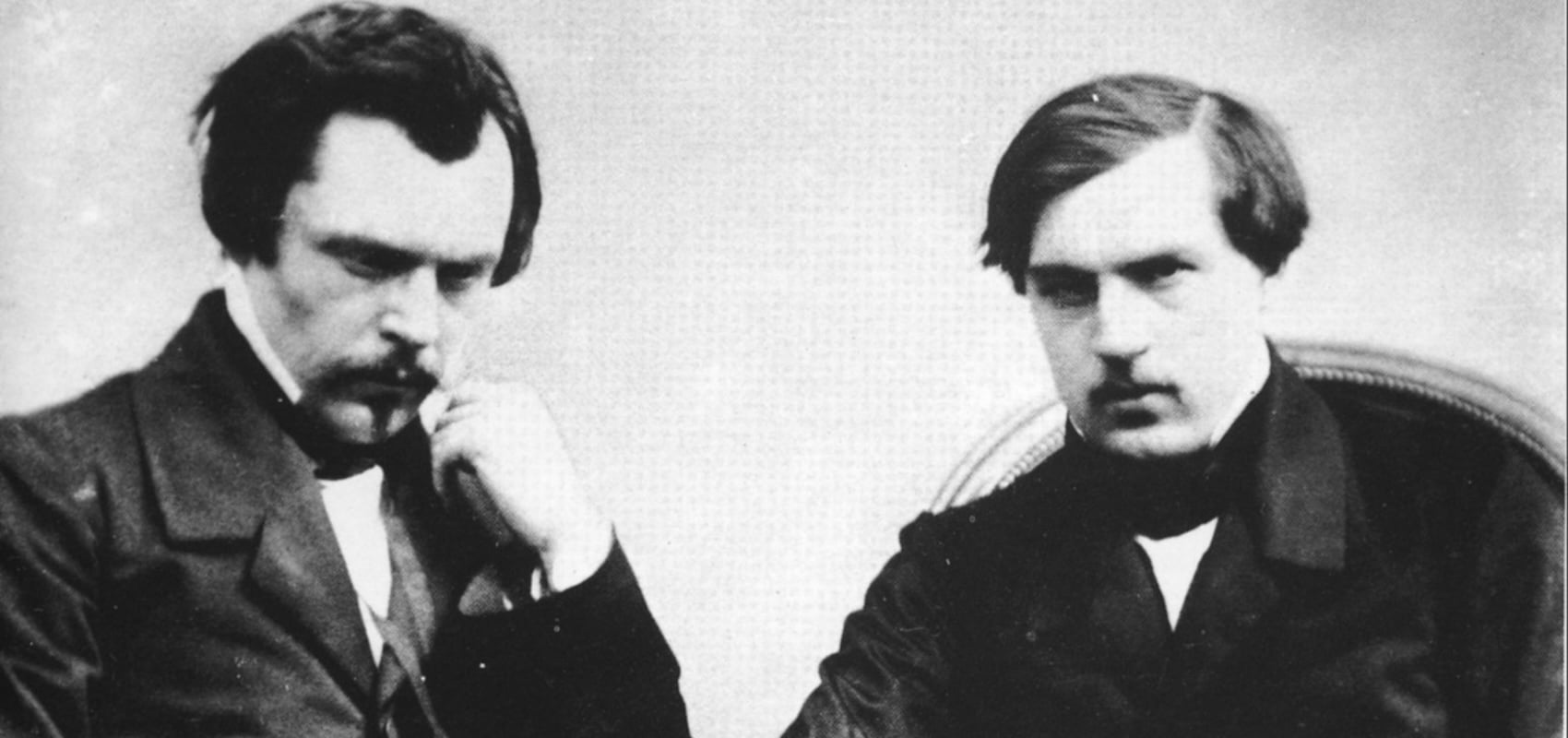
Novelists, playwrights, and historians, Edmond and Jules de Goncourt (1822–1896 and 1830–1870) were also the supreme chroniclers of the Parisian literary and artistic life of their time. The diary that the brothers kept from the eve of the 1851 publication of their first novel (written in concert, like most of their works) appeared in nine volumes between 1886 and 1896. A virtuoso performance in higher gossip, the Journal records the misadventures of some of the leading writers of the age, with the Goncourts at the center of the circle of companions, which encompassed Gustave Flaubert, Émile Zola, Ernest Renan, Théophile Gautier, Alphonse and Ernest Daudet, Hippolyte Taine, and Charles-Augustin Sainte-Beuve. Encounters with such outlying geniuses as Charles Baudelaire, Guy de Maupassant, Victor Hugo, Edgar Degas, and Auguste Rodin decorate the edges of the design.
These men served as priests of the religion of high art, devoting their lives to work that the multitude could never fully appreciate. Art alone was holy; faith in something so ridiculous as God or the immortality of the soul was fair game. Flaubert works fifteen-hour days for two straight months, carving one perfect sentence fastidiously after another to produce a thirty-page story: “Un cœur simple,” about a woman whose pious confusion evokes a deathbed visitation from an immense stuffed parrot, once a beloved pet, that she takes for the Holy Spirit. Flaubert is endlessly fascinated by the Marquis de Sade, whose unspeakable perversions naturally give his admirer the opportunity to mock the religion he despises: “He is the last word in Catholicism . . . [He] is the spirit of the Inquisition, the spirit of torture, the spirit of the medieval Church, the horror of nature.” Sainte-Beuve in café conversation with Baudelaire delivers “a tirade on atheism in comparison with which the most blasphemous eighteenth-century pamphlet would read like the Gospel according to St. John.” The scurrilous abuse of God, at top volume, brings every game of dominoes in the place to a sudden halt.
In 1889, Edmond and Zola exult and commiserate “about our lives which we had sacrificed to literature as perhaps nobody had ever sacrificed his life before, and we admitted to each other that we had been real ‘martyrs to literature’ and also perhaps ‘damn fools.’” Zola, a married man about to turn fifty, confesses that he feels a pang whenever he passes a pretty woman, thinking, “Isn’t that worth more than a book?” Ten years earlier Zola had “complained of being haunted by the desire to go to bed with a young girl—not a child, but a girl who was not yet a woman.” The legal consequences of this untoward lust engage his imagination: “I see the Assize Court and all the rest of it.” These reflections sober him up and subdue his ruinous urges.
The priests of high art frequently entertain themselves with conversation of “filth and depravity.” Alphonse Daudet recounts his sexual initiation, when he spent a week in a brothel at the age of twelve; the prostitutes were all sweet to him, concealing him from the authorities. He remembers rapturously the freckled skin, so wondrously soft, of his chosen woman. Daudet would contract syphilis at seventeen, suffer years of excruciating pain, and die at fifty-seven.
He was in esteemed company: Baudelaire, Flaubert, and Maupassant all died of the disease as well, and so did Jules de Goncourt, who caught the pox at nineteen and lasted till thirty-nine. The pages describing his final agonies are a horror: “Suddenly, throwing back his head, he let out a raucous, guttural, terrifying scream which made me shut the window. Instantly his handsome face was seized with convulsions which completely transformed it, deforming all his features, while terrible spasms jerked his arms as if they were being twisted in their sockets and his ravaged mouth emitted a trickle of bloody foam.” When it becomes obvious the end is approaching, Edmond’s first thought is the quicker death comes, the better. “But now I ask to be allowed to keep him, however crippled in mind and body he may be as the result of this attack, and I ask this on my knees.” This supplicant mood does not last long, however. As he looks into his brother’s suffering eyes, he thinks of the indifference or downright cruelty of God, who has created “so gifted and intelligent” a being, only to smash him in his prime.
This sense of the metaphysical injustice of physical suffering is a recurrent Goncourt theme. In a hospital the brothers visit to research a novel they are writing, they “feel tempted to consider Providence an abomination and to see an executioner in that God who is the reason for the existence of surgeons.” Someone of a different temperament might thank God for the existence of surgeons.
The price of sexual pleasure can be extortionate, yet the pleasure itself is not only momentary but contemptible in the light of day. Sensual riot is followed by stupefying ennui. “One week of love disgusts us for three months, and we come out of it spiritually sick and physically weary, dead to desire and filled with a vague, ineffable, infinite sadness. . . . Nothing but ash is left to us of the fruit we have squeezed. . . . Everything stinks in our hearts.” Once that lesson is learned, however, surely it is folly to repeat the experience again and again.
It comes as an utter surprise, then, that the Goncourts are moved in their “heart of hearts” by a Holy Week ritual in Rome, in which friars wash and kiss the feet of “wild-looking, lice-ridden peasants.” The diarists extol the surpassing beauty of the Catholic faith, which deserves the reverence that “men of culture and intelligence” bestow instead upon “the iron and marble religion of [pagan] antiquity.” “Everything that is gentle and sensitive and movingly beautiful in modernity comes from Christ.” It is hard, though, for worldly men who relish the pagan pleasures to live according to that truth.
Dear Reader,
Can I be direct with you?
War abroad. Socialists on the rise. AI upending human life. Endless uproar online. The modern attention economy doesn’t want readers — it wants users enslaved to the tyranny of the present.
First Things is the antidote: literary excellence, timeless truths, and a fixed point of reference in a culture that has lost its bearings.
But we can’t do it without readers like you.
Our goal: Raise $150,000 by November 1 to sustain First Things in the year ahead.
Your gift anchors readers in the permanent things.
Make your Fall Campaign gift now using the button below.
If you have any questions or would like more information, please contact Giovanni Del Piero, Director of the Editor’s Circle, at gdelpiero@firstthings.com or 212-627-1985.

YOU MIGHT ALSO LIKE
Forget Odysseus. Aeneas Is the True American Hero.
Who is our Odysseus? Or more precisely, who is the most Odyssean hero of American film? Matt…
Foucault’s Idol of Nothingness
Today marks the 100th anniversary of the birth of Michel Foucault. He was influential in his lifetime,…
The Last Statesmen?
In the latest installment of the ongoing interview series with contributing editor Mark Bauerlein, Steven B. Smith…
