
As the realistic English novel was emerging in a glorious birth amid the intellectual and moral tumult of the Enlightenment—the indomitable virtuous zeal of Samuel Richardson met at every turn by the irresistible hedonist zest of Henry Fielding—a very different sort of novel appeared on the scene, with a far more capacious understanding of what was real. In the introduction to the first such novel, The Castle of Otranto: A Gothic Story, published in 1764, Horace Walpole begs the reader’s indulgence for “this air of the miraculous” that violates the norms of fictional respectability. “Miracles, visions, necromancy, dreams, and other preternatural events, are exploded now even from romances.” But Walpole’s tale is of centuries past, he explains, when men believed in marvels unbelievable today—such as a venerable ancestor long dead stepping out of his portrait on the castle wall and entering the world of living men.
“Do I dream?” cried Manfred returning, “or are the devils themselves in league against me? Speak, infernal spectre! Or, if thou art my grandsire, why dost thou too conspire against thy wretched descendant, who too dearly pays for—” Ere he could finish the sentence the vision sighed again, and made a sign to Manfred to follow him. “Lead on!” cried Manfred; “I will follow thee to the gulph of perdition.”
Perdition is frequently a terminus for the less fortunate denizens of the Gothic universe: Supernatural evil is ever on the hunt for vulnerable souls and employs every diabolical resource at its disposal to ensnare them. To elude the snares in the hope of attaining salvation demands the complete attention of the Gothic heroes and heroines.
Matthew Lewis’s The Monk presents a man so sure of his virtue that he feels incapable of wrongdoing: the monk Ambrosio, who never leaves the monastery except to say Mass once a week in a nearby church, where he is the most dazzling orator in Madrid, the favorite of all the ladies, renowned as the holiest and most alluring man the city has ever seen. After he succumbs to his lustful and violent urges, committing rape and murder, the demon to whom he signs over his soul in order to escape the tortures of the Inquisition reveals that he is also guilty of incest and matricide:
You have shed the blood of two innocents; Antonia and Elvira perished by your hand. That Antonia whom you violated, was your sister! That Elvira whom you murdered, gave you birth! Tremble, abandoned hypocrite! Inhuman parricide! Incestuous ravisher! Tremble at the extent of your offences! And you it was who thought yourself proof against temptation, absolved from human frailties, and free from error and vice! Is pride then a virtue?
The ever-hopeful Ambrosio thought he still had a legitimate shot at divine forgiveness. But when a demon addresses you in cascading exclamations of extreme malevolence, your immortal soul is as good as cooked.
The other principal figure of the Gothic eighteenth century was the immensely popular Ann Radcliffe, whom less susceptible readers derided for her “hobgoblin romances” and “Terrorist System of Novel Writing.” Mary Shelley’s Frankenstein; or, The Modern Prometheus is the best novel of the next Gothic generation, and perhaps the greatest Gothic novel plain and simple, with an intellectual reach that transcends the usual bounds of the genre, taking on the hell-bent scientific ambition that would make gods of men. Charles Maturin’s Melmoth the Wanderer may be the next best novel of that time, with its sad tempter, not himself a devil but a sworn satanic associate, who in a career spanning centuries frequents insane asylums and dungeons of the Inquisition, coming and going just as he pleases, in quest of a broken man willing to change places with him; he never finds a taker.
But it was the late-Victorian Goths who refined the genre and have made the most lasting impression on our own time. Robert Louis Stevenson’s novella The Strange Case of Dr. Jekyll and Mr. Hyde is another brilliant study in modern scientific overreach, as the venturesome doctor experiments with his own nature and is initiated into the depths of human depravity, which at first he rather enjoys: “I knew myself, at the first breath of this new life, to be more wicked, tenfold more wicked, sold a slave to my original evil; and the thought, in that moment, braced and delighted me like wine.” Oscar Wilde’s The Picture of Dorian Gray also reckons up the terrible cost of a moment’s desire that seemed like a good idea at the time. The beautiful young Dorian idly wishes the portrait a friend has painted of him would age while his living person remained forever unmarred. When the portrait registers his decaying character, however, he must reconsider the gift he has been given and the conduct of his life: “But here was a visible symbol of the degradation of sin. Here was an ever-present sign of the ruin men brought upon their souls.” Yet not even such clear-sightedness can save him.
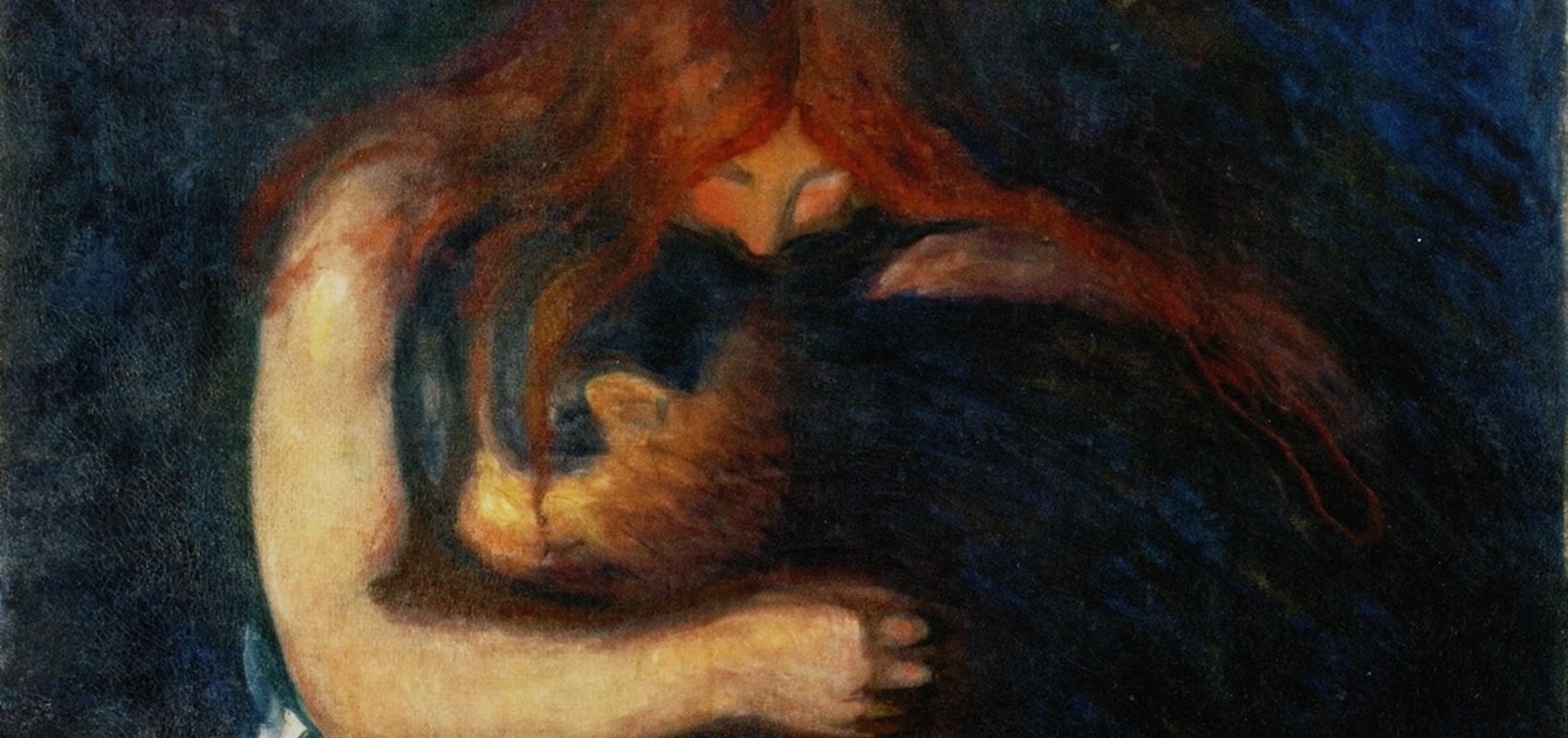
The Gothic novel is founded on the premise that life and death are stranger and more terrifying than we commonly suspect, wised-up moderns that we are; and the strangest and most terrifying tale of all is Bram Stoker’s Dracula. The vampire’s curse is eternal hell on earth: The commanding, aristocratic Dracula is a poor wretch, a slave to his consuming thirst for fresh blood. This infernal creature goes to and fro upon the earth, and up and down in it, in search of recruits for the legions of the undead. So, as is customary in Gothic tales—and, one might say, in actual human existence—the stakes for the heroes and heroines are vastly higher than simple life and death.
It is a stalwart crew of vampire slayers, men and women, who pursue this enemy of humankind—the nearest available fiend to the Devil himself. There are casualties, and the losses are hard to bear. So is the necessary physical destruction of Dracula’s victims, as the inestimable Professor Van Helsing relates:
I tremble and tremble even yet, though till all was over, God be thanked, my nerve did stand. Had I not seen the repose in the first face, and the gladness that stole over it just ere the final dissolution came, and realization that the soul had been won, I could not have gone further with my butchery. I could not have endured the horrid screeching as the stake drove home; the plunging of writhing form, and lips of bloody foam.
Fortifying himself for the ordeal with solitary prayer, this austere and tender-hearted man of profound knowledge and invincible will radiates goodness like a perfect innocent. Bram Stoker imagined the perfect man for the job.

YOU MIGHT ALSO LIKE
Nostos in the Ninth
When Roy Hobbs digs his spikes into the clay—bottom of the ninth, two outs, down by two,…
Inside the Roman Mind
It is seven years since the publication of Dominion by Tom Holland, the much-discussed book in which…
Earnest Lives: New and Notable Books
Ralph Waldo Emerson once declared, “All history resolves itself very easily into the biography of a few…
