
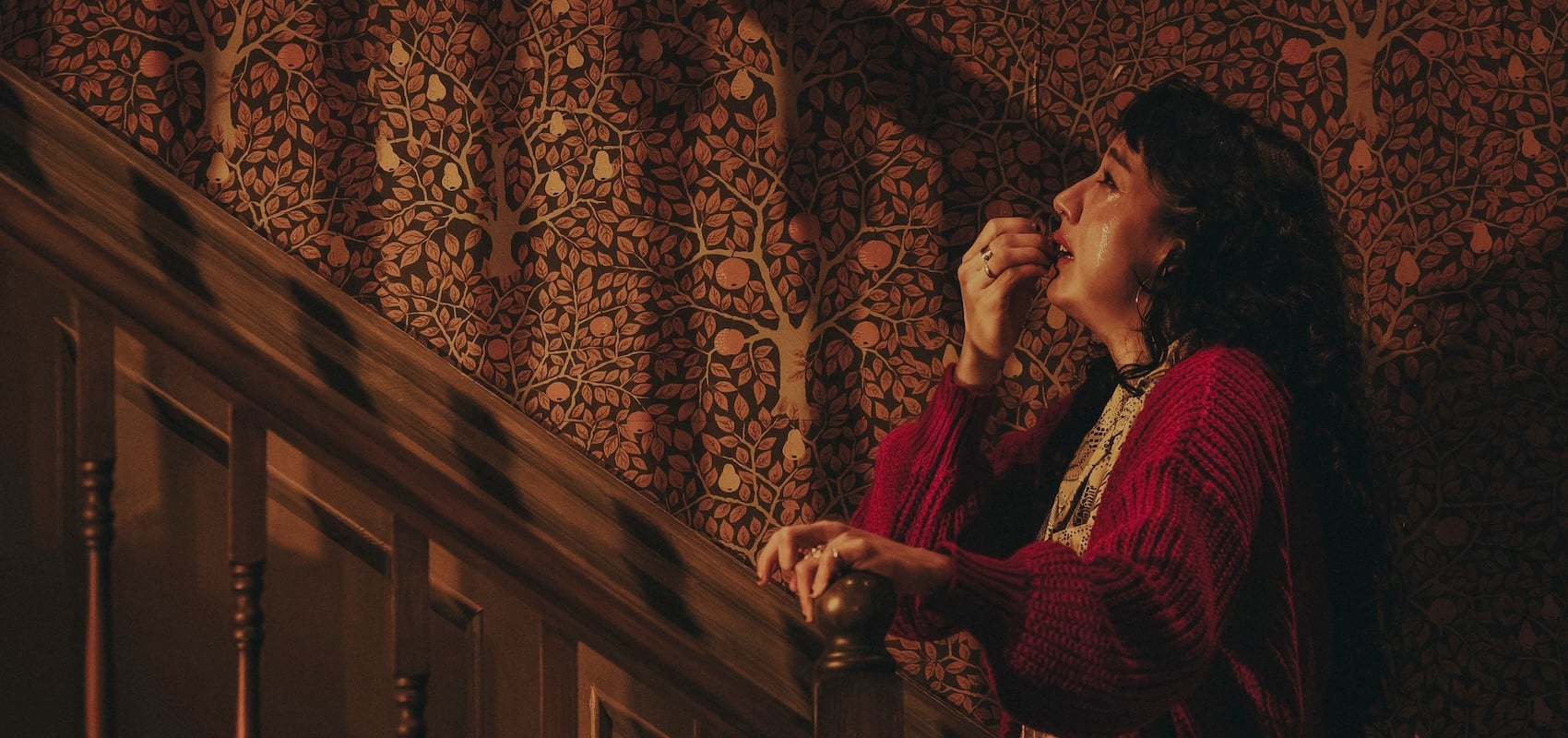
A new play inspired by the seven-film Paranormal Activity series is now on stage at the August Wilson Theatre in New York City. At the heart of the play is not simply the question of whether God and demons are real, but whether God can deliver us from evil. Paranormal Activity terrifies not with the threat of an absent divine, but with an impotent one.
The play follows a married couple, James and Louise (Lou), who have just moved from Chicago to London. The audience quickly learns that Lou has been experiencing “loss of time” and mental breakdowns, which she attributes to paranormal activity. James has trouble believing that Lou is not conjuring up a fiction in her head, and Lou’s investment in the spiritualist movement has led her to believe that it is not places but people that are haunted.
After James is targeted by supernatural forces, the couple invites Etheline Cotgrave, a famous podcaster Lou listens to and trusts almost religiously, to perform a séance at their new house. Cotgrave sets up candles, asks the couple about their relationship, and gets Lou to open up about the house fire that killed her parents when she was a young girl. Cotgrave warns the couple not to lie, as the ghosts already know the truth. She uses a machine to connect to the spirit world and translates the garble into words like “burning,” “fire,” and “pain,” concluding that the spirit is Lou’s late mother. Lou has a visceral reaction to this, insisting and eventually screaming that the spirit is not her mother. This seems to make the ghost angry and subsequently causes Cotgrave to fly into a similar rage. “This is all bullshit!” she yells as she packs up her stuff.
As time goes on and one character after another begins to act strangely, the audience is left unsure who is and isn’t under demonic thrall. James’s mother tells him, over FaceTime, to eat a bullet because he is “rotten,” only to show up at his doorstep from Boca Raton, Florida, minutes later. She then leads James in the Lord’s Prayer and asks God earnestly to search her heart.
The audience at my showing laughed uncomfortably at mentions of the Bible or any utterance of belief in a God who is mighty to save. And unfortunately, at the show’s conclusion, it appears they were right to laugh. The figure of James’s mother is revealed to be possessed by the spirit haunting their London home.
James calls himself an atheist in the beginning, seeks refuge in the Bible once the haunting grows particularly horrible, and finally asks what the label is for someone who knows God exists but doesn’t believe in him. Deciphering a code left for him by the ghost, he is drawn to Psalm 91:5, which he reads aloud:
You will not fear the terror of night,
nor the arrow that flies by day,
nor the pestilence that stalks in the darkness,
nor the plague that destroys at midday.
A thousand may fall at your side,
ten thousand at your right hand,
but it will not come near you.
But by the very end of the show, “it” does “come near” James, killing him. Lou herself gets possessed, and asks James if he has ever been to confession. She confesses a secret of hers, and he does the same: He killed a young girl while drunk driving when he was younger. But even this confession cannot save him. In fact, uttering his evil deed out loud becomes an occasion not for God’s mercy but for the ghost to exact its revenge.
All trust, interpersonally or spiritually, is decimated as both audience and actor learn they cannot believe in any person or power. And that is the essence of the show’s horror: an all-encompassing darkness that chokes out all love and joy, a darkness so powerful that no god, no childhood faith, no old Bible kept for sentimental reasons can save you.
The show succeeded in scaring me, and playwright Levi Holloway’s script is a triumph. The actors are extraordinary, and the audience members, despite a lack of theater etiquette (a critique for another day), were deeply invested in the plot’s twists and diversions. Even taking into account the nihilistic sentiment the play seems to espouse, I highly recommend seeing this show as Halloween approaches. In addition to its considerable technical and theatrical achievements, the play did not leave me with the deep dismay that its characters are ultimately forced to accept. Rather, I left being unable to suspend disbelief enough to grant that the spirits were anything other than demons and knowing demons would be unable to utter “our Father who art in Heaven” without cowering at the sound of his name.
Any nihilistic void the play carves out for the sake of fear (and entertainment) bears no resemblance to the reality of the spiritual powers that actively vie for our souls and animate our imagination for what lies beyond. Some people are interested in ghosts and spirits and paranormal activity because they seem to offer an alternative vision of the afterlife, one that does not require faith in God, even if one knows deep down that he may exist. But the horror the play inspires draws on the same deep desire that inspires Christian devotion: the desire to be saved, known, and protected; to trust, love, and be loved by something greater than ourselves and more powerful than the evil that stalks us.
Paranormal Activity is currently scheduled to play through January 3.
Image by Matthew Murphy
Dear Reader,
Can I be direct with you?
War abroad. Socialists on the rise. AI upending human life. Endless uproar online. The modern attention economy doesn’t want readers — it wants users enslaved to the tyranny of the present.
First Things is the antidote: literary excellence, timeless truths, and a fixed point of reference in a culture that has lost its bearings.
But we can’t do it without readers like you.
Our goal: Raise $150,000 by November 1 to sustain First Things in the year ahead.
Your gift anchors readers in the permanent things.
Make your Fall Campaign gift now using the button below.
If you have any questions or would like more information, please contact Giovanni Del Piero, Director of the Editor’s Circle, at gdelpiero@firstthings.com or 212-627-1985.

YOU MIGHT ALSO LIKE
Why the Death Penalty Is a Sore Point for Papal Authority
Pope Leo XIV marked World Day Against the Death Penalty, observed on October 10, with the following…
A Culture of Parricide
I learned a new word the other day: déploration. It’s the French, directly from the Latin, for “lament.”…
The Myth of St. Francis
At the beginning of his 2020 encyclical, Fratelli Tutti, Pope Francis speaks of “an episode in the…
