
With Constitution Day taking place this month, a few books on the Founding of our republic are worth notice.
Is the U.S. Constitution a democratic instrument? Some scholars argue that it isn’t, and they have their reasons. After all, the Senate grants equal representation to Rhode Island and California; one federal judge can override a popular vote, as happened in Arizona in 2014 when an amendment to the state constitution defining marriage as between one man and one woman was declared unconstitutional by a federal judge; and it takes three-quarters of the states to pass a constitutional amendment, which means a thirteen-state bloc can block it. Ilan Wurman’s The Constitution of 1789: A New Introduction, a thorough review of every article in the document, tackles that question, among many others. Wurman drills down into the debates at the time over words and phrases, even punctuation, showing how scrupulous Madison and the others were with every bit and piece of the framework. He examines cases such as Myers v. United States (1926), which considered the president’s power to fire executive personnel (a timely issue today), and how the Lincoln-Douglas debates interpreted the Dred Scott decision. Wurman is a law professor at the University of Minnesota, but writes for laymen. One can imagine teachers of civics and government in high school and college freshman courses dipping here and there into the book for lesson plans. A useful and handy resource.
To Michael Platt, the Declaration of Independence should be understood as the outcome of deliberation. A war was needed for sovereignty, but it was words spoken and written, words debated and revised, that made our country what it is. Platt’s The Deliberation That Founded America is a celebration of our country’s ideals—and of the ideal way in which they were expressed, recorded, and publicized. He declares, “We are more what we are because of our principles than any other people on the face of the earth.” The bulk of the book is a careful and patient exegesis of every word in the Declaration. To whom does Jefferson refer when he mentions “the people”? Was George III genuinely guilty of tyranny? And, at the end, what exactly are the “independent states” that the Declaration has spoken into being? “None of the signers could have known that the war would lead to victory and peace,” Platt notes. Had the British prevailed, their lives might have been taken and their property and wealth seized. We see the Founders from the vantage of their world-changing success. It is good to be reminded of the courage and daring that went along with the solemn principles.
Lawrence W. Reed’s Born of Ideas: How Principles, Faith, and Courage Forged America is a labor of love, not research. “The world will never forget, or cease to admire, what Americans did in 1776,” Reed writes. In brief chapters on American ideas of rights, property, equality, and so forth, along with the grounding of those ideas in specific people and events, the book makes a nice primer for middle and high school students. They will get lively introductions to important lessons of the past, such as the failure of the practice of “common land” that the Pilgrims attempted at Plymouth, and the Massachusetts Bay Colony experiment with paper money in 1690 (another disaster). With curricula from the 1619 Project, the College Board, and other left-wing organizations commonly implemented in public schools, teachers and parents should consider such proudly patriotic volumes as this one as an antidote to twenty-first-century cynicism.
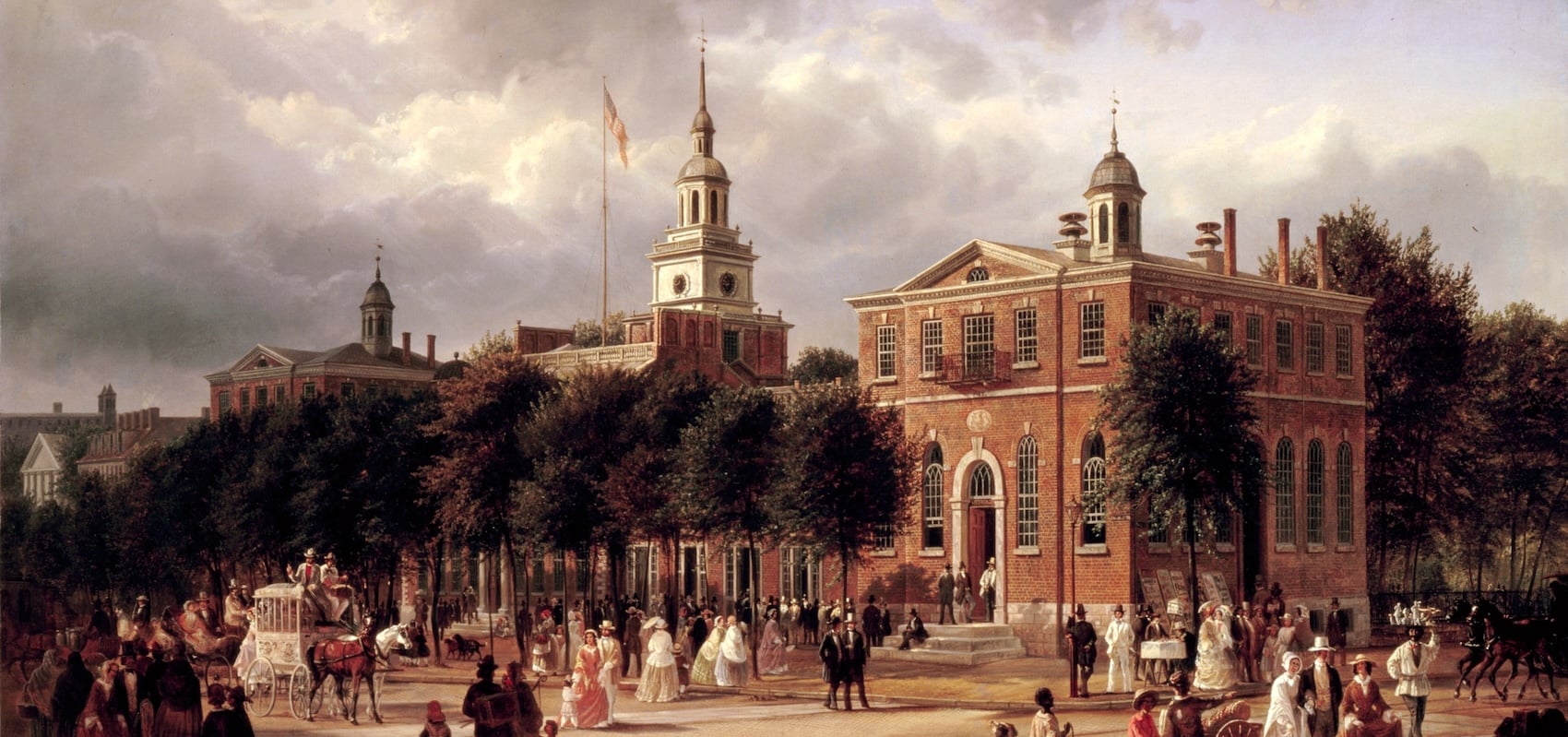
Independence Hall is forever tied to the Founding. The meetings that gave us the Declaration and the Constitution took place there. Henry Ford once sought to purchase the entire building and transport it to Dearborn, Michigan. The full significance of the building extends well beyond 1776 and 1787, says D. G. Hart in Independence Hall: The History of an American Icon. It didn’t even get the name “Independence Hall” until the 1820s. It started in 1732 as the Pennsylvania State House, which young Ben Franklin knew well because of the odd jobs he did for the legislature as a local printer. President Andrew Jackson’s tour of the city in 1833 ended with a reception in the building that was so crowded and raucous, some attendees jumped from the first-floor windows to escape the crush. The Hall was designated a national park 120 years later, and at the bicentennial the spot was a focal point for the visit of Queen Elizabeth II. These and many more entertaining episodes fill the book. Hart’s writing is brisk and smooth, giving the structure an identity and history equal to that of other historic sites in our country. Another superb offering from Creed & Culture press.
Three boys of high school age are on the hunt for a hidden fortune. They live in North Carolina and like to surf but have journeyed to Boston to search for the whole truth of the Boston Tea Party, which may involve lost treasure and a Samuel Adams wholly different from the fiery patriot of conventional history. Yes, it’s a young adult adventure book, The Boston Tea Party Conspiracy, a rousing chronicle with clues, cyphers, and copious references to the Freemasons, the India tea trade, and murders and disappearances from long ago. The book is part of a series, with other titles including The Hunt for Confederate Gold, The Pirate and the Alamo, and The Mummy of Ambrose Bierce. They come in nifty cloth versions with high-quality binding and paper, and nice margins and line spacing that make for easy reading with a flashlight under the covers. With fast-paced plots and abundant historical content, these books are perfect leisure reading for twelve- to fifteen-year-olds.
Dear Reader,
Can I be direct with you?
War abroad. Socialists on the rise. AI upending human life. Endless uproar online. The modern attention economy doesn’t want readers — it wants users enslaved to the tyranny of the present.
First Things is the antidote: literary excellence, timeless truths, and a fixed point of reference in a culture that has lost its bearings.
But we can’t do it without readers like you.
Our goal: Raise $150,000 by November 1 to sustain First Things in the year ahead.
Your gift anchors readers in the permanent things.
Make your Fall Campaign gift now using the button below.
If you have any questions or would like more information, please contact Giovanni Del Piero, Director of the Editor’s Circle, at gdelpiero@firstthings.com or 212-627-1985.


YOU MIGHT ALSO LIKE
Forget Odysseus. Aeneas Is the True American Hero.
Who is our Odysseus? Or more precisely, who is the most Odyssean hero of American film? Matt…
Meet the Post-Religious Right
There have been many books written about the online right and the Trump movement, most by people…
Candace Owens and the Sin of Anti-Semitism
According to the online Encyclopedia Britannica, Sir Moses Montefiore (1784–1885) was “an Italian-born businessman who was noted…
