
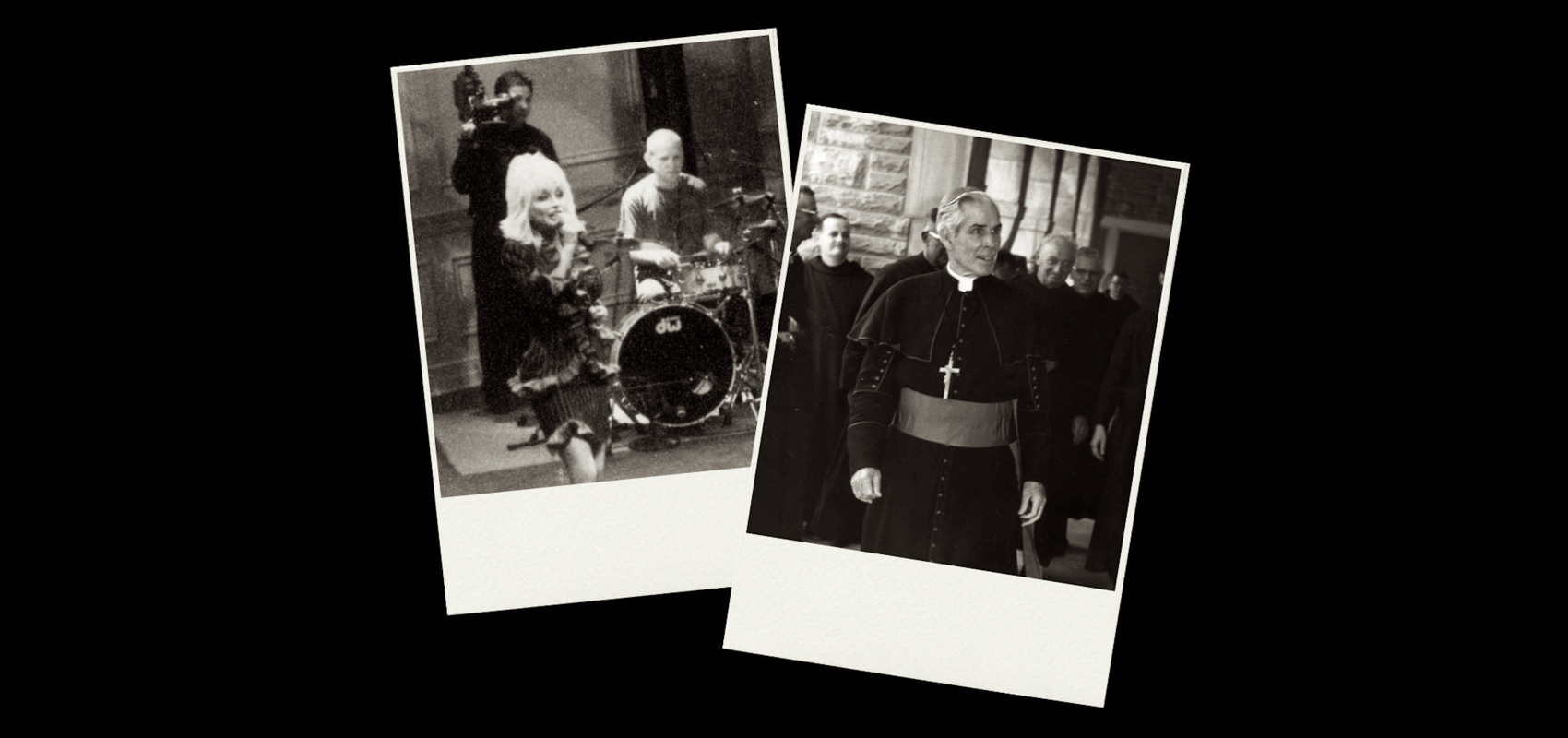
Dolly Parton and Fulton Sheen seem to have had little in common. She favored rhinestones; he wore a pectoral cross (though both understood the dramatic possibilities of a cape). She sang “Jolene.” He explained the seven deadly sins on a blackboard. She built Dollywood. He championed the Christian future of “pagan babies,” the children in mission lands whom American Catholic schoolkids “adopted” with spare change.
Yet, as America mourns Dolly Parton and as Fulton Sheen is beatified in St. Louis, the resemblance is hard to miss. They were two of the most conspicuously Christian personalities ever to succeed in American mass entertainment. And everybody loved them.
“Everybody,” of course, is an exaggeration. Dolly had her critics, and Sheen had enemies formidable enough to impede both his ministry and, for a time, his progress toward the altars. But each achieved something rare in an increasingly divided culture. They inspired affection across lines of creed, class, politics, and education. People who wanted nothing to do with Pentecostalism loved Dolly Parton. People who would never have entered a Catholic church arranged their Tuesday evenings around Bishop Sheen’s weekly TV program, Life Is Worth Living.
This wasn’t because either concealed the faith. Dolly spoke easily about God, prayer, Jesus, heaven, and her upbringing in the little Pentecostal church where her grandfather preached. She recorded gospel music throughout her career. When asked about her success, she spoke gratefully of gifts received from God and work done for his glory. After the death of her husband, Carl Dean, she said plainly that she expected to see him again. Her family announced her own death with the words, “Dolly has lived in the light and is in the arms of Jesus.”
Sheen was, if anything, less subtle. He came before the TV cameras in the full regalia of his office, and he addressed the moral and spiritual crises of modern life. He talked about sin, confession, the cross, communism, psychoanalysis, motherhood, education, and eternity. He didn’t translate Christianity into the therapeutic vocabulary of the moment. He preached.
And the country watched. When Life Is Worth Living began in 1952, it occupied an unpromising position on the small DuMont network, opposite Milton Berle and Frank Sinatra. The prophet Elijah could not have seemed more the underdog. Yet Sheen’s audience soon numbered in the millions. Demand for tickets overwhelmed the studio. Fan mail arrived by the sack, as if for Santa Claus. Sheen appeared on the cover of Time and won the Emmy for Most Outstanding Personality. This was not an award for the ghetto of religious broadcasting. A Catholic bishop had become one of the biggest stars in the new medium.
Sheen relished his rivalry with Berle, who was then known as “Mr. Television” and “Uncle Miltie.” Sheen introduced himself as “Uncle Fultie.” Berle joked that the two men worked for the same employer: Berle’s sponsor was Texaco, maker of Sky Chief gasoline; Sheen worked for the chief in the sky. When Sheen won his Emmy, he thanked his four writers: Matthew, Mark, Luke, and John.
Dolly would have appreciated the joke. She, too, understood that self-mockery is one of the surest defenses against pomposity. She made jokes about her wigs, her neckline, her figure, her cosmetic surgery, and her carefully cultivated image: “It costs a lot of money to look this cheap.” But the jokes were never confessions of fraudulence. Dolly’s appearance was artifice. Dolly herself was not.
Something similar can be said of Sheen. His cape, gestures, dramatic pauses, and sudden turns toward the blackboard belonged to a carefully honed theatrical style. But the performance did not disguise the man. It revealed him. Behind the polish was a priest—a Catholic priest who spent an hour every day in prayer before the Blessed Sacrament. The showmanship was real, but so was the holiness.
That, perhaps, was the secret shared by the lady from the Smoky Mountains and the bishop from El Paso, Illinois. They did not confuse authenticity with informality. Both constructed memorable public personas. Both mastered the disciplines and forms of entertainment. Both knew precisely where to stand, when to pause, and how to deliver a line. Yet neither permitted the persona to become a substitute for the person. The performance served something they actually believed.
They also understood that an audience is not an enemy. Much contemporary Christian commentary begins by dividing the world into warring tribes and then proceeds by way of virtue signaling and dog whistling. The culture is hostile! The elites are persecutors! The audience is implicated in the other side’s errors and must be confronted, exposed, defeated! And, yes, there’s some truth in all of that. The institutions of popular culture are hardly hospitable to orthodox Christian or Jewish belief.
But neither Dolly nor Sheen led with hostility. They seemed to assume that the person on the other side of the TV screen was capable of recognizing goodness, beauty, humor, and truth. They spoke to that capacity.
This didn’t require them to surrender their convictions. Dolly’s songs inhabited a moral universe in which promises mattered, betrayal wounded, poverty had dignity, sacrifice could redeem suffering, and death did not have the final word. She could welcome people whose lives and views differed sharply from her own without pretending that differences didn’t exist.
Sheen could be even more demanding. He spoke about judgment, repentance, sexual morality, and the totalitarian temptations of the modern age. He wore on his sleeve, as it were, the markings of the most dogmatically demanding religion. Yet few viewers felt that he despised them. His criticisms of modern life were delivered by a man visibly delighted to be alive—in his native country and in his own day and age.
That delight makes the difference. Christian truth appeared in Dolly and Sheen not as a burden reluctantly shouldered but as a source of creative energy. They were funny because they were free. They were generous because they believed gifts were God-given and meant to be shared.
Dolly’s Imagination Library placed hundreds of millions of books in the hands of kids. She gave to schools, hospitals, disaster relief, and medical research. Sheen directed the Society for the Propagation of the Faith for sixteen years, raising vast sums for the missions and giving away the income from his television work. For both, public profession led naturally to public charity.
Their popularity tells us something worth knowing about religion in public life. America has not always rejected explicit Christian witness, even in its most commercial forms. It has often rejected what passes for Christian witness: scolding certainty without charity, moral earnestness without joy.
Dolly and Sheen offered something else. They never seemed ashamed of the gospel, but neither did they treat faith as a means to humiliate strangers. They had convictions, and they had ambitions, but they chose repeatedly not to be possessed by grievance, either personal or ideological. Dolly forgave Porter Wagoner after their acrimonious professional parting and then rescued his work from oblivion. Sheen never acknowledged the intra-Church machinations against him initiated by Cardinal Francis Spellman and others. Dolly and Sheen could laugh at themselves because they knew they were not the center of the Christian story.
There are limits to the comparison. Fulton Sheen was a bishop and evangelist whose vocation was to proclaim Christian doctrine. Dolly Parton was a singer, songwriter, actress, and businesswoman whose faith suffused her work without defining all of it. Today, the Church will declare Sheen blessed; there will be no ecclesiastical tribunal examining the heroic virtue of the proprietress of Dollywood.
Still, it seems fitting that Dolly should leave the public stage just as Sheen returns to it. Together they remind us that Christian witness need not become vague in order to become attractive. It must become credible. Credibility comes not only from saying true things, but also from embodying the joy, generosity, courage, and freedom those truths should produce.
Dolly sang beneath the rhinestones. Sheen preached in a Roman collar. They entered millions of homes, bringing the name of Jesus with them. People were glad to see them coming. And here they come again.
Dear Reader,
Can I be direct with you?
War abroad. Socialists on the rise. AI upending human life. Endless uproar online. The modern attention economy doesn’t want readers — it wants users enslaved to the tyranny of the present.
First Things is the antidote: literary excellence, timeless truths, and a fixed point of reference in a culture that has lost its bearings.
But we can’t do it without readers like you.
Our goal: Raise $150,000 by November 1 to sustain First Things in the year ahead.
Your gift anchors readers in the permanent things.
Make your Fall Campaign gift now using the button below.
If you have any questions or would like more information, please contact Giovanni Del Piero, Director of the Editor’s Circle, at gdelpiero@firstthings.com or 212-627-1985.

YOU MIGHT ALSO LIKE
Forget Odysseus. Aeneas Is the True American Hero.
Who is our Odysseus? Or more precisely, who is the most Odyssean hero of American film? Matt…
Why the Death Penalty Is a Sore Point for Papal Authority
Pope Leo XIV marked World Day Against the Death Penalty, observed on October 10, with the following…
Foucault’s Idol of Nothingness
Today marks the 100th anniversary of the birth of Michel Foucault. He was influential in his lifetime,…
