

American Odyssey:
What An Ancient Story Reveals About Our Divided Souls
by patrick j. deneen
creed & culture, 198 pages, $26
Who is our Odysseus? Or more precisely, who is the most Odyssean hero of American film? Matt Damon’s mopey trauma patient? Certainly not. Luke Skywalker, perhaps? No, too obnoxious and too chaste—an incel turned jihadist. John Wayne? Maybe, but I’d need to rewatch his oeuvre to know which character—they all run together—and my wife hates Westerns. Rather, I suggest the true American avatar of Odysseus—that man of many turns, slayer of monsters and concubine of goddesses—is hiding in the holiday section: Clark Griswold, as played by Chevy Chase in National Lampoon’s Christmas Vacation.
Consider Clark Griswold—now there’s an Odyssean hero! Polutropos indeed, a man of so many turns: Cleaver of trees, Apollonian illuminator of suburban palaces, and clever inventor of the non-nutritive cereal varnish, Clark seduces the Calypso of a lingerie counter, sacks a yuppie citadel, and abducts a pajamaed god—but all for the love of hearth and home and family, all for the sake of “the hap-hap-happiest Christmas since Bing Crosby tap-danced with Danny f***in’ Kaye!” And what a denouement! Wild beasts and faithless uncles burned alive, broken crockery and rabid dogs, and, at the end, the heroic island king stands unbowed, clutching his wife, bankrupt but defiant before an armada of drawn guns. That sounds like Homer to me:
I found Odysseus in the thick of slaughtered corpses;
there he stood and all around him, over the beaten floor,
the bodies sprawled in heaps, lying one on another . . .
How it would have thrilled your heart to see him—
splattered with bloody filth, a lion with his kill!
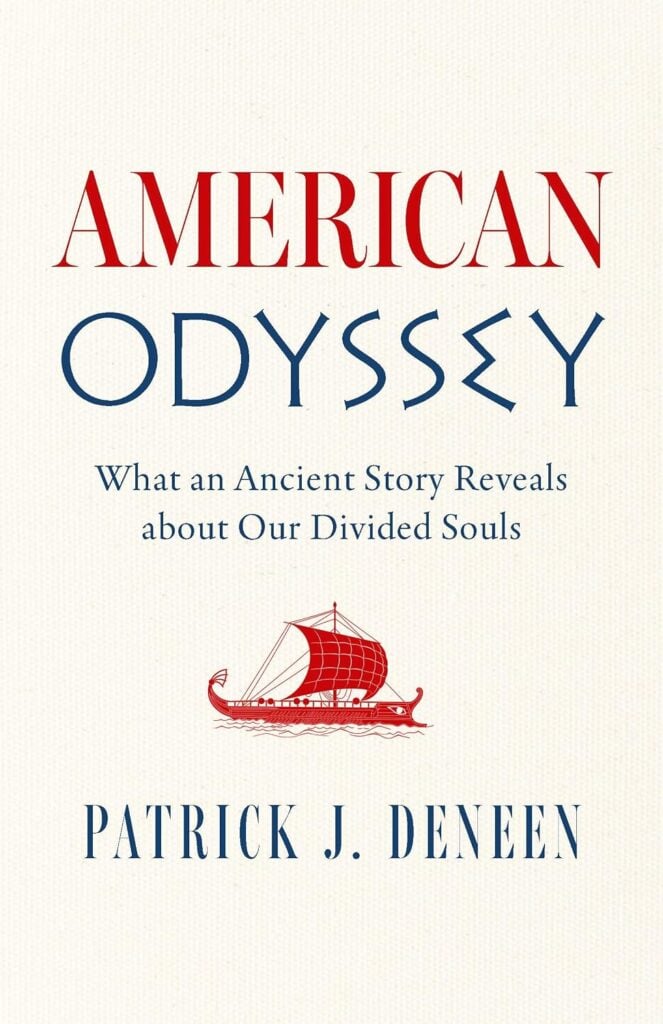
I know that some may disagree. Patrick Deneen, for one, makes decidedly different—but no less counterintuitive—selections in his latest book, American Odyssey. Claiming Homer’s poem as a foundational American text, Deneen traces its influence through four American cultural artifacts—The Wizard of Oz, Huckleberry Finn, Field of Dreams, and It’s a Wonderful Life—to illuminate what one might call the Odyssean-American experience. Seen through this lens, the yawning gulf between “somewheres” and “anywheres”—which often seems the fundamental quarrel of our bitter current politics—runs not between persons but rather through each American heart. Every American is thus a latent Odysseus, torn between a questing desire to leave and an aching longing for home.
Faced with these competing loves, Americans have usually followed the outward path—we are a restless people and, as the book notes, “free movement” is arguably the most foundational American right. But Deneen believes that in all our leave-taking, Americans—like Odysseus—have fatally neglected our homes. Deneen would call us back to nostos, and the final hero of his book is none other than George Bailey in It’s a Wonderful Life, a man who—like Clark Griswold—never left home at all.
This is an easygoing book, less an urgent argument than a reflective ramble through Homer and the author’s favorite twentieth-century films. But Deneen is a serious and important thinker, whose contributions have shaped, stamped, and accelerated our emerging postliberal epoch, and his timing is deliberate. Published to coincide with both the American semiquincentennial and the release of Christopher Nolan’s blockbuster film, American Odyssey is a considerable effort to fruitfully entwine Homer’s song with America’s story at a moment when nearly everyone is talking about both.
And like Nolan’s captivating, if rather sour, cinematic adaptation of the Odyssey, Deneen’s book seems implicitly to conclude that the whole adventure is a disastrous folly—a bloody, tragic, endless war, launched for no good reason, that casts the hero into a fruitless and interminable exile while the home he claimed to fight for wastes away; his family unmoored and listless; his substance gnawed by corrupt and lazy parasites. Nolan and Deneen are roughly the same age, and though they probably occupy opposite ends of the political spectrum, both men (in vastly different ways) have tuned the tenor of our times, and both (on vastly different scales) have now demotically re-presented the Odyssey as a provocative and didactic American critique. In their tellings, it would have been far better—for the hero, his family, and his home—if Odysseus had never sailed for Troy.
Each chapter of American Odyssey is divided in two parts: The first explores a particular theme from Homer and the second elaborates that theme through the lens of a modern American work. Deneen’s deep affection for the Odyssey, and his unassailable mastery of both the poem and its millennia of accumulated scholarship, make the first half of each chapter genuinely delightful to read.
Deneen offers a particularly compelling evaluation of the Greek gods. Reading Homer through Aristotle, he defines the gods as apolitical—they have no polis nor any need for politics—and also oblivious: Despite their powers, they are often utterly unable to foresee the consequences of their actions, or even recognize those consequences after the fact. (Zeus lazily complains that men blame the gods for their misfortunes—which is a bit rich since, in Homer’s world, the gods usually are to blame!) Moreover, the gods possess no natural desire or even preference for justice, but only grudgingly mete it out to keep the sacrifices coming—in other words, they’re only nice when they’re hungry. The gods are thus much more like beasts than they are like men, a fact that becomes clearer when one descends from Olympus into the divine middle classes—Scylla, Charybdis, Cyclopes, and Circe—whose tastes run less to mortal offerings and more to mortal flesh.
Man is something else entirely: puny and finite, yet wiser than the gods, for he cannot afford oblivion. His life is nothing but consequences, whether of his own acts or those of his fathers, his enemies, or his gods. And unlike gods and beasts, man is fundamentally a political animal; cut off from his city, he is nothing but a dirty speck of flotsam on the ocean. Adrift at sea—or entwined in Calypso’s ecstatic embrace—Odysseus is less than a man. Only by returning home, to his polis, “to be rejoined with his family and to assume his station as a citizen . . . can he properly secure his humanity.”
These insights may not all be completely original (Deneen draws not only from Aristotle but also from modern scholars like Jenny Strauss Clay), but they felt fresh and intriguing to me. Indeed, I found all of Deneen’s commentary on Homer engrossing and instructive, which is why it was a matter of some regret when he moved from the wine-dark sea to the yellow brick road.
The Wizard of Oz, in Deneen’s arresting summation, “is for Americans what the Odyssey was for the Greeks: a tale that provides a mythic revelation of our deepest inner selves.” Dorothy longs to escape from drab, dry Kansas—but ultimately her journey is a homeward one, and what wisdom she acquires in her long voyage through fabulous, floriferous, and dangerous Oz is distilled into her earnest, chastened, childlike prayer: “There’s no place like home.”
Deneen’s argument is well-sourced and convincingly argued, and his romp through Oz is genuinely entertaining, but it left me uneasy. Undeniably, Dorothy is an indelible American avatar, and her trajectory is certainly Odyssean—she plods the archetypal hero’s journey, as Deneen notes with a nod toward Joseph Campbell. But there is a perilous aesthetic disjunction in these comparisons—between Dorothy and Odysseus but also between Dorothy and America—which may conceal more than it reveals. An avatar is also a kind of disguise.
This becomes more apparent when Deneen lifts the film’s explanatory power into the realm of founding myth: “Our forebears’ journey to these shores,” he says, “was inspired by the same sentiments expressed in Dorothy’s opening song, ‘Over the Rainbow.’” This is a wholesome attitude, but I rather doubt the hard-eyed, black-suited forebear presently glowering from my overmantel spent much time dreaming of rainbows, much less of lemon drops above the chimney tops—in general, he preferred the bloodier bits of Shakespeare and the first two-thirds of the King James.
I don’t mean to score cheap points. Deneen knows far more than I do about the decidedly mixed legacy of America’s Founders—he wrote a significant book on the subject—but the average admirer of The Wizard of Oz may lack his depth of field. Many Americans really do identify with Dorothy—but not, I suspect, because she is Odyssean, nor even because they share her conflicted longing for both departure and return. Deneen projects Dorothy’s prismatic ballad back onto our forebears, but I think The Wizard of Oz reminds us not of our ancestors, but of our children—or, better, of ourselves as children. This is the American sweet spot; we like to imagine ourselves—both individually and corporately, as a nation in history—in childlike terms: precocious, well-meaning, innocent, and not fully culpable for the things we break along our way.
Alas, this childish veil—or uncanny mask—has only ever hidden us from ourselves. Dorothy’s rosy-cheeked visage is not the face America has shown the world these past two hundred and fifty years, and our epic journey was not a child’s progress through Technicolor dreamlands. We look more like the real Odysseus—the pirate king who burned cities, bedded goddesses, and blinded monsters before returning home to hang ungrateful slaves—and while our road through history has indeed been sometimes bricked in gold, it has just as often been a trail of tears.
The aesthetic and moral gulf between Homer and Hollywood resurfaces again in Deneen’s consideration of the 1989 baseball fantasy, Field of Dreams. The film’s hero (at least in Deneen’s view, which I endorse) is not Kevin Costner’s protagonist but rather Dr. Graham, a man who gave up dreams of baseball stardom for a selfless, ordinary life as a small-town doctor. When offered a tantalizing though posthumous second chance to enjoy that stardom in the film’s eponymous Elysian field, Graham’s shade refuses in order to save the life of a child and return to his wife.
Deneen analogizes Graham’s renunciation to Odysseus’s decision to leave the island of Calypso and return to “his aging mortal wife Penelope.” But this is an unsavory comparison: Graham renounces even a taste of worldly ambition, but Odysseus takes leave of his beautiful goddess only after sleeping with her every night for seven years, a priapic respite which followed ten years of martial glory and another three of swashbuckling adventure! Nor is he returning to a hovel; he goes back to be a king, which despite its headaches is a rather more exalted occupation than pediatrician.
Graham is not an avatar of the Polutropos, but rather his antithesis. The doctor is a Christian hero, but Odysseus is a pagan king—very much a monster according to the theology that ultimately produced Field of Dreams. When Christ said “I have overcome the world,” he meant the world of Odysseus. And overcome it he did—so thoroughly that modern bards hold country doctors higher than roving, lecherous warlords. Of course, Christ himself does not appear in Field of Dreams, which—like so much twentieth-century mood music—resounds not with reverberating Homeric echoes but with cultural Christianity’s long, withdrawing roar.
This plaintive note leads naturally to the final film the book considers, It’s a Wonderful Life. But here, polytropic Deneen makes an unexpectedly impish turn, inverting not merely Odyssean morality but also the popular understanding of Jimmy Stewart’s most famous film.
“The Odyssean hero George Bailey” is Deneen’s amusingly perverse description of Stewart’s protagonist, a character who has never left his hometown and notably avoided military service. Giving up his youthful desire to explore the world and shape it through architecture, Bailey has instead devoted his life to his family, his business, and his village of Bedford Falls—in short, to tending his home. But in Deneen’s telling, instead of renouncing worldly ambition (like Graham), Bailey sublimates it, and so turns himself into that most hideous of American villains: a real estate developer.
I suppose I should now disclose an interest: Real estate development is in fact my own profession, and if I betray some impatience in what follows, it is because I feel personally aggrieved. For Deneen, Bailey’s great crime is building “Bailey Park,” a new housing development that looks, as one would expect, like any postwar American suburb. Contrasting this nascent sprawl with the gentle density of downtown Bedford Falls, Deneen laments:
Bailey Park has no trees, no sidewalks, and no porches. The trees have been plowed under to make room for wide streets and large yards with garages . . . the subdivision is devoid of amblers who populate a civic space. The residents of Bailey Park are either hidden behind the doors of their modern houses or relaxing on their backyard patios. The absence of front porches indicates that an alternative conception of life will govern Bailey Park. It will be led in private, not in the intermediate public spaces that link the street to the home. One doubts that anyone will live in these houses for as many as two generations, much less four.
Now, I’m not personally fond of mid-century suburban development either, but most Americans can’t get enough of it and have flocked to it for, well, about four generations. Deneen is much too contemptuous of these communities, to which belong a very large share of America’s people. For a man of populist sympathies, here he unwittingly strikes a rather snobbish note.
Suburbs are not inimical to community, and suburbanites call upon their neighbors no less than town and city dwellers do—often rather more than they do, in fact, especially as handsome, historic town centers have been progressively gentrified. (The suburbs are where the families are.) And those backyard patios Deneen deplores are not inviolable private oases but, just as often, party pads—ersatz pleasure gardens to be shared and shown off.
And while we are certainly spiritually shaped by our physical environment, front porches and town squares are no guarantee of community. More than a century of successive technologies—automobiles, air conditioning, televisions, and smartphones—has increasingly withdrawn us from these “intermediate public spaces.” I live in Charleston’s dense, ancient core, perhaps the best-preserved architectural oasis in the country, where nearly every house is adorned with an elegant and commodious porch. But the porches are empty. Visiting our neighbors, we are swiftly ushered across the porch and through a series of air-conditioned rooms to the back garden, which is now usually furnished with a quintessentially suburban appurtenance—the swimming pool.
Bailey’s development, meanwhile, looks stark and naked in the film only because it was a real subdivision that had just been built, and buildable land must usually first be cleared. (Indeed, suggestively enough, lovely old downtown Bedford Falls was only a Potemkin movie set—but Bailey Park was the real thing.) Today, the neighborhood that starred as Bailey Park—actually in La Cañada Flintridge, California—is a tree-lined vision of verdant Americana, and most of the homes visible in the film are still there, well-loved and very expensive. The descendants of Martini, a bartender who buys one of Bailey’s new houses, would have done especially well to keep his home—still looking exactly as it did in the film, it is currently valued at $2.23 million.
This is a revealing point. Near the end of his book, Deneen laments the plummeting rate of American homeownership as evidence of “our widespread national and civilizational homelessness.” But skyrocketing housing costs are not some spiritual sickness; they are the obvious consequence of our failure to build precisely the sort of attainable housing that Deneen finds so dispiriting. In the film, Bailey builds his new homes explicitly to provide affordable housing. The working-class families who move into Bailey Park would otherwise remain in the clutches of the predatory rentier, Mr. Potter, and probably sink into penury. Thanks to Bailey’s ugly little houses, they’re granted a path to prosperity.
America is surely in desperate need of some kind of spiritual revival or ressourcement, but that will require a stable material basis. People need physical roofs over their heads before they undertake a restoration of their spiritual, communal, or national homes, and many of our social maladies and political psychoses stem from the fact that we live in bourgeois, property-owning democracies in which property has become unaffordable. Housing is the key.
The kind of housing Deneen prefers is difficult and expensive to build. Local zoning codes often prohibit it; changing or evading those codes is enormously time-consuming and expensive, and usually requires an army of consultants, planners, lawyers, and political fixers. My firm is currently attempting to build a new town of narrow, gridded, walkable streets; of front porches, small hidden garages, and houses built from natural materials. This proposal has met vociferous popular and regulatory opposition, has spent seven years in the planning stage, and is only now approaching government approval in one of the reddest, supposedly “business-friendly” states in the Union. Supply chains, meanwhile, are as brutal as the bureaucrats—to pick an example at random, the wood-framed, single-glazed windows that ennoble the houses of Bedford Falls can now cost up to four times more than the plastic-framed windows that disfigure a typical tract house (and in some jurisdictions, the former are prohibited by environmental and efficiency regulations that mandate double-glazing).
This is where nostos—or in this case, full-term nostalgia—collides with obdurate material realities. The houses in my new-urbanist village, if they are ever built, may be beyond the means of the average resident in the county—unlike George Bailey’s ugly little tract houses, which made homeowners of bartenders, gentling the condition of the ne’er so vile, and helped build a middle class.
Where does Odysseus come into all this? It was this question that first brought Christmas Vacation to my mind. Deneen’s case for American nostos needs a more hot-blooded, thumotic avatar than George Bailey. Clark Griswold is a properly Homeric hero, lustful but uxorious, valiant and violent but often ill-starred, the eggnog-swilling, chainsaw-wielding champion of the “fun, old-fashioned family Christmas.”
Rowdy, sexy, violent, funny, and reactionary, Christmas Vacation—unlike It’s a Wonderful Life—is boisterous popular entertainment, redolent of the Bronze Age; its devotees, deep in their Christmas claret, cheer and laugh and declaim its lines like feasting Greeks hailing Homer’s song. (Or at least that is the experience of my own family.)
I admit my selection is a vulgar, messy film—but then America is a vulgar, messy country, low-born and high-strung, a vast continent of a country with too much space and too much money and too many people: a grand, gorgeous, ravenous, romantic folly.
Consider our various competing national narratives: None of them is really a Jimmy Stewart picture, but they do have a touch of Homer about them. In one version, currently ascendant on the right, America was founded by monsters disguised as gods, enlightened periwigged hobgoblins who ordained a gospel of selfish anomy but are worshipped like Olympians. A different myth, favored by progressives, sings of religious fanatics and seafaring slavers who hated each other but together ripped a continent from its native peoples in an abominable holocaust, raping the land and sowing undying racial hatreds before their grandsons, gorged with capital, retook the sea to terrorize the nations.
Or, in a sunnier version of the same epic, philosophers and adventurers fled the sinking wrecks of their ancient cities and, after much wandering and many battles, built a shining new republic on a hill. Proud, brave, greedy, but generous; lusty, lustful, and unrelentingly violent; terrified of their querulous gods, but heedless of divine ordinances; pledged to law and liberty but unfaithful to both: They built their city into an empire without end, freeing first their own slaves and then the oppressed of all nations; defeating all foes; slaying tyrants, ogres, and monsters of all kinds to become the font of wealth and guardian of peace for the whole world.
I don’t mean to sound glib. I love this country and its people—all of them—in much the same way I love my family: I am obligated, as both debtor and creditor, even to the ones I don’t particularly like. But I admit I’m suspicious of our national myths—maybe because I’m from the South. We Southerners are always the villains in these stories (the Trojans, if you will), and our sympathies are more Latin than Greek.
Deneen is obviously quite right that the Odyssey is a story of return—a very long homecoming after a very long war. It’s about going back.
But America is never going back. We are the world’s great imperial power, and probably will be until the next dark age. Even within our official borders, we are a cosmopolitan and multiethnic empire, not merely in our great cities, but increasingly in places like Bedford Falls, Dr. Graham’s Iowa, and Dorothy’s Kansas. There is nothing inherently wicked in lamenting these developments (I can easily exceed Patrick Deneen in sentimental nostalgia), and it may be wise to slow their progress—but they are irreversible.
Under these conditions, a politics of Odyssean homecoming seems rather fraught with difficulties. Deneen, like Christopher Nolan, is interested in Odyssean and American psychology: What does Odysseus feel, and what does he want and long for—and do we feel and want and long for the same things? The answer to this question is obviously “yes”—not because Americans are the special spiritual descendants of Mycenean pirates, but because the human condition is universal and eternal, and we’ve all wanted the same damned things since Eden. The interesting question is what we do to get them.
Well then, how do we come home? And what happens if we return to find our homes occupied by people we do not remember, who do not share our manners or our memories? The Odyssean answer looks like this:
Then, as doves or thrushes beating their spread wings
against some snare rigged up in thickets—flying in
for a cozy nest but a grisly bed receives them—
so the women’s heads were trapped in a line,
nooses yanking their necks up, one by one
so all might die a pitiful, ghastly death . . .
they kicked up heels for a little—not for long.
Melanthius?
They hauled him out through the doorway, into the court,
lopped his nose and ears with a ruthless knife,
tore his genitals out for the dogs to eat raw
and in manic fury hacked off hands and feet.
Then,
Once they’d washed their own hands and feet,
they went inside again to join Odysseus.
Their work was done with now.
I’m afraid this kind of homecoming just won’t do. Deneen draws useful lessons from the Odyssey, and his emphasis on nostos has its place. But imperial America must look elsewhere for a proper epic myth, and I suggest we turn from the Aegean to the Latin West.
The Aeneid, not the Odyssey, is surely the American classical epic: a well-funded, highly anticipated blockbuster, with a screenwriter hand-picked by the emperor himself; self-conscious, wholesome propaganda wrapped in delicious popular entertainment, designed to unify, enculturate, and civilize a vulgar but cosmopolitan hegemon at the dawn of its imperial age. Like so much popular American art, the Aeneid is a derivative but transgressive sequel. It has all the best bits from Homer, but inverts the good guys and the bad. That hollow horse was a dirty trick—we all believe that now, don’t we? Surely, the Trojans should inherit the earth.
And compared to Virgil, doesn’t Homer seem a little . . . European? Agamemnon and Achilles lounge dyspeptically on the beach, prissily arguing over honor and status and women—a continental scene, worthy of a bosquet at Versailles. Odysseus, that attractive rogue, that man of splendid wickedness, traps his enemies and reminds his exotic paramour, night after night, how virtuous his wife is—an English Guards officer; like James Bond but the son of an earl.
But Aeneas is an American hero. He does not seek his irrecoverable home, or pine for the family he left behind; he carries home with him—his boy at his knees, his father on his very back, and his wife conveniently dead—forward toward his heaven-ordained dominion. His ego nec metas rerum nec tempora pono; imperium sine fine dedi: “On them I set no limits in space or time; I give them empire without end.” No limits! That’s what a properly American god would say.
Of course, I know the current American mood is more crepuscular than auroral, less Augustan than, say, Diocletianic—all Gibbonesque decadence, decline, and fall. Iran, we’re told, is Suez, or maybe Adrianople. Capitalism is late, inequality unsustainable. The New York Times, like Tacitus without the wit, laments the awful gilded taste on the Palatine, and whispers waspishly that the wicked emperor is surrounded by untrustworthy homosexuals.
Nonsense! It’s just a passing mood, a vibe, and I suspect we are closer to the beginning of the American age than the end. Western empires can fight in Persia for centuries, usually losing, without really inconveniencing anyone in the capital. As for mad, bad emperors, Rome suffered five centuries of them, each one usually worse than the last. Unsustainable inequality? At the beginning of Octavian’s principate, Roman senators were the richest men who had ever lived. Four centuries later, they were even richer. We’re always saying—praying—that “things just can’t go on like this.” But they can. History is much crueler than that. The barbarians usually fail to arrive.
So let’s hold to Aeneas, for ours is a Roman story. Greece is insular, cramped and squalid, a thousand angry poleis launching bloody wars over zoning ordinances. Rome is for everybody, universal and capacious, drawing all into herself, remaking the world in her image—doesn’t that sound like us? Of course, pace Jupiter, there must be some limits. As it happens, I can recommend a certain multiethnic, cosmopolitan religion, also from the Latin West and indeed still headquartered in Latium, that has historically been quite successful in managing and moralizing imperial societies—but that is a topic for another day.
Then again, I could be wrong. Perhaps our imperial moment will be swiftly snuffed out, and we’ll scurry through a darkened age of refuge and retrenchment, beating a homeward retreat. Either way, we’re adrift on the wine-dark sea of history, and whether we sail for Ithaca or Italy, there are monsters in the way.


YOU MIGHT ALSO LIKE
A Muslim Answer to Muslim Immigration
Modern America worships at the altar of youth and eagerly tracks in polls and market research its…
Meet the Post-Religious Right
There have been many books written about the online right and the Trump movement, most by people…
New Founders Wanted
It’s now 250 years since America declared her independence and embarked on the experiment of fashioning a…
