
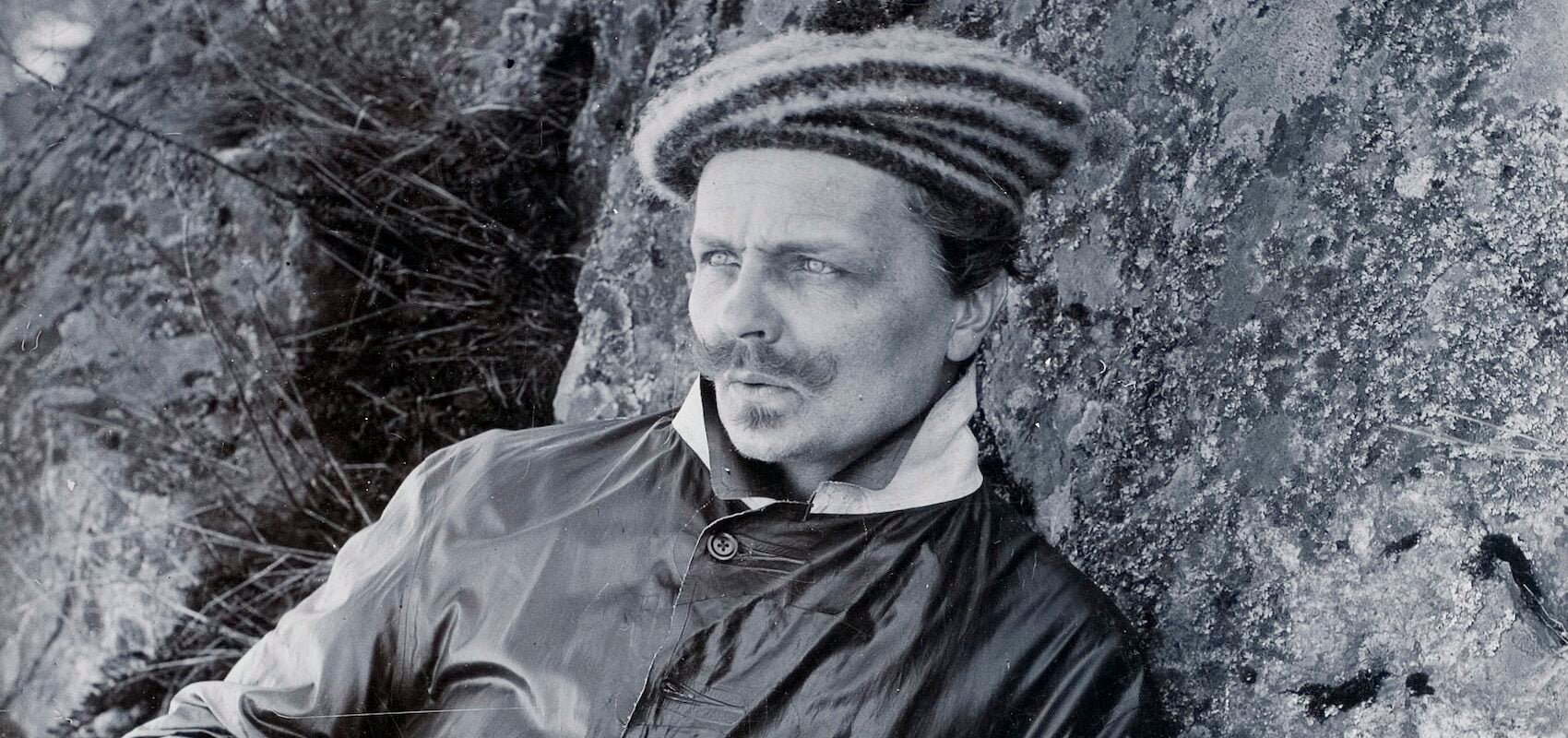
On the wedding night of his second marriage, August Strindberg (1849–1912), the Swedish writer, painter, polymath, and adept in occult lore, awoke from a dream to find himself strangling his bride. He didn’t quite manage to kill her, and profuse apologies ensued. He had mistaken her for his first wife. Satisfied that he had adequately made amends, Strindberg rolled over and went back to sleep; the newly initiated Fru Strindberg lay wide awake for a long time. Their marriage was done for a year later.
Perhaps no other man of genius has counted so ecstatically as Strindberg on finding the supreme earthly happiness in marriage. Woman’s peerless love promised erotic fulfillment in the highest sense. Beauty of face and form—he married women lovely to look at, two of the three being actresses—was the earnest of spiritual excellence. The tender embraces of his beloved wife held nothing less than the prospect of one day joyously seeing God face to face. But no other genius was more spectacularly heartbroken by the evanescence of wedded bliss than Strindberg—over and over, again and again. And he used his torturous experience to become the playwright who, in an unrelieved apoplectic fury, depicted the flying verbal knives and the death grip on the male genitalia that he knew to be married life at its most monstrous.
Today he stands with Ibsen, Chekhov, and Shaw as one of the pre-eminent playwrights of his time, largely on the basis of two or three tragedies of hatred between the sexes; yet his writings were a disappointment to him. Why did the pleasures of exercising his genius let him down? Although very little of his oeuvre is known to the English-speaking world, his achievement is prodigious, his body of literary work staggering: He wrote seventy-odd plays (he is known here almost exclusively for his plays, of which but a dozen or so are available in English, and really only two are ever performed, The Father and Miss Julie), fourteen autobiographical volumes, twenty novels and short story collections, a dozen political tracts, some ten thousand published letters, and two dozen assorted studies of alchemy, natural history, linguistics. Yet he was ever uncertain of his true vocation, prone to fits of dejection for wasting his time with drama and prose fiction, when he ought to have been concentrating on discerning and recording the plain truth, under the aspect of eternity. But the truth was the most elusive prize going—all the more elusive because Strindberg did not cherish it for its own sake, but needed it as consolation, for ideal love had failed him, or he had failed ideal love.
For quite some time, it has been accepted psychiatric practice to trace such savagery of erotic feeling to the subject’s unfortunate upbringing, and in Strindberg’s case to do so would not be far wrong. His mother, Nora, was an ignorant harridan with aspirations to saintliness, as she understood it by her dim lights, and she ripped into her young son continually for his evident unconcern for the good of his soul. He wasted his time reading all the wrong books, the one right book being the Bible—and even that, according to the teaching of the Pietist sect she belonged to, was better read aloud by an authorized preacher in public worship rather than studied in private, where all manner of untoward questions might intrude. Pietism was a consolation of the urban poor and uneducated; it endowed believers with the only superiority life allowed them, the confidence that they were to be the sole chosen occupants of heavenly mansions, while those forsaken by God burned forever. After the Protestant fashion, only belief was required, and doubt in the smallest dose was lethal. It was an uncongenial atmosphere for a youth aching for a more expansive mental life.
As he writes in the 1886 autobiographical novel whose truthfulness he swore by, The Son of a Servant: The Story of the Evolution of a Human Being, 1849–1867, Strindberg’s earliest memories were of “fear and hunger.” John (Johan in Swedish, Strindberg’s actual first name) “was afraid of the dark, of spankings, of upsetting everybody. Afraid of falling, of hurting himself, of being in the way. He was afraid of being hit by his brothers, slapped by the maids, scolded by his grandmother, caned by his father and birched by his mother.” His father, a shipping agent and the family’s financial mainstay, was barely tolerated in his own home; his wife unquestionably commanded in her domain. The father’s was a “thankless position . . . the provider for all, and the enemy of all.” He was also the dispenser of justice, or, as his son would forever see it, diabolical injustice, taking on faith every accusation made against the boy by any other family member, lashing the supposed wrongdoer with a vengeance, assuming the childish protest of innocence to be a lie and therefore redoubling the punitive blows, until the victim begging for mercy screamed a false confession. “The Family! Home of all social evils, a charitable institution for indolent women, a prison workshop for the family breadwinner, and a hell for children!”
Strindberg already knew his way around the domestic hell from the very start. He would never escape this hell, which came eventually to be of his own making. The child, of course, was innocent and could not begin to understand why these black-hearted forces were massed against him. In his youthful desperation, he turned to God for the antidote to this poisonous existence. “He was tired of living and he sought comfort in heaven.”
Soon enough, Strindberg’s determined secular intellect outmuscled his rather flabby religious belief. “To understand everything, to know everything became an obsession with him.” He acquired knowledge in heroic quantities, partly for its own sake but chiefly for the possibility it offered of rising in the world, attaining a station commensurate with his aristocratic idea of himself. Textbooks from his father’s bookshelves explaining the latest physics, chemistry, and chemical technology filled his imagination with the thrill of scientific discovery. Inventing a perpetual motion machine seemed a worthy aim; when it inevitably failed, he smashed it to pieces in disgust.
Where religious belief and unbelief are concerned, Strindberg was the quintessential man of the nineteenth and early twentieth centuries, that epoch of disorienting upheaval and the breakneck race to the abyss. His is the familiar story of a crisis of faith in the light of the new geology, evolutionary biology, biblical higher criticism, and egalitarian confidence in each person’s unaided intellect.
Under the new order, all established authority is questioned and every individual looks to his own conscience for certainty. Where that conscience came from, and how it was shaped by forces beyond one’s control, remained a mystery. The immortal soul would find its replacement in the cult of all-creating and all-devouring Nature and Nietzschean will to power. Young Strindberg had to disentangle himself from his earlier articles of faith, and living flesh was torn away along with the dead tissue of the outdated system. “His new self revolted against his old one, and for the rest of his life they fought with each other like an unhappy married couple who cannot get a divorce.” That is, Strindberg was among those choice spirits who continued to need God even though they were sure he was dead.
Not that Strindberg always admitted this need. The newfound zealotry of the convert to atheism carried him away at first. “Everything old had to be uprooted and thrown away. The fear of hell vanished; renunciation and asceticism seemed like sheer naïveté; youth and nature exerted their rights.” In the place of faith in God, he put his trust in the ego’s primacy. The life truly worth living demanded he embrace the freedom of the self, unencumbered by the morbid prohibitions the killjoy soul had imposed. He could be sure of that.
But then Woman entered the picture, and by the time she was done with him, Strindberg could not be sure of anything. A Madman’s Defense (written in French in 1888, published in German in 1893, and censored in Sweden until 1925) continues his thinly fictionalized life story through his young manhood. Although it touches on his early career as a playwright and journalist, the narrative is devoted mainly to his adulterous love for Siri von Essen (“Maria” in the novel), the Finnish-born wife of the Swedish Baron Wrangel. In due course, it turns to his own marriage to Siri, which drives him to the verge of insanity, ending in divorce in 1892, four years after the time covered in the novel. (Strindberg’s first marriage lasted many times longer than either of the next two.) This “transcendent beauty,” still another man’s wife, induces a religious trance. But it is not God he kneels to in veneration. “The need to worship, latent in my heart, awoke, and with it the desire to proclaim my adoration. The void left behind when religion was cast out was now filled again, the yearning to adore had reappeared in a new form. God was deposed, Woman took his place.” This vision of loveliness encompasses “woman as both virgin and mother.” Virgin outshines mother, however, for although Siri’s small daughter is at her side, Strindberg refused to countenance that a child could possibly exist. The thought of Siri’s having engaged even in marital sexual intercourse would despoil Strindberg’s rapture in the presence of “a soul incarnate, a soul pure and unapproachable, clothed with one of those radiant bodies with which the Holy Scriptures endow the souls of the dead.”
They are not yet even lovers when an argument with her warns him that his adoration is folly: “It was impossible for me to recreate God. The statue of the Madonna had fallen down.” The playwright discovers Woman in all her duplicity and cruelty, repugnant and terrifying, her talons bared and reaching for his throat. Although he has glimpsed the truth, the momentum of runaway desire sweeps him past the impediments to adultery. Consummation reactivates his fevered, profane religiosity. “And this is called a sin! Oh, what a heavenly sin, what a blessed desecration, what a divine guilt!” But the lovers must endure a parting. After he sees Siri off at the railway station, Strindberg reports falling into a despondent reverie: Is his love for her an incestuous perversion, seeking “gratification in possessing [his] mother?” Siri’s “motherly” kiss and “last embrace” made him prayerful—“led [him] back to God . . . [so that he] forsook the new faith that presages the progress of humanity.” In renouncing his atheist freedom, Strindberg inaugurated his “downfall.” Going forward, he would be whipsawed between erotic bliss and blighting remorse.
At first, married life brings fulfillment. Strindberg enjoys the early successes of his career as playwright; he relishes Siri’s popularity as an actress, often in plays he wrote specifically for her. Three children are conceived in hot-blooded, mutual passion and raised with love. Yet the inescapable suspicion that the children are not in fact his plagues him. Absent real evidence of Siri’s unfaithfulness, Strindberg contrives the direst fantasies from her all-too-sportive demeanor backstage at the theater, that stew of rank lasciviousness, that sexual snake pit. Carnal knowledge, he discovers, is not knowledge at all but indoctrination into tormenting doubt. “The main thing is to know. One has to know. Yet if a husband lived for a hundred years he would still never know anything about his wife’s true existence.” This fresh hell of suspicion makes Strindberg’s boyhood sufferings in his parents’ home seem trifles in comparison.
The Father, one of Strindberg’s two best plays, dramatizes the psychic battle of marriage gone wrong as husband (the Captain) and wife (Laura) grapple for who gets to dictate their daughter’s (Bertha’s) course of life. Laura wants to keep Bertha under her thumb at home, while the Captain backs Bertha’s desire to move out on her own. But Laura also wants Bertha to become a painter, which is what Bertha wants for herself, while the Captain wants her to become a teacher. Whatever Bertha might want, the decision is not hers to make. The battle of wills is between husband and wife. It is not a fair fight: An unarmed man must defend himself against a hungry lioness. Even worse, Laura has the wiles of a fox, like the perfect Machiavellian prince. Tears streaming, she tells the Doctor, whom she has just met for the first time, “My husband is mentally unbalanced. Now you know. You will be able to judge for yourself later.” Her proof of the Captain’s derangement rests on gross misrepresentations of the facts, cunning concealments, lies almost comically brazen. Laura intends to drive her husband mad, in fact. What she ultimately wants is complete command of her family.
When the Doctor admonishes her not to encourage the Captain’s suspiciousness, so dangerous in a troubled man, she takes it as a summons to action. With shrewd mental violence, her “satanic genius” for getting what she wants, Laura drives into his brain the suspicion that he is not Bertha’s father. When he begs to know the truth and she assures him that she has never been unfaithful, he refuses to believe her; only her confession of criminality will satisfy him.
On the field of battle, every contention from twenty years of marriage between sworn enemies is revived as ammunition. Laura compresses the essence of Strindberg’s teaching into a blunt aphorism: “Love between man and woman is war.” Sexual love cannot exist without reciprocal hatred—this is the playwright’s credo, uttered by the mortal foe of the entire male sex.
Laura calmly informs the Captain of her plan to have him committed to an insane asylum, and he throws a lamp at her in reply. Then, he tries to shoot Bertha, who has asserted her desire simply to be herself and voiced her refusal to become a mere instrument of his will. The Nurse had prudently removed the bullets from his revolver, and he remonstrates with her bitterly. “Why didn’t you let me kill the child? Life is a hell, and death a heaven, and the child belongs to heaven.”
Enfolded in a straitjacket, the Captain vituperates female treachery with the flair of a literary madman. At one point he speaks as Strindberg’s raisonneur, dissecting married woe to uncover the latest strains of bacterial feminism festering inside. The diatribe feels startlingly contemporary. “And who is to blame? Perhaps the idea of marriage is to blame. In the old days, one married a wife; now one forms a company with a woman who goes out to work, or moves in to live with a friend. And then one seduces the partner, or defiles the friend. What became of love—healthy, sensuous love? It died, starved.” Having said his piece, he dies of a stroke. Wife and daughter rush into each other’s arms as the curtain falls, celebrating their triumph more than mourning their loss.
Strindberg cultivated an epistolary friendship with Friedrich Nietzsche, and in 1888 he sent the self-proclaimed Antichrist his own French translation of The Father. Nietzsche’s response announced the sweet meeting of brother souls. “I read your tragedy twice with deep emotion: it has astounded me beyond measure to find a work in which my own conception of love—with war as its means and the deathly hatred of the sexes as its fundamental law—is so magnificently expressed.” Strindberg in turn observed that “they wanted to commit me to an asylum because of my tragedy”—“they” being the miscreants of “Christendom” and its loathsome secular offscourings, the socialists and the hagridden, Ibsen-loving feminists. As Strindberg wrote to the Danish critic Georg Brandes, who had introduced him to the writings of the German philosopher, he shared with Nietzsche a contempt for “the religion of the small, the paltry, castrates, women, children,” and a reverence for “the right of the strong and the wise against the foolish, the small (the democrats).”
Strindberg and Nietzsche were alike in their awareness that they failed to become the men of their monumental aspirations. In the opening sentence of the 1886 preface to Daybreak: Thoughts on the Prejudices of Morality, Nietzsche identifies himself with the narrator of Dostoevsky’s Notes from Underground—an intellectual of considerable powers wasted in hectic mental fretfulness to no good end, a sick, puny, forlorn creature whom his physical superiors shoulder off the sidewalk, and who tries to assert his manliness by humiliating a prostitute. Like Dostoevsky’s Underground Man, and like Nietzsche, Strindberg is a man of ressentiment, one for whom the world is not good enough because he is not good enough for the world, and who makes his general failure endurable by prodigies of imagination in which he is the sterling hero. He suffers from the fear that he is more loathsome than the virile, well-fed, easily satisfied bourgeois types whom he despises, and Strindberg’s compensatory fantasies of alchemical wizardry, of secret knowledge obtained by extreme daring that will prove his supremacy over all merely conventional sages, are his version of Nietzsche’s Übermensch fantasies. Nihilist despair is a step away: The world that exists ought not, and the world that ought to exist does not.
Nietzsche’s correspondence with Strindberg ended abruptly when the philosopher went insane, the victim of neurosyphilis. Strindberg lost the closest thing to a kindred spirit he had ever found. But then all his loves were short-lived. The Nietzsche-induced rapture would pass. Very different spiritual masters would spellbind Strindberg.
Nevertheless, a Nietzschean contempt colors the next major play Strindberg wrote, far and away his most famous in the English-speaking world. It is a story of a masculinized noblewoman who offers herself to an upstart servant for a backroom coupling, which turns out to be the mistake of her life. The titular character in Miss Julie (1888), as Strindberg explains in his fiery preface, represents “a man-eating half-woman,” a female figure that came into its own in the degenerate nineteenth century and “beg[a]n to make a noise” in an ill-considered “battle against Nature.” Striving for happiness, this “tragic type,” this failed example of womanhood, invariably spreads corruption and disorder; for “happiness is something that only a strong and hardy species can achieve.”
Julie, at twenty-five, is the botched progeny of an improvident count and his lowborn wife. As Julie tells her father’s valet and her momentary lover, Jean (she never learns his surname), her mother married despite her aversion to marriage, and bore a daughter despite not wanting children. Her mother brought her up to “learn everything that a boy has to learn, so that [she] might stand as an example of how a woman can be as good as a man.” This social experiment produced the living abortion that Strindberg anatomizes with merciless scorn. Burning sexuality is the punishment that will not allow Julie to hate men without reservation. But once the sexual itch has been scratched, a hatred near to insanity boils up within her: “You think I’m so weak—oh, I should like to see your blood, your brains, on a chopping block—I’d like to see all your sex swimming in a lake of blood—I think I could drink from your skull, I’d like to bathe my feet in your guts, I could eat your heart roasted!”
Julie vomits up her rage until there is none left. Her sexual disgrace, her fall from a great height, leaves her a shattered vessel, a practicing nihilist: “I don’t believe in anything any longer. Nothing. Nothing at all.” She is incapable of deciding what to do next: “I can’t feel anything, I can’t repent, can’t run away, can’t stay, can’t live—can’t die.” Begging Jean to order her to do something, she promises to obey him like a dog. With gentlemanly discretion he offers her a razor, and she does what is necessary. She believes dying is the one honorable thing she can do. It is sadly fitting that, as the Strindberg marriage was fast dissolving, Siri should create the role of Miss Julie in the play’s premiere—a private performance, for fear of the censor, in Copenhagen.
In Mr. Sammler’s Planet, Saul Bellow’s titular hero distinguishes between low-ceiling masterpieces such as Crime and Punishment and high-ceiling masterpieces such as In Search of Lost Time. Like The Father, Miss Julie has a very low ceiling—it does not impose demands on the audience’s intellect. But in its deathblow to modern romantic love and the egalitarian fantasy of ending class hatreds, delivered with unforgettable hot fury, it is a masterpiece.
In his continued scientific experiments and speculations, however, Strindberg kept the ceiling high as can be, if it was there at all. For him, life was a puzzle awaiting—demanding—a solution. Antibarbarus (1894) is a collection of four scientific essays with a marked metaphysical tang. It foretells the coming of the unified theory of nature, extending the discoveries of Charles Darwin and Ernst Haeckel into every aspect of intellectual endeavor. He envisions a society of the brightest and boldest thinkers, “an order of superior beings seeking new paths,” who would combine forces to crack the mystery of human existence.
Mostly, though, Strindberg labored in solitude and even secrecy. He plunged deep into alchemical magic and became convinced that he had transformed base metal into gold. His ambition was to think his way out of the known world, employing powers unfamiliar even to other men of genius.
Part of the excitement came from believing that the knowledge he sought was not only difficult to access but perilous if revealed—the devil’s handiwork, proscribed by churchly authority. The glamour of evil held its charms for Strindberg, but he had to pay for his sins. As he writes in the autobiographical Inferno (1897), he found himself in thrall to “Unseen Powers,” who tolerated his audacious delving into forbidden realities for a time, only to bring the hammer down on him. Alone in Paris in 1895, his second marriage having failed abruptly, in extreme poverty and relentless physical pain from disgusting lesions on his hands that would not heal, he came to suspect that offenses against the divine had earned him such misery. He resisted this understanding as long as he could, clinging to the assurance that he was an innocent sinned against by malign powers, blatantly cruel and unjust in their persecution. However, dreams and occurrences that at first seemed inconsequential began to reveal their depth of meaning. They became signs and portents, and he could no longer doubt “the intervention of a Power who chastised in order to reform.” On Whitsunday, as he was walking in the cemetery of Montparnasse, a feeling of peace yet also of “unaccustomed remorse” settled on him, and he understood that he must renounce all worldly goods in order to satisfy this power—that is, to seek the one thing needful without distraction. “No more love! No more money-making! No more honors! The way of the Cross, the only one that leads to Wisdom.”
Blessings showered down on him in short order. “All my undertakings prospered, unknown friends brought food to me as the ravens did to Elijah. Money came to me of itself.” But his idyll under the guardianship of good spirits gradually came apart. Invisible adversaries began to make his life first uneasy and then unendurable once again. Incidents that struck him as uncanny—the grain of wood and burnt coals assuming demonic shapes, fallen branches underfoot resembling letters of the Greek alphabet with personal significance for him—set his teeth on edge. Mysterious electric currents traveling from adjacent rooms jolted him day and night. He knew now that he was in the hands of the evil ones and the world was ugly as ever. “Born as I was with a longing for Heaven, I had wept, even as a child, over the filthiness of existence and had felt myself a stranger to my parents and in the community. Ever since my childhood I had sought God but found the Devil.” At the home of an artist friend, full of happy people in the most gorgeous surroundings, “the atmosphere of beauty and kindheartedness . . . seared my soul. In the midst of all this I felt as dissatisfied with myself as a damned man would be in Paradise, and it was here that I began to discover that I was damned.”
This terrible intuition was confirmed by his reading of Emanuel Swedenborg, the eighteenth-century visionary—or madman—and prolific writer who voyaged extensively through the unseen world, in hell and in heaven. By Strindberg’s reading, the Swedish seer,
perhaps without knowing it, depicts our earthly life when meaning to describe Hell. Hell-fire is our desire to make a name for ourselves in the world. The powers awaken this desire in us and permit the damned to achieve their objectives. But when the goal is reached and our wish fulfilled, everything is found to be worthless and our victory meaningless.
Strindberg was convinced that he was in hell on earth.
The Devil “in his traditional form” does not exist, Strindberg learned from Swedenborg; providence does its work with the assistance of the souls of the dead, who intend no wickedness. What Strindberg had believed to be deeds of cruelty for the satanic pleasure of causing human pain, he now understood as wise actions performed for our betterment. Swedenborg “had shown me the only way to salvation: to seek out the demons in their lair, within myself, and to destroy them by—repentance.”
With telling self-knowledge, Strindberg does not expect his latest spiritual infatuation to last. With the born rebel’s effrontery, he addresses the powers he holds responsible for his destructive temperament, his unconquerable dissatisfaction: “I know for certainty that before ten years have passed you will prove to me that religion is false.” Human life is evidently a joke to “the Gods,” and suffering humans can, at times, laugh at the joke themselves. But Strindberg seems nearer tears than laughter, and his anger sprays in an unexpected direction:
Jesus Christ our Savior, what is it that he saved? . . .
Is it possible—God forgive me—that even Christ has been transformed into a demon? He has brought death to reason, to the flesh, to beauty, to joy, to the purest feelings of affection of which mankind is capable. He has brought death to the virtues of fearlessness, valor, glory, love, and mercy.
From a desire to repent, Strindberg has pivoted to issuing denunciations.
Swinging wildly to extremes was the pattern of his life, and to a certain degree he knew that it cursed him. In 1898, when his daughter Karin wrote to tell him she wanted to convert to Roman Catholicism, Strindberg responded with paternal joy, and offered some spiritual counsel, wisdom acquired in his own “undisciplined and vacillating life, grounded on a lack of religion.” Catholicism, he insisted, was “the only religion for us Westerners,” for Protestantism was “no religion but merely theology, intellectual argument, free-thinking which only results in godlessness and doubt.” He advised that Karin “never reason about religion.” That the believer’s truths are beyond rational dispute is “axiomatic for me and thus cannot be proved and [does] not need to be proved, and if one attempts to prove an axiom, one gets tangled up in the absurd.”
If Strindberg despaired of finding an enduring faith, he still hoped for lasting love, and believed that he had really found it. In 1900, he met the twenty-one-year-old actress Harriet Bosse, and he married her the following year. The pregnant Harriet left him for the first time five months into their marriage. Strindberg’s insane jealousy appalled her, and his obscene, howling insults infuriated her. She would return only to bolt again, and then again. By the time they were divorced in 1904, they had lived separately for the better part of two years. But that was not the end of things, at least not for Strindberg. In 1908, after Harriet had become engaged to an actor, her spirit took to visiting Strindberg in bed. At first, he prayed to God for the fortitude to resist. But he became convinced that Harriet’s appearance was a sacred gift, and in his Occult Diary (published only in 1963) he kept a running score of their telepathic embraces, often three per night. Consorting with her succubus would be a sin by light of day, but fortunately the nocturnal regulations were more lenient.
Lovely, young aspiring actresses were common enough in Strindberg’s world. He was the founding artistic director of Stockholm’s Intimate Theatre, which produced only his own plays, with considerable success, making him a commanding figure in his circles, especially among ambitious, artistic young women who might thrill to the erotic charge of a famous older man. Although he was still in love with Harriet, in 1909 he proposed marriage to Fanny Falkner, a teenage waif who was starring in his plays despite her evident lack of talent. She accepted, then burst into tears of consternation and remorse as soon as she left his house. They never got so far as actual marriage.
Love having failed him once again, Strindberg had to rest content with the pleasures of work and with the fame and adulation due an aging literary icon. In his later years, he wrote plays very different from the naturalistic tragedies on which his reputation still rests. To Damascus (1898–1901) is a trilogy of autobiographical phantasmagoria, probably the best of his late plays. He said of this work that he was “attempting to imitate the disconnected but seemingly logical form of a dream where everything can happen, everything is possible and probable; where time and place do not exist, and where, on the insignificant basis of reality the imagination spins and weaves new patterns into a blend of memories, experiences, free fantasies, absurdities and improvisations.” It’s an accurate characterization, and like A Dream Play and The Ghost Sonata, the trilogy is forgotten, except by a coterie of committed obscurantists, as are so many modernist innovations once thought alluringly audacious.
Although during his lifetime the official Swedish cultural establishment emphatically overlooked Strindberg’s genius—no honors or emoluments, the Nobel Prize he expected went to Selma Lagerlof—in 1912, a torchlight procession of more than 15,000 admirers paid tribute to him on his sixty-third birthday, as he stood on his balcony to thank them. It was a sad farewell. He had long suspected that his severe abdominal pains had been the work of arcane Nordic voodoo by his enemies, but they were in fact symptoms of stomach cancer, which killed him later that year.
Strindberg was a figure of the night, well acquainted with the soul’s darkness. He knew firsthand the ordeal of the soul knocked loose from settled belief in the Christian God by the mental upheavals of the nineteenth century. He tumbled from one makeshift conviction to another and then another, none in the end providing the refuge he sought, and his frantic wanderings took him further and further from reason, order, true love, and the chance for happiness in this life and the next.
The “fear and hunger” that dominated and rotted his boyhood became lifelong afflictions—though it would not be literal hunger but sexual appetite and spiritual yearning that gnawed at him. He sought the healing presence of the divine, hoping against hope to find it in erotic idolatry, in scientific discovery, in pseudoscientific wizardry, in mystagogic lore, and in prayerful efforts to summon God’s own answering voice. None of these efforts succeeded, none gave him what he most wanted, though the diversions did gratify him for a time. At any one of his way stations, other people probably said, “Stop here, this must be it.” But Strindberg refused to settle for less than everything he wanted, that which the powers had denied to a man of his nature, upbringing, education, and luck—the usual impediments to human happiness that amount to what is often called “Implacable Fate.”
But what if there is no such thing as fate—or if, as Heraclitus said, a man’s character is his fate? Strindberg was a profoundly sensual man, who craved all the erotic sweetness he could gulp down. He was also driven by colossal ambition. He wanted the most coveted prizes, including the light of envy in everyone else’s eyes. He wanted what so many young men, and not-so-young men, want today, in the freest and most ambitious society there has ever been: to make their mark on the world, to succeed in work and love, and to enjoy a sufficient share of the world’s pleasures so that when the end comes, they will know that they have lived. “Man is excellently made, and eagerly lives the life that is being lived,” declared Mikhail Zoshchenko, who wrote with comic sadness of the life being lived in Stalin’s Russia. The life that is being lived in a modern democracy like ours, or in a constitutional monarchy like Strindberg’s Sweden, however different from that in the totalitarian tyranny Zoshchenko knew, is unlikely to be the best one available. The best requires some searching out. Strindberg sought, but he did not find the wholeness and peace that fulfills the soul, perhaps because he wanted too much else besides.
Strindberg made art out of the world’s ugliness, because he believed Nietzsche’s revolutionary philosophic claim that the truth is ugly, and he is known principally for his fears and hatreds. He was an inveterate and eloquent hater. Name your poison, whether the powers or the sad human creatures in their grasp, he could tell you the worst about them, with the authority of extreme personal misery to support his case. He was above all a man obsessed with himself, yet his writings are hardly ablaze with self-knowledge. Responsibility for all his sufferings falls unfailingly on the women he loved and hated. It is hard to believe he did not know better. It’s common wisdom that it takes two to tango. But one’s true self is sometimes the most impenetrable mystery.
Like Strindberg and Nietzsche, Dostoevsky began his literary undertaking in “the foul rag and bone shop of the heart” (to quote another Nietzsche admirer, William Butler Yeats). But unlike them he made his way up and out, into the light of Christ’s love. The simple and transcendent beauty of the last pages of The Brothers Karamazov comes from the pen of a man not fired by ressentiment but rather possessed of the rarest understanding of the exalted human place in creation. Strindberg never attained the depth or the serenity of soul that might have enabled him to write like that. Strindberg’s last play, The Great Highway, states simply the cause of his greatest pain: “I suffered most from not being the man I longed to be.”

YOU MIGHT ALSO LIKE
After Disenchantment
What does the phrase “disenchantment of the world” mean? Disenchantment is easy to identify and even easier…
Form vs. Monsters
The nature and aims of Catholic fiction have been a matter of debate for generations now. What…
Tell the Stories of Your People
Fifteen centuries ago, in a land whose frontiers had collapsed, whose fields were overrun, and whose monarch…
