

Karl Barth and the Idolatry of the Nation:
Confronting Christian Nationalism
by james marriott
doubleday, 208 pages, $26
As the postwar era draws to an end, some Christians continue to reach for analogies to the 1930s. Social decay recalls Weimar; populist political movements and demagogues are 1933 all over again; Christian compromise with political powers resembles the German Christians. And some American Protestants, alarmed by the rise of Christian nationalism and the growth of rhetoric celebrating nation, ancestry, and heritage, wonder whether we need a new Confessing Church, another Barmen Declaration—another Barth, perhaps.
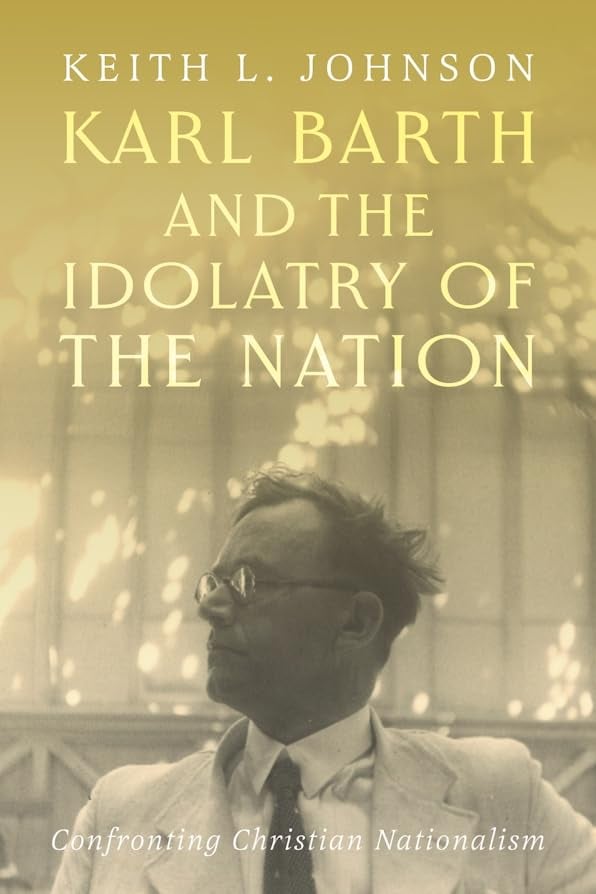
In Karl Barth and the Idolatry of the Nation: Confronting Christian Nationalism, Keith L. Johnson seems to think so. He seeks to retrieve Barth’s resistance to German nationalism as a resource for the American church today. As a piece of Barth scholarship, working from the Barth archives, the book largely succeeds. Johnson closely traces the development of Barth’s resistance theology—from the aftermath of the First World War through the struggles within the German church (the Kirchenkampf), the rise of National Socialism, the drafting of the Barmen Declaration, Barth’s censorship by the Nazi state, and finally his expulsion from Germany. On Johnson’s reading, Barth’s central contribution was to perceive the political catastrophe of his times as downstream of a prior theological failure: German Protestantism had set something alongside the Word of God.
Central to Johnson’s account is Barth’s famous disagreement with Emil Brunner over natural theology. Barth’s thunderous Nein! in response to Brunner’s defense of natural theology, and Barth’s equally full-throated rejection of natural law, can seem excessive when read apart from the historical context. The background provided by Johnson makes Barth’s response more comprehensible (even if one remains ultimately unpersuaded). Nazi-supporting theologians like Paul Althaus and Emanuel Hirsch were appealing to “orders of creation,” “natural revelation,” and nation, race, and Volk as revelatory in themselves of God’s purposes, without any need to be subordinated to or reordered by Scripture and Christ. A “both-and” theological approach, harmonizing creation and grace, became the theological grammar for interpreting the gospel in accord with a prior account of German identity, which became functionally authoritative over the apostolic witness. It underwrote what Barth called a Christianity of the “hyphen”—in this case, “German-Christian.”
Johnson is especially good at explaining why Barth grew suspicious of the maxim that “grace does not destroy nature but perfects it.” Althaus invoked it to argue that Christ did not abolish German Volkstum but fulfilled and sanctified it. Hirsch used something like it to treat racial and national distinctions as primordial orders of God’s creation: Aryan peoples suited by nature to be leaders, others to submit. Both operated according to a logic that no longer let revelation judge German self-understanding; instead, revelation was subtly judged by it. Accordingly, Christ was not present as the holy other, the Lord who stands above every nation and ruler, but rather was reshaped to fit the national ideal.
Barth perceived that this theological reasoning set the terms for God’s revelation. If one starts with the “natural” orders of race, nation, and political authority and then applies the classic maxim, “grace” will increasingly turn out to mean little more than baptizing what the theologian already thinks nature requires. Barth’s opposition to natural theology was a refusal to let any creaturely reality—the nation above all—determine in advance what God’s revelation means.
This dark chapter in theological history is worth remembering, because some on the contemporary Christian right deserve to be judged by it. National “soul”-talk can too easily echo Romantic, Herderian ideas of the Volk. The assumption that God has fitted peoples with distinct capacities can generate a pernicious racial hierarchy, and a distorted ordo amoris can be pressed into the service of justifying racial chauvinism and opposing interethnic marriage. And there can be a temptation to read a strongman’s rise as a providential rescue from lost privilege and national decline. Johnson is right that Barth can help us name what is wrong with these missteps. The root of the problem is not so much political as theological: The gospel has been fitted into a story whose central subject is something other than Jesus Christ and his people.
While Johnson is right to warn against these temptations, he takes the argument a step further, suggesting that our times “hauntingly” resemble Barth’s own. On this point, the book is less than successful.
Part of the problem lies with Johnson’s definition of “Christian nationalism”—the primary sickness for which he wants to prescribe Barthian medicine. He defines Christian nationalism as an ideology that “fuses Christianity with civic life by telling a story that places one’s nation at the center of God’s purposes for history.” In this fusion of identities, “loyalty to God becomes indistinguishable from loyalty to the state, and vice versa.” According to Johnson, “Christian nationalism collapses the distinction between divine and national identity.”
Perhaps this strong version of providential nationalism might describe some who are associated with the label. Yet many Americans now called “Christian nationalists” would not recognize themselves in this definition. Some believe that America has been shaped by Christianity throughout its history and ought to remain so. Others support some form of religious establishment. Others simply want law and public institutions to reflect Christian moral teaching, which could be understood as a form of civil religion. These positions may deserve criticism, but they are not the same as claiming that America is God’s singular instrument, or that one ethnic group has been raised up to play a redemptive role. Those who wish to buttress the Christian influence on American public life do not necessarily incline toward the errors of the German Christians whom Barth opposed. A faithful mapping of our present moment requires more care.
The larger problem lies with Johnson’s reluctance to specify how Barth’s circumstances resemble ours. This is particularly striking, since Johnson’s account of Barth’s context is remarkably concrete and precise. He narrates in exacting detail the attempt to construct a unified Reich-church modeled on the centralized structure of the Nazi state; the abolition of ecclesiastical independence and the pressure to install state-approved church officers; the institution of the “Aryan Paragraph” that threatened to exclude Jewish Christians or render them second-class members of the church; the federal demand that government decrees be read in worship; the suppression of dissenting theologians; the pressure to open classes in religious schools with the Nazi salute; the compulsory oath of absolute allegiance to Hitler; and more. These concrete developments are what made Barth believe he was in a theological crisis, a status confessionis in which those faithful to Christ must utterly reject the Nazi-influenced German-Christian movement.
But the details Johnson adduces suggest more disanalogies than parallels. There is no American Reich bishop. The government is not interfering with church elections or seeking to impose a unified Protestant denomination. No state pressure is putting Jewish Christians at risk in churches or demanding that pastors read Trump’s executive orders in worship. No theology professors are required to pledge allegiance to the president. Keith Johnson has not been summoned before a court for refusing the MAGA equivalent of the Nazi salute. Whatever one thinks of Trump, Vance, and the contemporary Christian right, these differences are profound.
Despite these obvious differences, Johnson insists that Barth’s context feels “hauntingly familiar” to our own. But the purported similarities are left largely unstated. One gets the impression that Johnson writes under conditions of censorship similar to what he narrates, as though naming names and making concrete connections would invite real professional and legal risks. But this reticence is self-imposed. Johnson is not Barth after Barmen, facing state and church censorship. He is an American theologian publishing a book with a prominent press, written for an audience that welcomes criticism of all things Trumpian or Trump-adjacent. If he thinks contemporary pastors, theologians, and Christian groups are repeating the errors of the German Christians, he should identify them and clearly articulate his arguments against their stated positions. Perhaps Johnson does not do so because he has stretched the analogy beyond what the facts reasonably bear out.
This does not mean that Barth is irrelevant to our times. But his relevance lies in the common temptation to make the ideologies of the moment into criteria for revelation. To be sure, there are dangers involved when nation, race, culture, or political order become so authoritative that Christians can only confirm our secular assumptions and commitments. But in fact, progressive ideology is far more entrenched in many churches as an authority superior to the apostolic tradition than the idolatry of the nation that Barth faced.
The trouble is that Barth’s solutions create problems of their own. Those problems began to surface even in the early days of the Kirchenkampf. Johnson’s book opens with a dilemma Barth faced. He was told by his publisher, Albert Lempp, that if he wanted to continue to publish his journal, Theological Existence Today!, the Nazi government would require each issue to pass through political censors. Lempp encouraged him to confine his writings to dogmatics and not politics. Barth refused, appealing to the chastisement in Isaiah 56:10 of the watchmen who see danger coming and say nothing to help the people. Here we see Barth conceding implicitly that theology cannot help being political. But Barth insisted that his resistance efforts were purely theological, not political in the broad sense of concern for the good of a nation or people. His rhetoric is confusing, if not incoherent. Was National Socialism to be resisted solely on theological grounds? Or was Hitler’s movement an assault on human dignity that any properly formed conscience should oppose? Barth’s polemics against natural law and other concepts that try to identify a basis for moral judgment undermine our ability to answer the latter question. Johnson never fully resolves the tension.
Reading this book, one notices an instability in Barth’s politics. Johnson repeatedly emphasizes Barth’s insistence that his resistance efforts were theological rather than political. However, Barth was hardly quiescent politically before the Nazi period. As Johnson notes, he was dubbed the “Red Pastor” for his speeches to Christian socialists and his encouragement of factory workers’ campaigns for better labor conditions. He did not, one would assume, interpret this work as an abandonment of the gospel or idolatrous pursuit of political power. One wishes that Johnson had sought to harmonize these threads in Barth’s life and thought. At the very least, Barth’s earlier political engagement complicates any sharp distinction between theological resistance and political action.
The book’s consistent target is the theology of the “hyphen”: German-Christian; gospel-and-culture; revelation-and-nature; Christ-and-Volk. Barth’s argument is that the natural term eventually dominates the supernatural, determining its content, remolding grace rather than grace transforming nature. Thus, German Christianity becomes more German than Christian, and the Church becomes more preoccupied with natural greatness and retaining its own cultural standing as the guardian of national culture than proclaiming the Word. While there is wisdom here, Barth repeatedly translates what should be a necessary hierarchy into an unnecessary opposition.
This false dichotomy comes out most clearly in the dispute over the relationship between nature and grace. Johnson does a good job explaining why Barth rejected the maxim that grace does not destroy nature but perfects it, but he does not prove that Barth was correct in doing so. Just because certain Nazi-aligned theologians made use of the maxim does not mean that maxim is incorrect. Abusus non tollit usum. The point of this venerable principle about grace and nature, in fact, is to affirm the goodness of creation while denying its self-sufficiency. In this account, nature can neither define nor fulfill itself apart from God, his revelation, and the work of Christ. Certainly, the maxim can be twisted to support falsehoods, as can every theological truth. But the proper response is discerning the right application, not discarding the truth altogether.
A similar rejection based on abuse is at work when Johnson comes to Barth’s critique of “orders of creation.” As Johnson shows, the nationalist theologians of Barth’s time used this concept to propound very specific understandings of race and nationality, as well as gender and family structures. These aspects were treated as equally fundamental “orders of creation.” Perhaps there are theological reasons to shun talk of “orders of creation.” But in his summary of Barth, Johnson does not distinguish between, on the one hand, the suspect claims of racial and national superiority, which Barth resisted, and, on the other hand, a classical Christian understanding of the created structures of marriage and the family, which Barth himself upheld. Again, the questions return: Was the problem with the Nazi-aligned churches theological—a mistaken concept of nature in relation to grace? Or was it one of a moral conscience captured and perverted by modern ideologies?
Barth’s account of Christ and culture faces similar problems. As Johnson recounts, Barth repudiated the idea that Christians have a duty to sustain national character or family values; rather, they are called to live according to the new birth of the Word. But these elements do not need to be opposed. Certainly, it is not the primary calling of the Christian to promote family values, however worthy the goal. The family is a created good, though, and its design is depicted in the Word of God. Thus, promoting these truths can be a form of living out one’s faith and loving one’s neighbors. Moreover, if political communities provide real goods—like peace, justice, and solidarity—then caring about their health need not betoken national idolatry.
There are ways of conceiving of the relationship between the gospel and particular cultures that avoid both the German theologians’ errors and the fierce Barthian response. For instance, Tim Keller would regularly preach that the gospel does not impose a uniform, universal culture that completely erases one’s cultural background; rather, an African Christian becomes more truly African, not less so. Similarly, the missiologist Lamin Sanneh has drawn attention to Christianity’s distinctive “translating impulse”: Because God has no linguistic favorites, the Church receives the vernacular of every people as a legitimate vehicle for the Word of God. Translation therefore dignifies the particularity of cultures rather than requiring their abandonment. It recognizes, in Sanneh’s account, a providential resonance between the universal gospel and the particular cultural worlds into which it comes. As at Athens, the missionary encounters signs that God has already been at work among a people, and the gospel takes up their language and cultural forms as the medium through which it is proclaimed.
At the same time, translation is not mere preservation. The Word, once translated, also gives people new ways of seeing their own culture, providing resources for self-criticism, renewal, and transformation. Christianity thus neither dissolves particular cultures into a generic universalism nor simply ratifies them as they are. The gospel enters particular cultures, receives them as genuine vehicles for its proclamation, and then reworks them in light of God’s revelation.
Barth’s dialectic leaves little room for transformation-in-continuity. By opposing idols, he smashes too many images. German Christians were not wrong for loving Germany, but for loving Germany wrongly. A truly Augustinian order of loves relates created goods to God in a participatory hierarchy. Created goods that are not God are to be loved less than God; they should only be loved in and for God. But they do not need to be framed as rivals. The gospel rebukes our disordered loves and redirects them. It does not require us to cease loving created goods.
Johnson’s narration reveals another troubling pattern in Barth’s reasoning: Barth’s habit not only of dichotomizing truths, but also of drawing the line of faithfulness narrowly around himself and his positions. Again and again in this story, Barth condemns other figures who, even if they opposed Hitler and his agenda, did so from more moderate positions.
Otto Dibelius, for example, spoke of the German church as tied to the German people. This formulation should be understood as an attempt to insist that theology always takes place in history, that the gospel is not opposed to the particularity of human life, that the Church is rooted among real people, that the Word takes flesh and dwells among us in the middle of concrete histories. Barth heard only idolatry. Any compromise or failure to draw the lines where Barth did was rejected as capitulation.
Johnson explains that this pattern was a source of Barth’s loneliness during these years. But it might also be worth identifying it as a prideful distortion of his moral reasoning. The tendency to draw the line of faithfulness around oneself makes it harder to win over those who are perhaps not that far away from one’s own position, and who might turn out to be important allies in resisting evil. To a certain degree, Barth’s alienation was self-imposed.
Christians should place their primary identity in the Church and understand that the best thing they can offer the world is to live under the Word in faithful fellowship. The Church’s primary task is never to preserve the nation, support a party, or recover a lost cultural heritage. The unity humans long for is not ultimately that of blood, soil, class, or party, but that produced by the reconciliation of man with God and the demolition of the walls between Jew and Gentile, resulting in one body from every tribe, tongue, and nation. A Christianity that forgets this vocation of faithfulness above all else will become easily co-opted as a servant to worldly projects. Barth and Johnson are right to remind us of this.
But a proper ordering of our loves does not require the negation of real goods. The Church can understand itself as the society in which the unity for which we were made is most fully realized, while continuing to serve families, cities, and nations. We are called to love our neighbors. Those neighbors are not humanity in the abstract, but concrete people in particular places and times, who participate in goods worth celebrating and preserving, believe errors worth correcting, and suffer from vices worth curbing. The catholicity of the Church does not erase particularity. Rather, it teaches us how to inhabit the time, place, and people in which we are placed by God’s providence without absolutizing them.
Barth was correct to insist that no Gentile nation belongs at the center of the biblical story. He was correct to expose the theological disasters that follow when providence is too neatly mapped onto national destiny. He was correct that the Church must at times deliver an emphatic Nein! to political powers demanding the allegiance that belongs to Christ alone. But “Christ alone” does not mean “Christ instead of creation.” The redemptive lordship of Jesus does not annihilate love for created things; it judges, heals, and rightly orders them.

YOU MIGHT ALSO LIKE
De Gaulle Triumphant
The Second World War left Europe invaded and ruined, divided between Soviet and American occupations. Hitler’s defeat…
New Founders Wanted
It’s now 250 years since America declared her independence and embarked on the experiment of fashioning a…
While We’re At It
♦ Erin Piacenti, a thirty-two-year-old wife and mother, was killed in Times Square on August 31. Her…
