
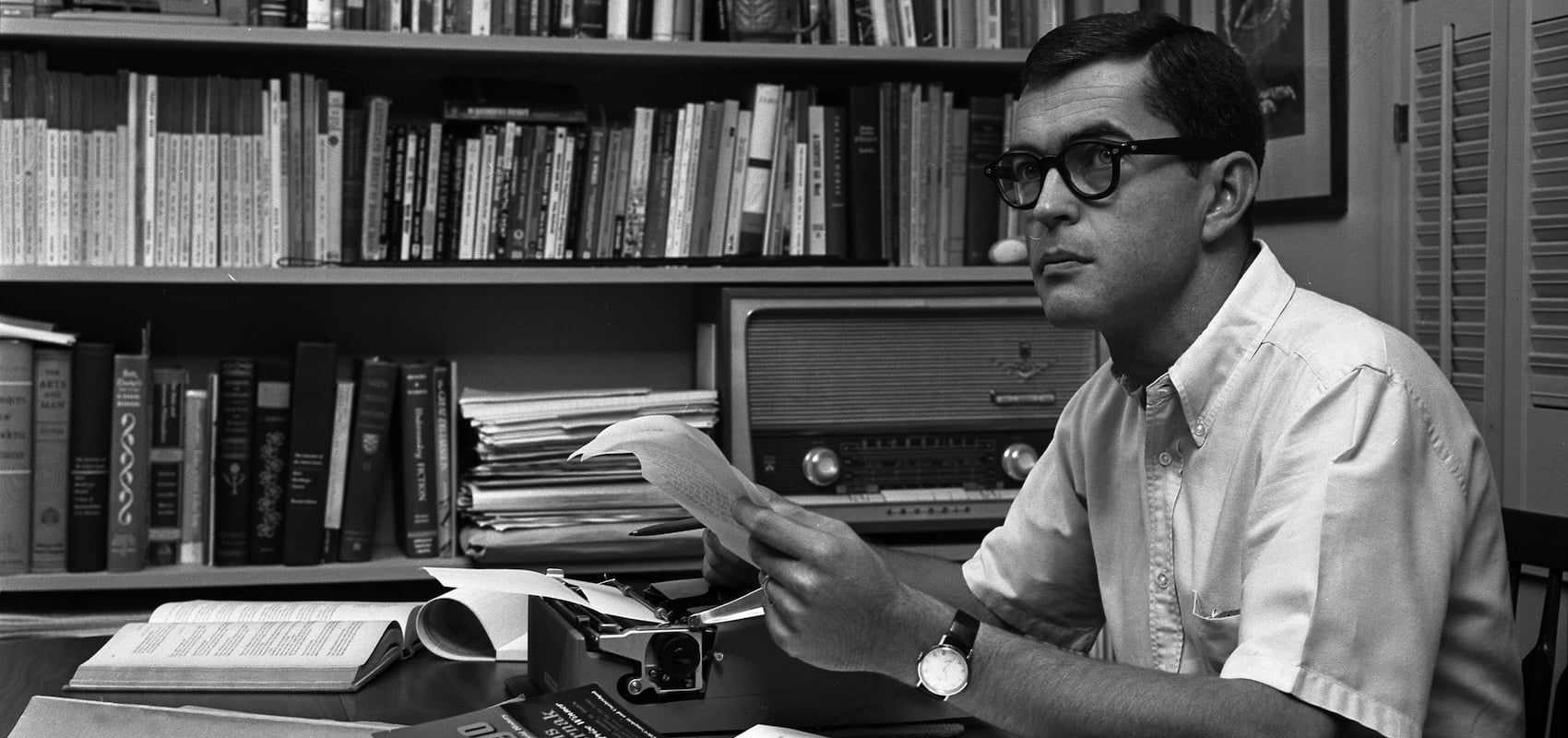
Of all the titles I’ve been tracking this year, the one I am most delighted to have in hand is Henri Coulette’s New and Selected Poems, edited by Michael Caines and Boris Dralyuk. Coulette (1927–1988; “Hank” to his friends) had only two books published in his lifetime: The War of the Secret Agents and Other Poems and The Family Goldschmitt. “Most of the copies” of the latter, the editors recount, “were accidentally pulped at the publisher’s warehouse, ensuring that the book would fail to receive even the lukewarm reviews that greeted his debut.”
Accidentally pulped? What makes this misfortune uncanny is the extent to which it sounds like a detail from one of Coulette’s own poems. You could say that in his work, irony takes the place of religion. Indeed, it wouldn’t be an overstatement to say that irony was his religion—irony directed as much against himself as anyone else. Not even the appearance in 1990 of The Collected Poems of Henri Coulette, edited with an introduction by Donald Justice and Robert Mezey—a handsomely produced volume published by the University of Arkansas Press and including a section of “Uncollected Poems” written in the years after Coulette’s second book—sufficed to break the streak of bad fortune: The collection was barely noticed.
We can hope that this superbly conceived new volume will mark a change. In the book description, we read that Coulette “stood out for his unfashionably brilliant command of poetry’s formal resources, and the idiosyncratic range of his concerns, which include film noir and espionage, not to mention life’s little ironies and larger tragedies.” True. But then, inadvertently, a false note is struck: “To read him, Zbigniew Herbert felt, was to be ‘in the presence of a major poet,’ and one who had ‘seized upon thematic material of central importance to the modern world.’”
I greatly admire Zbigniew Herbert, and his praise was well-meant, but Coulette was not a “major poet,” and it does him no favor to hang that label on him. He was Henri Coulette (imagine an emphatic expletive between “Henri” and “Coulette”), and that was more than enough. As for “thematic material of central importance to the modern world,” lead me to the vomitorium. And then please savor with me one of my favorite Coulette poems, “Lines for LBG-30, Computer, Poet”:
So there you are in Glendale,
your circuits open and hot,
your dials iridescent—the pure poet breaking through,
into pure nonsense, your own
tenth muse, inhuman, perfect.I must envy you, for see
how this hand trembles among
these half-finished, abandonedodes, how migraine dulls the eye
that looks on them. If sometimes
my worksheets stir and blossom,airborne, they do so only
in that odd, recurring dream
wherein I dream my dying,and see the whole world file past,
forgiving me, blessing me—
my mad mother, my good wife,the poets I’ve stolen from,
the interminable strangers.
Dreamless, you go on and on.If I feed you my sick lines,
will your indifference clean
and polish and complete them?
A marvelous poem even if read in isolation, this gives the flavor of Coulette’s work. It’s relatively short, as most of his poems are. It is also tricky. On the surface, the poet is bemoaning his inadequacy (“my sick lines”), and yet in fact the poem is superbly crafted. There is, then, a sharp distinction between the speaker and the poet, characteristic of Coulette. Many of his poems, like this one, are written in the first person, but the I is almost never Coulette himself.
There are exceptions to this rule, of course; see for example the title poem of The Family Goldschmitt. And routinely Coulette will draw on personal experience while projecting a “voice” that isn’t to be taken as his own. “The Blue-Eyed Precinct Worker”—another poem, like “Lines for LBG-30, Computer, Poet,” from Coulette’s first book—begins thus:
Liberal, blue-eyed, shivering, trying not
to look like a bill
collector or detective,
I move through the slums in a drizzle—
the slums of Pasadena, where—nutmeg, bronze,
and purple—the Negroes live.
The speaker and a stray dog that has been following him as he moves from house to house come to “the muddy edge of the dark arroyo.” From there, “on the far rim,” “the houses of the rich” are visible: “It is the dinner hour, and they eat / prime rib of unicorn, or breast of phoenix.” Coulette found that last line in a crime novel, The Ferguson Affair by Ross Macdonald (the pen name of Kenneth Millar), and appropriated it for his own purposes.
In the mid-1960s, Coulette wrote to Macdonald, inviting him to come to Cal State for a “visiting writer professorship, held in the recent past by Christopher Isherwood and Dorothy Parker” (and, we might add, held by Zbigniew Herbert a bit later), as Tom Nolan recounts in his excellent 1999 biography of Macdonald. Macdonald couldn’t spare the time but appreciated the gesture, and a year later Coulette and his wife, Jackie, visited Macdonald and his wife, the novelist Margaret Millar, in Santa Barbara; Macdonald and Coulette became friends. A few years later, for the title of his last novel, The Blue Hammer, Macdonald borrowed a phrase from a Coulette poem, “Confiteor.”
This may seem like a rather trivial detail, however charming to readers who (like me) greatly admire Coulette and Macdonald both, but I think otherwise. Nolan quotes a perceptive observation by Jackie Coulette:
One of the things that I think drew the two of them together: Ken was the only person Hank ever met who’d lived in more different houses by the age of eighteen than Hank; I think Hank had lived in thirty-nine places by the time he was eighteen, and Ken beat him.
“Tell all the truth but tell it slant”: By the time they were eighteen years old, Macdonald and Coulette had both absorbed Emily Dickinson’s lesson.
Image by the Los Angeles Times via Creative Commons. Image cropped.
Dear Reader,
Can I be direct with you?
War abroad. Socialists on the rise. AI upending human life. Endless uproar online. The modern attention economy doesn’t want readers — it wants users enslaved to the tyranny of the present.
First Things is the antidote: literary excellence, timeless truths, and a fixed point of reference in a culture that has lost its bearings.
But we can’t do it without readers like you.
Our goal: Raise $150,000 by November 1 to sustain First Things in the year ahead.
Your gift anchors readers in the permanent things.
Make your Fall Campaign gift now using the button below.
If you have any questions or would like more information, please contact Giovanni Del Piero, Director of the Editor’s Circle, at gdelpiero@firstthings.com or 212-627-1985.

YOU MIGHT ALSO LIKE
The Real World of Francisco de Zurbarán
Throughout the summer, I visited the National Gallery in London at least once a week. This is…
Souls at Stake
As the realistic English novel was emerging in a glorious birth amid the intellectual and moral tumult…
A Woman’s East of Eden
Zoe Kazan’s seven-part Netflix adaptation of John Steinbeck’s East of Eden brings a woman’s sensibility to a…
