
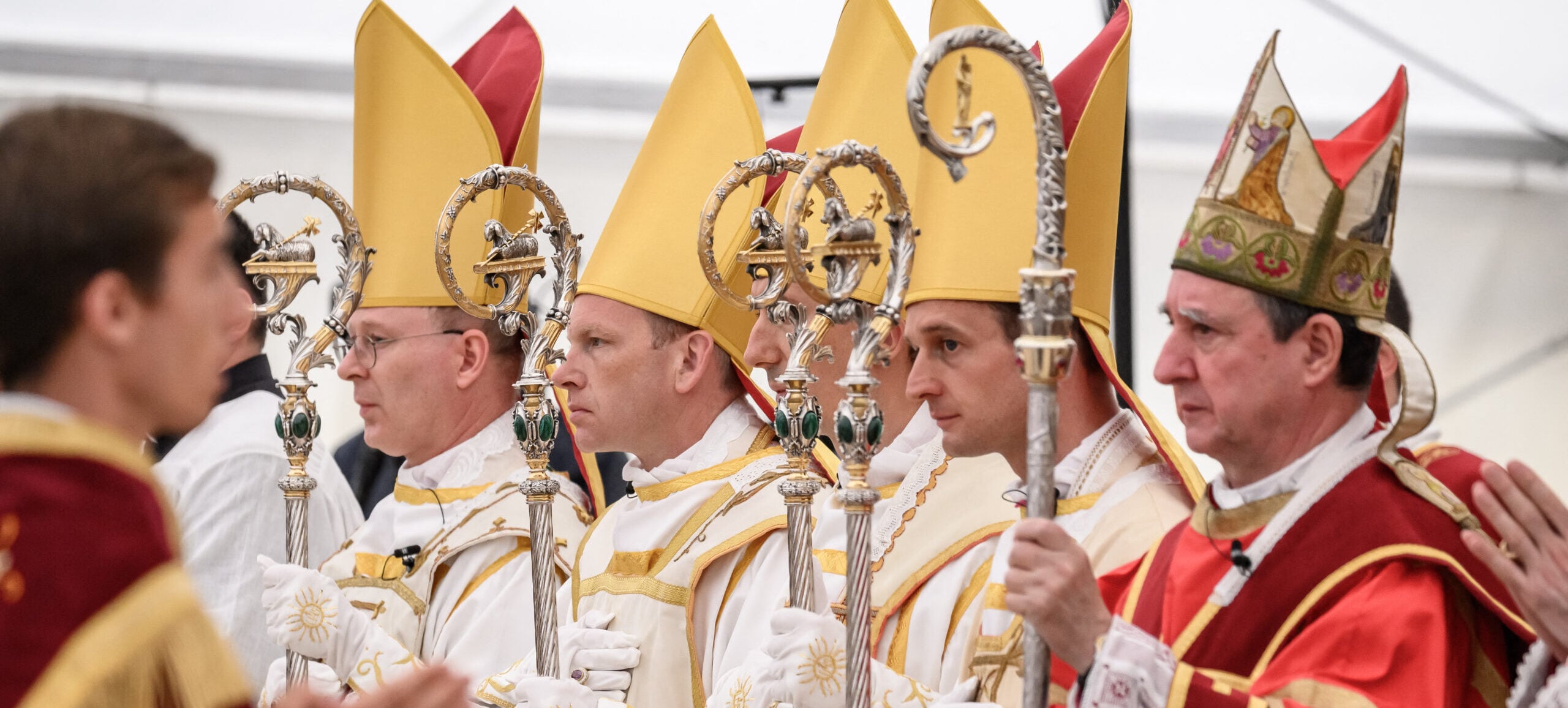
And so it has happened. The Society of St. Pius X has gone ahead with its illicit ordination of four new bishops, and the Vatican has responded with the expected announcement that the act is schismatic, incurring the penalty of an automatic excommunication. But this time the excommunication is more far-reaching than the one in 1988, which was limited to the bishops involved. The current excommunications include anyone who is in some way formally a part of the SSPX, including priests and laity.
This excommunication therefore has an air of finality to it that cannot be glossed over with a thousand paper cuts of various canonical distinctions. Combined with Pope Leo’s refusal to meet in person with the head of the Society, one cannot avoid the conclusion that the Vatican is saying to the SSPX, in its own “ecclesiospeak” fashion, that enough is enough. After more than fifty years of various attempts at reconciliation and normalization—attempts that have been met with rejection after rejection from the SSPX—the Vatican has finally decided that it is time to stop pretending that such a reconciliation is possible.
Fr. Davide Pagliarani, the superior general of the Society, has himself said as much when he cut off any further dialogue with Cardinal Fernández, on the grounds that such conversations are exercises in futility. He then lamented Pope Leo’s refusal to meet with him, painting the Society as a kind of innocent victim of Vatican negligence. But why should the pope meet with a man who has already stated that, in effect, reconciliation is impossible? Why give him the visibility and respectability of a papal audience, complete with a smiling photo op, that would only serve to make the Society appear as some kind of legitimate ecclesial reality?
This is an impasse created by the Society itself. Fr. Pagliarani may have eventually gotten his papal audience had he continued his negotiations with the Dicastery for the Doctrine of the Faith and demonstrated a genuine willingness to acknowledge that reconciliation with Rome is the only way forward for the Society, which claims, on paper at least, that it seeks to be loyal to the See of Peter. Any truly “traditional” Catholic would move heaven and earth to reconcile with the Vicar of Christ and would be willing to make theological concessions to bring that about.
What this points to is that the very raison d’être of the SSPX is one of rejection. It exists to resist the Second Vatican Council, the post-conciliar reforms, and the magisterium of several popes. Therefore, it was simply impossible for the Society to be conciliatory toward the very Roman authority it has been vilifying for many decades now without denying its deepest identity. Rejection of what it regards as a modernist, Freemason, Protestantizing Church is in its DNA. It is its myth of origin and its constitutive creed. As the current cliché goes, it is a feature and not a bug.
It is this essential nature of the SSPX as a Society born of rebellion that the Vatican is calling out. That is what’s at stake here, not the fact that the Society has certain sharp theological disagreements with Vatican II and the new liturgy. Many in the Church critical of Vatican II and the Mass of Paul VI have nevertheless maintained their obedience to Rome. Even Pope Benedict, in his commentaries on the Council, noted some of its deficiencies and elements within it that need, at the very least, updating or clarification.
Therefore, SSPX’s claim that it is allowed to dissent from the Council because its teachings were merely pastoral and non-definitive is a red herring. The Society has gone far beyond respectfully voicing theological disagreements on contested issues. It has called into question, with incendiary scorched-earth rhetoric, the entire conciliar and post-conciliar project, denouncing it as riddled with modernist heresies. The Society has weaponized its own private theological interpretation of tradition, claiming to embody “true Catholicism” and the abstract fiction of “Eternal Rome,” invented by Lefebvre out of whole cloth, against the authority of a valid ecumenical council and the magisterium of every post-conciliar pope.
SSPX sympathizers have done their best to deflect attention from this reality and have engaged in “whataboutism” arguments. They point, as many of us have, to the problematic nature of the German Synodal Way, and complain that Rome has done nothing about it. However, Rome has explicitly rejected several requests from the Germans, including allowing lay people to give the homily at Mass, blessing same-sex unions with official liturgical ceremonies, and establishing new governing structures that marginalize the bishop’s central role as the chief shepherd in his diocese. Disciplining the Society for engaging in illicit episcopal ordinations could also be a Vatican warning shot aimed at the Germans.
The excommunications are a sad outcome, even if they were inevitable. And since excommunications are meant to be remedial and not solely punitive, one hopes that many of the priests and lay people involved in the SSPX will find this to be a bracing moment. It must be jolting for those in the Society who hold to a very narrow version of extra ecclesiam nulla salus to suddenly find themselves as part of the extra ecclesiam.
Image by Fabrice COFFRINI / AFP via Getty Images.
Dear Reader,
Can I be direct with you?
War abroad. Socialists on the rise. AI upending human life. Endless uproar online. The modern attention economy doesn’t want readers — it wants users enslaved to the tyranny of the present.
First Things is the antidote: literary excellence, timeless truths, and a fixed point of reference in a culture that has lost its bearings.
But we can’t do it without readers like you.
Our goal: Raise $150,000 by November 1 to sustain First Things in the year ahead.
Your gift anchors readers in the permanent things.
Make your Fall Campaign gift now using the button below.
If you have any questions or would like more information, please contact Giovanni Del Piero, Director of the Editor’s Circle, at gdelpiero@firstthings.com or 212-627-1985.

YOU MIGHT ALSO LIKE
The Myth of St. Francis
At the beginning of his 2020 encyclical, Fratelli Tutti, Pope Francis speaks of “an episode in the…
Job and Her
It is said that Job lost everything, but she has lost more. All her possessions—the money, the…
Letters—November 2026
I appreciate J. H. H. Weiler’s desire for God’s mercy to be extended to Gentiles and his…
