
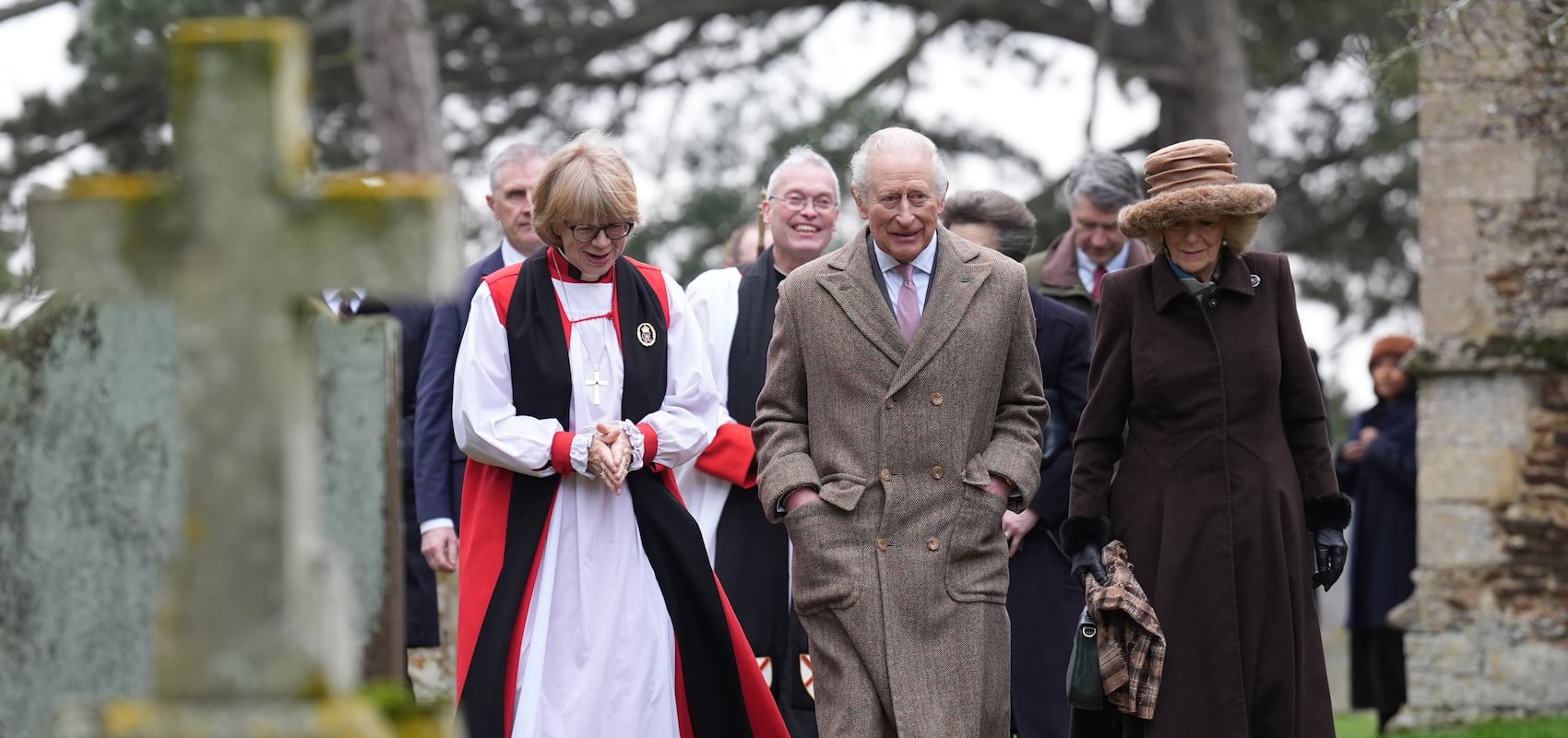
Buckingham Palace has updated the official description of the monarch’s role vis-à-vis the Church of England. No longer is the king the “Defender of the Faith”; rather, “His Majesty is Supreme Governor of the Church of England and protects the space for Faith within the multi-faith nation.” The description is inspiring in rhetoric but rather empty of dogmatic content.
This shift in language is not a minor drafting choice. It points to a deeper problem at the heart of English culture. Not only does the new formula repudiate the idea that any form of robust Christianity played a positive role in English history; it also reveals that English culture now lacks the tools to negotiate the country’s current religious spectrum except through relativistic pieties of multiculturalism—pieties that the other religions of significance, most notably Islam, reject.
The king’s ambition for his role should be no surprise. It is consonant with his long-held convictions. For many years, then-Prince Charles made it clear that when he succeeded his mother as the British head of state, he would reinterpret “Defender of the Faith” as “Defender of Faith” or, to make the point explicit, “Defender of Faiths.” The title, originally granted by the pope to Henry VIII for his defense of Catholicism against Martin Luther, rapidly morphed in the Reformation to refer to the monarch’s role in defending the teaching and liturgy of the Church of England as its supreme governor. Today, the role of the monarch in this regard has become rather complicated. And it’s not the king’s fault.
There are at least two problems for the king that should elicit our sympathy. First is the parlous state of the Church of England. When it comes to defining the faith he is supposed to defend, the Church offers little help. Progressive Anglicanism is a subset of the wider culture’s moral chaos; apparently queer and proud, it panders to the weird fringe with no positive vision beyond an inclusivity that excludes orthodox Christians. Its evangelical counterpart, long dominated by former public (as in, elite private) schoolboys, is marked by its suspicion of theology proper and impatience with ecclesiology. The standard evangelical claim that it is “the best boat to fish from” has always been a convenient way of using pious rhetoric to shirk any responsibility for the wider disaster that is the Church of England.
Yes, as some Anglican friends have pointed out, Presbyterianism—my own tradition—is fragmented. But the truth of that claim does not render it any less of a tu quoque fallacy when it comes to discussions of ecclesiology. And now public school Anglican evangelicalism is reeling from the grotesque abuse scandals surrounding Jonathan Fletcher and the late John Smyth. Neither progressivism nor public school evangelicalism provides attractive and compelling moral visions to the king of any faith worth defending.
The second problem is that, while Britain may now be a “multi-faith” nation, it no longer has any understanding of what religion is and why it is important. Therefore it lacks the vocabulary to discuss its role in public life. Again, the Church of England must take some responsibility for this. Multiculturalism in the U.K. has in practice meant the denigration of England’s history and culture, and that has inevitably meant that the role of Christianity, at least in its churchly form, has been denigrated too. The Church of England could have resisted, acknowledging its sins but pointing to the historic faith as the source of forgiveness. Instead, it responded by participating in the problem, its public theology often being little more than a rote quotation of the latest left-wing pieties, whether it be a repudiation of Thatcherism in the 1980s or the former (evangelical) archbishop of Canterbury’s support for assisted suicide. If the Church’s problem in the past was that it functioned as the Tory Party at prayer, its problem now is that it has simply swapped one political alliance for another equally worldly one. English Christianity, at least in its most public form, is today what it has been for many, many years—an ode to Feuerbach, no more than worldly anthropology in a religious idiom.
Public Christianity in England has long since been evacuated of any doctrinal content or counter-cultural pungency. The fact that the Church of England remains established and yet only a fraction of the country bothers to attend even once a year means that it is in a permanent state of having to justify its own existence on grounds other than the strictly doctrinal and liturgical. And multiculturalism has proved a merciless master, demanding cultural relevance wedded to a dogmatic anti-dogmatism.
As a result, the king’s aspiration to be “Defender of Faith” is understandable. To defend “faith” in such a context is to defend some nebulous sense of the significance of religion. In the short term, this defuses the political tensions a monarch might cause by asserting the historic truth claims of Christianity in a society where other religions now have a significant presence. But it also exposes the deeper problem: England has no significant institutions by which Christianity can leaven the broader culture. Indeed, there isn’t even a vocabulary left to have meaningful discussions about Christianity in particular, or even religion in general, in the public square. And King Charles’s studied ambiguity is merely a symptom of that, not the cause.
Image by ASSOCIATED PRESS


YOU MIGHT ALSO LIKE
SlutCon’s Emotional Void
The tech-rationalist phenomenon “SlutCon” caused quite a stir online, perhaps predictably. SlutCon was a multi-day retreat and…
The Boys on the Brink
In the latest installment of the ongoing interview series with contributing editor Mark Bauerlein, Leonard Sax joins…
Vatican II Didn’t Kneel to Modernity
In his weekly catecheses on Vatican II, Pope Leo is now discussing Gaudium et Spes, one of…
