
H. Richard Niebuhr famously denounced the liberal church of his day, summarizing its theology in a single withering sentence: “A God without wrath brought men without sin into a kingdom without judgment through the ministrations of a Christ without a cross.” What he did not note—but perhaps implied—is that such theology typically manifests in worship that is infantile, offering a pastiche of the wider culture’s predilections that would qualify as kitsch, if its purveyors had the wit to see it as such. The progressive church is always a poor imitation of what the world considered cool the day before yesterday.
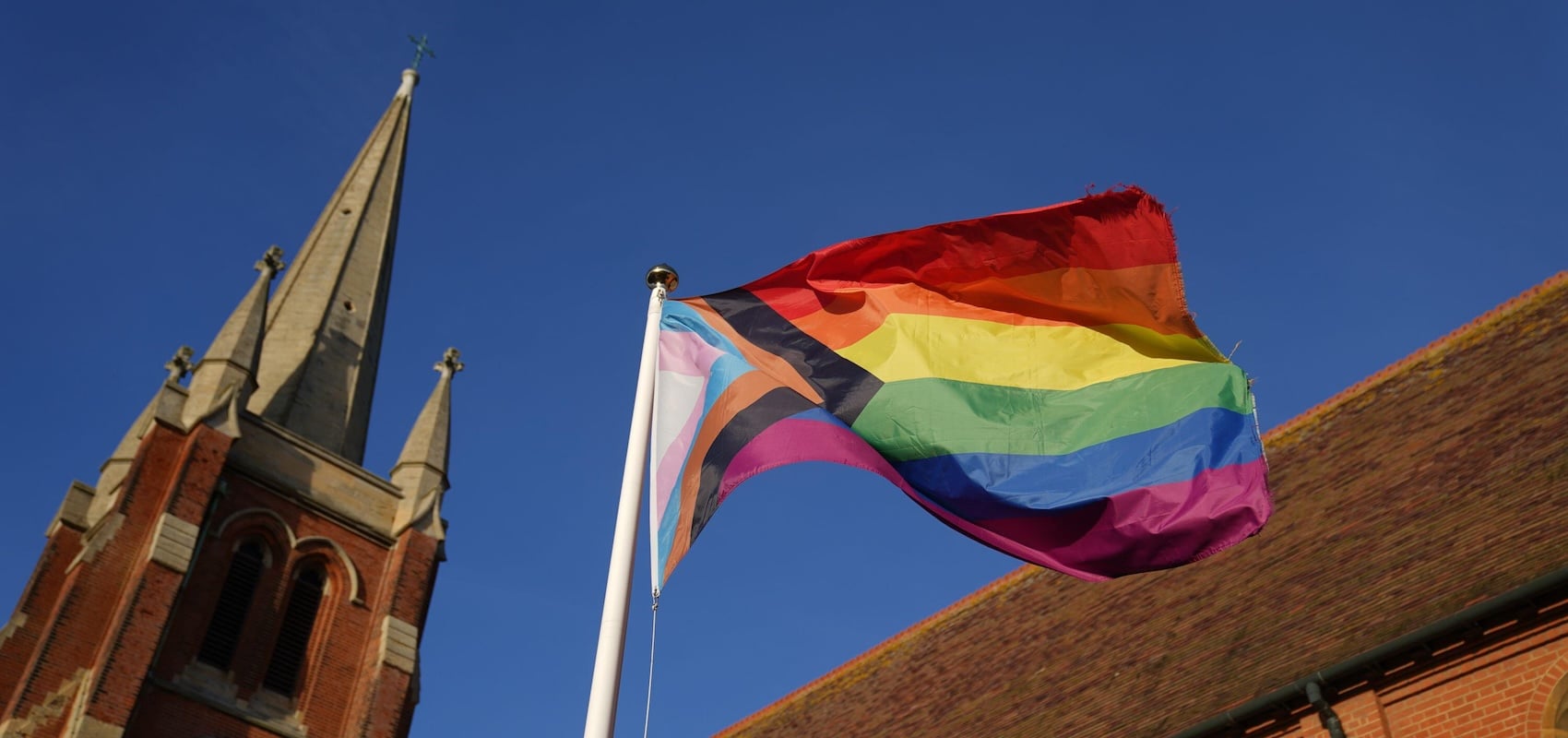
Walking through the streets of London in early June, I encountered a first-class example of such third-class theological life, courtesy of Pride Month, Anglican style. Pride Month has had a lower profile in recent years. The Pride flag is still there, of course—most visibly at Canada House on Trafalgar Square—but there seems to be some confusion over which version to fly, with the trans-inclusive design appearing less frequently than in previous years. Perhaps the coalition has overplayed its hand. It strains credibility to claim marginalization when you are the only group with an entire month devoted to celebrating you, with your symbols displayed everywhere from high street stores to corporate headquarters to government buildings around the world. No other group can claim such annual privilege or cultural power. And Pride now runs well ahead of public taste. Call me a Victorian reactionary, but I suspect that the increasing prevalence of queer furries in Pride parades is unlikely to broaden the rainbow coalition’s popular appeal.
Yet there is one place where Pride remains dominant: progressive parishes in the Church of England. Wandering back to my hotel from a visit to Hatchards bookshop, I was struck by a church noticeboard advertising not merely a month of Pride-affirming liturgics but a whole year’s worth. A Q&A with “the next generation of queer priests” in March (tickets available for a mere £5); a queer movie night in April; an evening of LGBTQ questions for clergy in May, followed by a screening of the film Pride; a Pride service in June; a drag performance and then another queer service in July; a Drag Sports Day in August; another Pride service in September; an evening denouncing conversion therapy in October; another queer movie night in November; and in December, a queer Christmas Carol Service where the public is invited to join the congregation to “celebrate the Nativity through song, blending its beauty with iconic queer anthems—from Cher to Ariana, Bowie to Gaga—for a truly unforgettable night.” A month is clearly not enough for this parish as it hijacks the rainbow from God’s promise to Noah and attaches it to human confusion for a whole year.
This is a dramatic but tragic example of what happens when Christianity loses sight of its transcendent purpose. It is one of the ironies of progressive theology that however sophisticated its intellectual articulation, its liturgical expression tends toward childishness.
Another irony is that churches that try to ape the tastes of the day in order to speak to the times typically fail to do so. They simply offer the standard fare of the surrounding culture in a cringe-inducing religious idiom and often with an enthusiasm that aspires to be shocking but is merely out-of-date. Pride rises in progressive Anglicanism in London at the very moment its grip on June appears to be weakening.
Further, under the guise of prophetic courage, these churches are actually demonstrating cowardice, preferring to affirm the fashionable falsehoods of the sexual revolution to the truths of the faith they claim to adhere to. Christianity does not affirm the values of the earthly city, left or right, and then seek to blend them seamlessly into celebrations of the most disruptive moment in human history—the incarnation of God himself. Instead, it points beyond, to things above, to something better. Rather than calling people back to a true vision of humanity, progressive churches offer the fraudulent answers of a culture that will do anything but face up to its mythology—the cult of human autonomy, expressed most pungently in the sexual revolution. This is not the gospel of Christ; it is the mendacity of the age.
What was striking about the noticeboard was that neither God, Christ, nor the cross were mentioned. So perhaps Niebuhr needs updating: “No god, wrathful or otherwise, brought men, women, or those of alternative genders without sin to a drag show without judgment through the ministrations of no Christ and no cross.” The situation has not improved. Even the linguistic idioms of the faith, gesturing as they did toward orthodoxy, have finally been abandoned—apparently in favor of such theological giants as Bowie, Grande, Cher, and Gaga. And this raises the question: What is the Church of England for?
The first event of this parish’s liturgical calendar, the Q&A with “the next generation of queer priests,” poses as its topic: “What is the future of the Church of England?” I will answer that (and waive my own £5 fee): If Pride Year is allowed to stand as a liturgical reality in any parish, that parish should not call itself a church. Indeed, as I read this parish noticeboard, the words of Oliver Cromwell came to mind: “You have sat too long for any good you have been doing lately. Depart, I say, and let us have done with you. In the name of God, go!”
Dear Reader,
Can I be direct with you?
War abroad. Socialists on the rise. AI upending human life. Endless uproar online. The modern attention economy doesn’t want readers — it wants users enslaved to the tyranny of the present.
First Things is the antidote: literary excellence, timeless truths, and a fixed point of reference in a culture that has lost its bearings.
But we can’t do it without readers like you.
Our goal: Raise $150,000 by November 1 to sustain First Things in the year ahead.
Your gift anchors readers in the permanent things.
Make your Fall Campaign gift now using the button below.
If you have any questions or would like more information, please contact Giovanni Del Piero, Director of the Editor’s Circle, at gdelpiero@firstthings.com or 212-627-1985.


YOU MIGHT ALSO LIKE
Why the Death Penalty Is a Sore Point for Papal Authority
Pope Leo XIV marked World Day Against the Death Penalty, observed on October 10, with the following…
The Myth of St. Francis
At the beginning of his 2020 encyclical, Fratelli Tutti, Pope Francis speaks of “an episode in the…
Job and Her
It is said that Job lost everything, but she has lost more. All her possessions—the money, the…
