
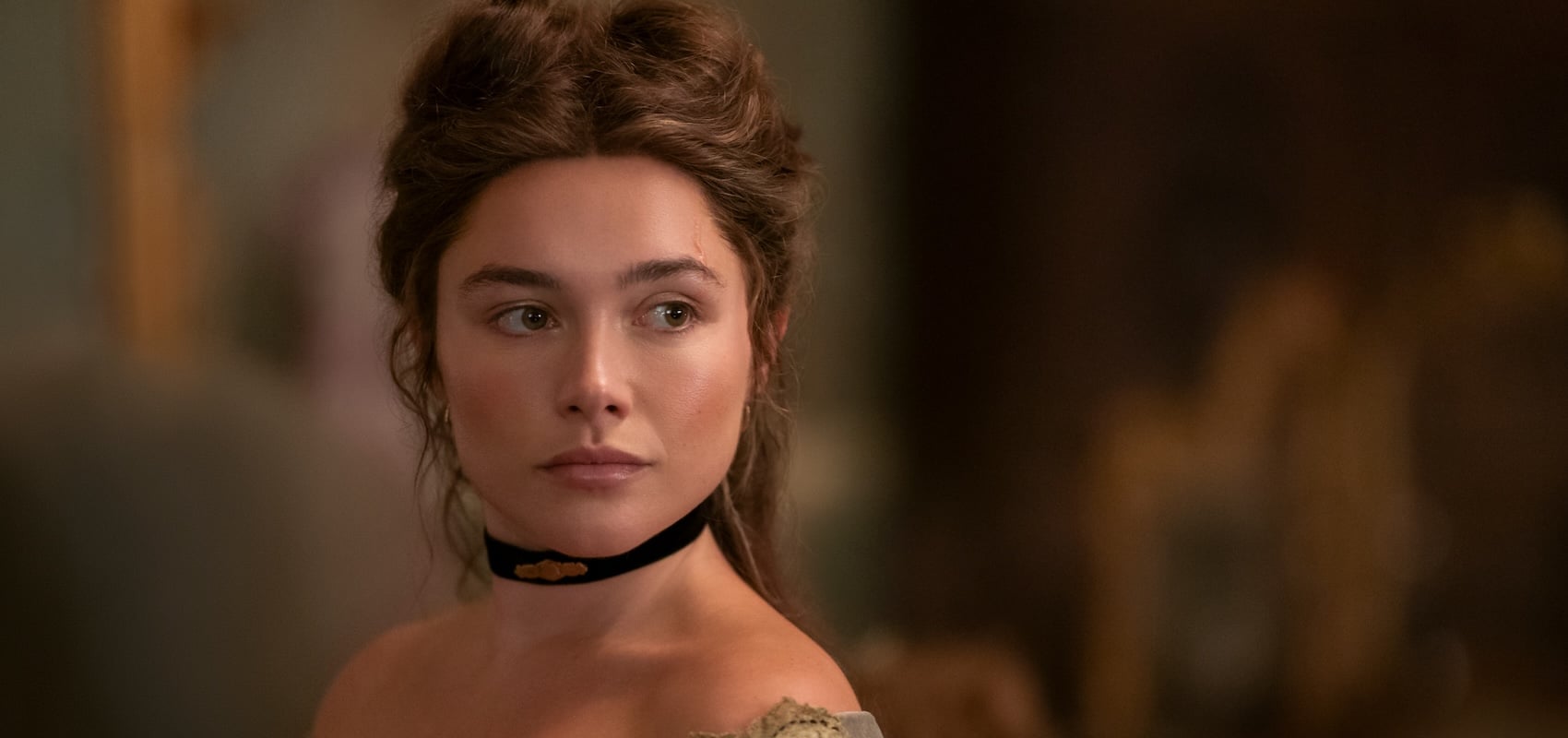
Zoe Kazan’s seven-part Netflix adaptation of John Steinbeck’s East of Eden brings a woman’s sensibility to a man’s epic—for better and for worse.
East of Eden’s great subject is the unloved child, or, in the words of David Wyatt, “the hell of parental rejection.” For Steinbeck, the archetype of such rejection is the Cain and Abel story: God favors Abel’s sacrifice over Cain’s, setting in motion a generational cycle of revenge and guilt. So, too, Civil War veteran Cyrus Trask (Tracy Letts) favors his son Adam’s (Christopher Abbott) birthday gift over that of Charles (Mike Faist), Adam’s half-brother. Charles almost beats Adam to death in a fit of jealousy. Kazan softens this murderous episode; in the novel, Charles retrieves a hatchet with the intention to finish the job. The same gentling extends to the casting: Faist’s charisma and boyish looks undercut Charles’s malice.
Nowhere is this softening more overt than in Kazan’s characterization of Cathy Ames (Florence Pugh). Steinbeck once told a family friend that Cathy “is a total representative of Satan.” But for Kazan, Cathy is an honest liar, a murderer “who is trying to survive.” That fight for survival shapes the series from its opening scene, in which we see Cathy crawling toward the Trask farmhouse after being beaten by Mr. Edwards, the pimp who made her his mistress.
Kazan trades Steinbeck’s absolute evil for the more palatable figure of the monstrous victim, a Cathy shaped for twenty-first-century feminist sympathies. In the novel, a ten-year-old Cathy is found half-undressed in a barn with two fourteen-year-old boys. Steinbeck suggests that Cathy orchestrated the scene, but Kazan has a different reading. In the show, Cathy, here five, is lured with candy into the woods and assaulted. “There are things that Steinbeck describes in the book that I read slightly differently than he maybe intended them,” Kazan told Variety.
Kazan adds a scene, before a teenage Cathy kills her parents by burning down the family home, in which we see her father beating her and calling her his “property.” When Mr. Edwards insists she drink champagne despite her repeated refusal, she begins to down the whole bottle. “It’s really better if you sip it,” he says. Cathy responds, “I didn’t want it. Remember that.” This sentiment becomes a refrain throughout that absolves Kazan’s Cathy of some of the blame for her crimes. Pugh’s deep voice and emotive line delivery manage to make this version of Cathy sometimes convincing, but always mesmerizing.
When Cathy drags herself onto the porch of the Trask homestead, Charles points a shotgun at her head, while Adam insists on nursing her back to health. Enamored, he asks Cathy to marry him and move with him to Northern California’s Salinas Valley. On their wedding night, Cathy drugs Adam before going to Charles’s bed. After Cathy gives birth to twins, Caleb and Aron, she leaves Adam for Salinas, where she becomes the madam of the “most vicious and depraved” whorehouse in town after poisoning its former proprietress. Kazan can only rehabilitate Cathy so much without radically altering the events of the story.
If fathers withhold their love in East of Eden, mothers withhold themselves entirely. Adam’s mother kills herself when he’s a child; Cal and Aron initially think their mother, Cathy, is dead. The novel aches with this maternal absence from the very first page, where Steinbeck describes the mountains east of the Salinas Valley as being “full of sun and loveliness and a kind of invitation, so that you wanted to climb into their warm foothills almost as you want to climb into the lap of a beloved mother. They were beckoning mountains with a brown grass love.” In the novel, the Trasks’ Chinese house servant, Lee, largely assumes the role of mother, raising Cal and Aron after Adam falls into a years-long depression.
Kazan’s adaptation makes this surrogate motherhood even more explicit, a decision that affirms Lee (Hoon Lee) as the heart and soul of the Trask family, a centrality that Hoon Lee’s performance earns at every turn. After Adam overcomes his depression and the family moves into Salinas, Lee leaves to open a bookshop in San Francisco’s Chinatown. Kazan expands on Lee’s time away. Describing his years with the Trask family to a fellow immigrant, Lee says he would often imagine he had a wife to stave off the loneliness. “In my job, I had many responsibilities. Cook, housekeeper, accountant, nurse, tutor.” The immigrant replies, “It sounds like you were someone else’s imaginary wife.” Lee returns home soon after.
Kazan can’t seem to help herself in relativizing Cathy’s evil, but as modern adaptations go, hers conveys the deeper moral and spiritual themes of Steinbeck’s classic. This becomes especially apparent in the final episode, which depicts how the cycle of revenge and guilt continues in the twins’ generation. Cal resents Aron and their father’s favoritism toward him. He drives Aron away from home by revealing that their mother is the madam of a whorehouse, but is then crushed by guilt when Aron enlists in the army and dies in France. At Adam’s deathbed, Lee guides Adam’s hand to Cal’s as he implores the father to forgive and bless his only surviving son. “Don’t crush him with rejection. Help him, Adam. Let him be free.” It is here that Lee realizes the story’s greatest act of mediating, maternal love—a warm, “brown grass love”—which, however imperfectly embodied, overcomes the curse of paternal rejection.
Dear Reader,
Can I be direct with you?
War abroad. Socialists on the rise. AI upending human life. Endless uproar online. The modern attention economy doesn’t want readers — it wants users enslaved to the tyranny of the present.
First Things is the antidote: literary excellence, timeless truths, and a fixed point of reference in a culture that has lost its bearings.
But we can’t do it without readers like you.
Our goal: Raise $150,000 by November 1 to sustain First Things in the year ahead.
Your gift anchors readers in the permanent things.
Make your Fall Campaign gift now using the button below.
If you have any questions or would like more information, please contact Giovanni Del Piero, Director of the Editor’s Circle, at gdelpiero@firstthings.com or 212-627-1985.

YOU MIGHT ALSO LIKE
Women Should Not Tolerate Porn
Young women today have unrealistically high standards. When I speak to conservative young men about dating, this…
A Culture of Parricide
I learned a new word the other day: déploration. It’s the French, directly from the Latin, for “lament.”…
Job and Her
It is said that Job lost everything, but she has lost more. All her possessions—the money, the…
