
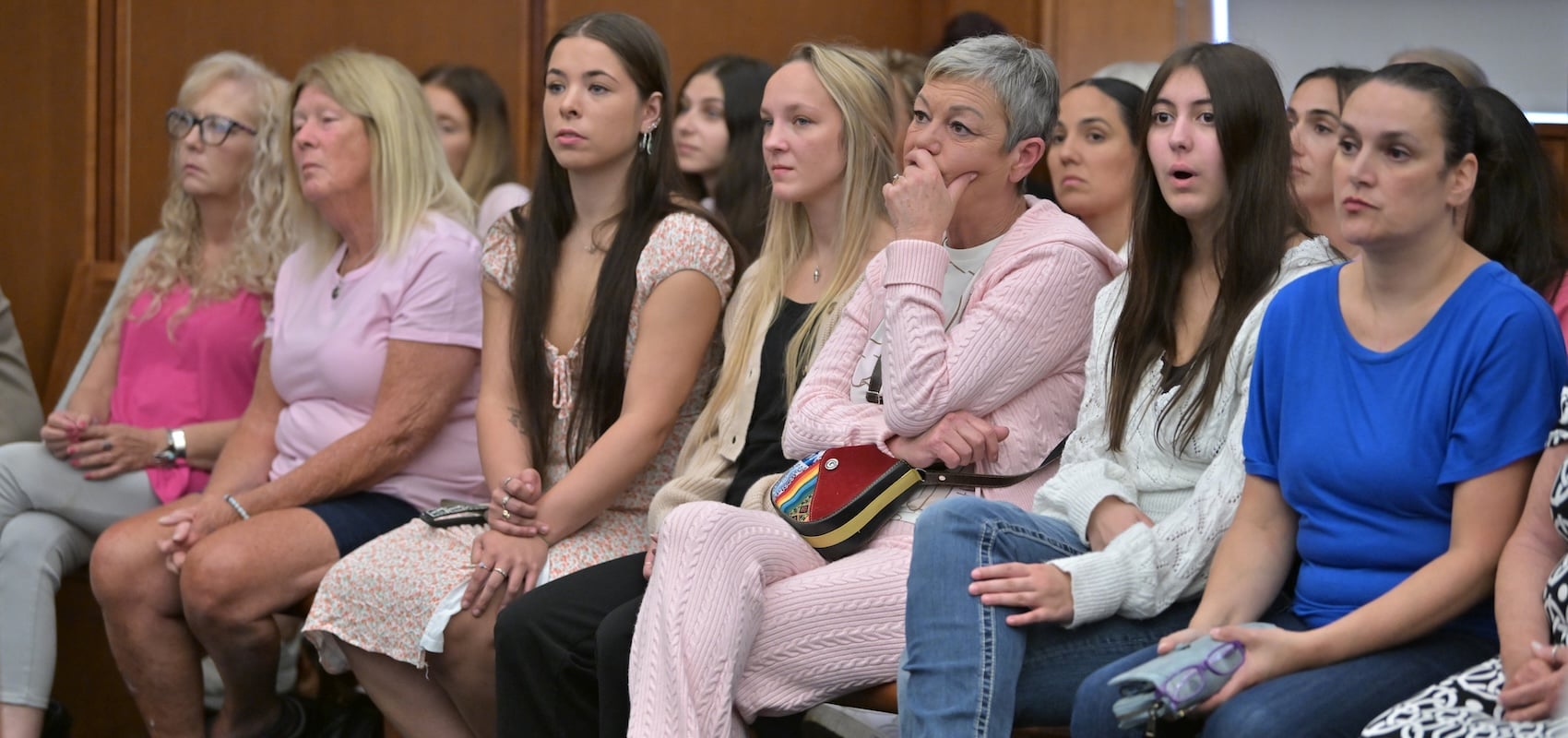
The Lindsay Clancy case has taken an odd turn online. Clancy is facing three counts of first-degree murder after her children were found strangled in the family’s Duxbury home in 2023. She has admitted to killing them. Nevertheless, since the trial began in July, a whole internet contingent—seemingly made up entirely of women—has formed around Clancy, convinced that she has been framed by her husband, Patrick. “He did it,” reads one comment on an Instagram video showing surveillance footage of Patrick running errands for the family when, according to the official timeline, the murders occurred. “Look at his shoes, they’re different,” another adds.
It is easy to attribute this phenomenon to one too many true-crime documentaries, but the more interesting possibility is that these women are sensing something real. The furor around the case foregrounds a much deeper ambivalence about what modern parenting has become.
The case against Patrick begins with a simple accusation: He was a bad father and husband. In the Clancy marriage, many women recognize a familiar pattern—a husband who goes away on too many business trips, has too many comfortable brunches, and makes his wife shoulder too much of the burden. Clancy’s diaries detail her all-too-relatable struggles with motherhood. As author Reshma Saujani writes: “If you are a mother, you could have written any of these confessions.”
She continues: “We ask women to do the most physically and psychologically demanding work of their lives with none of the infrastructure that every other wealthy nation considers a non-negotiable.” Lindsay was a loving mother genuinely trying to do her best, writes another commentator in Parents magazine. “It is time we do better—and more—to help the new parents in our lives.”
Clancy becomes the emblem for aggrieved mothers who believe they are doing it all and then some, who feel abandoned by their husbands and society. Mothers everywhere can project themselves onto her when it comes to this sense of abandonment. So intense is their identification, they are convinced Lindsay cannot also be a murderer, because murder is an action with which they cannot empathize. Therefore, “the husband did it”—an assertion that even Clancy’s defense refuses to make.
By all accounts, Lindsay was a “good mother.” What did this good motherhood entail? The family’s former nanny described a “wonderful mother” who was intensely concerned with her children’s safety, sleep schedules, and what they ate. Lindsay’s diaries, read out in court, detail the thoughts of a woman who was obsessed with her eight-month-old’s nap schedule “to the minute,” whether he was hitting his milestones, and whether she could parent him as intensively as she had her first two children. She was racked with guilt over sleep training, over not being able to continue breastfeeding, over not earning enough money or connecting enough with her husband amid all of these worries.
In the months leading up to the children’s murders, she wrote, “Our generation is inundated with information about every aspect of parenting and everything that can go wrong if you don’t get it right,” and “for the last five years, I’ve just filled my mind with all things parenting and it’s just unhealthy.” She wrote that she was terrified of “doing something wrong to mess up their development.”
Anyone concerned with doing parenting “right” over the past few decades will recognize the world she is describing. Woe betide the parent who does not take heed of headlines like “Poor sleep affects learning and behaviour,” or of reports on how breastfeeding is not only “best” but makes children healthier, happier, and even more successful in adulthood. There is endless information about attachment styles, warnings about screens, emotional regulation, sensory play, tummy time, and about how getting it wrong can secure or sabotage a child’s future. Just giving the information seems harmless, but the corollary is obvious: If parents can influence an outcome, it’s their responsibility to do so, and their fault if they fail.
Parenting books did not cause Lindsay Clancy to kill her children. But the language through which she described her distress reflects a common cultural vocabulary, and it’s this that Clancy’s defenders seem to be instinctively connecting with: the fear of making a mistake and damaging your children, the endless self-surveillance, the belief that being a good mother means knowing and managing every minute risk.
Back in the mid-1990s, Sharon Hays termed what many women experience as the “cultural contradictions” of contemporary motherhood, in which mothers are expected to be intensive workers but also intensively parent their children. This, coupled with what sociologist Frank Furedi calls “parental determinism,” or the cultural belief that parents are all-powerful determiners of children’s lives, means that parenting has become a guilt-riddled project of constant effort and optimization. It seems there is no social problem that cannot be traced back to, “Well, what did the parents do?” It doesn’t just take a village, but apparently a host of scientists, experts, institutions, awareness raisers, and the right cocktail of psychiatric drugs to get through this fraught time that we call modern parenthood.
There is sometimes a dim realization of the resulting burden. The Guardian cites “ridiculous Instagram-worthy standards of motherhood,” while Saujani writes that modern motherhood is “a weight no person should be asked to carry alone.” But the word “alone” is doing a lot of work. The solution, apparently, isn’t to realize that the cultural demands of modern parenthood have gotten out of hand, but to enlist more hands—and especially those of fathers. Hays herself acknowledged that greater paternal involvement might ease the strain on mothers but warned that the end result could well be that men too would be overburdened with responsibilities currently plaguing women, and for which there is no clear upper limit. The liberation from intensive motherhood would simply be the universalization of intensive parenthood.
The “Patrick Clancy did it” brigade reveals just how much anger women feel toward husbands who don’t seem to carry the same crushing weight of parenthood. But the answer isn’t to spread that crushing weight equally across exhausted parents, nor is it to leap to the delusion that Patrick Clancy is the murderer. We may never know what truly led Lindsay to do the unthinkable. What is clear, though, is that the online reaction points to something broken in modern parenthood. Fixing that will do far more good for our culture than persecuting an innocent man.
Image by Josh Reynolds via AP
Dear Reader,
Can I be direct with you?
War abroad. Socialists on the rise. AI upending human life. Endless uproar online. The modern attention economy doesn’t want readers — it wants users enslaved to the tyranny of the present.
First Things is the antidote: literary excellence, timeless truths, and a fixed point of reference in a culture that has lost its bearings.
But we can’t do it without readers like you.
Our goal: Raise $150,000 by November 1 to sustain First Things in the year ahead.
Your gift anchors readers in the permanent things.
Make your Fall Campaign gift now using the button below.
If you have any questions or would like more information, please contact Giovanni Del Piero, Director of the Editor’s Circle, at gdelpiero@firstthings.com or 212-627-1985.

YOU MIGHT ALSO LIKE
Why the Death Penalty Is a Sore Point for Papal Authority
Pope Leo XIV marked World Day Against the Death Penalty, observed on October 10, with the following…
Forget Odysseus. Aeneas Is the True American Hero.
Who is our Odysseus? Or more precisely, who is the most Odyssean hero of American film? Matt…
Foucault’s Idol of Nothingness
Today marks the 100th anniversary of the birth of Michel Foucault. He was influential in his lifetime,…
