
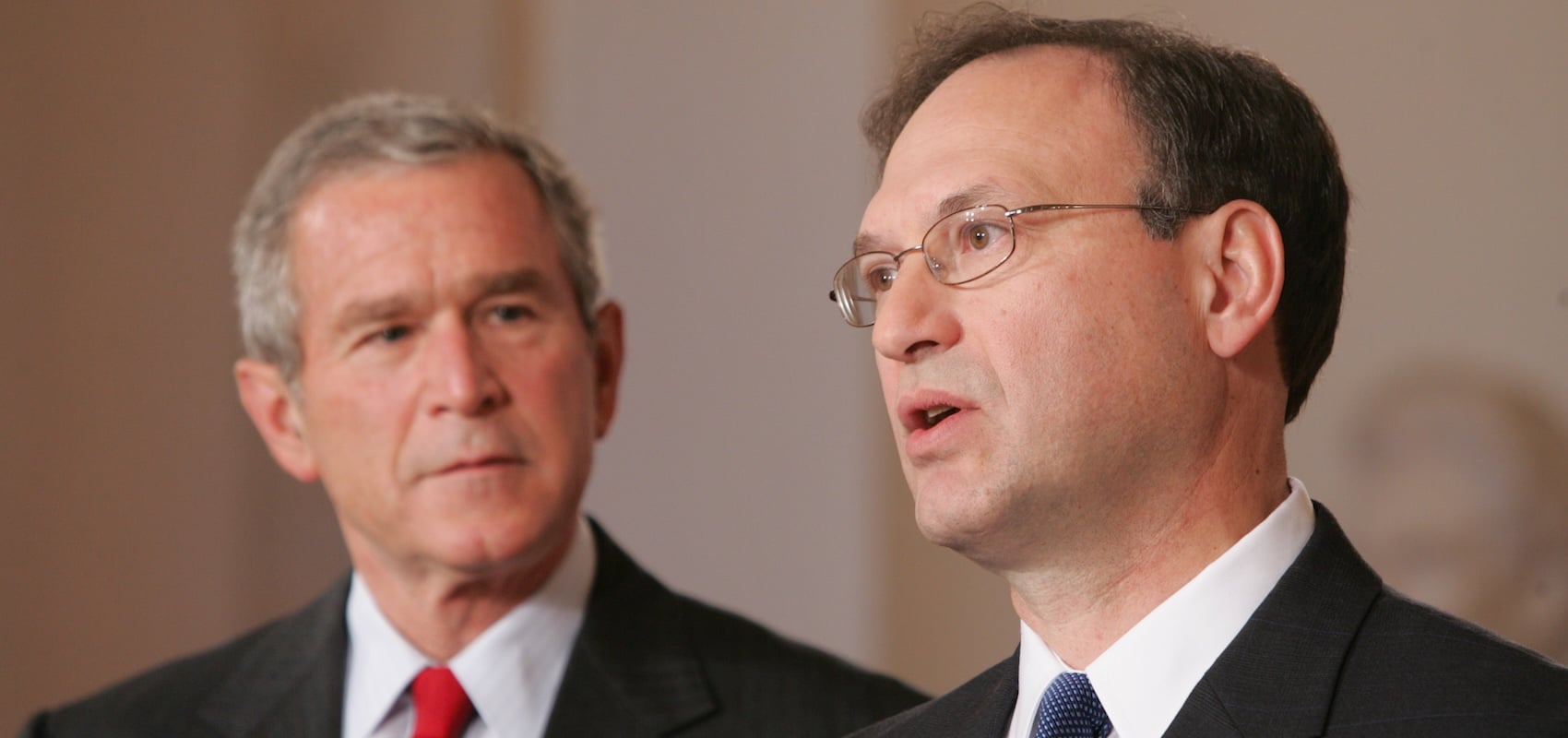
So Ordered:
An Originalist’s View of the Constitution, the Court, and Our Country
by samuel a. alito jr.
basic liberty, 320 pages, $32
Late in Barack Obama’s presidency, a bitter conflict broke out on the right. Conservative institutions that had long understood themselves as challenging liberal hegemony were suddenly being attacked as part of the corrupt establishment. “Con Inc.,” as its critics called it, was seen as too concerned with fashionable opinion and too attached to procedural niceties. The adversaries of this conservative establishment felt that something had gone profoundly wrong in American society—and that the conservative movement had been complicit in this change. Their sense of loss and betrayal was summed up in the question, “What has conservatism conserved?”
Generally, this intraconservative civil war is understood to have started on June 16, 2015, when Donald Trump descended the golden escalator and announced his presidential campaign. (“They’re bringing drugs. They’re bringing crime. They’re rapists. And some, I assume, are good people.”) But the battle lines of that debate are hard to understand unless one takes into account an event that occurred ten days later. On June 26, the Supreme Court handed down its decision in Obergefell v. Hodges, announcing a constitutional right to same-sex marriage. For those who regard marriage as one of the building blocks of civilization, the decision was a sign that something had gone profoundly wrong in American life. Conservatism had failed. Something different was needed.
Yet the most incisive critic of that decision was himself a conservative—and not just any conservative, but one who modeled both the convictions and disposition evoked by that word. In his dissenting opinion, Justice Samuel Alito warned that by treating opposition to same-sex marriage as an irrational animus, the court had created a situation in which those who disagreed with its decision would face civil disabilities. “Those who cling to old beliefs will be able to whisper their thoughts in the recesses of their homes, but if they repeat those views in public, they will risk being labeled as bigots and treated as such by governments, employers, and schools.” Alito’s words looked prescient when a lower court held in 2021 that a person with traditional views on sexual morality was presumptively unfit to be a juror on a case involving a lesbian. Alito renewed his warning in response to the case, saying that it “may be a foretaste of things to come.”
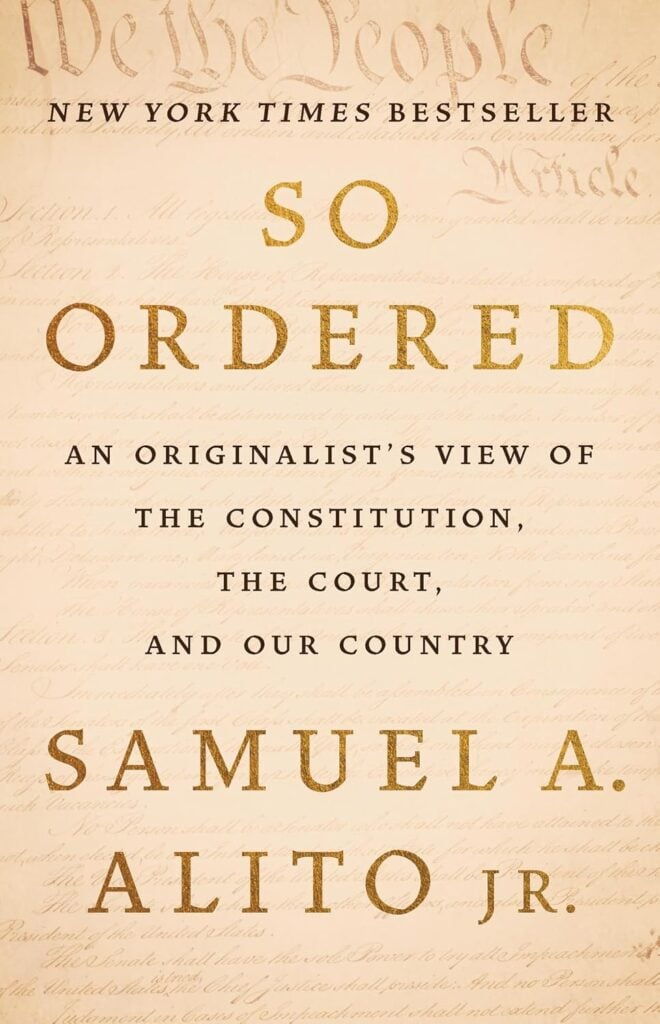
Alito’s greatest—and most controversial—moment came when he authored the majority in Dobbs v. Jackson Women’s Health Organization. The opening sentence of his opinion framed abortion not as a matter of private judgment and personal liberty but as “a profound moral issue.” Some had confidently predicted that the court’s conservatives would never reverse Roe, saying that the procedural concerns of textualists—adhering to the original public meaning of a law, whatever that meaning might be—needed to be replaced by a substantive vision of the good. They also charged textualists with chasing after respectability and giving undue deference to wrongly decided precedents. Alito and the other members of the majority showed that textualism was capable of delivering genuine conservative victories, even if it did not explicitly aim at these things. This accorded with a deeply conservative instinct. Adhering to inherited forms is not an empty exercise, but can help to preserve and restore a civilized society. As the right comes to be dominated by figures such as Donald Trump and Elon Musk, who combine a libertine ethic with a revolutionary vision of social progress powered by AI, Samuel Alito shows what an actually conservative conservatism looks like.
Samuel Anthony Alito Jr. was born in Trenton, New Jersey, on April 1, 1950, when that city was known for producing things of quality (a sign on the city’s Warren Street Bridge still proclaims: “Trenton Makes, the World Takes”). His father, Samuel Sr., was an Italian immigrant who established the research office for the New Jersey State Legislature. There he developed a reputation for careful nonpartisanship and exacting standards. He and his wife, Rose, resolved that they would have the smartest children in suburban Hamilton Township.
Not everyone recognized Alito’s exceptional qualities when he arrived at Princeton in 1968. His reserve made it easy to view him as a dull and plodding scholarship kid. But as the politics professor Walter Murphy recognized, Alito’s diligence was harnessed to a formidable intellect. He paid more attention to his books than to campus politics. But what he saw only reinforced a conservative outlook rooted in his Catholic faith and love of country. As his fellow students protested the Vietnam War, he joined ROTC. The sight of privileged WASPs engaging in anti-American displays didn’t sit right with the middle-class student whose father was born overseas. His parents “did the hard work of becoming American,” as he later put it. And here these students were treating that hard-won thing cheaply.
Alito penetrated further into the American establishment, while hardening in opposition to its enthusiasms, at Yale Law School. There he took constitutional law with Charles Reich, author of the new-age tract The Greening of America. The experience sounds something like watching Marianne Williamson teach Thomistic philosophy. One day, a student brought wine to class and Reich began to chant “Who put the acid in the wine? Who put the acid in the wine?” Alito may not have learned much about the Constitution during class hours, but he glimpsed something important about the academy. Rule by experts was by no means preferable to a system of government based on popular consent.
Alito found a kindred spirit in Leon Garth, a federal judge for whom he clerked. Garth was a working-class kid made good who shared Alito’s sense that the judge should not act as a kind of philosopher-king. (“My own personal predilections have no place in the decisions that I make, and they should not have a place,” Garth said.) Alito was passed over for a Supreme Court clerkship, just as he would later be overlooked when George W. Bush picked John Roberts and then Harriet Miers for the Supreme Court before finally turning to the more substantial Alito. He instead went to work for a federal prosecutor named Maryanne Trump, whose younger brother was making a name for himself in the New York real estate scene.
Like Garth, Alito avoided inserting his opinions into his work. This reticence led people to doubt his bona fides when he applied for a position in the Office of Legal Counsel for the Reagan administration. Was Alito really a conservative? The letter he wrote to make his case was used against him when he was later nominated for the Supreme Court. But every former Alito clerk—fifty-one in all—signed a letter saying that it “never once appeared to us that Judge Alito had pre-judged a case or ruled based on political ideology.”
During the confirmation hearings, critics dubbed Alito “Scalito,” as though he were a clone of the brilliant, gregarious Italian-American who already sat on the Supreme Court. That would be no bad thing. But the two men differed in important ways. Scalia’s commitment to the original public meaning of the text—called originalism in matters of constitutional interpretation, or textualism as applied to statutes—could lead him to sparkling formulations and bold conclusions. Alito writes more modestly. His impeccable prose is quieter than Scalia’s. It draws no attention to itself. This difference in style reflects a divergence in temperament. If Scalia was something of a rebel, gleefully defying liberal pieties, Alito was more instinctively conservative.
This disposition is reflected in his judicial philosophy. In So Ordered, a new collection of his speeches, he returns repeatedly to Washington v. Glucksberg, a 1997 case in which the Supreme Court held that the Fourteenth Amendment protects only those rights that are “deeply rooted in this Nation’s history and tradition.” Alito contrasts such rights with the ones announced by Obergefell. While crafting his dissent in that case, Alito channeled Edmund Burke. “At present,” he wrote, “no one—including social scientists, philosophers, and historians—can predict with any certainty what the long-term ramifications of widespread acceptance of same-sex marriage will be.”
Insisting on a textualism tethered to the nation’s history and tradition proved important as people began to stretch the term’s meaning. “We’re all textualists now,” Elena Kagan declared in 2015. Her point was underlined in 2020, when Neil Gorsuch authored the majority opinion in Bostock v. Clayton County. Gorsuch, a highly capable textualist, found that Title VII of the Civil Rights Act, which prohibits discrimination on the basis of sex, therefore prohibited discrimination on the basis of sexual orientation or gender identity. Gorsuch’s opinion showed how easily an ostensibly textualist opinion could depart from the text of the law. As Alito showed by quoting from every contemporary unabridged dictionary, no one at the time of the law’s drafting imagined that the word “sex” encompassed sexual orientation and gender identity.
A theory, however well-grounded, is no substitute for judgment. This may explain why Alito describes himself as a “working judicial originalist,” someone who strives to keep his analysis of the text grounded in history and everyday experience. You can see Alito’s good sense in his lone dissent in the case of Snyder v. Phelps, which concerned the Westboro Baptist Church’s protest outside the funeral of a marine killed in Iraq. As Alito observed, “In order to have a society in which public issues can be openly and vigorously debated, it is not necessary to allow the brutalization of innocent victims.” Alito showed similar prudence as the sole dissenter in United States v. Stevens, where he concluded that there is no free-speech right to disseminate “crush videos” that show the killing of animals in order to satisfy a sexual fetish. “The First Amendment protects freedom of speech,” he wrote, “but it most certainly does not protect violent criminal conduct, even if engaged in for expressive purposes.”
Reading Alito’s calm, clear prose, one gets an indelible picture of the man. Direct, unassuming, quietly pious, and erudite. These qualities, even more than his love of baseball, mark him as a distinctively American type. John Adams said that our system of government was made for a moral and religious people. It cannot be sustained by a theory—be it originalism, common-good constitutionalism, or anything else. It requires men of virtue exercising prudence in the pursuit of justice. Samuel Alito is such a man. No less than cars or computer chips, we will have to start making more of them in America.


YOU MIGHT ALSO LIKE
Britain’s Porn Ban Exposes the Lie of Sexual Liberation
Philip Larkin joked in his poem “Annus Mirabilis”—an ironical reflection on the sexual revolution—that “Sexual intercourse began…
Why the Death Penalty Is a Sore Point for Papal Authority
Pope Leo XIV marked World Day Against the Death Penalty, observed on October 10, with the following…
AI Child Porn and the Libertarian Lie
On August 25, Judge John Z. Lee of the U.S. Court of Appeals for the Seventh Circuit…
