
Hyperpolitics:
Extreme Politicization Without Political Consequences
by anton jäger
verso, 128 pages, $19.95
In a simpler time, the internet was full of cats. Flooding message boards and YouTube with images of the web’s furry folk mascot was frivolous, perhaps, but harmless, a suitably nonsensical distraction—and what was one to post about online, if not cats? We soon found out. In a perilous turn in our political and technological history, the denizens of the web put down Whiskers and seized their pitchforks, pinned on their campaign buttons, and donned their tinfoil hats, the better to wage the ferocious political battles that had become ubiquitous both online and off.
The curious thing about this evolution is that, though the internet had become a different place, it was the same people in both cases. The public that had once tuned out politics became obsessed with it, eager to inject it into everything. Making sense of this transformation from apathy to mandatory hysteria, particularly in its digital manifestations, is the largely successful aim of Anton Jäger’s Hyperpolitics, a concise study of some of the paradoxes of contemporary public life, with its variance between spirited action and helpless indolence, its gap between agitation and all-but-null achievement. Indeed, if anything, Jäger underestimates the wackiness of the political present—a wackiness perhaps always augured by the internet’s feline avatar. As Hunter S. Thompson might have said, when the going gets political, the political turns weird.
With just a few variables, Jäger, a lecturer in politics at Oxford, develops a new classification of the last few decades of Western politics. After decades of more or less normal mass politics, the 1990s’ end of history ushered in postpolitics, marked by low politicization and low institutionalization—weak political engagement and limited participation in civil society. The Cold War gave way to a mix of consumer gratification and social malaise, the one both causing and temporarily assuaging the pains of the other. Citizens dropped out of public life, there being few serious matters to care about, let alone fight over, which in any case would have distracted from all the shopping still to be done. Everything could safely be outsourced to the consultants and NGO technocrats.
Discontent lingered, and the fuse was finally lit around the time of the 2008 recession, initiating the era of antipolitics. Citizens around the world rediscovered the realm of politics and didn’t like what they saw. The result was a global rise in demonstrations. From Occupy Wall Street to the Arab Spring to the swelling of radical parties across Europe, citizens revolted in belated indignation at how the elite had used their complacency to snooker them out of wealth and power. But this period’s blend of repoliticization and deinstitutionalization meant that more attention was given to rejecting the current regime, come what may, than to building a replacement.
When even after years of activism the political abuses persisted, just as civic affiliation continued to dwindle, we accelerated into hyperpolitics, in which high politicization and low institutionalization are both taken to extremes. Hyperpolitics—Jäger takes the term from philosopher Peter Sloterdijk—is “a redoubling of antipolitics, a mode of viral panic typical of the internet age with its short cycles of hype and outrage.” The hyperpolitical mode was inaugurated around 2015, when the rise of Trump and a host of European copycats, along with Brexit, heightened everyone’s sensitivity to politics until politics seemed to be all there was. It is the political mode we find ourselves in today.
What is strange about hyperpolitics is that for all the tumult and emotion, nothing ever happens. Everyone seems to be more politically active than ever, yet there is no actual change. America and many European countries see mass protests for Black Lives Matter; a few months later, we’re all back home like nothing happened. The Tea Party leads a libertarian charge into the halls of power; the government still doesn’t shrink. Banks face mounting ire from just about every faction but emerge from the recession largely unscathed. During two Trump terms, which were supposed to usher in a revolution for good or ill, Washington proceeds basically as before. Each time a contentious matter comes to the fore, we resort to “social media ‘wars of movement’”—brief scrambles for immediate vindication—instead of “institution-building ‘wars of position’”—patient laboring toward durable reform—“with the primary forms of political engagement as fleeting as market transactions.”
The turbulence of contemporary politics—with a new scandal, a new slogan, a new enemy every day—thus conceals a deeper regularity. We risk facing “postmodern renditions of ancien régime peasant uprisings.” Back then, a kingdom or two might collapse, or a dynasty might be wiped out; today’s pseudorevolts do little more than replace one empty suit with another. Even the outliers, Jäger suggests, only prove the rule. True believers on the left tend to fizzle out soon after gaining power (the Syriza party in Greece) or never even make it that far (Bernie Sanders). As for the right, claims about the supposed fascism of Trump, Jair Bolsonaro, and others distract from the structural force of deinstitutionalization that impedes political action of any stripe.
Jäger’s attempt to make sense of our political schizophrenia—marked by upheaval but also by stasis—makes Hyperpolitics a worthy contribution to a broader conversation over the last decade about the stagnation and decadence of modern life. Why do we feel so stuck? Why has the present felt like the past for so long? Tyler Cowen, Ross Douthat, and others have grappled with these questions, but Jäger’s leftist commitments suggest a different framing: Why hasn’t there been a revolution?
His emphasis on deinstitutionalization provides a novel explanation, rooted in our lack of roots. Jäger channels Robert Putnam’s Bowling Alone and other works to contend that our stuckness, the impossibility of fixing our political problems even as we rage against them, is due to our modern atomization and our failure to join the civic groups that make political action possible. We’re too lonely to participate in a mass movement; before the workers can collectivize, they need to be sociable enough to know how to join up. As a result, we want lasting reform but are incapable of organizing to make it happen, so we are left struggling with “incessant yet uncoordinated excitation.”
Jäger’s avowedly “materialist” approach obliges him to make the rather cramped case that the associations we need to join are labor unions and political parties, as though Tocqueville had converted to Trotskyism. But even if his institutionalization is selective, he strikes a sure hit in arguing that the conveniences of modern life, and their luring us to stay home, have drastically limited what kinds of political activity are possible today. “Netflix, drugs, and delivery services have turned the twenty-first-century home into a self-enclosed repository of creature comforts.” Why wage the general strike when you have Uber Eats?
In his survey of recent decades, Jäger neatly schematizes a chaotic start to the century. And he packs many provocations into little more than a hundred pages, making Hyperpolitics the rare book one might wish were longer. As it stands, Jäger only glances at what ought to be considered some essential features of hyperpolitics—most important, the way technology cuts off all this political activity from reality and thereby renders much of our seeming “repoliticization” artificial.
Jäger observes that “the life-worlds of the online are the primary environment for this sort of deinstitutionalized, impermanent engagement, offering repertoires of social expression that require little to no long-term obligation.” In this he is surely right. As many critics of “slacktivism” have noted, modern tech, especially social media, has often proved to be not a boon to organizers as promised but instead a soporific that saps our willpower and coaxes us into impotent scrolling, even as our furious tweeting allows us to think otherwise. In this way, digital amenities facilitate an ersatz mode of political participation that inhibits substantive change.
But Jäger fails to recognize the factitiousness of all this political furor. He believes that political action is getting stalled—that there was a promising start, which failed. But the truth is that there was hardly anything there to begin with. Jäger reasonably points to huge turnouts in recent U.S. elections and the Brexit referendum, as well as the surge in strikes, protests, and attempted presidential assassinations, as evidence of heightened political activity. True, but the fact is that a great deal of the “extreme politicization” of the last decade has been an online phenomenon from start to finish. A typical political episode consists of an offensive tweet sparking a digital mob, then sputtering away once the newsfeed refreshes, leaving untouched the actual substance and stakes of politics—enacting laws, implementing policies, pursuing any positive agenda. When everyone can participate in the full cycle of contemporary activism without ever getting up from the couch, how politicized can we really be?
The media’s role as both depressant and stimulant thus gives today’s extreme digital politics an ineradicable scent of fakeness. When what matters is not primarily events in the “real” world, but those on the screen, political engagement all but inevitably comes untethered from reality, calling into question whether any genuine convictions underlie all the hyperpolitical froth. Jäger is of course right that politics is now everywhere, especially online, but all that activity obscures a deeper torpor, a detachment from any true political substance. His assessment of the ’90s—that “in conditions of convergence, culture wars alone offered a simulacrum of rivalry”—might be even more true today, thanks to tech’s reality distortion field.
That tech-driven simulacrum also suggests an answer to a question that is central to Jäger’s argument, but that he never really answers: Why has politics “extremitized” in the U.S. and around the world? If it wasn’t always the case that everything from Super Bowl performances to the passing of the federal budget created a supposed existential crisis, why is it the case today? The digitality of our politics offers a parsimonious answer: Politics today can be so vicious precisely because, as the old saw about academic squabbles goes, the stakes are so low. Unleashing a cri de coeur on X or lobbing a grenade in the comments section is free, and there’s no penalty for being wrong, so why not join the fray?
That may be a counterintuitive way to make sense of the present, but after all, the very activity in question makes it difficult to realize what’s happening. As we rush from one outrage to another, they begin to blur together. Soon we forget what last week’s protest was about, and no one notices that nothing was accomplished. The essence of hyperpolitics is not the extreme politicization itself, but the phenomenon’s two-faced nature: We think we are active combatants, when we are more passive than ever. Our political passions belie a fundamental lethargy.
Hyperpolitics has other features Jäger doesn’t note. One, arising from its unreality, is just how fun it is. One cannot observe political marches today without noticing what a good time the participants are having. The subject might vary—remind me which sign to bring this time, the one about Jeffrey Epstein, or the one about corporate greed?—but each performs a similar function, offering a chance to blow off steam and experience the euphoria of doing one’s part to thwart the forces of evil. Indeed, due to our sinking civic participation, protests are among the few opportunities left to us to go outside and see people, so that politicization and atomization are related in a way Jäger passes over. Because hyperpolitics is “without political consequences,” it doesn’t much matter which cause you take up. We can fume at the latest scandal, then drop it when something juicier comes along, just as we might binge-watch a show—hardly what one would expect if people’s convictions were as real as Jäger takes them to be.
He also has less to say than one might expect about one of the decade’s more notable developments: the widespread sense that everyone seems to have gone insane. Surely what is distinctly hyper today is not just the quantity of political expression, but the qualitative bizarreness of it—not just that everything has a political gloss, but that the gloss is so often so kooky. Unless you have the imagination of a Thomas Pynchon, you could not have conceived of anyone’s having the opinions people do in fact have on the water supply, Vladimir Putin, the Jews, or the Charlie Kirk assassination.
As Jäger’s frequent invocations of philosopher Jean Baudrillard indicate, he recognizes the virtual-reality looniness of much of modern life. But somehow that madness does not extend to people’s basic political attitudes, which Jäger treats as more or less authentic—as though everyone suddenly and simultaneously really did feel so strongly about racism that they just had to go on a rampage. This notion is difficult to reconcile with the essential plasticity of today’s political convictions, by which this week’s fashionable belief becomes next week’s cancelable offense. A more plausible explanation that accounts for the randomness with which each moral crusade arises is again that, within hyperpolitics, the actual stuff of our disputes matters less than the creation of an outlet for our latent bored berserker who is primed by the internet to revolt and looking for a chance to run amok—provided there’s still time for Netflix.
How long can hyperpolitics last before it exhausts itself, breaks through into reality, or collapses in the face of an external crisis? Jäger leaves the verdict ambiguous. On one hand, if nothing changes even when the public recognizes a crisis—Jäger suggests climate change and economic inequality, but the reader could substitute others—then that crisis will go unresolved until it comes to a head and something has to give.
On the other hand, if the system has managed to survive so many years of inaction, then perhaps despite all the ruckus, we actually don’t face any terrible crises. Our failure to transform the objects of our wrath hasn’t stopped the system from chugging along. Jäger’s prediction that the near future will offer more of the same is probably right, not because the righteous proletariat continues to be thwarted, but because people are, despite their fury, more or less sated. The fun-house unaccountability of hyperpolitics is just too entertaining to reject for the real thing. In this sense, hyperpolitics may truly be “less a corrective to postpolitics than yet another manifestation.”
Indeed, No Kings, Stop the Steal, wokeness, right-wing authoritarianism, and all the rest should not fool us. What is most striking about contemporary politics is its sedateness. The fact that not a single Western government suffered a coup or collapsed into civil war during the pandemic is the strongest possible indicator of the system’s stability, and of people’s basic acquiescence to the status quo. The answer to the question of why there hasn’t been a revolution is thus rather prosaic: As fed up as people are, they still don’t want one—not enough to do anything about it, anyway. To give all the grievance, the absurdity, the persistence of the hyperpolitical a worthy credo, we need only tweak the exhortation of Network’s Howard Beale: I’m as mad as hell, and I’m going to keep taking it!
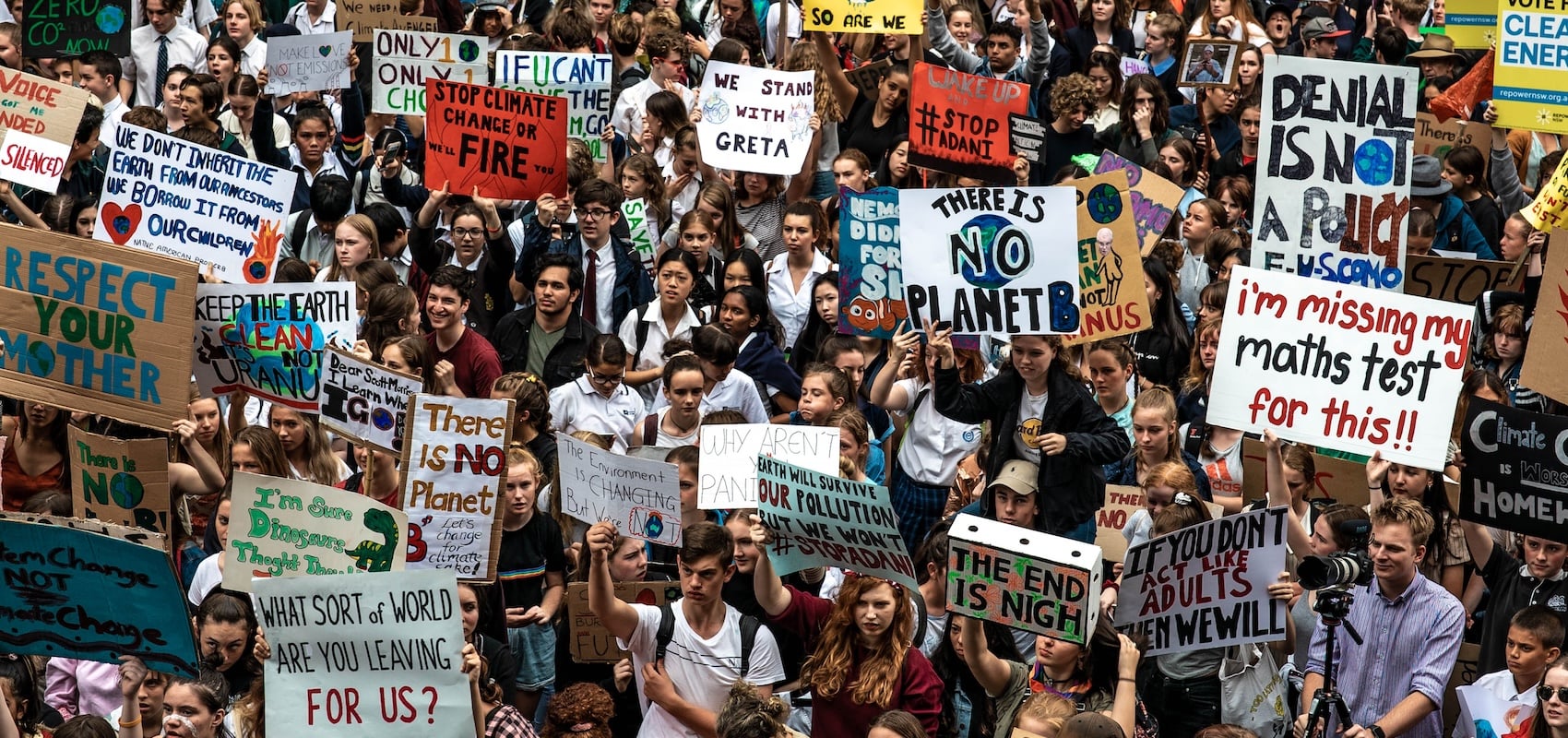
Image by School Strike, licensed via Creative Commons. Image cropped.
Dear Reader,
Can I be direct with you?
War abroad. Socialists on the rise. AI upending human life. Endless uproar online. The modern attention economy doesn’t want readers — it wants users enslaved to the tyranny of the present.
First Things is the antidote: literary excellence, timeless truths, and a fixed point of reference in a culture that has lost its bearings.
But we can’t do it without readers like you.
Our goal: Raise $150,000 by November 1 to sustain First Things in the year ahead.
Your gift anchors readers in the permanent things.
Make your Fall Campaign gift now using the button below.
If you have any questions or would like more information, please contact Giovanni Del Piero, Director of the Editor’s Circle, at gdelpiero@firstthings.com or 212-627-1985.

YOU MIGHT ALSO LIKE
Forget Odysseus. Aeneas Is the True American Hero.
Who is our Odysseus? Or more precisely, who is the most Odyssean hero of American film? Matt…
Candace Owens and the Sin of Anti-Semitism
According to the online Encyclopedia Britannica, Sir Moses Montefiore (1784–1885) was “an Italian-born businessman who was noted…
Meet the Post-Religious Right
There have been many books written about the online right and the Trump movement, most by people…
