
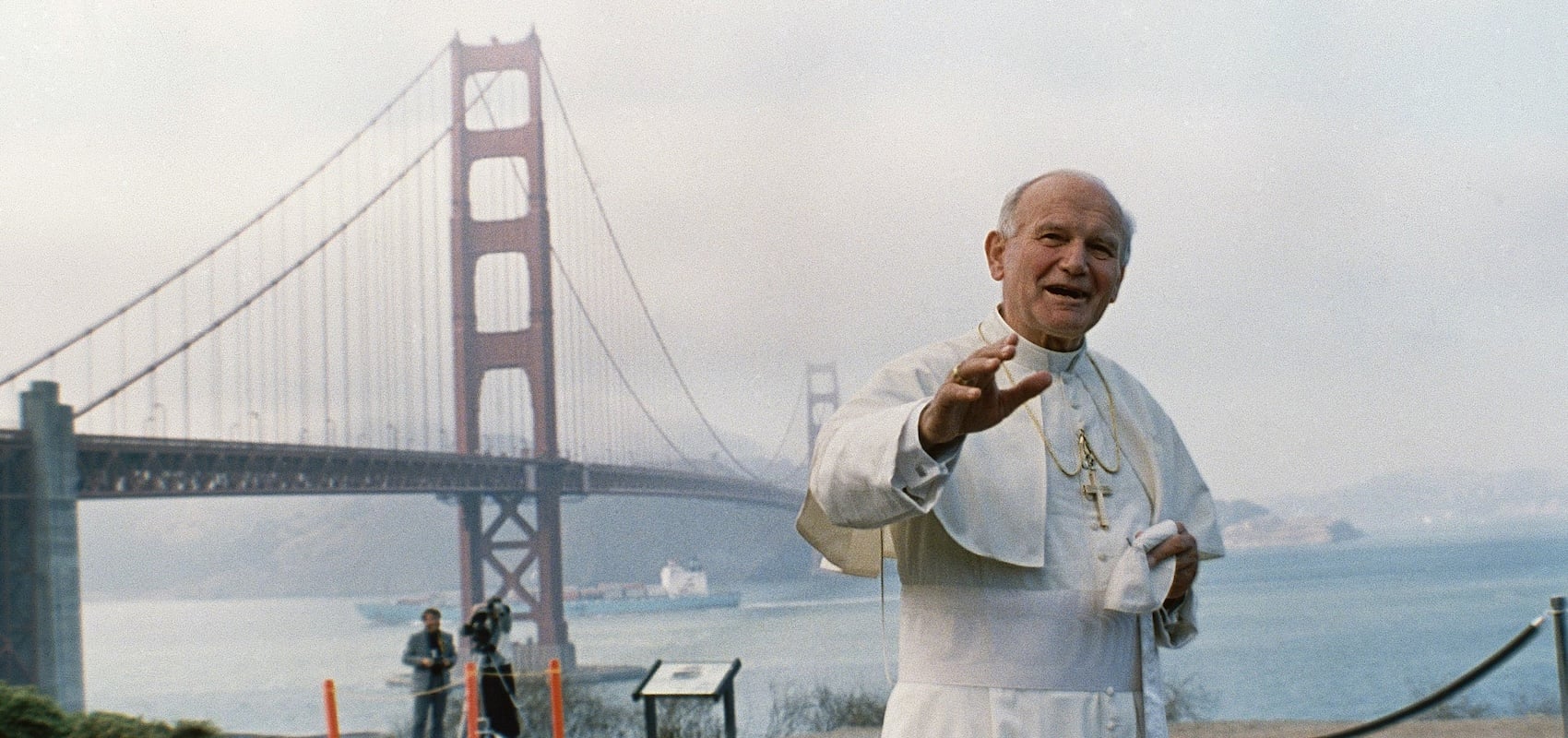
When he was elected bishop of Rome on October 16, 1978, Cardinal Karol Wojtyła had a rather limited experience of the Catholic Church in the United States. He had met American churchmen at the Second Vatican Council, and a few of them visited Poland in the ensuing years. The Cracovian cardinal had made two visits to the United States, one during the national bicentennial in 1976, but the majority of his time during these trips was spent with Polish-American communities. So it’s probably fair to say that John Paul II began his papacy with an impression of American Catholicism not dissimilar from that of other European intellectuals: The U.S. Church had an enviable network of institutions—ranging from parishes to healthcare and social service facilities to schools, colleges, and universities—but the Church was more wealthy than cultured and lived too comfortably within the American status quo.
In short, while the new pope wasn’t hostile to the Church in the U.S., neither did he see it, in 1978, as one possible template for the Catholic future. That would change dramatically over the next quarter century, in part because of the renewal that John Paul II helped ignite in American Catholicism and in part because of his growing understanding that the United States, while deeply rooted in Europe, was not simply Europe transplanted.
The change in both papal perceptions and the U.S. Church began with John Paul’s first American pilgrimage in October 1979. The extraordinary response he drew in Boston, New York, Philadelphia, Des Moines, Chicago, and Washington suggested that there was considerably more vitality in the Church, not least among young people, than the pope may have previously thought: vitality that could animate what John Paul would later call the “New Evangelization.” At the same time, the enthusiasm the pope evoked suggested to more alert U.S. Catholics that it was time to get out of a defensive crouch, abandon the post–Vatican II tong wars, and get on with the council’s summons to sanctify the world.
Over the next two decades, John Paul continued to inspire a renewal of evangelically vital Catholicism in America. Concurrently, he came to understand that his social magisterium was being discussed far more seriously in the United States than anywhere else, and that the defense of life he proclaimed in the 1995 encyclical Evangelium Vitae found greater public expression in America than in the rest of the so-called “developed” world combined. That, in turn, suggested to John Paul that the American Founding had been rooted in principles of the natural moral law that were congenial to the biblical idea of the inalienable dignity and infinite value of every human life.
After the crack-up of European communism in 1989–1991, two questions posed themselves: Were democracy and the free economy simply political and economic mechanisms that could function well on virtually any cultural foundation? Where might the new democracies of postcommunist Europe look for models of how to live freedom nobly? John Paul II answered the first question in the 1991 encyclical Centesimus Annus: It takes a certain critical mass of people living certain habits of the heart and mind—certain virtues—so that free politics and free economics support individual human flourishing and social solidarity. And from many hours of conversation with him, I can say that John Paul II hoped that Poland and the other newly self-liberated countries of central and eastern Europe would learn some lessons from the American experience in building their postcommunist societies.
Why? Because the pope saw in the United States a developed democracy in which religious conviction continued to shape the lives of the majority of citizens and in which religiously informed moral argument played a significant role in public life. The United States was not France, where secularism was constitutionally enshrined; nor was the American republic Great Britain or Germany, where biblical religion had long ceased to shape national cultures and public affairs. In the United States, John Paul II hoped, the vision of the free and virtuous society he outlined in Centesimus Annus—a society in which the Church helped shape a vibrant public moral culture directing the enormous energies let loose by political and economic freedom—might be realized, and other countries might see in that realization how freedom and virtue go together.
As America approaches its 250th birthday, it would do well to remember that the emblematic figure of the second half of the twentieth century had such high hopes for us: hopes that now seem a call to a national examination of conscience.
George Weigel’s column “The Catholic Difference” is syndicated by the Denver Catholic, the official publication of the Archdiocese of Denver.
Image by ASSOCIATED PRESS


YOU MIGHT ALSO LIKE
Who Killed the Clancy Children?
After a Massachusetts jury failed to convict Lindsay Clancy of strangling her three small children to death…
Vatican II Didn’t Kneel to Modernity
In his weekly catecheses on Vatican II, Pope Leo is now discussing Gaudium et Spes, one of…
A Terrible Coarsening
The now-ubiquitous terms “reproductive health” and “reproductive freedom” have contributed mightily to a slaughter of the innocents…
