
The Saturday after Easter, on a cloudless morning, I fell and shattered my left elbow while taking a walk with my husband. Although the sidewalk is uneven and full of cracks, I cannot blame my fall on the town. No, I simply tripped on my husband’s left heel and came crashing down. I knew the moment it happened that the elbow was damaged, because I had broken the same elbow only two years before. On that occasion, I had been walking with my daughter, engaged in a lively conversation, while on the way to a lecture. I twisted my right ankle, and fell hard on the left elbow. Hours of surgery, a cast, a splint, and months of physical therapy had made it a memorable experience—one that I was quite desperate never to repeat.
Indeed, I had spent the past two years exercising daily, obsessively working on strength and balance, investing in sturdy shoes—adieu to high heels!—and avoiding all potentially interesting and therefore distracting conversations while in motion. No longer would I cast my eyes heavenward. Nor would I admire the passing scenery, the exuberant golden retriever or the riotous wisteria. No, eyes fixed constantly on the path, strictly earthbound was I. And yet, despite all of my precautions, here I was again—back on the ground in agonizing pain and all too aware of what the future months held in store. That first fall had been just before Lent, so it made a certain sort of cosmic sense that I should suffer for forty days and forty nights. This time, however, we had all only just finished singing “Jesus Christ is risen today, Alleluia!” so my timing felt distinctly off.
My thoughts turned to a book I had recently read, Georges Bernanos’s The Diary of a Country Priest, because I had taken particular note of a passage promulgating self-loathing as an essential step in one’s journey to God. As I lay upon the ground contemplating my lot, it would be impossible to overstate how much I loathed myself, and yet—I was less than sure that my condition was a promising gateway to holiness.
O Felix culpa, oh fortunate fall? Adam’s fall redeemed the world, but what of mine?
As a child, I tumbled off some rocks in the backyard and needed stitches on my chin—the scar is with me still. I have fallen off the stage, twice—once in a too vigorous rehearsal as Helen Keller, and once at the New Jersey Shakespeare Festival, resulting in a broken leg.
Less dramatically, I have broken my arm falling off a ladder while decorating a Christmas tree, and once while crossing from the dining room to the living room. I have sprained my ankles more times than I can recall—sometimes in dance class, but also simply stepping off a curb.
My mother, too, was given to falls and broken arms. Perhaps most memorably, she fell off the Berlin Wall. It was 1967, my father was lecturing in East Berlin, and my mother and I were staying in West Berlin while waiting nervously for his return. We decided to take a bus tour of the Wall, which made a stop at the one location where you were allowed to climb some stairs and spy on the grim, communist side. As we walked back down the stairs, my mother fell and landed on—you guessed it—her elbow. My grandmother on my father’s side was also a great faller, particularly when she wasn’t getting enough attention. She almost managed to ruin my college graduation by falling down the stairs of the lovely historic inn where they were staying. Fortunately, my patient and long-suffering grandfather took care of her and insisted we continue the festivities without them.
Meanwhile, my father’s misbegotten escapades were the stuff of family lore. He was notoriously accident-prone and would slice off fingers during Easter dinner, or fall into cacti while on vacation. Most famously, at the end of a lengthy day of misfortune known by all as “The Black Friday Story,” he slipped on ice, slid under our car, and was run over by my mother.
But it was his final fall, down the staircase of their home—which my mother attempted to prevent by hurling herself in front of him—that would send them both into the hospital and into a downward spiral from which they would never really recover.
My husband, however, remained unamused by our family disasters, and more often than not, would gloomily evoke the Greeks: “Every house is the House of Atreus.” So it was that I found myself questioning the curse that seemingly runs through my family. Was falling a genetic predisposition? A neurosis? A curse? Am I destined to fall again and again?
All of this and more was coursing through my mind as they wheeled me into surgery. In these situations, there comes always a moment of complete inevitability—when you simply surrender and put yourself entirely in the care of others. There is nothing more you can do. The rest is up to the doctor, the nurses—and God. “Into thy hands, Oh Lord, I commend my spirit.”
Hours later, after waking up, there’s a gratitude and a calm, followed closely by a desperate thirst and craving for ice. When my husband was finally allowed back to see me, he said the surgeon (the same lovely man who had put me back together the first time) was pleased with how the surgery had gone, but newly astonished at the tininess of my bones. It seems I have remarkably petite bones; I am basically a chicken in human form.
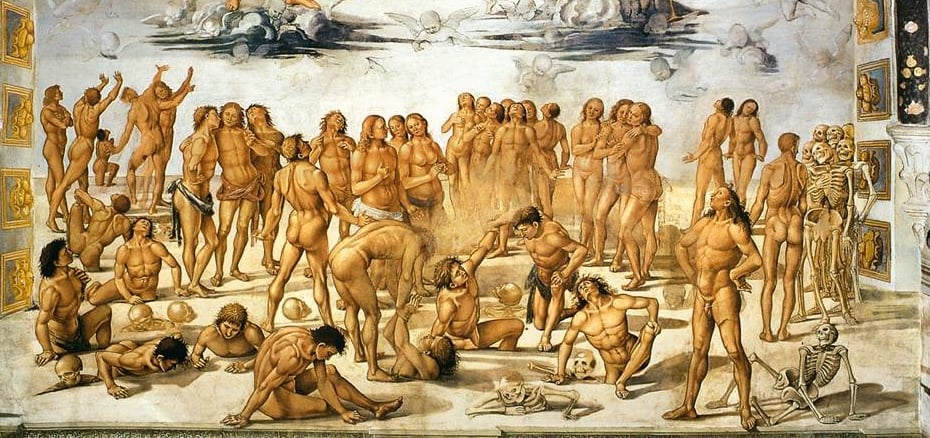
I think about my birdlike, sixty-eight-year-old bones, brittle and dry. I think about my father’s favorite prophet, Ezekiel, and his prophecy to the Valley of Dry Bones. God brings Ezekiel to a vast valley filled with disconnected, very dry bones, and asks, “Can these bones live?” Ezekiel replies that only God can know. Then God says, “Prophesy to these bones and say to them, ‘Dry bones, hear the word of the Lord!’” As Ezekiel speaks to the bones, he hears a great rattling, and sees the bones coming together, with tendons and flesh and skin.
On car trips, my parents and I used to sing the classic American spiritual “Dem Bones”: “The toe bone’s connected to the foot bone, the foot bone’s connected to the heel bone,” and so forth. It used to occupy us for extended periods of time, and my father loved to belt out the chorus, “Dem bones, dem bones, dem dry bones, now hear the word of the Lord!” Ezekiel watches as the bones become a living and resurrected people—the people of Israel. And the Lord says “I will bring you back to the land of Israel. . . . I will put my Spirit in you and you will live, and I will settle you in your own land.”
When my father died, the sermon at his funeral was about Ezekiel and the dry bones. Six years later, on the morning of October 7, 2023, my ninety-eight-year-old mother died. I did not know about the attack on Israel until later that day because I was with her. Some have suggested, not entirely fancifully, that the death of my mother unleashed fearful and demonic forces. It seems as plausible to me as anything else. “Can these bones live?”
Will my dry bones heal? Will I fall and fall and fall again? I have fallen in love. I have fallen asleep. I have fallen into error and fallen into sin. In the Merriam-Webster Dictionary, the first definition of “fall” is “to descend freely by the force of gravity.” To descend freely—a small consolation? My descents were free but descents none the less. And yet, the second definition is “to become born—usually used of lambs.” With each free fall, we are born again. Or so we must hope. As Ezekiel says to God, “Oh Lord God, you know.”
Dear Reader,
Can I be direct with you?
War abroad. Socialists on the rise. AI upending human life. Endless uproar online. The modern attention economy doesn’t want readers — it wants users enslaved to the tyranny of the present.
First Things is the antidote: literary excellence, timeless truths, and a fixed point of reference in a culture that has lost its bearings.
But we can’t do it without readers like you.
Our goal: Raise $150,000 by November 1 to sustain First Things in the year ahead.
Your gift anchors readers in the permanent things.
Make your Fall Campaign gift now using the button below.
If you have any questions or would like more information, please contact Giovanni Del Piero, Director of the Editor’s Circle, at gdelpiero@firstthings.com or 212-627-1985.

YOU MIGHT ALSO LIKE
The Last Statesmen?
In the latest installment of the ongoing interview series with contributing editor Mark Bauerlein, Steven B. Smith…
A Culture of Parricide
I learned a new word the other day: déploration. It’s the French, directly from the Latin, for “lament.”…
The Myth of St. Francis
At the beginning of his 2020 encyclical, Fratelli Tutti, Pope Francis speaks of “an episode in the…
