
The media would like you to know that the Great American State Fair, which took over the National Mall this month, was not, in fact, great. Snooty social media influencers labeled it “mid” and “lonely.” Washingtonian magazine called it “bleaker than expected.” And USA Today gleefully declared it a “fabulous flop.”
But the fair was never meant for the elitist critics. Its target audience was always the families who traveled from all over the country to mark America’s 250th birthday in the nation’s capital. It was for the flag-waving children perched on shoulders and the frat boys garishly decked out in stars and stripes. Its atmosphere was unapologetically patriotic and unmistakably American, and so were the people it attracted. That was, of course, the real transgression of the Great American State Fair.
The fairgrounds were a hive of activity from the moment you entered the gates. The sheer amount of coordination, organization, and construction to pull off such an undertaking was astounding. Air-conditioned booths had to be built for every state and territory in addition to a host of federal agencies. There were food halls, official merchandise shops, and pavilions where event sponsors handed out freebies and provided photo ops. Carts zipped around, distributing pallets of complimentary water for attendees braving D.C.’s record heat. Three different stages offered an array of programming all day long, from panels featuring Trump administration officials and interviews with the Artemis II astronauts, to performances by U.S. military bands and rapper Flo Rida.
The fair was the brainchild of Task Force 250, the White House arm charged with realizing President Trump’s vision for a birthday bash as big and raucous as America itself. So thoroughly was the National Mall transformed that you nearly forgot where you were until, behind the swinging gondolas of the Ferris wheel, beyond the cotton candy booth, and over the din of Lynyrd Skynyrd’s “Free Bird” blasting across speakers, you caught a glimpse of the Capitol rotunda and realized what a surreal experience this was.
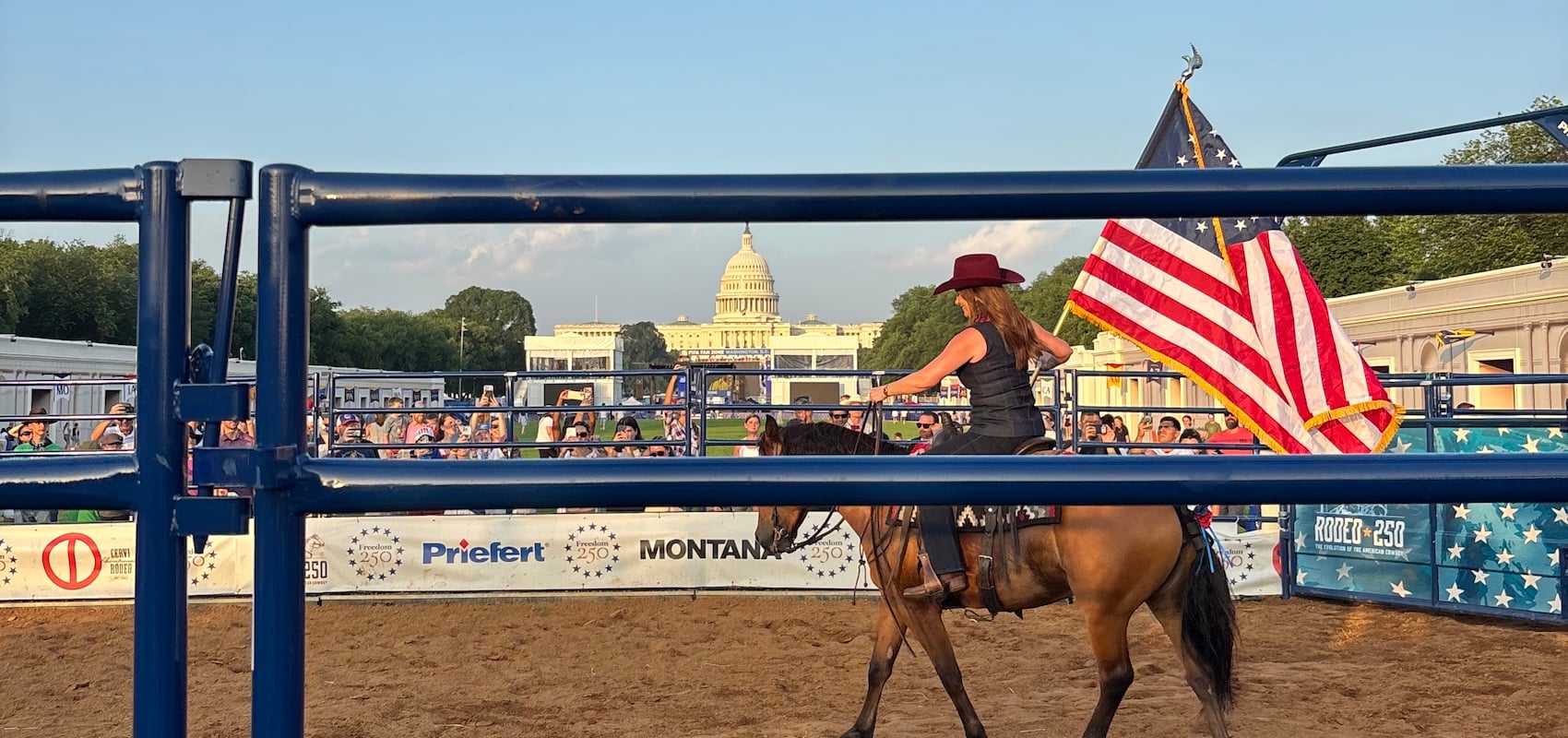
It was even more surreal during the fair’s nightly rodeo. While the arena was too small for a full event, organizers did an impressive job of highlighting the history of the American cowboy and the origins of the sport. Stunt riders, trick ropers, and bull riders demonstrated the spirit of adventure and grit that tamed the West and built America. Watching a bronc buck its rider in the shadow of the House and Senate chambers felt like stepping into a bygone era.
In the middle of the Mall, fairgoers lined up for one of the plush manatees Florida was giving away—by far the most popular stop of the fair. The Department of War also drew a crowd: Uniformed servicemembers handed out scavenger hunt instructions, and kids got their faces painted in camouflage. On the opposite end, Arizona’s booth invited guests to speak with a Native American storyteller and walk through rooms simulating the state’s different landscapes, complete with sound and lighting effects.
Not every pavilion was so elaborate, though. Several Democrat governors boycotted the fair to score political points against Trump, resulting in empty booths and disappointed constituents. But others, with a rebel spirit that would make the Founders proud, rallied.
Pennsylvania was one example. After Gov. Josh Shapiro opted out, Democrat senator John Fetterman and Republican Dave McCormick joined forces to ensure their state was represented. The two made calls to business leaders around the state, including local antique flag dealer Jeff Bridgman, to garner support. The result was over fifty organizations coming together at their own expense. Bridgman sent a collection of framed flags, many with ties to the Keystone State, and volunteers worked over the weekend and through the night to put them on display. Others hauled in a replica Liberty Bell, while Knoebels Amusement Resort sent a park bench. Another volunteer drove in a carload of Utz potato chips to distribute. Staff from both senators’ offices manned the booth, and the line of visitors wanting to get a peek inside was consistently out the door.
Massachusetts was in a similar situation until Donna, a retired schoolteacher aghast that a state so pivotal to American independence would be absent, stepped up. She gathered the assortment of Bay State memorabilia she had on hand, called up a local maple syrup producer who supplied her with samples, booked the last hotel in D.C., and drove ten hours from Massachusetts to man the booth herself. As word spread across Facebook, two of her friends (“The Minutewomen,” she called them) drove down to lend a hand. Then a Massachusetts bakery sent suitcases of cookies to hand out. A costumed Revolutionary War reenactor showed up. And a couple who owns a 3D printing business delivered hundreds of Massachusetts keychains to give away. Donna became somewhat of a celebrity as fairgoers stopped by to thank her for her efforts. Ironically, the scrappiness, self-reliance, and resolve of the men and women who jumped in to staff their state’s booth exemplify the patriotic spirit that launched the Revolution far better than any tourism department display could.
Perhaps this is all “cringe” to the critics who railed against the fair. Their criticisms, however, came not from a desire to see the fair be an even greater success but from disdain that it was a success at all.
The truth is, patriotism is back in all its gritty, brash, audacious glory. It’s Olympic hockey legend Jack Hughes, through bloodied, broken teeth and fresh off his golden goal, shamelessly proclaiming his pride in being an American. It’s stadiums of sports fans belting “Take Me Home, Country Roads.” It’s foreign World Cup fans, fascinated by our Bass Pro Shops and Buc-ee’s gas stations, prompting Americans to look differently at the culture we take for granted. And it’s a sprawling fair in the middle of the National Mall showcasing the people and places that make our nation great.
As the kids say, it’s cool to love America again.
Dear Reader,
Can I be direct with you?
War abroad. Socialists on the rise. AI upending human life. Endless uproar online. The modern attention economy doesn’t want readers — it wants users enslaved to the tyranny of the present.
First Things is the antidote: literary excellence, timeless truths, and a fixed point of reference in a culture that has lost its bearings.
But we can’t do it without readers like you.
Our goal: Raise $150,000 by November 1 to sustain First Things in the year ahead.
Your gift anchors readers in the permanent things.
Make your Fall Campaign gift now using the button below.
If you have any questions or would like more information, please contact Giovanni Del Piero, Director of the Editor’s Circle, at gdelpiero@firstthings.com or 212-627-1985.

YOU MIGHT ALSO LIKE
Forget Odysseus. Aeneas Is the True American Hero.
Who is our Odysseus? Or more precisely, who is the most Odyssean hero of American film? Matt…
Foucault’s Idol of Nothingness
Today marks the 100th anniversary of the birth of Michel Foucault. He was influential in his lifetime,…
Meet the Post-Religious Right
There have been many books written about the online right and the Trump movement, most by people…
