
What follows is a lightly edited version of the written testimony Camosy prepared for the Tom Lantos Human Rights Commission hearing on “Artificial Intelligence in the Military Domain: Implications for Human Rights,” which was scheduled for July 1, 2026, but postponed until a later date.
Introduction: Our Founders’ Theological Conviction and Our Moment
We find ourselves here at a very special time and place: on Capitol Hill, July 1, 2026, just three days before this nation marks its 250th anniversary. In 1776, the Founders of this republic made momentous, history-changing claims about human dignity and equality that rested on explicitly theological truths. They wrote that all are created equal by God, that they are endowed by their Creator with unalienable rights. Our country was founded on the idea that rights come from God’s creative work, not from government; not from productivity, capability, or strategic utility. Our human dignity and equality precede every institution, every calculation of efficiency, and every consequentialist appeal—including appeals to global military advantage.
The question before this commission today—whether autonomous weapons are consistent with human rights—is related to other deep questions that our Founders would have answered theologically. Are human lives reducible to data? Should decisions that take human life be reduced to algorithms? Does every human being, on every part of every battlefield, bear a dignity that cannot be processed, calculated, or automated away? Must decisions to take human life, especially by the richest and most technologically advanced militaries in human history, be made with human moral oversight?
With the promulgation of Pope Leo XIV’s encyclical Magnifica Humanitas, Catholic answers to these questions have received significant national and international attention in recent weeks. I argue that such answers are consistent with our Founders’ fundamental convictions and rightly place autonomous lethal weapons in the same moral category as other technologies this nation has rightly opposed. I will also argue that addressing autonomous weapons requires something the Founders understood well: refusing to let the pernicious logic of competition among powerful global actors define the limits of what is morally permissible—and, relatedly, who we imagine ourselves to be as a country.
Who I Am and What I Have Witnessed
I am a professor of moral theology at the Catholic University of America. Though I have taught and written on a broad range of moral issues, I have focused on bioethics and have tried to use the Catholic intellectual and moral tradition to creatively and consistently defend the dignity of the human person, from fertilization until natural death and at every stage in between.
Beginning this past October, however, I have been drawn into something I did not expect: a sustained, serious, and creative engagement with several of the people building frontier artificial intelligence systems. I have participated in formal convenings with Anthropic’s researchers and leadership. I have developed extended conversations and even friendships with people working across multiple frontier AI labs. I helped plan a major daylong conference on Magnifica Humanitas in Silicon Valley on June 6, which brought together a sitting congressman, the bishop of San José, researchers from Anthropic and Google DeepMind, scholars from Stanford and UCSF, and well over three hundred members of the public. On June 17, I helped the United States Conference of Catholic Bishops (USCCB) brief Capitol Hill staff on the encyclical. The House Members Dining Room was packed, and a good portion of the question-and-answer period focused on autonomous weapons.
I was also the primary organizer of an amicus curiae brief signed by fourteen Catholic moral theologians and ethicists in Anthropic PBC v. U.S. Department of War. Our brief argued from the Catholic just war tradition and Catholic social teaching that autonomous weapons systems operating without meaningful human oversight violate the most fundamental requirements of moral accountability. The brief is publicly available on the court docket.
What I have found in these conversations is not arrogance, but something much closer to vertigo—brilliant and deeply moral people caught in a diabolical structure of sin that is pulling them toward terrible outcomes they do not want. Those most committed to ethical AI are, by their own account, trapped in a prisoner’s dilemma: If they slow down, they have reason to believe that a less scrupulous competitor—domestic or foreign—will end up dominating. But they also see that winning requires them to blow past key moral and practical safeguards. This problem is central to the autonomous weapons question, and I will return to it later in my remarks.
The Reality on the Ground (and in the Air) Right Now
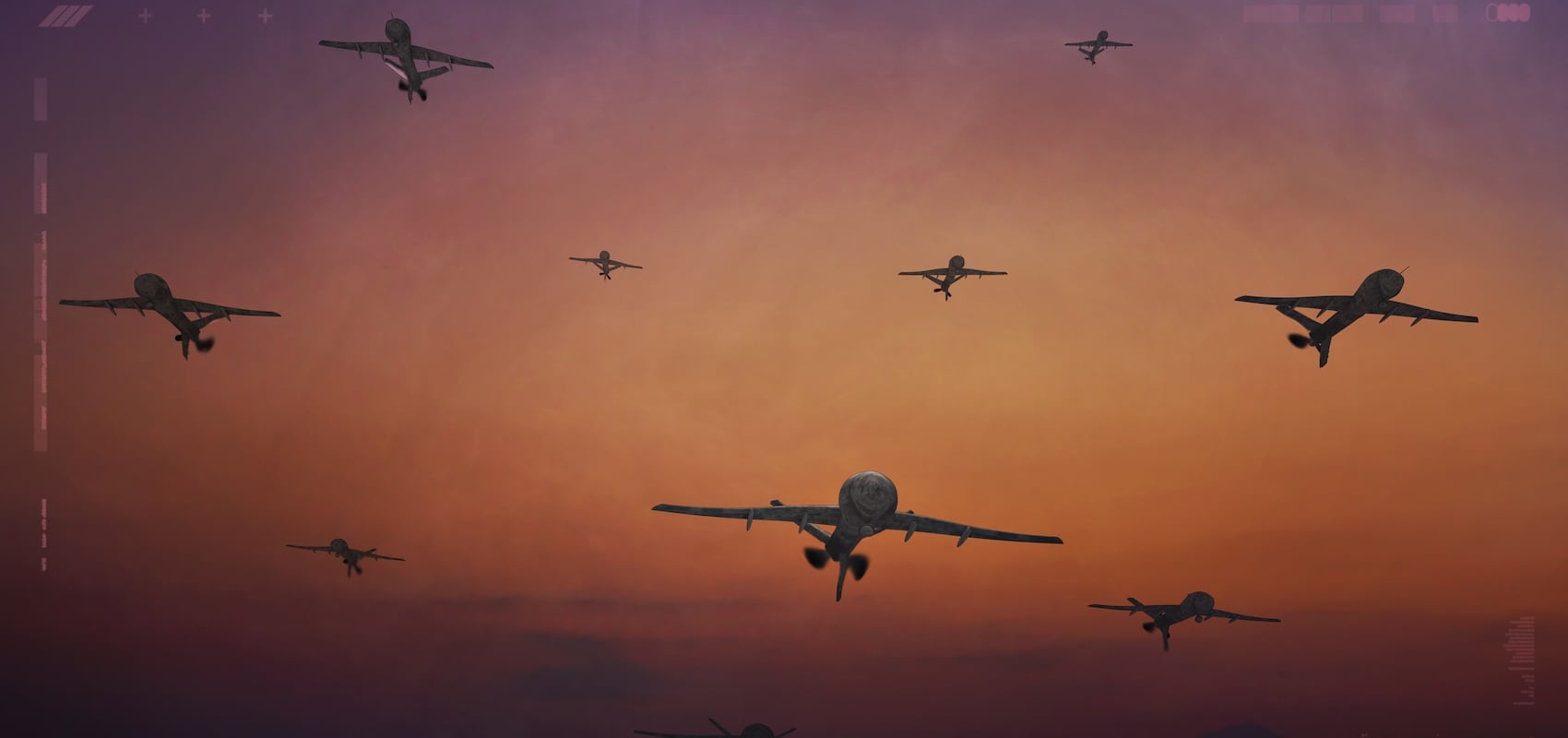
My colleagues with me at this hearing can speak much more expertly about this question, but I wanted to highlight that just this past month, a senior figure in the Ukraine defense industry confirmed to the New Scientist that autonomous drones with no human oversight were used on the battlefield for the first time. The source who used the drones described it this way: “We just launch it and we know everything will be dead—everything that will be found there in this particular area will be dead. . . . There is no connection to the drone at all, you cannot see the video, nothing.”
“We know everything will be dead.” This sentence foretells a world in which the decision to take human life has been entirely removed from human moral agency. Happily, we are the inheritors of a just war tradition that resists moving in this direction.
The Moral Argument
The Catholic just war tradition, developed over more than 1,500 years by Augustine, Aquinas, and their successors, has been deeply influential in how the Western world has thought about war. At its core, this tradition insists that decisions that take human life must be made by human beings who bear moral accountability for those decisions. Without such accountability, it is not even clear that “war” is the right term for what is happening on these battlefields. Human accountability is the structural requirement that makes moral evaluation of warfare possible in the first place.
As we said in our amicus brief: “Algorithms cannot be morally responsible for decisions that intentionally take certain human lives and expose others to mortal risk.”
Pope Leo’s encyclical Magnifica Humanitas puts this point directly: “Moral judgment cannot be reduced to calculation, for it involves conscience, personal responsibility and the recognition of the other as a person. Therefore, it is not permissible to entrust lethal or otherwise irreversible decisions to artificial systems.” And: “The decision to use lethal force cannot be delegated to opaque or automated processes, but must remain under effective, self-aware and responsible human control.”
Bishop James Conley of Lincoln, Nebraska (one of the most traditional and pro-life bishops in the U.S. and the proud son of a World War II veteran), wrote publicly this past May: “The Church is clear that such weapons could not be used justly, even in a just war.” He approvingly cited our brief’s argument that deadly actions in war “require human beings to be the ones morally responsible—and to take moral responsibility—in order for actions in a war to be just.”
The USCCB has collectively called lethal autonomous weapons systems “a grave development of military technology,” warning that by creating the illusion that war is “less costly,” such weapons make going to war easier and more likely.
The just war tradition’s requirements are not standards that better algorithms might eventually satisfy. They are moral requirements that depend on human judgment exercised by people who bear genuine responsibility for the consequences. We have already discussed moral accountability, but let’s engage two other concepts: discrimination and proportionality.
Discrimination, or distinguishing combatants from non-combatants, cannot be accomplished by a computer doing pattern recognition. It is a moral judgment that requires taking individual human situations seriously: understanding context, recognizing human beings as image-bearers rather than as data profiles, and bearing moral responsibility when errors are made. An autonomous system cannot carry that responsibility.
Proportionality, or requiring that harm does not exceed what is militarily necessary, requires weighing values that cannot be reduced to algorithms. AI-directed drone swarms cannot understand or weigh the value of a human life against other values. Human beings must make such judgments.
The Pro-Life Critique
I was invited to testify at this hearing by the office of Co-Chair Chris Smith, whose decades-long commitment to the dignity of every human life I deeply admire. A very similar perspective has guided my own career. The pro-life movement argues that the first kind of violence directed at a vulnerable population is often conceptual. The vulnerable human being must be reduced to something less than a person in ways that create the conceptual space for physical violence. In the abortion context, this takes the form of abstracting the unborn child from his or her humanity. He or she must be reduced to a clump of cells or “product of conception.” Unborn children are described as burdens, as parasites—as medical waste after a medical procedure. The primary justice-centered argument against abortion has been to call out this way of thinking and insist that every human being (regardless of size, age, dependency, or cognitive capacity) possesses an unconditional dignity that must not be abstracted away.
Autonomous weapons reduce human beings in similar ways. A targeting algorithm converts a human being into a data profile, a set of characteristics that either meet or fail the kill criteria. He or she is not encountered as a person with a face, a name, a family, a soul. The idea that the person bears the holy image of God is not considered. He or she is processed merely as an input to a decision function.
Here’s Pope Leo on this: “Any technology that facilitates attacks without seeing the face of human beings lowers the moral threshold of conflict.” That sentence applies to every single context in which human beings are reduced to data rather than encountered as persons.
I do not want to be misunderstood. I am not saying that autonomous weapons and abortion are morally equivalent in every dimension. They are not. But they are connected by the same underlying anthropological and moral commitments: that every human being, in every circumstance, is owed the dignity of being recognized as a person, and treated as one whose life cannot be taken by a process that excludes moral encounter and human accountability. The pro-life tradition has been making this argument for fifty years. The USCCB developed a consistent ethic of life in the early 1980s by first seeing this connection between nuclear weapons and abortion. Similar connections ought to be made between traditional pro-life issues and autonomous weapons today.
Religious Freedom and Conscientious Objection
Despite significant recent attention to religious freedom in other policy contexts, this dimension has received very little attention in the autonomous weapons debate. This commission, however, is one of the best bodies in the world for addressing the religious freedom implications of autonomous weapons for U.S. service members.
The Catholic archbishop for the Military Services, USA, responsible for the pastoral care of approximately 1.8 million Catholics in the armed forces, has said publicly that Catholic service members could, “within the realm of their own conscience,” refuse an order they judge to be morally impermissible. He offered this pastoral guidance in the context of the Iran conflict and the potential invasion of Greenland, but the principle applies with particular relevance to autonomous weapons systems.
Pope Leo XIV himself stated: “Conscientious objection allows individuals to refuse legal or professional obligations that conflict with moral, ethical or religious principles deeply rooted in their personal lives. . . . Conscientious objection is not rebellion, but an act of fidelity to oneself.”
Here is a gap this commission should examine. U.S. military law currently recognizes conscientious objection to war in general, but not to specific conflicts, and not to specific weapons systems. This limitation flows from the Military Selective Service Act of 1967, which the Supreme Court interpreted in 1971’s Gillette v. United States to cover only those who oppose all war, not those whose sincere religious beliefs lead them to refuse a particular conflict or a particular weapon. Critically for our topic in this hearing, Gillette did not hold that the Constitution prohibits broader protection; it held only that Congress had not provided it. Congress can and should provide it. A Catholic soldier ordered to deploy or supervise an autonomous weapons system that makes lethal targeting decisions without human moral oversight has, under explicit Catholic teaching and the logic of the just war tradition, sincere and grave religious reasons for conscientious refusal. Under current law, that soldier doesn’t have the proper legal protection, but this commission should recommend that Congress provide it.
It is true that respecting religious freedom in this way would likely make things more complicated for the military chain of command, but such respect also makes things more complicated for healthcare systems. Both can and should find workarounds. The conscience protection frameworks that protect Catholic healthcare workers from being compelled to participate in abortion offer a model for how to think about this. The legal protections that apply to the nurse should also protect the soldier. Federal law protects Catholic and other religious healthcare workers who refuse to participate in abortion or euthanasia, even when their employer or the government wants them to do so. Those protections exist because we recognize that requiring a person to participate in a process he or she believes to be gravely morally wrong violates his or her religious and moral freedom. The same logic applies here: If a Catholic service member believes (consistent with the explicit teaching of the pope, the archbishop for Military Services, and the USCCB) that deploying fully autonomous lethal weapons is gravely morally wrong, requiring him or her to do so violates his or her First Amendment rights.
I urge this commission to examine whether existing conscience protection frameworks should be extended to cover military personnel ordered to deploy fully autonomous lethal weapons.
Taking Pressure Out of the System
I want to return to the prisoner’s dilemma I described at the outset. Perhaps the most important thing this commission can do is directly address this dilemma and take the pressure out of the system.
The argument for autonomous weapons almost always takes the same tired form: Our geopolitical adversaries are developing them, so we have no choice. If we restrain ourselves, then we hand them a massive strategic advantage. This is the logic of a prisoner’s dilemma. Each actor, reasoning individually, concludes that defecting—building the weapons—is safer than cooperating, even though cooperation would leave everyone better off. The race continues because no individual agent believes he can afford to be the first to stop.
These kinds of consequentialist arguments have a long history of undermining human dignity. The same logic was made against the abolition of slavery. “The Southern economy requires it!” It was made against the Geneva Conventions. “Wartime necessity demands it!” It was made against nuclear nonproliferation. “Our adversaries won’t stop!” In each of these cases, however, the prisoner’s dilemma logic was eventually rejected. Collective action—treaties, international law, moral solidarity—let the pressure out of the system.
The Catholic moral tradition and the Declaration of Independence both understand human dignity to be primary. Secondary consequentialist considerations can never alienate human beings from their basic rights. Bishop Conley put it plainly in his May letter: “There are certain standards for which we stand, regardless of consequences. Period.” Acknowledging this is not calling for weakness. On the contrary, courageous moral clarity when it may not produce the best consequences demonstrates a very significant kind of power—the kind that refuses to submit to prisoner’s dilemma logic.
Pope Leo XIV’s encyclical argues that AI “must be disarmed.” That is, it must be freed from the logic of armed competition. That phrase describes precisely what is needed for autonomous weapons: not just regulatory tweaks, but an authentic effort to build the international frameworks that can release the pressure driving this terrible race. The United States is not well-positioned to lead that effort if we are racing to build the most capable autonomous weapons. But we can lead if we insist that some lines cannot be crossed regardless of what our perceived adversaries do.
Please rely on the Catholic Church as a partner as we move toward collective action on autonomous weapons. The Church operates in virtually every country where the AI arms race is being run. It has well-established diplomatic contacts with China. It has relationships and institutions in other places where the U.S. and other players cannot easily operate. When international treaties succeeded in constraining weapons that powerful actors initially resisted (as they have with landmines, cluster munitions, and chemical weapons), it was because civil society organizations, religious institutions, and determined legislators created the conditions for the possibility of collective action. This commission can contribute to creating those conditions now.
Conclusion
I wish to conclude by invoking the spirit of what made this country worth founding: the conviction that human beings bear a dignity prior to and beyond any government, any technology, and any calculation of geopolitical advantage. The Founders understood that such dignity could only be grounded in God’s creative power. Furthermore, they explicitly and presciently warned future generations that an undue focus on amassing human power (especially on a global scale) would put this nation’s founding principles at risk.
The people building the most powerful AI systems in the world are not monsters. They feel trapped by competitive pressures they did not create. A similar prisoner’s dilemma logic is now driving the autonomous weapons race. The question before this commission, and before the country, is whether we will meekly bow to the horrors that such logic produces—or whether we will stand firm on who we are as a country and help build the moral and institutional infrastructure that can break the logic leading us to such horrors.
Every single human being on every side of every conflict is owed the dignity of being seen and recognized as a person, not processed as data. This commission should insist on it.
Dear Reader,
Can I be direct with you?
War abroad. Socialists on the rise. AI upending human life. Endless uproar online. The modern attention economy doesn’t want readers — it wants users enslaved to the tyranny of the present.
First Things is the antidote: literary excellence, timeless truths, and a fixed point of reference in a culture that has lost its bearings.
But we can’t do it without readers like you.
Our goal: Raise $150,000 by November 1 to sustain First Things in the year ahead.
Your gift anchors readers in the permanent things.
Make your Fall Campaign gift now using the button below.
If you have any questions or would like more information, please contact Giovanni Del Piero, Director of the Editor’s Circle, at gdelpiero@firstthings.com or 212-627-1985.

YOU MIGHT ALSO LIKE
Foucault’s Idol of Nothingness
Today marks the 100th anniversary of the birth of Michel Foucault. He was influential in his lifetime,…
Forget Odysseus. Aeneas Is the True American Hero.
Who is our Odysseus? Or more precisely, who is the most Odyssean hero of American film? Matt…
Why the Death Penalty Is a Sore Point for Papal Authority
Pope Leo XIV marked World Day Against the Death Penalty, observed on October 10, with the following…
