
Girls®:
Generation Z and the Commodification of Everything
by freya india
henry holt, 384 pages, $29.99
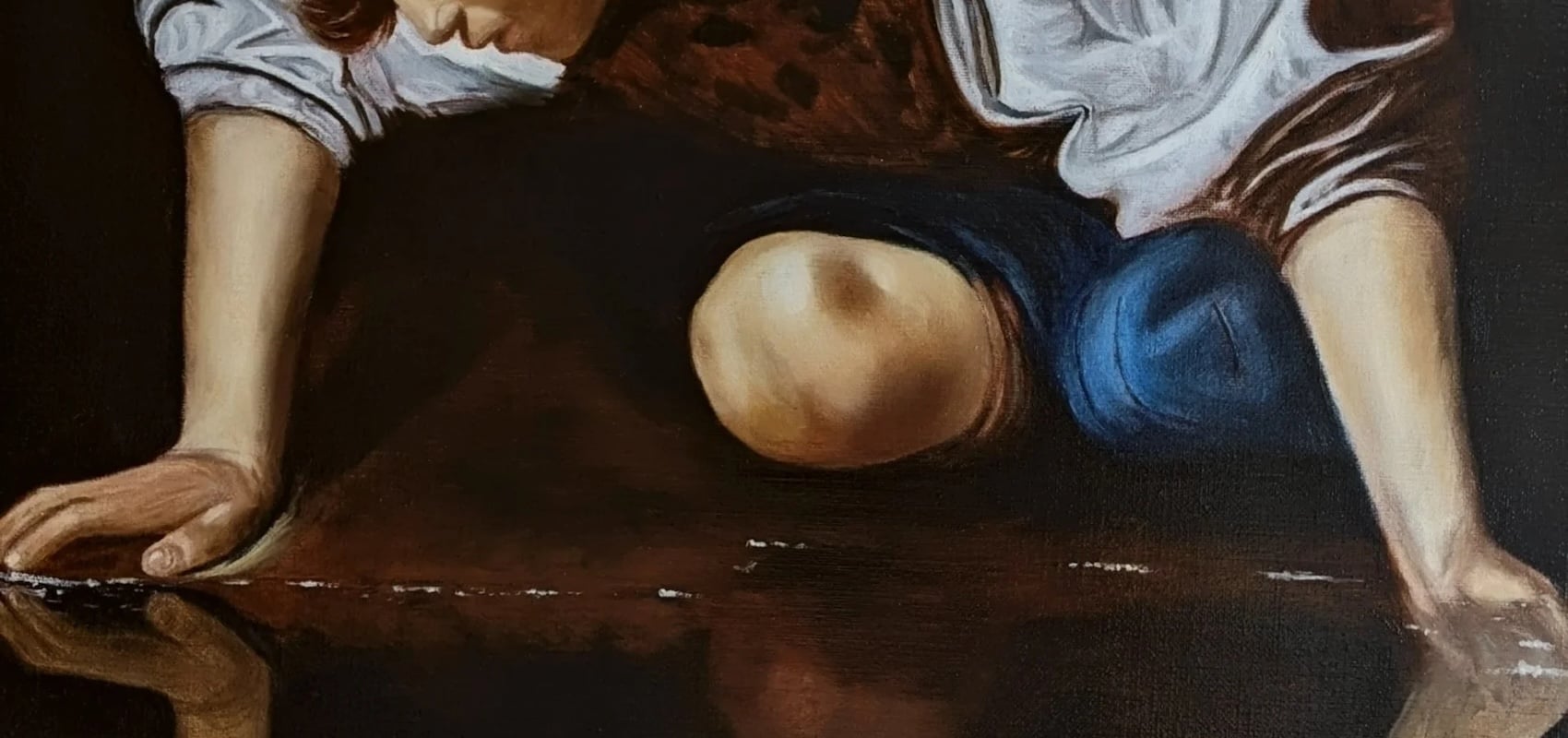
The myth of Narcissus tells of a beautiful young man’s obsession with his own image, captured in a reflecting pool. He scorns all others, so entranced by himself that he gives up food, drink, and human connection to stare at his own reflection. Eventually he dies of starvation and thirst, his death a punishment for his yearning to possess what can never be his.
Imagine if Narcissus had been able to manipulate, shrink, adapt, pinch, and tuck his own reflection. Imagine, in other words, if he had been empowered to control and create the object of his obsession. This is the reality documented by Freya India in Girls, a book about the new face of Narcissus.
Girls details the recent behavior of industries working to capture the eyes, hours, and pocketbooks of young people in the digital age, specifically young girls. “Every industry mentioned in this book—the beauty industry, mental health industry, tech industry, dating industry, porn industry—pulls our attention inward, toward our appearance, our feelings, our wants, our desires,” India writes. “These industries need us to be obsessed with ourselves. They depend on our vanity and self-absorption, so they sell it to us as empowerment.”

India, a talented and earnest twenty-six-year-old British writer and journalist, is the author of a successful Substack (also called Girls) and many articles describing the particular challenges facing Western Gen-Z kids. She has a compelling personal story, which will be familiar to all but the most watchful parents of digital natives: Given her first smartphone at age eleven, with zero supervision, she was nearly swallowed whole by the digital marketplace.
India’s chapter-by-chapter report from the online battlefield is a bit of a slog, as it’s packed with the kind of information you know you really ought to be better acquainted with, but you’d really prefer never to think about. India does the reader a great service compiling all the evidence and data in one place, and parents especially should make use of her work to equip themselves to make important decisions regarding tech and screen time in their homes.
Still, at times Girls reminded me of the homilies my old priest used to give, under waving hippie felt banners, during the Obama Administration. Our diocese would often send us a priest at the very end of his career, kind and well-traveled, but tired. Father would invariably deliver a litany of cable news horribles, one grisly factoid after another, to the point of audience exhaustion.
At the end, he would offer a smattering of platitudes designed to soothe us: God is love, and there’s nothing you can do about any of the rest of this. Father’s reassuring fatalism offered little comfort. This kind of homily, or book, is only as good as the medicine offered to defeat its crushing disease.
How are children with no life experience, skills, or prudence to navigate the digital global bazaar? For innocent little girls like the eleven-year old India, all it takes is all they’ve got: beauty, youth, and the empty hours of childhood, all offered up to the online marketplace. As the kids develop their personal brands, they hand over their traffic patterns, comments, youthful indiscretions, and purchase histories to companies for free! These companies have figured out how to profit from the endless peering, offering the kids new tools and tricks to manipulate their images. As India observes: “When girls feel anxious and unsure of themselves, industries rush to sell them someone else to be.”
We’re so accustomed to the fact that the digital age presents a unique challenge to the relationships and mental health of young people that we have lost our ability to see how bizarre it is. How unlikely that the removal of the space between private and public, between countries and cultures, between hemispheres and continents, would result in loneliness and disconnection. It’s hard to disagree with India’s observation: “The promises of connection have not panned out. We are the most ‘connected’ generation in history, but we are by far the loneliest.” In the pre-digital age, we believed that distance, cost, time, opportunity, and the price of information were all that stood in the way of a new age of understanding and global community. How strange that the actual result of widespread connectivity is a lack of culture.
India makes a convincing argument that, in the digital age, loneliness is caused by commodification. A common culture, in which people participate as themselves, is replaced by a market of people as personal brands and sales tactics. In this world, everyone is Narcissus staring at his image while leaving self and substance starved. Nobody knows anyone anymore, because we are all presenting our curated images of ourselves for the rest of the world to consume. We used to have to travel to the merchants and salesmen, the hustlers in the town square, and geographically subject ourselves and our children to the sales pitch. Now, the global bazaar finds us in our homes: in our living rooms, in our beds as we scroll away, at our dinner tables as we eat, and on our sofas as we unwind. India describes in detail how this marketplace has become more entertaining than ever before, and more participatory. We are no longer only buying and consuming—we are drafted to hawk our wares, too.
India presents this recent development of the marketplace and its increased access to our kids as the main demon of the story. The market—capitalism—has commodified our kids. But I am not sure she has identified the right villain.
Here’s a thought experiment: At any point in history, if we were to leave a young girl with plenty of time and a big bucket of money alone in the town square unsupervised, how long would she last before every single merchant—and more than a few vocational representatives, such as religious orders and nonprofits, political campaigns and swindlers—made a pitch for her money? In any society there has ever been, someone with little sense and a pile of money will be taken advantage of. That’s not a new development of either capitalism or humanity.
What is different today is that the marketplace is able to commodify, and enrich itself from, the formerly idle hours of childhood. Meta and other social media companies realize that empty childhood time is extremely valuable. The average parent is at least a couple steps behind, unaware of the extent to which the global bazaar has set up shop in the living room, and unconcerned with how addictive the whole experience is designed to be—especially for kids. How can parents arm their children with the strength of character to turn away from a marketplace as fascinating, and as dangerous, as Narcissus’s pool?
India’s prescription is more self-esteem. She hopes to make her contemporaries realize that they are worth more than what the marketplace values. The conclusion of her book is a kind of therapeutic-culture call to arms: Girls must look inside themselves to find their true worth. “True empowerment,” she writes, “can only be found by remembering what makes us human, and holding on to that.”
But what is it that makes us human? What are we supposed to remember about ourselves to help us retain our humanity in the digital age? And whose job is it, really, to teach a young woman the value of her own time and money?
It’s not enough to tell a child that she is worth more—particularly if the adults in her life convey through their actions that she’s not. Parents who leave their child to peruse the marketplace for hours a day value neither the time nor the potential creativity of that child. If they thought their child’s time valuable, they would put it to good use and help her extract its latent value.
“The adults around us stayed lovingly neutral,” India writes, “but the world is not neutral. We were left to learn right and wrong from advertisers and influencers.” True, but the solution is not more self-esteem. It is to stop leaving underaged kids alone in the marketplace with a pile of cash and empty hours. Modern parents want to neglect their children, then declare themselves helpless victims of the internet when these kids are co-opted by the global marketplace.
Our children cannot be expected suddenly to value themselves from the depths of their own (neglected) personalities though sheer force of character. There is no substitute for parents. And the cure for modern loneliness is the same as the cure for Narcissus: We have to cultivate a love for others, for making things in real life, for culture and life outside of the self. We cannot allow the self to become the sole obsession and skill of our young people. Social media companies definitely have a role and a use for the time and leisure of our young people. If we do not give our children something better to do with the idle hours of childhood, the global bazaar will co-opt them.
Girls illustrates in sharp detail that a childhood of empty time, boredom, and limited parental involvement is no longer available. Our options are either limited parental involvement with social media stepping into the breach, or an active role for parents in shaping and policing middle childhood and early adolescence.
The actual solution for parents who wish their children to avoid India’s fate is to teach kids the value of their time, the value of their attention, and the value of their money. Kids must actually do something with their time and attention.
Creativity and labor, when directed to worthy objects, bring not only value and esteem, but also confidence. They leave an indelible mark on the soul. If a child learns a foreign language, learns to play an instrument, learns to fix cars or grow things or lead teams of people, learns to organize campaigns or weld, learns to sew or cook food, nothing and nobody can take those skills away. They are hers forever, and she is now a different kind of person than she was before acquiring them.
Teach children to do things, limit their exposure to temptation, and they will grow to value their own time. Leave them idle, without supervision, and they will not.
There is no replacement for parents. Freya India’s Girls reveals that our time, like any other, is apt to enslave Narcissus.


YOU MIGHT ALSO LIKE
Romancing the Machine
A friend of mine asked a researcher at Anthropic whether Claude was conscious. He replied, “Are you…
The Boys on the Brink
In the latest installment of the ongoing interview series with contributing editor Mark Bauerlein, Leonard Sax joins…
Who Killed the Clancy Children?
After a Massachusetts jury failed to convict Lindsay Clancy of strangling her three small children to death…
