
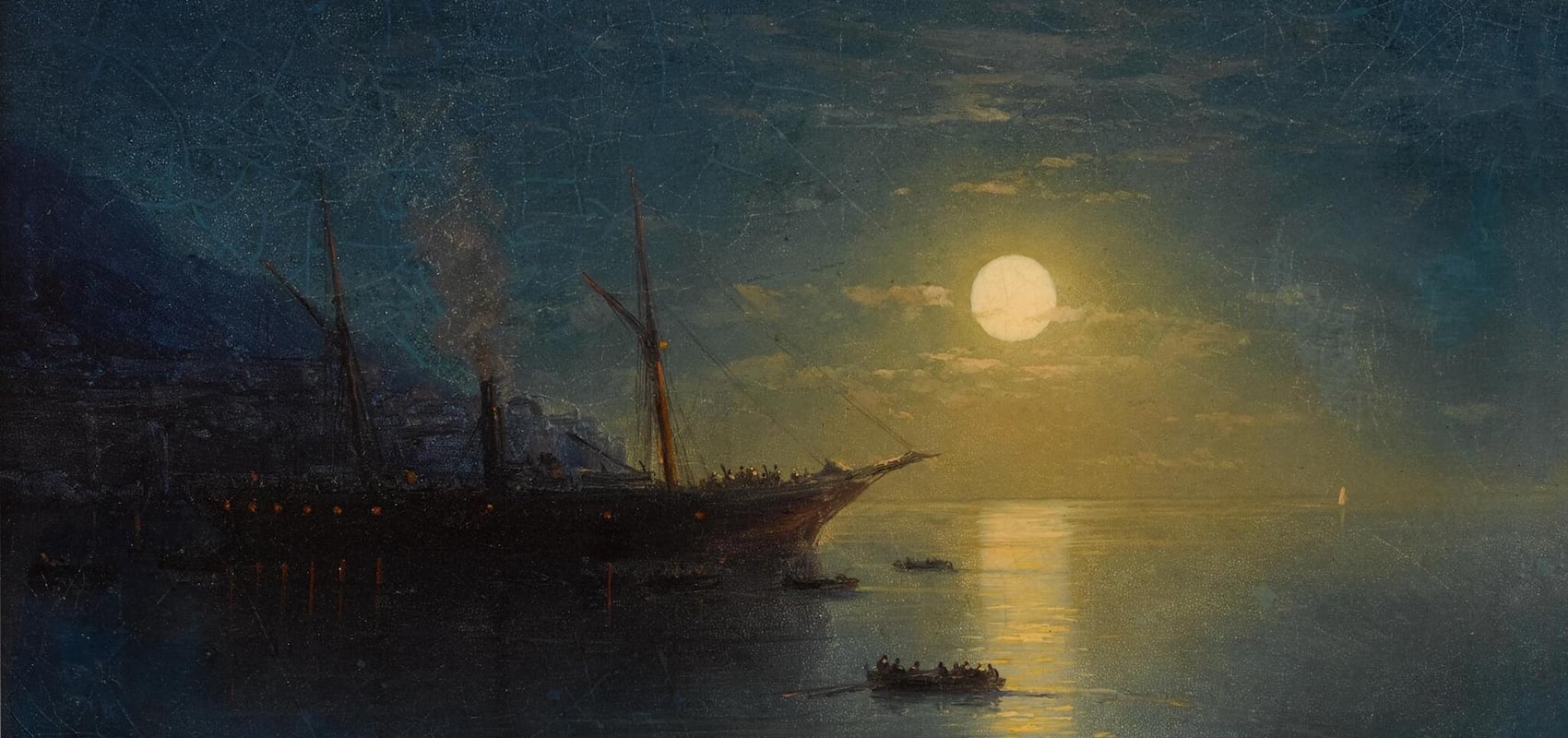
Nocturnes:
and the Fascination of Night Music
by susan tomes
yale university, 368 pages, $30
One day around 1836, in the ancient city of Dijon, the young French poet Aloysius Bertrand was dreaming his dreams, when “the cough of someone walking dispersed [his] reveries.” Bertrand observed the stranger’s “threadbare frock coat buttoned up to his chin, his felt hat, shapeless, that never brush had brushed, his hair long like the foliage of a weeping willow.” This new acquaintance, it turned out, was in possession of occult secrets. He pressed into Bertrand’s hand a manuscript: Gaspard de la nuit, fantaisies à la manière de Rembrandt et de Callot. And then he slipped away.
Or so Bertrand wrote. Six decades later, in 1895, the Spanish pianist Ricardo Viñes pressed a copy of Gaspard de la nuit into Maurice Ravel’s hand. Over the next decade, Bertrand’s collection of gothic prose-poems came to haunt Ravel’s musical imagination, and in September 1908 he completed Trois poèmes pour piano d’après Aloysius Bertrand. In Ravel’s hands, Gaspard de la nuit became a three-movement suite for piano, distilling the essence of Bertrand’s vision into music—by turns macabre, dazzling, and delicate—that lifted the idiom of Chopin and his high-Romantic successors to near-unplayable levels of brilliance. He had been thoroughly seduced. “It’s marvellous, all the romanticism of the nineteenth century is contained in that little book,” he told his young piano pupil Henriette Faure. “Ah, so you are sometimes a Romantic, after all!” she exclaimed.
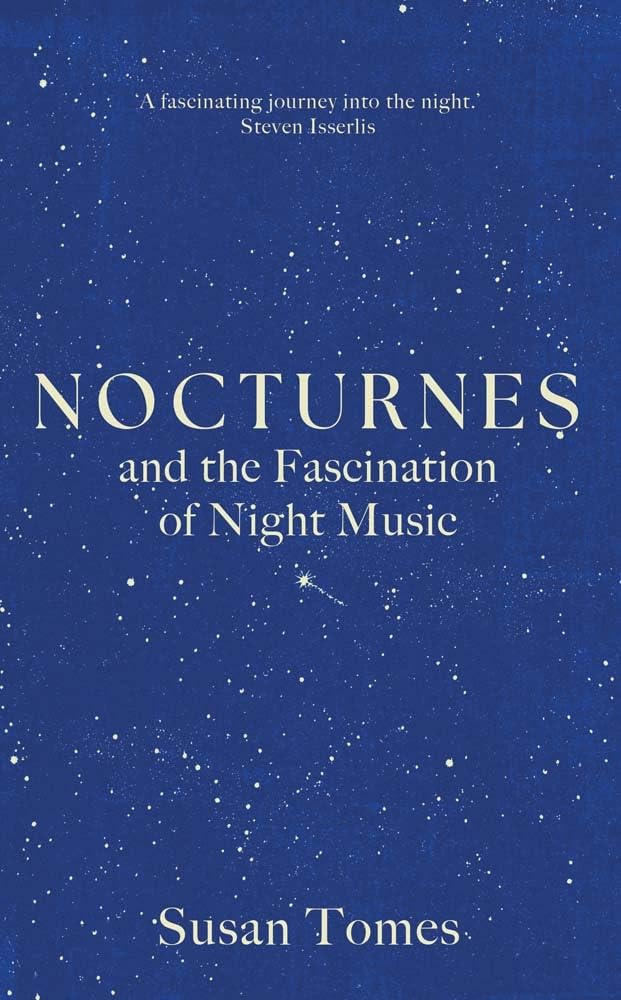
Ravel offered no reply, but neither did he deny the intensely Romantic inspiration behind his own Gaspard de la nuit. For him, as for Susan Tomes—author of Nocturnes, a new study of music inspired by the hours of darkness—it’s a given that the fictional narrator of Bertrand’s fantastic tales is “of the night,” the realm of mystery and wonder. The name Gaspard, suggests Tomes, “is a version of a Persian word meaning ‘royal treasurer,’ which we may take as alluding to an imaginary figure who guards the glittering gems of night.” Fittingly, in a book devoted to the music of fantasy and allusion, Tomes is never reluctant to let her own imagination have its say.
And if Ravel’s dark, flashing masterwork lies slightly to one side of Tomes’s main subject, the genre of piano music known as the nocturne (a “night piece”)—well, that makes it as good a place to start as any. The Romantic piano nocturne rarely does anything as crude as state its theme up front. It sets a mood, an atmosphere: typically a gentle, undulating accompaniment played by the left hand, over which the right hand’s melody floats or languishes. The trick is to make the essentially percussive piano sound as if it were singing. It’s no coincidence that the nocturne blossomed in the era of bel canto, and Tomes urges us to think of “Casta diva,” from Bellini’s Norma, as the platonic model of the piano nocturne.
More prosaically, she imagines the Irish pianist-composer John Field (1782–1837), generally agreed to be the originator of the Romantic piano nocturne, hearing coachmen singing as he slogged across Europe in the early nineteenth century. She cites the Field scholar Katelyn Clark: “This texture—the pervasively repeating, rolling broken chords against a loose, expressive melody—might well evoke the perpetual movement of the carriage in counterpoint with the song of the coachman.” We’re a long way here from the moonlit idylls and candlelit boudoirs usually associated with the nocturne. But how the form evolved—that is, how that melancholy coachman’s song became the quintessence of the Romantic piano, with consequences as diverse as Ravel’s dazzling showpiece and (in our own time) Max Richter’s eight-hour musical insomnia-cure Sleep—is the story that Tomes sets out to tell.
She’s uniquely well placed to tell it. Tomes is the author of eight books on classical music, and the elegant, perceptive music columns she contributed to The Guardian between 2001 and 2010 are exactly the sort of thing that we mourn when we lament the decline of civilized discourse in arts journalism. But she’s also a professional pianist of high distinction, whose discography ranges from Brahms and Mozart to the “English jazz” of Billy Mayerl. As pianist of the chamber collective Domus, she shared in a Gramophone Award for a disc of Fauré piano quartets. The group’s successor, the now-disbanded Florestan Trio, left benchmark recordings of practically the entire standard repertoire for piano trio.
No pianist plays that much chamber music without learning how to communicate honestly and clearly about her art, and Tomes is an outstanding practitioner of an almost impossible craft: explaining the inner workings of classical music without jargon or academic gobbledygook. A generation ago, a classical music book aimed at the general reader would have included printed music examples as a matter of course. There are none in Nocturnes, and whether their absence represents timidity on the part of Yale University Press, or a pragmatic acceptance of a wider decline in musical literacy, doesn’t really matter. The pleasant surprise is that it’s been published at all. Tomes is able to translate a performer’s technical insights, and even the physical sensation of playing, into lucid, unaffected prose.
In short, you don’t have to be a pianist to follow Tomes’s explanations at the keyboard. Chopin, she explains, declared that “the third finger is a great singer.” So why, she asks, did he specify the use of the little finger in his famous Nocturne op. 9 no. 2 (probably the one piano nocturne that everybody knows)—a finger that is “usually considered weak”? Tomes’s explanation makes it seem entirely logical. “Perhaps it was because the passage is pianissimo, and Chopin wanted the effect of ‘speaking’ rather than singing, so making the little finger move from note to note would ensure a gentler touch and introduce natural articulation into the phrase.” It all makes sense. Better, it sends you back to the music with renewed attention—always a hallmark of good music writing.
Tomes is an engaging storyteller, too. The idea of the nocturne is so embedded in the culture of piano music that it comes as a surprise just how few major composers produced these works in any quantity. For Tomes, there are only three real giants, with Chopin and Gabriel Fauré being the most celebrated. But it’s the third (and earliest), John Field, who emerges as the protagonist, and for whom you sense Tomes feels a particular affection. For all his influence, the Dublin-born Field remains little known outside of specialist histories and a circle of devoted (but discerning) pianists, including Alice Sara Ott, whose 2025 recording of his nocturnes is essential listening for anyone who enjoys this book.
Tomes follows Field from his boyhood as a piano prodigy in Georgian Dublin to his unlikely partnership with the virtuoso and piano salesman Muzio Clementi, serving as instrument-demonstrator, sidekick, and unpaid assistant. In 1802 Field followed Clementi to St. Petersburg where, tired of washing Clementi’s laundry, he decided to chance his arm as a virtuoso in his own right. The contrast between Field’s modest demeanor and the brilliance of his playing fascinated upper-crust Petersburgers, and Fildanstovo (“Field fandom”) came to define a generation of young Russian sophisticates. Characters in War and Peace listen to his music, and decades later, Tolstoy recounted with pride that his mother had been a pupil of Field.
Success proved Field’s undoing. In later life, contemporaries described him as a figure of Falstaffian debauchery, a permanently tipsy pasha in a squirrel-fur dressing gown. (According to Tomes, Field might have been the first musical celebrity to use a banknote to light his cigar.) Exhausted by touring and less than optimal lifestyle choices, Field died of pneumonia in Moscow, at the age of fifty-four. By then he had composed as many as eighteen nocturnes for piano.
More importantly, he had given them a name and an audience. Musical settings of the Vespers had existed since the Middle Ages, when the primary connotations of night were sleep, fear, and religious contemplation. By contrast, the Notturni and Nachtmusiken (serenades) of Haydn, Mozart, and their contemporaries were lively entertainment music, meant to accompany candlelit revels. Field’s masterstroke was to capture a new Romantic sensibility, and by scaling it to the piano, make it available at home to every young middle-class dreamer. The night was now a time for fantasies and delicious longing, and Tomes suggests that it was the peculiar blanched light of St. Petersburg’s summer “white nights,” in particular, that gave Field’s nocturnes their artless, translucent quality. She describes them as “roses without thorns.”
Field’s formula proved endlessly adaptable. Tomes brings the same insight to his thornier successors Chopin (who seems to have been underwhelmed by Field) and Fauré, and to the countless pianist-composers who wrote occasional nocturnes or—without using the term itself—took the idea of night music in unexpected directions. Here are Liszt, Alkan, and the Schumanns, as well as Maria Szymanowska, Sigismond Thalberg, and many less familiar names (Tomes is astonishingly comprehensive). By the 1870s, the genre was inspiring painters such as James McNeill Whistler, whose London nocturnes—radical, semi-abstract studies in color and atmosphere—themselves inspired composers such as Claude Debussy. Debussy’s ravishing Nocturnes for orchestra (1899) incorporated a wordless chorus, further blurring the sonic boundary between reality and dream.
And now (which, in classical music, effectively means any time after 1913)? Romantic genres didn’t fare well in a modernist century, though Tomes gamely follows the nocturne’s evolution through the anti-Romantic parodies of Erik Satie and Bartók’s bristling, whispered evocations of the natural world at night. But Tomes is a pianist, after all, and the keyboard is her portal to the fantastic. In attempting to address the nocturnal theme in opera and orchestral music, she freely admits that she has taken on an impossibly large task. She skates over the vast, erotically charged nocturne that is Act 2 of Wagner’s Tristan und Isolde, and swerves Richard Strauss’s bedroom scenes outright, though she’s good on Schoenberg’s Erwartung.
Chapters on nocturnes in visual art and poetry feel like they were added at the publisher’s request, and although Tomes is never less than eloquent, she barely brushes the surface. It’s impossible to blame her. Music is a universe in itself, and the only absence that really grieves me is the gorgeous nocturne from Borodin’s String Quartet no. 2 (1881)—a movement whose melting tenderness has been described as the sort of music Chopin would have composed, if he’d written for string quartet. But then, I’m a cellist.
Two living composers cited by Tomes offer a curious postscript to the nocturne’s two-hundred-year dream. Lowell Liebermann confesses to Tomes that his piano nocturnes have no specific narrative inspiration—for him, the term “nocturne” is simply a catchall for when publishers and audiences insist that his shorter piano works should have titles. And Tomes opens and closes with the extraordinary worldwide success of Max Richter’s marathon Sleep (2015): an overnight sequence of near-static music designed for dozing, for which audience members are provided with camp beds.
Are these the twin poles of classical music in the twenty-first century? Chilly formalism on the one hand and aural Soma for the passive and the stress-frazzled on the other? Tomes is more hopeful, encouraged by the fact that Richter insists on using live musicians for his Sleep performances, and the fact that two centuries after Field, the uniquely tactile sound of the piano is still at the heart of this music.
True, sleep is always an option during Richter’s work, as it doubtless was when St. Petersburg socialites, drowsy with champagne and blinis, nodded off during Field’s elegant soirees. Audience behavior is eternal. But Tomes agrees with Richter that listening to a live performance—even at its most meditative—is a fundamentally active pursuit. For as long as humans seek to square that paradox, they’ll continue to make (and listen to) the music of the night. Nocturnes, writes Tomes at the end of this wise and civilized book, “stand on the threshold between ‘day mind’ and ‘night mind,’ looking both ways.” We listen, she concludes, “because we feel we are in an enchanted place, and we sense that the music will soon vanish, as dreams do.”
Dear Reader,
Can I be direct with you?
War abroad. Socialists on the rise. AI upending human life. Endless uproar online. The modern attention economy doesn’t want readers — it wants users enslaved to the tyranny of the present.
First Things is the antidote: literary excellence, timeless truths, and a fixed point of reference in a culture that has lost its bearings.
But we can’t do it without readers like you.
Our goal: Raise $150,000 by November 1 to sustain First Things in the year ahead.
Your gift anchors readers in the permanent things.
Make your Fall Campaign gift now using the button below.
If you have any questions or would like more information, please contact Giovanni Del Piero, Director of the Editor’s Circle, at gdelpiero@firstthings.com or 212-627-1985.

YOU MIGHT ALSO LIKE
A Culture of Parricide
I learned a new word the other day: déploration. It’s the French, directly from the Latin, for “lament.”…
The Chariot Burials
Wheeling through the clotted earth, / Bronze, bone, and leather clumped in clay...
William of St. Thierry
“Where love and understanding join, hearts are tranquil, / They rise above the turmoil of this world…
