
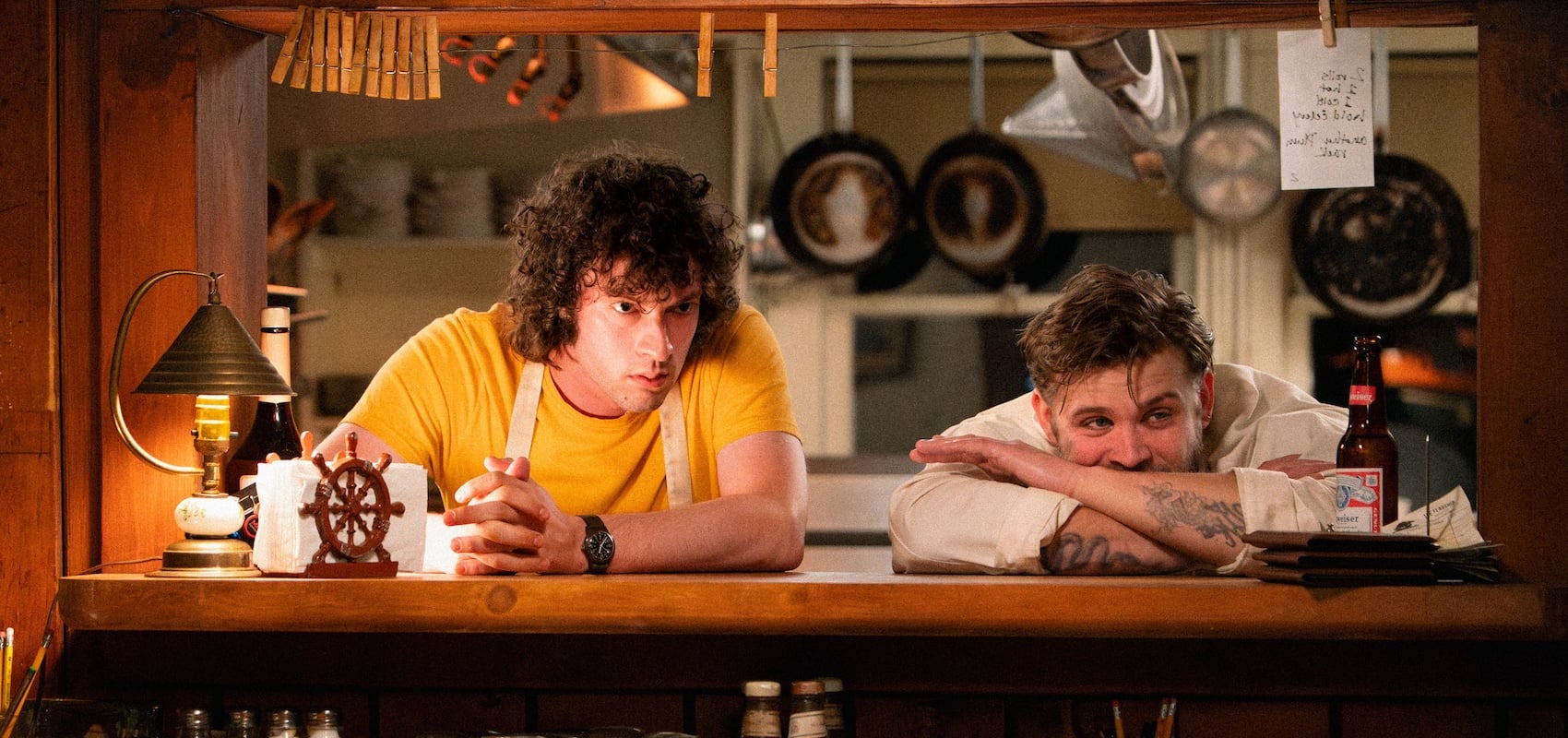
In his breakout 2000 memoir, Kitchen Confidential: Adventures in the Culinary Underbelly, Anthony Bourdain recounts his early years as a cook in Provincetown, Massachusetts. The memoir serves as the basis for director Matt Johnson’s Tony, but Bourdain fans will immediately recognize that Johnson and the film’s writers took many liberties, condensing multiple summers, people, and events from Bourdain’s life into a cinematic bildungsroman. In reality, the events that led to Bourdain’s time at the Culinary Institute of America were much more pedestrian. The amalgamation pays off, as the film serves as a portrait not only of Bourdain’s youth but of his entire life, complete with his darker struggles and unfulfilled expectations.
After losing out on an expected writing fellowship, “Tony” (Dominic Sessa), a cocky, nunchaku-carrying lout, follows a crush (Emilia Jones) to Provincetown, where a harsh but wise Portuguese chef takes him in and introduces him to the life of chefdom. At the same time, a charismatic cook named Sal (Leo Woodall) draws him into a world of drugs and promiscuity.
Both of these characters represent two warring sides of Bourdain’s personality. The self-destructive, heroin-addicted, punk-rock persona helped spawn today’s ubiquitous “badass,” tattooed celebrity chef. But it is the introspective and hard-working better half that many of Bourdain’s fans grew to appreciate, and it shines through in “Chef” (played beautifully by Antonio Banderas). Chef is obsessively punctual, thoughtful about food and its importance to local cultures, industrious, knowledgeable, and lonely—much as Bourdain was in real life.
Chef is also deeply religious. He chides his cooks for using the Lord’s name in vain (while ignoring their drug use and sexual innuendos), and he forces Tony to attend Mass with him. There, Tony lingers on an image of the Blessed Mother. In real life, Bourdain referred to himself as an atheist (he also does so in the film), although his family was Catholic on his father’s side and Jewish on his mother’s. He once stated in an episode of No Reservations, “I’m not exactly a good Catholic. I do have the paperwork to suggest that I might be.”
In what is perhaps a bridge too far, the film also seems to imply that in his darkness, haunted by the black dog of depression his entire life and suffering from terrible bouts of addiction, Bourdain served as a sort of expiating figure. Chef calls Sal, the devil on Bourdain’s left shoulder, a “sin-eater”—someone who, in old folk tradition, would eat food placed upon a corpse and take the dead person’s sins upon himself. Bourdain was certainly no saint, although that may be exactly why so many people have found him relatable.
Lately, the internet has taken to dismissing Bourdain and what some call “Bourdain-bros”—a certain type of Eat Pray Love bohemian man who deals in faux profundity. But the real Bourdain encouraged an openness to others that is easily taken for granted and doesn’t come naturally to most. Food is universal, yet also deeply autochthonous. It offers a window into another culture. Few things are more intimate than a shared meal. In a world that often dismisses food service as low-status work, Bourdain insisted on its dignity.
By the time Bourdain committed suicide at the age of sixty-one, he had a life that seemed enviable from the outside. He had a daughter, a romantic relationship with a beautiful woman, and arguably the best job in the world—traveling, eating great food, and writing about both. In reality, things were much grimmer, as they often are. Bourdain’s suicide was not the inevitable result of a disposition of character. There were particular and private events that led up to it, which have been discussed ad nauseam. When watching his shows and reading his books, however, one cannot help but feel that he had great expectations of the world that could never be fulfilled. This fact inevitably led to his melancholy.
In the film, Chef tells Tony the story of François Vatel, a chef in seventeenth-century France. Vatel ran himself through with a sword after a lavish banquet he threw in honor of Louis XIV fell short of his own high expectations. It is no accident that Matt Johnson chose this story for the film. The world could never live up to Bourdain’s expectations, but people of faith know that it doesn’t have to. There is a world beyond this one. It is ours by birthright, and it’ll fulfill and surpass every expectation that this one cannot.

YOU MIGHT ALSO LIKE
SlutCon’s Emotional Void
The tech-rationalist phenomenon “SlutCon” caused quite a stir online, perhaps predictably. SlutCon was a multi-day retreat and…
The Boys on the Brink
In the latest installment of the ongoing interview series with contributing editor Mark Bauerlein, Leonard Sax joins…
Serial Liar, Serial Comma
How would you write a public letter that you know will become front-page news? Would you write…
