
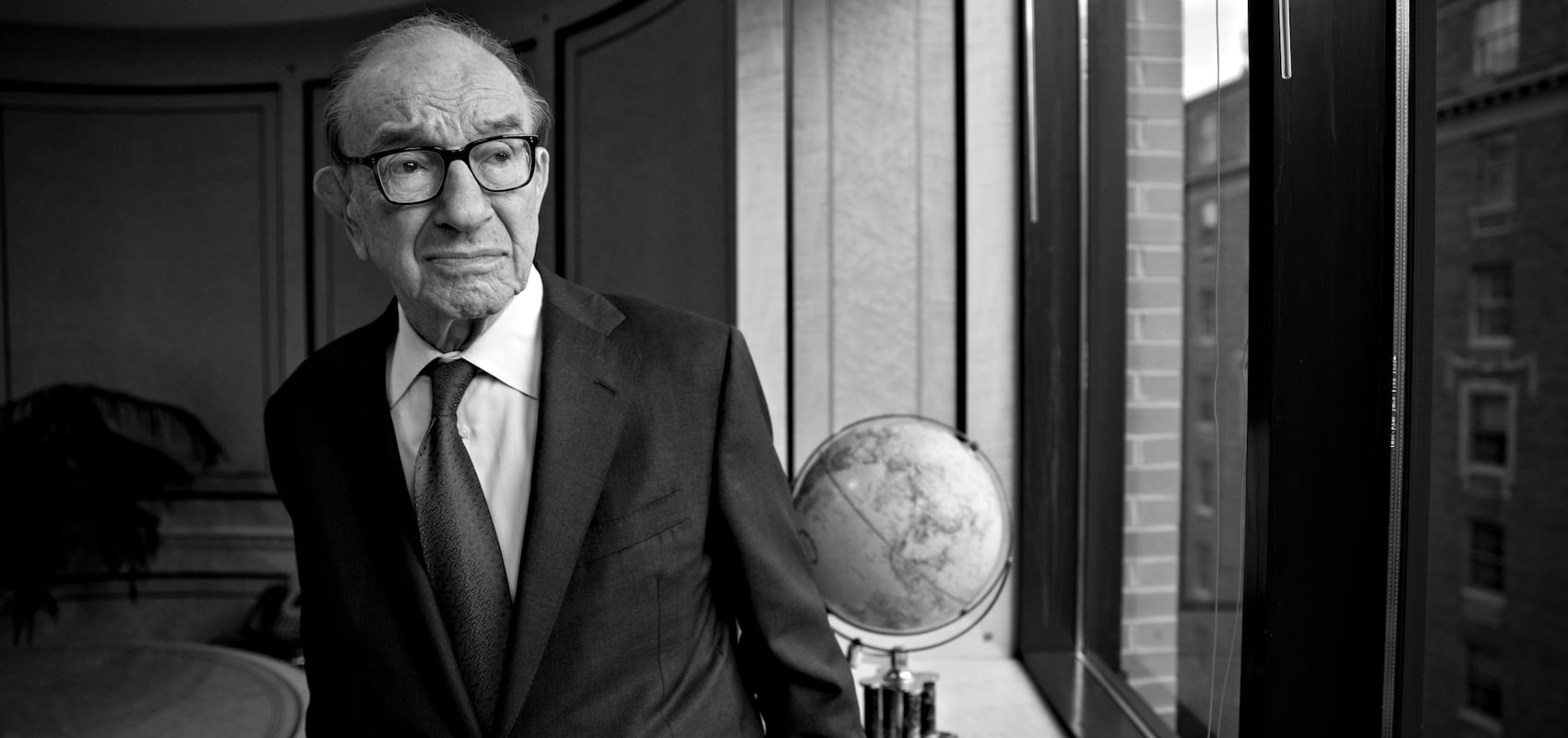
Alan Greenspan died this week at the age of one hundred. Greenspan had a long time to make his imprint on the world—and make his imprint he surely did. Perhaps no face is as synonymous with modern central banking as Greenspan’s. This was no accident. The media regularly touted Greenspan as a “Master of the Universe.” He was the central banker that put central banking on the map. Before Greenspan, central bankers were not widely known outside of technical economic circles and bond markets. Greenspan put a face to the profession and, during his tenure, gave the position a preeminence that it had not had since the founding of Sweden’s Sveriges Riksbank, the world’s first central bank, in 1668.
Part of the attention Greenspan attracted stemmed from his tenure as chairman of the Federal Reserve from 1987 to 2006. The length of his tenure as chairman was almost as impressive as his long life. But his fame was no doubt aided by a long and concerted public relations campaign dating back at least to 1968 and the establishment of the Nobel Prize in Economics. Alfred Nobel’s will, in 1895, allocated endowments for prizes in physics, chemistry, physiology, literature, and peace. The Nobel Prize in Economics was uniquely created in 1968 by the Sveriges Riksbank, which to this day finances the prize.
In their book The Nobel Factor, Avner Offer and Gabriel Söderberg document how the prize emerged out of a conflict between the social democratic Swedish state and the Riksbank, which was dominated by what would now be called “neoliberal economists”—that is, strong believers in free market economics. The prize was effectively created to bestow an aura of scientific authority on the discipline of economics—an authority that eventually culminated in a push to make central banks independent of government, based on the argument that they were engaged not in normal political policymaking but in scientific-technocratic management.
Greenspan’s tenure at the Fed was arguably the culmination of this process. It is ironic, although fitting, that the least “scientific” of modern central bankers became the human embodiment of the scientific-technocratic claims of the economic managers. Greenspan was rarely if ever portrayed as a scientist in the press; rather, he was portrayed as a sort of magician, a druidic figure who could make the economy grow much the same way shamans of the past made the rain fall and the harvest bountiful. The culmination of this drive to clothe economic policymaking in the imprimatur of science was the creation of a new religion—call it “pagan capitalism.”
Greenspan was the perfect man for the job. It was and is an open secret that Greenspan was not strong on technical economics. He moved through the world by intuition, and he was notoriously difficult to pin down—perhaps, it must be said, because there was not a great deal to pin down. Greenspan’s entire career trajectory was a giant self-contradiction. He emerged from the intellectual circles associated with Ayn Rand and the “objectivists”—a philosophical cult that Rand created and promoted especially in the 1960s and 1970s. The objectivists preached extreme individualism and market capitalism. Reading Greenspan’s writings at this time, we find a man that was, like many libertarians, in principle opposed to modern central banking. This was not a youthful dalliance. His 1966 ode to the gold standard, “Gold and Economic Freedom,” was written when Greenspan was forty years old.
Libertarians typically distrust modern central banks because they can engage in money creation, which they argue interferes with the “natural” workings of the market economy. Yet Greenspan himself was the high king of money creation and market manipulation—so much so that central bankers of the old school were horrified by his excesses. When the hedge fund Long-Term Capital Management (LTCM) went bankrupt in 1998, Greenspan brokered a bailout of the fund in a move that many read as central bank meddling in markets. “Why should the weight of the federal government be brought to bear to help out a private investor?” former Fed chairman Paul Volcker asked in a speech in Boston around the time of the bailout. It was under Greenspan’s tenure that the “Greenspan put” was established: Any time it looked like stock markets were sagging, the magician in chief would wave his magic monetary wand and markets would rally.
Debates around Greenspan’s legacy are typically between social democrats and Keynesians, who decry his adherence to free market economics, and neoliberals, who support his free market beliefs. Yet the neoliberals can never really justify the sort of arbitrary and unscientific interventions that Greenspan undertook. And the Keynesians can never really come to terms with the fact that the easy money policies associated with his tenure were precisely those advocated by John Maynard Keynes himself and the social democrats in the 1920s and 1930s. I would argue that Greenspan embodies something more fundamental that transcends the political “right” and “left” of today: namely, the rise of “hyperliberalism.”
Hyperliberalism is liberal ideology in its most advanced form. It is a system of ideas and policies premised on the belief that government institutions should work to maximize societies’ embrace of liberal social and economic principles. As both a devoted disciple of Rand’s radical liberalism and a central banker who actively shaped market behavior, Greenspan perfectly embodied the hyperliberal moment that emerged after the Cold War. His death, and the controversy that surrounds his career, in turn perfectly embodies its end—and the beginning of a new world.
Image by ASSOCIATED PRESS
Dear Reader,
Can I be direct with you?
War abroad. Socialists on the rise. AI upending human life. Endless uproar online. The modern attention economy doesn’t want readers — it wants users enslaved to the tyranny of the present.
First Things is the antidote: literary excellence, timeless truths, and a fixed point of reference in a culture that has lost its bearings.
But we can’t do it without readers like you.
Our goal: Raise $150,000 by November 1 to sustain First Things in the year ahead.
Your gift anchors readers in the permanent things.
Make your Fall Campaign gift now using the button below.
If you have any questions or would like more information, please contact Giovanni Del Piero, Director of the Editor’s Circle, at gdelpiero@firstthings.com or 212-627-1985.

YOU MIGHT ALSO LIKE
Three TikToks in a Trench Coat
On today’s episode, Meagan O’Rourke joins Virginia and Germán. Reporting on Gen-Z trends has become trendy. It’s…
The Cold Beauty of Jan Morris
Jan Morris (1926–2020) was a writer of astounding gifts who not only recorded history but made it.…
A Muslim Answer to Muslim Immigration
Modern America worships at the altar of youth and eagerly tracks in polls and market research its…
