
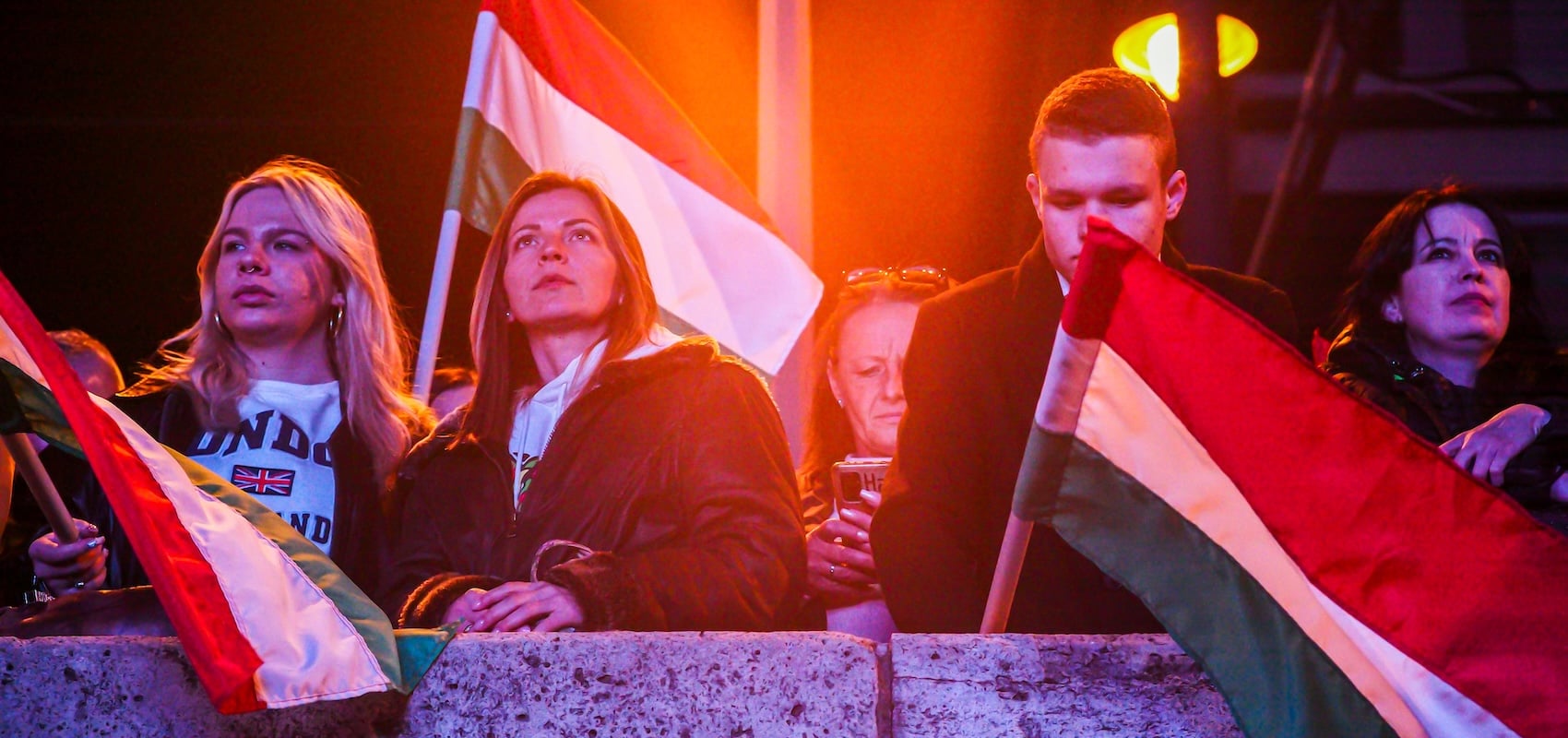
On Sunday night, after a heated and chaotic election campaign, Hungarian prime minister Viktor Orbán and his Fidesz party lost in a landslide after sixteen years in power. The result of the election is definitive: The opposition leader Péter Magyar’s Tisza party has won 138 seats—more than two-thirds of the total seats and enough to secure a supermajority. This supermajority will allow Magyar and his party to undertake extensive and deep changes in Hungary that could reverse a lot of what Fidesz has achieved in their sixteen years in power.
After every election, people will try to read their own concerns into the results. But if we take a step back, the Fidesz loss can be explained quite simply: Every ruling party that has faced re-election and has presided over the post-2022 inflation shock has lost ground—and most have been thrown out by voters. It really is “the economy, stupid”—and this shows up consistently in surveys about the concerns of citizens. Hungary, like many countries in the central and eastern European region, was hit harder by this crisis than most. Fidesz thought they could explain that the inflation was the result of the Ukraine war, which they opposed, and not due to any policy mistakes that they made. But voters did not buy it.
Despite its small size, Hungary has become a disproportionately powerful voice in global politics, especially in the last decade. This means that to understand what Magyar’s victory means, we must take at least three different perspectives on it. From the standpoint of domestic politics, Magyar effectively ran on Fidesz’s own platform—promising to keep migration low, maintain Hungarian cultural nationalism, and keep the generous family support system that Fidesz built in place. This is no doubt a sort of “embedded victory” for Fidesz; their platform is solid and voters continue to support it after sixteen years. But there are strong doubts in Hungary that Magyar will be able to deliver. While Magyar comes from Fidesz, the people that he has surrounded himself with and who will run the government ministries are standard European liberals.
The liberals who jumped on board with Magyar have the same laundry list of agenda items that we find among liberals everywhere. Their friends in Brussels will no doubt back them up on this as they have conflated many of Hungary’s more socially conservative policies with “rule of law” violations, but ultimately these issues are of secondary interest to Brussels. For Brussels, the Hungarian election was about two things: the Ukraine war and the creation of a European federalist superstate, two issues that have become increasingly intertwined in recent years.
European Commission President Ursula von der Leyen made this quite explicit the day after the election when she said: “Moving to qualified majority voting in foreign policy is an important way to avoid systematic blockages, as we’ve seen in the past. And we should use the momentum now really to move forward on that topic.” This is no easy task to get done, but it shows a clear desire to ensure that smaller countries cannot block the will of the bigger countries. The fact that this issue has been tied to foreign policy shows neatly how, as Orbán has been warning for months, the European Union is moving from being an economic union to a war union.
In his acceptance speech, Magyar surprised some with his stance that Hungary will continue to rely on Russian energy supplies, an issue that Hungary has been criticized for by Brussels. But this should not be misinterpreted: Brussels bureaucrats know that many countries in the region, due to their energy grids having been built in Soviet times, are unavoidably reliant on Russian energy. They merely used this as a cudgel with which to beat Orbán. There are questions about how much Magyar desires to go against the whims of Brussels, but he will soon find out that the pressure they can bring to bear—especially given the composition of his own party—will overwhelm him if he tries to oppose them.
Finally, there is the question of the intellectual community that has built up in Orbán’s Hungary. Broadly speaking, this intellectual community is associated with alternative currents in conservatism and the so-called “postliberal movement.” It relies on the alternative intellectual ecosystem that Fidesz-aligned organizations have created. These have raised the ire of those in Brussels who see them as a direct challenge to their liberal intellectual credibility. Diversity of thought is not a particularly attractive prospect for many in Brussels, not least because their own late-liberal ideology has become so thin, authoritarian, and unconvincing. Significant efforts will be made to dismantle this ecosystem as best they can.
Strangely, this aspect of the election has received much attention in the United States. Those on the left and the more libertarian-leaning right seem convinced that an attack on the Fidesz-aligned intellectual ecosystem will destroy alternative conservative and so-called “postliberal” thinking. This is a strange conceit and speaks to the limited imaginations of those who hold onto it. No doubt, Fidesz has been an incubator of alternative thinking in transatlantic conservatism, but these ideas are in the ether and are unlikely to go away any time soon. In fact, many alternative conservative and “postliberal” thinkers in Hungary have arguably been unable to work as much on their ideas because they have been distracted with realpolitik.
The interruption in Hungary will likely be a temporary one anyway. Magyar and his party have been handed an extremely difficult set of circumstances. Due to the continued blockage of the Strait of Hormuz, Europe is on the brink of an energy crisis that will hit significantly harder than the 2022 inflation that nailed shut the coffins of so many ruling parties in Europe. Orbán could have used the goodwill he has built up in Moscow and Washington to secure access to at least some energy supplies. Magyar, on the other hand, has no cards to play. His team, who have no experience in government, will soon be faced with the challenge of managing this crisis while simultaneously purging government ministries of experienced operators who they dislike due to their closeness to Fidesz. Since Hungarian voters ultimately voted on cost-of-living issues, the smart money is on the honeymoon between them and Magyar being a short one. Fidesz’s role in the opposition will mainly consist of saying: “I told you so.”
Photo by Neil Milton / SOPA Images/Sipa USA)(Sipa via AP Images
Dear Reader,
Can I be direct with you?
War abroad. Socialists on the rise. AI upending human life. Endless uproar online. The modern attention economy doesn’t want readers — it wants users enslaved to the tyranny of the present.
First Things is the antidote: literary excellence, timeless truths, and a fixed point of reference in a culture that has lost its bearings.
But we can’t do it without readers like you.
Our goal: Raise $150,000 by November 1 to sustain First Things in the year ahead.
Your gift anchors readers in the permanent things.
Make your Fall Campaign gift now using the button below.
If you have any questions or would like more information, please contact Giovanni Del Piero, Director of the Editor’s Circle, at gdelpiero@firstthings.com or 212-627-1985.

YOU MIGHT ALSO LIKE
Foucault’s Idol of Nothingness
Today marks the 100th anniversary of the birth of Michel Foucault. He was influential in his lifetime,…
Forget Odysseus. Aeneas Is the True American Hero.
Who is our Odysseus? Or more precisely, who is the most Odyssean hero of American film? Matt…
Meet the Post-Religious Right
There have been many books written about the online right and the Trump movement, most by people…
