
Can we have a vibrant, free, and pluralistic society without the liberal dogmas of neutrality and diversity? Are we able to defend the dignity of the human person without liberalism’s commitment to the autonomous, atomized self? Does liberalism provide a public philosophy religious people can affirm, at least in its broad outlines? Or should we seek a more substantive vision based in strong claims about moral authority and the common good? Should we want an America “after liberalism”?
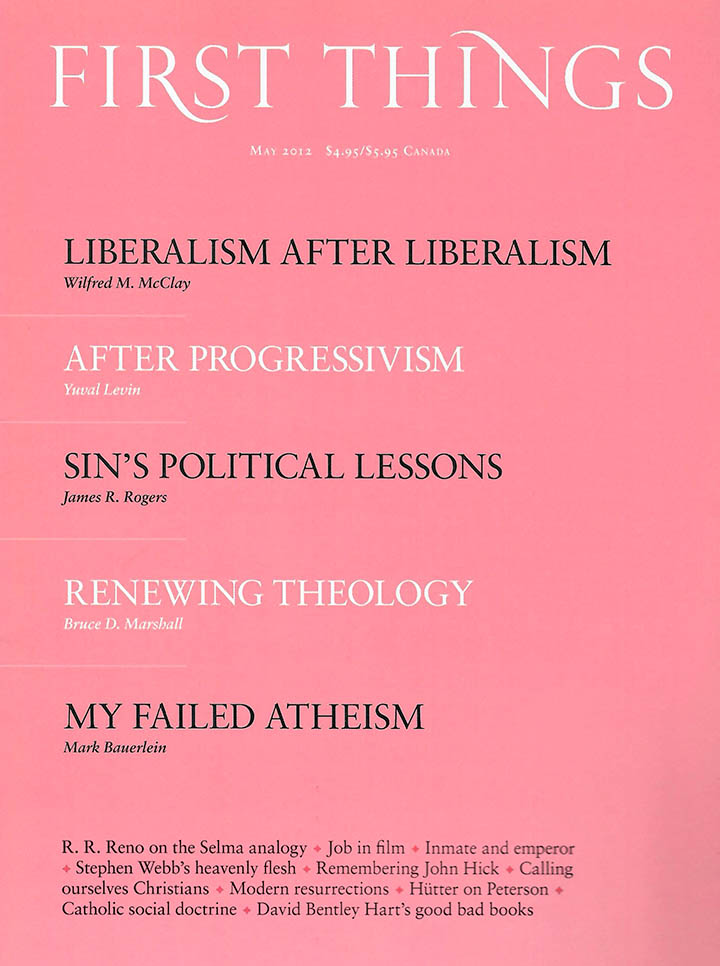
Fundamental questions these, and the topics of the After Liberalism seminar, composed of a group of some twenty scholars, First Things editors, and others who met in late February with the support of the Simon/Hertog Fund for Policy Analysis and of Fieldstead and Company. In this issue we present one of the main papers, Wilfred McClay’s “Liberalism After Liberalism,” with responses from James Rogers and Yuval Levin. The other major papers—by Patrick Deneen, with responses from Paul Griffiths and Daniel Mahoney; and by David Yeago, with responses from Shalom Carmy and Thomas Joseph White—will follow in the next two issues.
Richard John Neuhaus often spoke of “the American experiment,” our democratic project that is as much a cultural commitment as a constitutional system of representative and limited government. In a deep sense, he thought, we’re all liberals.
And rightly so, if by liberalism we mean the defense of the dignity of the human person against coercion and domination. But today that’s not what liberalism means. Going back to John Stuart Mill’s influential little book, On Liberty, modern liberals have come to focus on cultural or moral empowerment. For someone who calls himself a liberal today, we are not free if we don’t have the means to do what we want.
As Mill observed, laws control behavior, but a social consensus penetrates so deeply into our personalities that our consciences themselves enforce society’s rules. Mill thought that the dominance of a social consensus was the most profound kind of tyranny, and he argued that if we care about liberty we should diminish its power so that people can have the freedom to undertake “experiments in living.”
After the 1960s, liberalism in America continued to support the expansion of the welfare state, but to a great degree the unifying ideals of liberalism have shifted from economic fairness to social and cultural liberation. As a result, most contemporary liberals support attacks on traditional cultural norms. Liberals champion transgression, not because they want ordinary people to smear themselves with chocolate and sit naked on street corners, or to urinate in jars with crosses in them, but because transgression empowers in exactly the sense Mill desired. It weakens the social consensus and thereby expands the individual’s moral freedom.
This vision of moral empowerment is why the dictatorship of relativism is seen by liberals as a great achievement. It’s good for children to believe that there are no (or at least very few) moral truths, because a weakened moral authority gives them more freedom to “find their own way” and undertake “experiments in living.” It is good for them to be freed from the inherited authorities of parents, community, and church, because these “impose values” that restrict the child’s ability to “grow” into “who he is.”
In a dictatorship of relativism the cardinal virtue becomes nonjudgmentalism, the ideal habit of mind to supervise moral and cultural liberation. Our liberal culture prudently restrains excesses (get HIV tests regularly!) and provides the resources needed (free contraceptives!), but it does so with therapeutic affirmations of “personal choices.”
This ideal of lifestyle liberation is part of the moral mission of moral relativism. The dictatorship of relativism is not a regime of coherent principles of freedom, fairness, or even reasoned debate; it’s a vision of empowerment, helping people to have the freedom to live as they please. This goes a long way to explaining the current weaknesses and dangers of liberalism, many of which preoccupied us at the seminar.
For example, as Matthew O’Brien pointed out, liberalism’s own self-image has changed. Not long ago liberals thought of themselves as advancing a governing philosophy based on strong principles and firm convictions. Today liberalism can’t appeal to strong, robust moral truths, at least not overtly, for they threaten the dictatorship of relativism and therefore compromise the goal of lifestyle liberation. So liberals defend liberalism as “mainstream” rather than true. Richard Rorty was explicit: He did not pretend to prove or justify the liberal project. Instead, liberalism rightly rules because it’s the way we do things around here. Conservatives are not to be engaged in debate. They are to be denounced as “mean-spirited” and “divisive.”
What was once a fairly broad governing liberal consensus has become insular and increasingly self-enclosed. In his new book The Righteous Mind, psychologist Jonathan Haidt observes that Americans have a range of moral concerns: caring for the weak, fairness, liberty, loyalty, respect for authority, and sanctity. His studies suggest that hard-core liberals are animated by only half of them—caring for the weak, fairness, and liberty—though the rest of the country, interpreting them differently, affirms all six. As a result, liberals find conservatives alien, nearly always interpreting conservative political opposition to liberal dominance as motivated by irrational fears such as racism or “homophobia” or “fear of the Other” rather than as morally serious beliefs about the common good.
Notice which of the six from Haidt’s list liberals do not affirm. Loyalty, respect for authority, and sanctity require the preservation and transmission of robust and commanding moral truths. Lacking these concerns, progressives have very little of what sociologists call social capital at their disposal, which is to be expected, since enduring communities require loyalty and respect for authority. As a result, they must bend the institutions that fall under their control to serve their political goals, and government power becomes an indispensable tool for empowering “experiments in living.”
In recent years popular referenda about the definition of marriage have consistently affirmed the traditional understanding. All cultures (aside from those few dominated by contemporary liberals) understand marriage as a union of male and female. It’s not in spite of but rather because of this massive and continuing cultural consensus that liberals adopt an aggressive and tyrannical approach. Sexual “minorities” must be “empowered,” and that means pulverizing the opposition. At the overwhelming majority of colleges and universities in America, for example, a job candidate known to be an articulate spokesman for this traditional and universal view will be blackballed, while professors in endowed chairs speculate about the morality of infanticide.
If this is what liberalism has become, does it have any continuing value? As Joseph Weiler pointed out at the seminar, there are many places in the world where a strong dose of liberalism would do a great deal of good. All the participants acknowledged that in the modern era, liberalism, however understood, has taught us how to live with pluralism, especially religious pluralism. Given the passions evoked by religious faith, the liberal achievement of religious tolerance and pluralism is no mean thing, and social conservatives need to affirm it.
At the same time, our deliberations were overshadowed by a dark foreboding. As the seminar drew to a close, Bruce Marshall observed that the bonds of citizenship function as a kind of friendship, and friendship requires agreement about ultimate ends. Given the reality of pluralism, perhaps we should all be liberal in the sense of expecting a relatively thin agreement about ultimate ends in public life. But no social order can be entirely neutral about moral truth. Diversity cannot be infinite, and our solicitude for the individual cannot involve granting plenary liberties of life and conscience to citizens. Not everything can be permitted; some things, even some ideas, must be prohibited.
It was a sobering insight, one that clarified our situation. Today liberalism cleaves to Mill’s vision of freedom: Life is more and more enhanced as people have more and more freedom to decide how to live their lives, including the freedom to decide what is right and wrong. Social life is fuller and people are happier when free from inherited moral and cultural authority.
Religious faith stands opposed to this vision of freedom and thus to the form that modern liberalism has now taken. Religious authority commands our loyalty, and it drives us toward the all-encompassing and demanding ideal of sanctity. When Jesus says that the truth shall set us free, he sees us in the thrall of sin, and we enter into the freedom he promises as God’s life-giving authority penetrates more and more deeply into our lives. We are empowered insofar, and only insofar, as we accept the discipline of moral and divine truth.
Liberals like to imagine that religious conservatives are censorious scolds, the supposed extremists responsible for our rancorous public debates about moral issues. But the opposite is more nearly the truth. Lifestyle liberationists must view a religious commitment to the humanizing role of moral and religious authority as heretical, an approach that is beyond the pale of the social consensus because oppressive, and therefore not to be tolerated, or at least tolerated as little as possible. It’s this conclusion that’s making liberalism illiberal. And it’s this betrayal of liberalism’s liberality that’s polarizing our country.
As I said, the seminar ended on a sobering note.
Rowan Williams Steps Down
The current archbishop of Canterbury has announced that he will step down at the end of this year. Williams is widely respected as a first-rate scholar, a creative thinker, and a generous man, but his tenure as head of the Church of England and symbolic center of the Anglican Communion has been difficult, which is not surprising.
No successor to St. Augustine of Canterbury could have sailed smoothly through the last decade of Anglican conflict. Anglicanism in the West (England, Canada, Australia, and America) has been rearranging its theological priorities to hold on to whatever remains of its role as chaplain to right-thinking (which of course means left-leaning) people who are spiritually inclined. This has meant the subordination of doctrine to various contemporary claims about rights. Thus Anglicanism in the West now has women priests and bishops, as well as homosexual clergy.
In recent years Anglicanism in the developing world has resisted these changes and has done so with an increasing confidence that reflects a very different trajectory. A decade or so ago an Anglican bishop from Southern Sudan stayed with me. Over dinner one evening, I asked him how many priests were active when he took over as bishop in 1982. “Eight, perhaps ten,” he replied. How many are there now? I asked. “Two hundred,” he reported with his modest smile. In his adult life he had witnessed the Christianization of his people. He was not a man inclined to think Christianity needs to be refashioned to fit the culture, because his tribal culture was being so thoroughly refashioned by Christianity.
Rowan Williams never fit well into this basic split. His politics have always been progressive, and in a post-sixties context that means consorting with lifestyle liberationists and multiculturalists whose views of human flourishing are largely at odds with traditional Christianity. Like so many baby boomers, Williams is antibourgeois, a sentiment not entirely at odds with Christianity but one that tends to take for granted the cultural capital that sustains a life of piety. Although his arguments were always far richer and more substantive than the usual ones, he found ways to affirm women bishops and homosexuality.
Yet his piety tends to be traditional, and his theology closely tied to the classic sources. His essays and books on the Church Fathers are superb, not just rich in learning but also rich in spiritual wisdom. He has not taken up the usual liberal Protestant project of using theological categories to empty the gospel of its power and force. An influential teacher in his first career as a professor, he is rightly seen as an accomplished Christian intellectual.
During his years as archbishop of Canterbury, Williams was unable to articulate a synthesis that would draw the sting out of the conflict between the parties contending for the future of Anglicanism. His combination of progressivism with orthodox habits of mind never became a stable, coherent outlook. I doubt it can. The progressive side always seems to have trouble with the “once delivered” part of orthodoxy’s affirmation of “the faith once delivered.”
From the Editor’s Desk
Every month Richard John Neuhaus would tackle substantive issues in some depth in the Public Square and then pen the wonderful While We’re At It section. When I took over last year, I committed myself to writing the opening reflections in the Public Square. David Mills applied his ample skills to producing the While We’re At It section. He’s been writing it for many issues now, and with this one his byline appears for the first time. Thanks, David, for renewing what was for so many of us, for so many years, the first thing we read in First Things


YOU MIGHT ALSO LIKE
The Left Is Right About the Bible
“Texas Public School Students Will Be Required to Read the Bible,” warned a headline in the New…
Two Spectacles, Two Frances
The Stade de France, the country’s largest soccer stadium, holds about 80,000 fans. On Friday, September 25,…
Lindsay Clancy and America’s Canadian Future
On September 4, the judge declared a mistrial in the Lindsay Clancy case, the result of one…
