
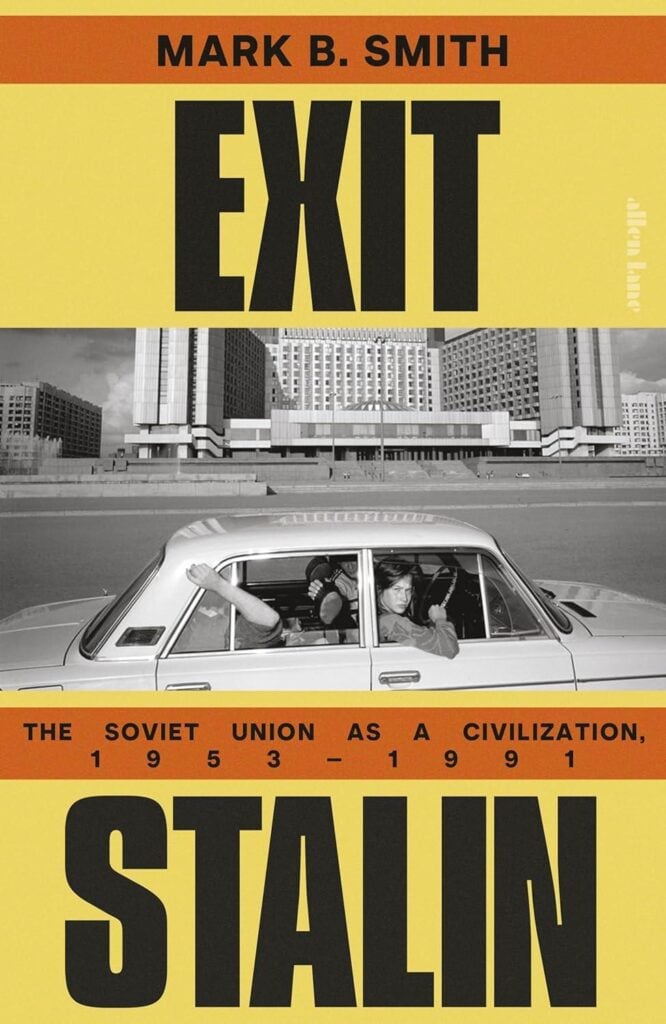
Exit Stalin:
The Soviet Union As a Civilization, 1953–1991
by mark b. smith
w. w. norton, 576 pages, $49.99
Vladimir Putin chose to invade Ukraine in the month of February, rather than waiting a few weeks longer, because the spring thaw was about to turn Ukraine’s soil into a muddy morass on which Russian tanks could not travel. The annual thaw in Slavic lands is a time of hope but also difficulty, explains Mark B. Smith in his new history of the Soviet Union after Stalin. “Over several weeks, temperatures fluctuate above and below zero. Huge reserves of snow melt. Water flows and then freezes again. Streets become filthy. Rural roads turn impassable. From beneath the ice, lost items and old waste appear. This is a time of awkwardness and uncertainty. It lacks the pristine qualities of winter or the joy of spring.”
The equivocal nature of the Thaw metaphor for the midcentury period of Soviet liberalization is lost on Western audiences, but for Russians it was essential to the term. The decade after Khrushchev’s “Secret Speech” denouncing Stalin’s crimes in 1956 was a time of incomplete freedom. Yes, the old era’s climate of fear abated, novels and movies reflected a new spirit of openness, and millions of prisoners were released from the gulag. On the other hand, no one could be sure how far this new freedom extended or whether it was only a temporary reprieve.
The Thaw took its name from a novel by Ilya Ehrenburg published in 1954. The novel itself is pretty trashy stuff. The main plot of The Thaw is about a female schoolteacher who falls in love with an engineer at the factory where her husband works. She leaves her husband, not for the engineer but for the sake of her own independence, and on the last page she and the engineer kiss. Whatever freshness Soviet readers detected in the novel was not political but psychological. Its emphasis on self-discovery was a relief after years of socialist realism, when it was regarded as bourgeois and decadent to focus on individuals rather than classes.
The thesis of Exit Stalin is that Soviet society after 1953 enjoyed “some measure of legitimacy” and “normality.” This was controversial to say during the Cold War, but it is plainly true. The average Soviet citizen was a believer in socialism and sincerely proud of its accomplishments, which, after all, included defeating the Nazis and delivering a rising standard of living. In 1955, only four Soviet citizens in a thousand owned a refrigerator and five in a thousand owned a television. By 1985, it was 91 percent and 97 percent.
Russians knew their system was flawed. It was hardly news to them that socialism had a lot of red tape, for example. The novel The Seekers (1954) by Daniil Granin is summarized by Smith in this way: “An engineer who has designed a new locating device is stymied by bureaucrats, careerists and Party busybodies; unlike them, he is committed to pure research and social progress.” That was the kind of criticism that the Soviet government welcomed. Socialism is imperfect, and the solution is more socialism.
The break with the Stalin era was widely understood and explicit. People were no longer shot in the back of the head in the basement of the Lubyanka or even thrown haphazardly into camps. There had to be a trial. The KGB was not allowed to torture people. “If you’d landed with me ten years ago, you would have confessed that your grandmother had balls,” one interrogator grumbled to a dissident in the 1960s. In the third edition of The Origins of Totalitarianism, published in 1966, Hannah Arendt states in her introduction that “the Soviet Union can no longer be called totalitarian in the strict sense of the term.”
So no one was afraid of the midnight knock on the door anymore. In that case, what was the Cold War all about? Why did the United States have a decades-long, very expensive foreign policy dedicated to eliminating the Soviet system if it was, as Smith says, basically normal? That is the other main theme of Exit Stalin, for Smith believes that the more subtle oppression of the post-Stalin era was inhumane in its own way. “Even if most people lived their lives in peace,” he writes, “they did so in a wider context of injustice.”
For the nature of this injustice, Smith looks to the dissidents. These were “a very specific corner of the Soviet intelligentsia,” he admits, which is another way of saying they were a tiny minority of a tiny minority. Very few people agreed with their criticisms of Soviet society. Nevertheless, their activities loom large in Western histories of this period. Smith devotes several pages to the trial of Andrei Sinyavsky and Yuli Daniel, two writers convicted of anti-Soviet agitation and sentenced to the labor camps in 1966. In 1970, Eduard Kuznetsov and Mark Dymshits were put on trial for hijacking a plane in an attempt to fly a group of Jewish refuseniks to Israel after they had been refused permission to emigrate. They were found guilty and sentenced to death, a sentence quickly commuted to fifteen years in prison.
Smith assumes these incidents show that the Soviet regime was self-evidently evil. “This awful case showed the special pathology of Soviet civilization,” he writes of the Kuznetsov–Dymshits case. I am not sure about “special.” Hijacking a plane is against the law in the United States, too, even if you have a good reason. The fact that the refuseniks believed themselves to be above the law did not endear them to the Russian public.
The Sinyavsky–Daniel trial was a good illustration of the new era of “socialist legality.” Neither man was physically coerced during interrogation. The prosecutors did not just rail against them as enemies of the state but took pains to demonstrate that the writers had violated Article 70 of the criminal code, which banned “slanderous fabrications which defame the Soviet state and social system,” in the works they had published pseudonymously in the Western press. It was not that they had criticized the Soviet Union, the judge explained. It was that they had slandered it:
I want to clarify something. Imagine a communal apartment where Ivanova is arguing with Sidorova. If Ivanova were to write that a certain lady is ruining another lady’s life, that would be an allusion, an allegory. But if she were to write that Sidorova was pouring garbage into her soup, then that would be grounds for legal investigation, as a kind of denunciation, a form of slander or something like that.
Yuri Feofanov was the legal correspondent for Izvestiya during the Sinyavsky–Daniel trial. He writes in his 1996 memoir that what turned him against the writers at the time was their duplicity. Sinyavsky had a lucrative career under his own name in the Soviet press, writing essays that enthusiastically praised Lenin, socialism, and the Soviet system, “and in foreign editions, under the pseudonym Abram Tertz, he wrote directly contradictory things.” Feofanov thought the sentence was too harsh and filed a column to that effect, which was spiked by his editor for its “defensive” tone, but he did not think the defendants were noble or honest.
The other event usually cited as revealing the iron fist inside the velvet glove of the Thaw is the 1968 invasion of Czechoslovakia, when the Prague Spring was crushed by Soviet-led tanks. Eight dissidents were arrested in Moscow for staging a sit-down protest in Red Square with placards reading “Freedom for Dubček” and “Shame to the Occupiers.” Smith lauds these protesters for their “transcendent moral example.” It must be acknowledged that that is not how the protesters appeared to passersby. The public’s attitude—even Mikhail Gorbachev’s professed position at the time—was that millions of Russians had died liberating Prague from fascism, and this gave the USSR every right to ensure the Czechs did not throw away the socialist revolution for which they had paid such a high price in blood. The fact that the Prague uprising had a strongly anti-Russian character, just as Hungary’s had in 1956, reduced sympathy for them in the imperial metropole.
Smith rests his moral case against the Soviet Union on its treatment of marginal groups: liberal intellectuals, homosexuals, ethnic minorities, hippies. It is natural for a historian living in modern Britain to think this way, since minority rights are as central to our ideology as workers’ rights were to the Soviets’. However, in the final tally of this era’s crimes, surely the oppression faced by the ordinary majority counts for just as much. Many regimes in history have mistreated minority groups they viewed as potentially destabilizing or subversive. Not many have attempted to eradicate religion. The number of parish churches in the Russian republic fell from 13,430 to 7,560 between 1958 and 1965. Bibles were sold on the black market, where they cost half a month’s wages. Even in the more relaxed Brezhnev era, being known as a churchgoer was fatal to a person’s career.
The kinder, gentler era of repression was characterized by what the KGB called “prophylactic measures.” Thisreferred to the practice of bringing a person into the local KGB office for a chat about the risks of continuing on his present course of antisocial conduct, whether that was drunken complaining about the fools in the Kremlin or participation in samizdatnetworks. Vera Lashkova was brought in for such a chat as a college student after helping to distribute anti-regime leaflets in 1965. The KGB man took a fatherly tone, she recalled. “Vera, you’re very young, you’re talented, you need to study. Think about what you’ve gotten yourself into,” he told her. Putting his hand on her shoulder, he said, “No, Vera, we will not give you up to the enemy!”
The number of citizens subjected to prophylactic measures between 1967 and 1970 was 70,000, according to Smith, or about 17,500 per year. By coincidence, that is comparable to the number of people arrested each year in the United Kingdom for speech offenses. It is easy for us to say in retrospect that the Russians who supported sending tanks into Prague must have been brainwashed. But, according to a 2025 poll, a majority of the British public supports the prison sentence imposed on housewife Lucy Connolly for an angry tweet she sent after three girls aged six, seven, and nine were stabbed to death by Axel Rudakubana, the son of Rwandan immigrants. Twenty percent of respondents said her sentence was too lenient.
This was the comparison in the back of my mind as I read Exit Stalin, though Smith never raises it: Which regime was more oppressive, Brezhnev-era communism or modern liberalism? If we say that the bad thing about Soviet communism was not the midnight knock on the door, which had ceased to occur by that time, but the failure of the regime to respect its citizens as free people entitled to their own views, then how do our rulers compare? Which population is closer to zero, Orthodox Christians in the Kremlin in 1970 or evangelical Christians on the Harvard faculty in 2026?
The average Soviet believed that his country had free speech within certain limits, and that the only people affected were an unsympathetic minority whose reckless activism imperiled the precious socialist achievements for which his grandparents had fought and died. That is how the average American feels now. We have government censorship, too, such as the collusion between three-letter agencies and social media companies described in the Twitter Files, or the way civil rights law gives protected minorities the power to censor speech that makes them feel uncomfortable. People shrug it off because these limits tend to fall on bad people—racists, xenophobes, anti-vaxxers. Americans feel about the civil rights movement the way the Russians felt about the Bolshevik revolution: It was our nation’s contribution to humanity but a fragile victory that could easily be reversed, so if our leaders show zeal in protecting it, well, they should.
Late Soviet civilization did not feel oppressive to those who stayed within the lines. That does not mean it was not oppressive. It just means that it could have gone on oppressing for a long time without provoking any popular backlash. The reason the Soviet Union fell was not because the human heart cries out for liberty, but due to prosaic factors such as the satellite nations’ debt burden and the falling price of oil. It is consoling to believe that regimes that disregard individual freedom cannot long survive, but the lesson of the post-Stalin Soviet Union is that such regimes can endure and even achieve genuinely great things, such as sending the first man into space. Freedom is preserved not by the laws of the universe but by the actions of individuals, specifically those who can think outside the system in which they live. Such individuals were rare in the Soviet Union, and they are no more common today.

YOU MIGHT ALSO LIKE
Roger Scruton’s Eternal Youth
In this episode, First Things senior editor Dan Hitchens joins R. R. Reno on The Editor’s Desk…
The Left Is Right About the Bible
“Texas Public School Students Will Be Required to Read the Bible,” warned a headline in the New…
Two Spectacles, Two Frances
The Stade de France, the country’s largest soccer stadium, holds about 80,000 fans. On Friday, September 25,…
