
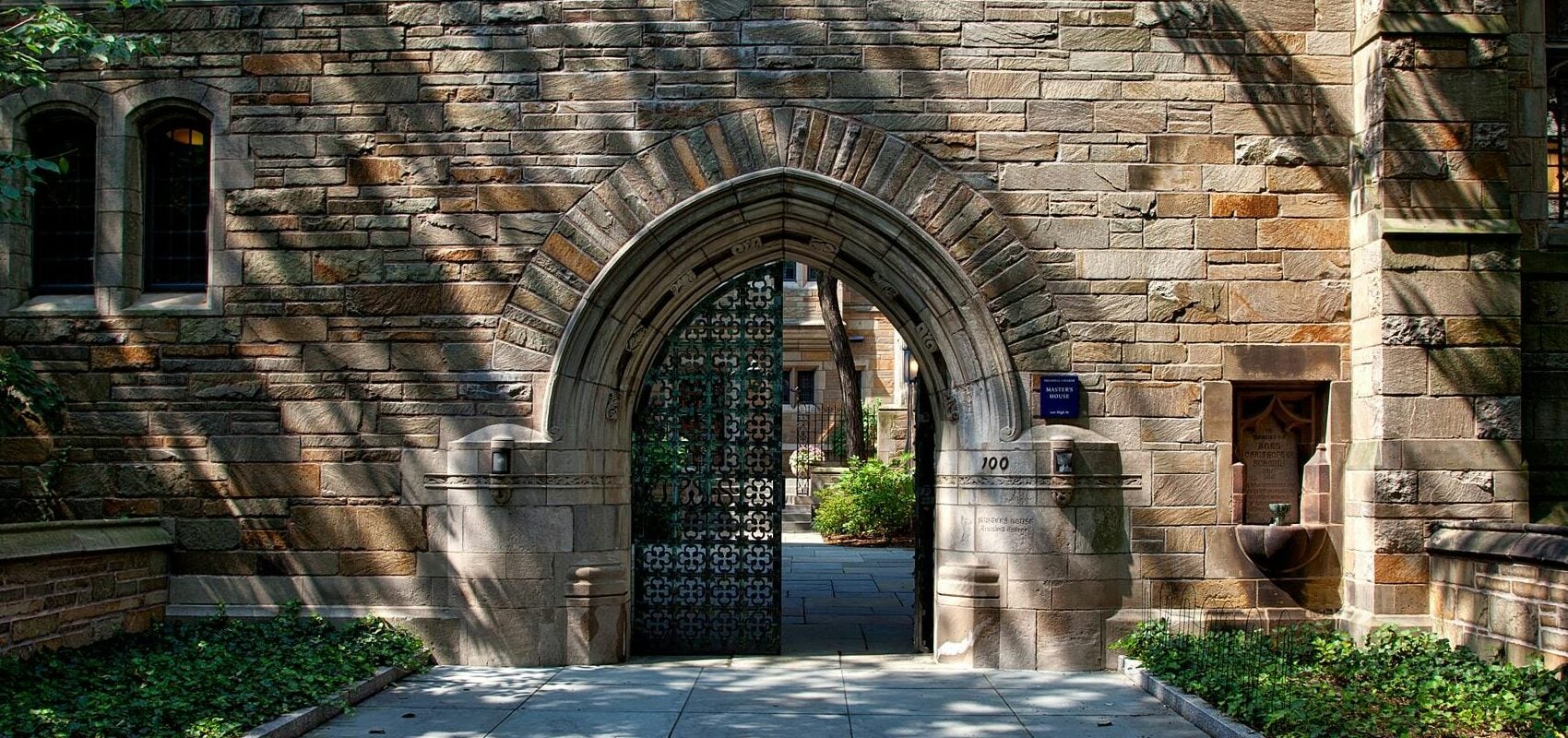
In early April, Yale University released the “Report of the Yale Committee on Trust in Higher Education.” The faculty committee had been formed a year earlier, charged with the task of understanding why the American public increasingly distrusts fancy universities like Yale. The resulting report is blessedly succinct, intelligent, and in many regards helpful. But this reader found it inadequate, perhaps inevitably so, given the magnitude of problems facing higher education.
The report notes the soaring costs of undergraduate tuition, as well as the unpredictable and often opaque procedures for awarding aid to students whose parents are not rich. The report also has critical things to say about the admissions process, which is likewise unpredictable and opaque, leading to doubts about its fairness. These are important issues, but to my mind others loom larger.
One such issue concerns the social function of elite universities. Although legally private, as the report observes, prestigious universities like Yale must be “aligned with public purpose.” They are in a sense semi-public, not just because they receive substantial sums in federal grants, but more importantly because they function as the credentialed “mind of the nation,” and they form the next generation of leaders.
Therein lies a grave problem. To an unprecedented degree, Yale and other schools of its ilk are transparently partisan, aligned only with the progressive side of the increasingly intense contest for the future of American society. The report cites a 2025 estimate that “Democrats outnumber Republicans 36 to 1 across the Faculty of Arts [and] Sciences, the Law School, and the School of Management.” More importantly, DEI measures were not forced on Yale and other institutions; rather, they were enthusiastically pioneered by academic institutions for the express purpose of re-engineering America’s elite and thus changing the nation.
For a long time, the tilt toward progressivism was tolerable. Republican elites agreed with the goals of DEI, even as they sought to implement its measures in more moderate ways. This convergence reflected what I call the open-society consensus, which was bipartisan. Trust in places like Yale is falling now because that consensus is failing. Populism represents a rebellion against the open society that is most obvious in debates about immigration but also manifest in a new nationalism. Rather than serving as a unifying consensus, the imperatives of the open society now code left-wing.
It will be very difficult for Yale to escape its increasingly partisan identity. Although few faculty are radical, nearly everyone gives the radical faculty veto power in crucial areas, while their extreme views are carefully protected, often with solicitous slogans about the need to hear all voices and other platitudes that employ feel-good terms such as “diversity” and “inclusion.” In today’s university culture, it’s still the world of Eleanor Roosevelt, who quipped that communists are liberals in a hurry.
I can easily imagine a radical lesbian professor of women’s studies offering a class titled “The Case Against Men.” Eyes may roll, but the consensus among faculty will be that this kind of provocation is marginal, and therefore not a threat to anything important, and, anyway, provocation plays a salutary role in the education of young people. Normie faculty and administrators will probably cite Yale’s 1974 Woodward Report (underscored by this report), which affirms “the right to think the unthinkable, discuss the unmentionable, and challenge the unchallengeable.”
But I cannot imagine a class titled “The Case Against Gay Marriage.” The uproar would be too great, and the entire body of normie faculty, nominally committed to challenging the unchallengeable, would agree that such a class is unacceptable, a threat to vulnerable members of the community, and contrary to the university’s values.
This reaction against reaction arises because there exist in the United States a substantial number of people who reject gay marriage. These people provide electoral support to the Republican Party, they have institutional heft in churches and other organizations (such as First Things), and of late they have made noise in various corners of the online world. For this reason, a class titled “The Case Against Gay Marriage” would be seen as dangerous. Young people need to be protected from the temptation to think heretical thoughts on matters as important as gay marriage.
There are other prohibitions that operate at Yale. I don’t think it would be possible to invite Vice President JD Vance to address Yale Law School, of which he is a graduate. I can’t imagine a class titled “The Successes and Failures of MAGA.” I don’t think it’s possible to teach “The Conscience of Modernity: Joseph de Maistre, Juan Donosco Cortes, and Ernst Jünger,” even though such a class would have an impeccable historical rationale.
I’m grateful that Yale’s president Maurie McInnis commissioned this report. It suggests that she and other leaders at Yale know they have a problem. However, the drafting committee did not think deeply enough. Over the last three generations, Yale and other elite universities have become indispensable pillars of the progressive political and cultural projects that have sought to transform American society—projects that have triggered a politically potent reaction. Very rich and powerful people devoted to these projects will not allow elite universities to abandon their roles. In our time of increasing political polarization, they will insist on a cordon sanitaire. Dissent from progressive projects will be prevented from drawing on the institutional prestige of places like Yale.
For this reason, it will be very difficult for Yale to be “aligned with public purpose,” if by that notion we mean providing an intellectual forum for understanding our present and profound political, cultural, moral, and even metaphysical polarization. Consider the recently established Yale Center for Civic Thought, which is meant to foster “thoughtful public discourse and civically responsible intellectual life.” Not a single member of the faculty or external boards of advisers is known as a public supporter of Donald Trump, the candidate who received a majority of the votes in our most recent election. Consider as well the report’s gentle acknowledgment that Yale’s now globalized faculty makes consensus increasingly difficult to attain. No doubt true, but the committee cannot bring itself to say that diversity and inclusion have been false gods.
The Yale report opens with what the committee members imagine to be a ringing affirmation: “Universities exist to preserve, create, and share knowledge.” Yet Yale’s motto is lux et veritas, not lux et scientia. This is not an innocent mistake. Knowledge can be possessed, deployed, and used. Truth commands, demands, and requires our service. The way forward will require Yale’s faculty and administration to consider the possibility that, however much knowledge they possess, they do not know the truth about many important matters facing us today: what it means to be a man or a woman, the nature and role of marriage, the good of nations, the limits of diversity, and much more. Such concessions amount to allowing doubts about the sexual revolution, liberalism, and even modernity. It will require extraordinary leadership to allow these doubts to be articulated, explored, and tested. I hope President McInnis is up to the job.


YOU MIGHT ALSO LIKE
The Boys on the Brink
In the latest installment of the ongoing interview series with contributing editor Mark Bauerlein, Leonard Sax joins…
Serial Liar, Serial Comma
How would you write a public letter that you know will become front-page news? Would you write…
The Left Is Right About the Bible
“Texas Public School Students Will Be Required to Read the Bible,” warned a headline in the New…
