
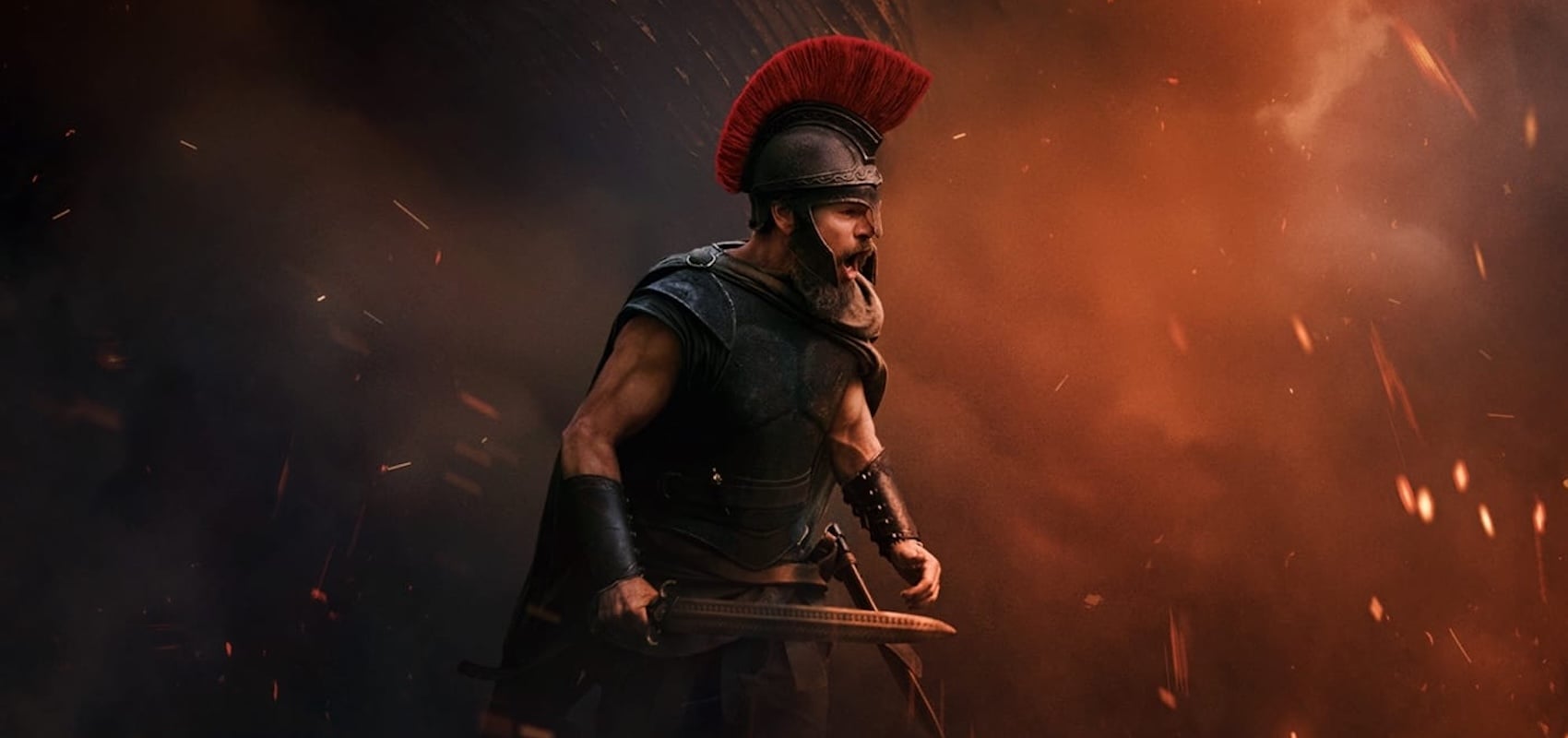
There is much to like about Christopher Nolan’s Odyssey. The movie is visually stunning; the set pieces, from the fall of Troy to the slaughter of the suitors, can only be described as epic in scope. But Nolan does not skimp on small details that pay off later either, such as the backstory for one of the Odyssey’s most beloved characters: Argos, Odysseus’s hunting dog, whose cute birth scene makes his death all the more affecting.
Beyond the engrossing visuals, Nolan successfully gets across many of the key themes of the poem. Especially effective is his presentation of xenia (hospitality), which is referred to in the film as “Zeus’s law”—one of Zeus’s main epithets was xenios, the protector of strangers. All the main conflicts of the plot—Odysseus and his men versus the Cyclops and Circe, the Greeks versus the Trojans, Agamemnon versus Clytemnestra—are framed as test cases for the limits of hospitality and appear as negative examples that Odysseus must learn from, if his own nostos is to be more successful. This is exactly Homer’s conceit.
Much of the casting is also largely on target. Anne Hathaway conveys the full emotional range of Penelope’s character and exposes the impossible situation she has been put in. Hathaway exudes a commanding charisma that enthralls the audience as much as the suitors. The power struggle with her son, Telemachus, played convincingly by a bumbling, insecure, and indecisive Tom Holland, echoes the stormy relationship between the two characters in the opening books of the Odyssey. John Leguizamo is a standout Eumaeus, the swineherd who remains loyal to Odysseus during his long absence and who acts as Telemachus’s ersatz father figure. Leguizamo movingly expresses the mix of powerlessness, loss, and hope felt by the subjects of the absent king. Robert Pattinson is a suitably cowardly and despicable Antinous, Penelope’s main suitor.
By contrast, the characterization of Matt Damon’s Odysseus is hit and miss. Nolan brings to the fore Odysseus’s notorious leadership failures, such as when he insists, against the advice of his men, on staying in the cave of the Cyclops, instead of simply bagging the cheese and returning to the ships. Although Odysseus makes the same mistake in Homer’s epic, he more than makes up for it with his signal ingenuity. Indeed, if there is one story that everyone knows about Odysseus, it is how he outsmarts Polyphemus the Cyclops: The man of many wiles engages in a witty dialogue with the monster and gets him drunk on wine, all while telling him that he is “Nobody.” When Odysseus and his men then blind the giant and he starts yelling, all that the other Cyclopes on the island can get from Polyphemus is that “Nobody” blinded him. Inexplicably, Nolan omits this wheeze, one of the most famous bits of wordplay in world literature, and the whole sequence falls flat as a result.
Nolan’s handling of the Cyclops episode is symptomatic of the director’s reduction of Homer’s andra polytropon to a strangely one-note brooding and shell-shocked veteran. It is no coincidence that in Homer’s poem Odysseus claims to be nobody: The identity of the man who loves telling “lies that are like the truth” to both friend and foe is the central question of the Odyssey. Damon never gets the chance to show the extraordinary range of Odysseus’s character, in large part because the second half of the poem, containing all the most psychologically compelling scenes of Odysseus’s recognition by his household, is squeezed into the last quarter of Nolan’s film.
Other characters, especially female ones, also suffer from severe simplification. Athena (Zendaya), who in Homer serves as the indispensable stage manager of both Telemachus’s journey and Odysseus’s return, is here reduced to a passive bystander who occasionally nags Odysseus. Since Nolan has removed all the other divine characters, Athena could have been cut entirely and no one would have noticed her absence. Meanwhile, Homer’s most willful and enigmatic female creation, Helen (Lupita Nyong’o), appears as a flat, silent victim of Menelaus’s comically over-the-top machismo.
It might seem unfair to criticize a three-hour film for failing to convey fully the depths of a plot that, as Aristotle observed in his Poetics, is highly complex. Although Nolan generally does a good job of trimming down the source material by eliminating and combining certain plotlines—most notably, Odysseus does not end up on Scheria with the Phaeacians but instead tells his adventures to Calypso—the director also inserts material of his own devising. Not only do many of these additions take up time, but they also detract from the story.
The most egregious example of such an unforced error is a fight scene in the Pylos temple, where a band of suitors disguise themselves as priests of Athena in order to ambush Telemachus on his journey back. At the very last moment, the prince is joined by Odysseus, who, after spending ten years to get back home, has somehow teleported from Ithaka to mainland Greece to help out his son. This unnecessary sequence not only makes it seem as if Telemachus needs his father to fight his battles for him—thereby undermining whatever hard-earned character development the prince has undergone—but also interrupts Odysseus’s reintegration into his kingdom and cheapens the effect of the hero’s actually climactic slaughter of the suitors in the palace.
Although the final battle is fun to watch, many of the end scenes are rushed and unsatisfying. The director replaces Penelope’s ultimate trial of Odysseus, which culminates in a very physical reunion, with a saccharine Hollywood ending where the happy couple literally sail off into the sunset. The hapless Telemachus, who only managed to kill a single lowly goatherd in the entire film, is left to rule Ithaka, with nary a word of advice. One is left feeling that although Nolan manages to embark us on a supremely entertaining odyssey, he never quite gets us home.

YOU MIGHT ALSO LIKE
Serial Liar, Serial Comma
How would you write a public letter that you know will become front-page news? Would you write…
Shakespeare Under Stalin’s Shadow
”We wish that we could pass this play over, and say nothing about it. All that we…
Roger Scruton’s Eternal Youth
In this episode, First Things senior editor Dan Hitchens joins R. R. Reno on The Editor’s Desk…
