
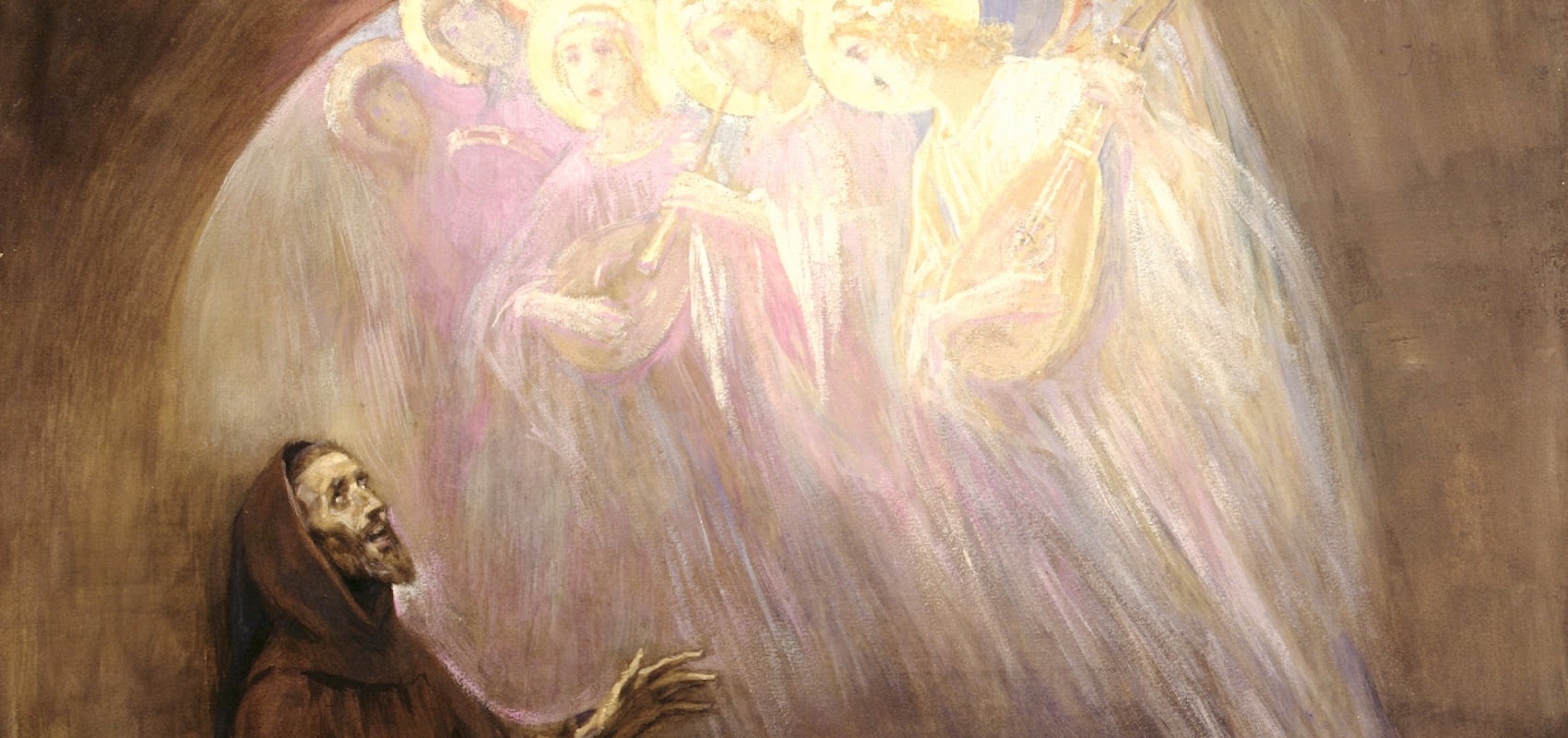
Make Your Home in This Luminous Dark:
Mysticism, Art, and the Path of Unknowing
by james k. a. smith
yale university, 256 pages, $28
Philosopher James K. A. Smith suffered through a period of profound depression. He found solace and insight in the writings of some of the great Christian mystics. And what he learned, he tells us, is that there is a wisdom and peace that transcends what can be provided by philosophical analysis, arguments, and systems.
That premise has the makings of an interesting book. Unfortunately, Smith did not write one. I am sorry to be hard on someone who does seem to have gone through a period of real emotional distress. The trouble is that what he presents as a remedy is worse than unhelpful. Shockingly, given Smith’s prominence as a Christian thinker, the book’s philosophical content is muddleheaded where it isn’t simply banal. And the appeal to the mystics ends up being something of a bait and switch. Smith’s main interests turn out to be contemporary art, movies, novels, and music—which he strains, unsuccessfully, to connect to the mystical tradition. The result is a self-indulgent mess that offers the reader no helpful entry into mysticism but only a vague, anticlimactic sentimentality. I wish I could say something nicer.
In his younger days, Smith tells us, his work in philosophy was characterized by “intellectual swagger” and “pugilistic polemics” aimed at “winning” and finding “security.” The point of constructing an airtight argument was to dominate others; the quest for knowledge was about building an intellectual fortress within which he might feel safe. This spirit, he claims, reflected that of the Western philosophical tradition, which has from the beginning tended toward “conquest,” “control,” and “exclusion.” In his own experience, he says, it yielded only “a sterile, lonely cell” that “locked other people out.” The sequel was a spiritual crisis. He came to realize that deep down he was still just “a little boy” looking for affirmation. His solution was to advocate a different approach to philosophy, his aim being not to “defend The Truth” but to “figure out how to love.” Whereas he once aspired to be “the confident, heresy-hunting Augustine,” now he “dream[s] of being Mr. Rogers.” His new dream requires abandoning “discursivity,” leaving behind the “antiseptic precision of binary logic,” and reconceiving philosophy as open-ended contemplation, more about “the process, not the conclusion.”
There are several serious problems with this new understanding, not the least of which is that it reduces philosophy to banal pop psychology clichés. (Find your inner child, for whom life is a journey rather than a destination!) Smith’s portrayal of the Western philosophical tradition is a caricature, and even he seems to acknowledge in one or two places that his criticisms apply more to modern philosophy than to earlier eras. For example, he notes that modern thought has had a tendency to make intellectual life dryly academic, and to focus on aspects of reality that can be exploited technologically or commodified. The ancients, by contrast, emphasized that philosophy is a way of life with a contemplative dimension.
But these remarks are made in a drive-by fashion. The differences are not explored in any detail, and Smith’s critique of the moderns is not developed in any interesting or convincing way. Nor does it occur to Smith that what was problematic about his younger self’s approach to philosophy may have reflected the failings of one James K. A. Smith, rather than of philosophy itself. But Smith is hardly the first writer to try to read momentous philosophical and theological conclusions into what are really just personal hang-ups.
More important, Smith never makes clear what his alternative approach to philosophy amounts to. The mystical writers are supposed to help here, but Smith badly mishandles them, and the result is obfuscation rather than enlightenment. Texts from the likes of St. John of the Cross and St. Teresa of Ávila are quoted, but their meaning is distorted by Smith’s interpretive lens. “My first steps on the contemplative path,” he recounts, “began in the quiet of a cinema, in the bright hush of a gallery, in absorbed solitude with poetry or a novel.” It was not religious or other traditional art that brought him insight, but rather “the vanguard of the avant-garde”—the “experimental, nonrepresentational, abstract, and conceptual, art we so often think of as ‘secular,’” which “baffles and even repels,” “flirting with ugliness . . . [and] bubbling over into excess,” and in which “our expectations are upended.” This now hackneyed modernist upending of the conventional, Smith proposes, has some interesting parallelism to the dark night of the soul described by the mystics.
Hence we are given ponderous descriptions of Smith’s “encounters” (as he refers to them) with various oddball exhibits, movies, and musical compositions. Visiting a museum in Italy, he finds himself “bored by Michelangelo” and “bored by Botticelli,” but “enchanted by Paolini”—a contemporary artist known for his seemingly random arrangements of bric-a-brac. “I am immersed in this exhibition,” Smith recounts, “with no idea what’s going on, and loving every second of it. I love it even more for its inscrutability” (italics in original). He reports that listening to a recording of Erik Satie’s “Vexations”— a piece in which the same brief sequence of notes is played over and over 840 times—produced a “frisson” in which his “soul was suspended like Satie was pressing the sustain pedal on my heart.”
He enthuses similarly about the “plotlessness, wordlessness, slowness, and alienation” of “slow cinema.” Wim Wenders’s Paris, Texas “dilated my heart,” he reveals, borrowing St. Teresa’s description of her intimacy with God. But it isn’t God he feels at one with. Smith continues:
As I sit quietly, mesmerized by the film, a kind of folding takes place: I start to watch myself watching the movie. I become curious about what this movie is doing to me. . . . allowing myself the indulgence of being absorbed while also, in concurrent reflection, fascinated by my fascination. . . . As I sit quietly with this film, I find I am also with myself in ways I never have been before.
The reader has to soldier on as, page after page, we are presented with over-the-top cooing about “art that wounded me with love,” or about a film scene in which a character “is cleaning dog shit off the driveway and it is beautiful,” or about how a movie “awakens me to the cosmic sea in which I float, vulnerable but loved”—and on and on.
That these reactions have nothing to do with mysticism should be obvious from their sheer onanism. If the mystic looks within, he does so to get beyond himself to God. Smith, by contrast, luxuriates in his own emotional responses, and does so in an embarrassingly exhibitionistic manner. Moreover, the objects of this public reverie are decidedly less than divine—jarring or random events in movies and novels, bizarre musical compositions, the bits and pieces thrown together in a modern sculpture. The philosopher of art Arthur C. Danto famously characterized contemporary art as a “transfiguration of the commonplace.” Of course, he didn’t mean it in a literal theological sense. Yet Smith seems to think that in delighting in musical dissonance and disjointed arrangements of objects he is somehow put in touch with the transcendent.
His only basis for a comparison to mysticism is the fact that the mystic typically reports a breakdown and humbling of ordinary cognition, which cannot capture God’s infinite essence. This, Smith supposes, is analogous to the confusion and discomfort the observer feels when presented with a typical piece of contemporary avant-garde painting, music, or sculpture.
But the comparison is unpersuasive. As is well known, St. Thomas Aquinas judged his work to be “straw” compared with what had been revealed to him in a mystical vision. But that was not because the vision somehow showed that all his claims were false or his arguments worthless. On the contrary, Christ is also said to have appeared to Thomas and commended his work: “You have written well of me.” Rather, it is simply that reason, however far it can take us, reaches its limit when seeking to comprehend the divine nature. Mystical experience transcends what reason can reveal, but in doing so it does not falsify reason’s deliberations or obliterate our rational nature.
By contrast, too much contemporary art, as Roger Scruton notes in his book Beauty, reflects a “cult of nihilism” devoted to “acts of aesthetic iconoclasm” or “postmodernist desecration.” It is not concerned merely to identify the limits of reason or of traditional standards of beauty. Instead, it delights in what is irrational and ugly, engaging in subversion for its own sake. In this way it is often diabolical and leads us in a direction opposite to that of mysticism—not to a realm higher than human reason can reach, but to one that is lower or subrational.
Smith tries to assimilate the mystics to this irrationalist sensibility, claiming that their experiences are “intended to break the mind,” yielding a “decentering of rationality” and insights that are “something other than knowledge.” But this account is wrongheaded. To “break” a human being’s mind is to leave him not wiser, but insane or lobotomized. Since Smith thinks he has reasons for his position, reasons that are better than those his opponents can offer, he has hardly “decentered” rationality. He just exercises it badly, because he scorns the standards by which reasoning can be evaluated for cogency. And since he is making truth claims of various kinds—claims about art, mysticism, philosophy, and so on—he himself purports to have a kind of knowledge. Smith allows that his view may therefore sound incoherent, but he offers no solution to that problem other than gimmicks, such as use of the strikethrough when he speaks of the “knowledge” his position is supposed to give us. This is philosophy of a sophomoric kind. A professor should have grown out of it by the time he left graduate school—not adopted it in middle age like a comb-over or a sports car.
When a Christian falls into philosophical error, heterodoxy cannot be far behind. Sound theology teaches us that grace does not destroy nature but restores, perfects, and elevates it. By contrast, Smith’s misinterpretation of the mystics entails a denigration of our natural rational powers so extreme that it leaves nothing for them to do. With this castration of reason, Smith absorbs the natural into the supernatural, while at the same time entertaining the opposite extreme error. For by modeling the mystical vision on the “feels” one experiences when looking at a piece of contemporary artwork, he trivializes it, reducing the supernatural to a banal aestheticism. (It will come as no surprise that Smith also insinuates that his “mystical” insights have led him to be accepting of the trans phenomenon. Mercifully, we are spared any detailed discussion of this.)
Like the art he admires, Smith’s prose is an assault on reason and good taste. He commends “learning to love being gobsmacked by what gives”; advocates “cultivating a posture of decentered availability”; opines that “solitude is a form of subtraction that multiplies care”; wants to make of the heart a “supple, throbbing organ of openness”; sees in contemporary art a “new encounter with alterity that pulses with personality”; and so on. This is all good for a laugh at the beginning of the book, but just annoying by the middle of it, and proved an unexpected Lenten penance by the end. Nor is it a mere stylistic foible. Muddled and sentimental writing reflects muddled and sentimental thinking.
If Smith has found his way out of depression, we should all be glad. But it helps no one to present as the mystics’ “cloud of unknowing” what is really just the fog of unreason.
Dear Reader,
Can I be direct with you?
War abroad. Socialists on the rise. AI upending human life. Endless uproar online. The modern attention economy doesn’t want readers — it wants users enslaved to the tyranny of the present.
First Things is the antidote: literary excellence, timeless truths, and a fixed point of reference in a culture that has lost its bearings.
But we can’t do it without readers like you.
Our goal: Raise $150,000 by November 1 to sustain First Things in the year ahead.
Your gift anchors readers in the permanent things.
Make your Fall Campaign gift now using the button below.
If you have any questions or would like more information, please contact Giovanni Del Piero, Director of the Editor’s Circle, at gdelpiero@firstthings.com or 212-627-1985.

YOU MIGHT ALSO LIKE
Why the Death Penalty Is a Sore Point for Papal Authority
Pope Leo XIV marked World Day Against the Death Penalty, observed on October 10, with the following…
The Myth of St. Francis
At the beginning of his 2020 encyclical, Fratelli Tutti, Pope Francis speaks of “an episode in the…
Job and Her
It is said that Job lost everything, but she has lost more. All her possessions—the money, the…
