

Jan Morris:
A Life
by sara wheeler
harpercollins, 432 pages, $37.50
Jan Morris (1926–2020) was a writer of astounding gifts who not only recorded history but made it. First, as the young reporter James Morris, he joined the successful 1953 British expedition to Mount Everest, and in a journalistic feat for the ages got the news back to London just in time for the coronation of Queen Elizabeth II. Nineteen years later, by then a world-renowned travel writer and popular historian but plagued by years of gender trouble, James entered the Casablanca sex-change clinic of the surgeon Georges Burou and re-emerged as Jan. Or so he said.
Morris’s enigmatic life has already inspired two full-length treatments, but this third effort by Sara Wheeler is unlikely to be surpassed. Whereas the average literary biography resembles a giant cargo ship stacked with box containers—impressive, presumably necessary, but unsightly and hard to love—Wheeler’s book flies out of the harbor with its rigging taut against the breeze and its sails sparkling in the sunshine. Witty and judicious, the book’s 350 pages are notably concise: detailed where the reader hopes for detail, brisk where the attention might go astray. “To breathe life into an inert mass of material,” goes Wheeler’s definition of the biographical task, “then discard most of it.”
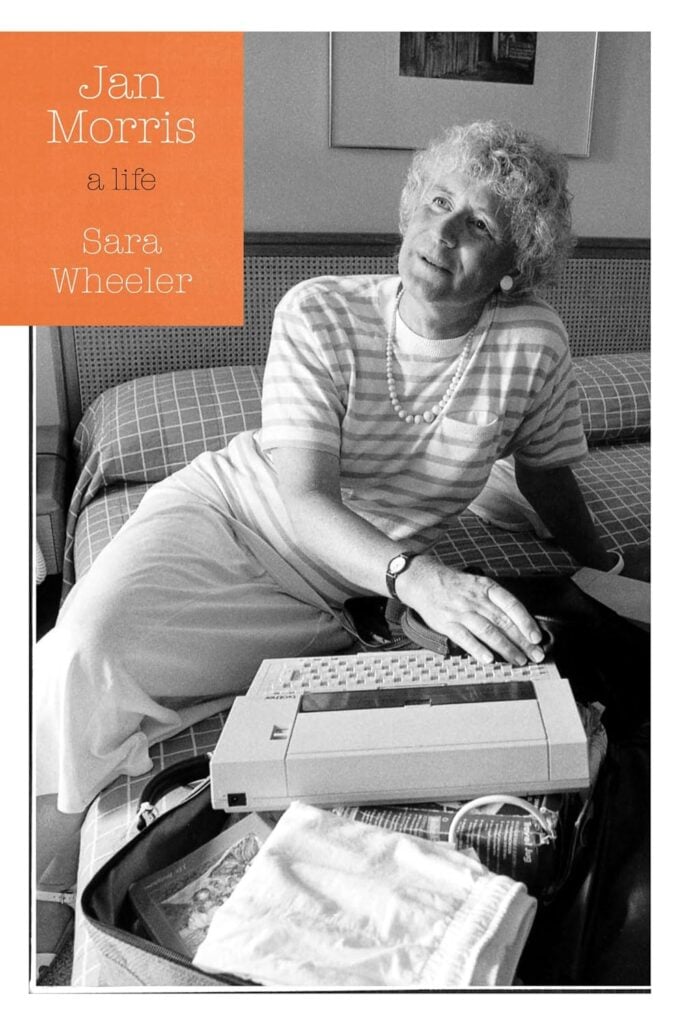
Wheeler guides us through the childhood in Somerset and Oxford, the early successes as a foreign reporter, the marriage to the long-suffering Elizabeth, the years of frenetic traveling and freelancing, the sex change, and the eventual retreat to Wales, without fuss and with a delectable, borderline catty, humor. “Why,” Wheeler muses, did Morris “dress like a Walmart version of the Queen?” R. S. Thomas, the superb if cantankerous poet and Morris’s neighbor in North Wales, is introduced to us as “a preacher of sermons on the evils of fridges.” At one point, Morris recants some earlier invective against Australia, saying that, having grown older and humbler, “I thought a little less of myself.” Wheeler observes: “This turned out not to be the case.” The biographer’s running commentary, somewhat reminiscent of the asides to the audience in Elizabethan drama, allows her to be frank about Morris’s selfishness, cruelty, narcissism, and sheer weirdness. With the exception of one predictable topic, Wheeler is utterly candid and rarely takes her subject’s word for it.
Nevertheless, the book is written in a spirit of homage: partly thanks to Wheeler’s belief, expressed several times, that we are all too messed up to throw the first stone, and partly because she is convinced of Morris’s greatness as a prose stylist. There is some controversy on this point: For a few critics, Morris is a sentimentalist peddling travel-brochure fantasies. They should try writing something like this (here Morris is evoking the omnipresence of the British Empire):
Sea-captains of every nationality knew the Empire as a chain of harbours and coaling-stations, and the most ubiquitous of maritime aids. Financiers saw it as the power of the pound sterling, the king of currencies. To Argentinian commuters it was the Buenos Aires Tramways Company, British owned and operated. To Italian railwaymen it was the familiar Adriatic specials, the trains which, speeding from Calais to the waiting India liners at Brindisi, sent the Anglo-Indians back to their labours in the east. To the pleasure cities of Europe it was bronzed but skinny tourists with money to spend, talking to each other in inexplicable jargon, and frequently meeting colleagues in the public gardens—“Dammit, Hodgson, Helen, good to see you! Well I never! Care for a spot of tiffin? Found yourselves somewhere decent to stay? Damme, a long way from Jacobabad, ain’t it?”
Or if that is too breezy and picturesque, this snapshot of the calamitous 1915 Dardanelles campaign:
The beauty of the place, which entranced many of the soldiers when they first landed on Gallipoli, turned sour with time, and an overwhelming sense of decay fell upon the peninsula. No longer did the soldiers write with such delight of the glorious sunsets, the hyacinths and the heather. Now the landscape became terribly oppressive, as the spring gave way to the ferocious summer, and then to a wet raw winter. Flies swarmed everywhere over the bridgeheads, day by day the wounded went away to the hospital ships queuing up offshore, the men grew dirtier, thinner, more unkempt, plagued by dysentery, septic sores, frostbite. “The beautiful battalions of April 25th,” Hamilton wrote, “are wasted skeletons.” Corpses lay everywhere, blackened and unburied between the lines, or lost in inaccessible ravines, and their smell was inescapable: off the beaches the Navy tried to sink the floating bodies of horses and mules by churning them up with their propellers. The British infantrymen, patient as ever, grumbled their dispassionate obscenities: the magnificent Australians almost gave up being soldiers at all, fighting like brigands or guerrillas, and sauntering among their dug-outs with their shirt-tails hanging out, or wearing nothing at all—“like flies,” one New Zealander thought, “wandering about like aimless men.”
Anyone who has attempted to write narrative nonfiction will know how hard it is to do this kind of thing. You need to know a huge amount of detail, from hard reading and perhaps hard traveling. You need the imagination to select, from this atticful of knowledge, the particular objects that will fall together into place, seemingly without effort. You need the sense of rhythm and balance to make it sing, and the artistry to give it freshness and energy. And you need to do it over and over again. Morris did it for fifty years and more than fifty books, though even Wheeler is caustic about several of them. When Morris remarks, “My own conception of the Port of New York was cast in a romantic-historical genre,” the biographer adds with a touch of exasperation: “One wonders what she did not conceive of in this genre.”
Still, romance and history are part of life, and books that are fascinated by them are not automatically less truthful than those that are transfixed by war, injustice, or degradation. Morris’s report on the trial of Adolf Eichmann is superb journalism, precisely because it registers Morris’s more whimsical responses—the accused, hearing his atrocities described, resembles “some elderly pinched housewife in a flowered pinafore, leaning back on her antimacassar and shifting her false teeth, as she listened to the railing gossip of a neighbour”—as well as the supreme evil of Eichmann’s crimes.
Morris’s eye was trained as an intelligence officer in 1940s Palestine, then as a foreign reporter for the London Times. Having blagged his way onto the Everest expedition, he impressed the mountaineers with his resourcefulness, not least when Edmund Hillary and Tenzing Norgay returned from the summit to camp (22,000 feet up) with the great news. First, Morris had to race down the mountain to a telegraph station; then to get his exclusive back to London without its leaking, when Everest was crawling with rival journalists. The radio operator had refused to submit a message he couldn’t understand, so Morris devised a code that didn’t look like one. “SNOW CONDITIONS BAD STOP ADVANCE BASE ABANDONED YESTERDAY STOP AWAITING IMPROVEMENT ALL WELL,” he cabled. This meant: “Summit reached May 29 by Hillary and Tenzing.” The queen got the news on June 1; The Times reported it the next morning, the day of the coronation. It was the last really triumphant date in the history of the empire.
The saying goes that if you want to understand somebody’s Weltanschauung, you must know what the world looked like when he was twenty. In the late 1940s, Britain still theoretically ruled much of the world, but was visibly bankrupt and about to go into a vertiginous decline. Morris watched this process across the Middle East—in Cairo, in Iraq, and during the Suez Crisis, when London tried to strong-arm Washington and discovered it was too weak to do so. This moment of vanishing grandeur became Morris’s picture of the modern world: a place where a more interesting past was still palpable, but mostly or entirely swallowed up by the disorienting present tense. In 2001, Morris visited a former Soviet colonel in St. Petersburg, “living alone in a comfortless flat (bed unmade, crockery unwashed) in an apparently deserted and half-derelict tenement block.” Like Morris, he had lost an empire—once, he said, the rock of his life—and was now “left wondering what it had all been about.”
He was an archetype, I presently realized. Everywhere people were similarly disturbed, with the same sense of rudderless betrayal. There was something febrile in the air of the world . . . There was something threatening and unwholesome about the emergence of the United States as a power that could do anything it liked. There was something ominous about science, which seemed to be tinkering with matters almost occult in their significance—it would not be long, an Egyptian student seriously assured me, before mankind mastered the creation of life itself. There was something creepy to the Internet, an ectoplasmic presence seeping into private homes.
It is impressive that Morris, a cosmopolitan to his fingertips and an idealist about progress, should have intuited this as the crisis of the age: people cut off from their nations, their past, even their humanity, and thus bewildered and vulnerable.
Of course, Morris sensed this lostness acutely because he had wandered, not just between places, but between identities. He recounted that, at the age of three or four, “I realised that I had been born into the wrong body, and should really be a girl.” Even as a dashing military officer and a macho foreign correspondent, Morris was haunted by a female identity and came to believe that he “would rather die young than live a long life of falsehood.” The displacement became so unbearable, Morris insisted, that a physical transition was the only way out.
Wheeler takes all this at face value and implies that only a lack of “compassion” would incline anyone not to. The only permitted criticism is from trans activists who argue that Morris’s framing of the question is outdated. Yet the biography is too good not to raise doubts, perhaps unintentionally.
Neither Morris nor Wheeler can pin down, for one thing, what it means to be a man or a woman. Morris would talk windily and stereotypically about femininity: One interlocutor was dismayed to find that the entire concept seemed to come down to something about handbags. At other times, Morris would claim, “I haven’t gone from one sex to the other. I’m both now.” Or say that perhaps the real goal was to transcend gender altogether. The family was annoyed that, after so many years of upheaval in their lives, Morris seemed to resent questions on the subject, complaining that “people try to define something that is undefinable.”
Wheeler suggests that we should not try too hard to unravel what Morris called a conundrum. But this is having one’s cake and eating it—several cakes, in fact. If gender is too ineffable to talk about, how can one have a certain conviction that one is in the wrong body? If one is both genders at once, then what is the purpose of the physical surgery? If the aim is to abandon the whole notion of gender, then why is it so important to adopt one identity rather than another? And so on. One can sympathize with the plight of those experiencing gender dysphoria without accepting this particular set of paradoxes.
A cynical psychoanalyst, you feel, could have a field day with some of the material Morris provided. “All the best sex, in my view, aspires to the condition of incest,” was one conviction. Visitors would be shown a picture of Morris’s obsession, the early-twentieth-century naval chief Admiral Fisher: “I’m going to have an affair with him in the afterlife!” Morris was a socially sensitive individual—a social climber, Wheeler suggests—who grew up among people who could remember Lord Kitchener and the trenches. He wrote, superlatively, about England’s spartan public schools and the stiff-upper-lip stoicism of the British soldier. The feminine appears in his work as the principle of spontaneity, emotion, poetry, music, indeterminacy, beauty. Something in me responds enthusiastically to this side of Morris’s writing; having grown up in a relativistic, egalitarian Britain, I have never felt much angst about how to integrate it into my personality. If I had been born in 1926, I might have.
In any case, we’re surely not obliged to think that Morris needed to get a sex change, any more than we have to nod along with even the most heartfelt first-person account of some other life-altering choice: leaving one’s spouse, say, or converting to Islam. Or indeed becoming a fanatical Welsh nationalist, a position Morris adopted in the late 1970s. Like so many things in the story, it was never entirely clear what this was all about, beyond a romantic attachment to Wales itself—and, perhaps, a desire to escape the imperial inheritance. A senior figure in Plaid Cymru, the nationalist party, was advised by Morris to adopt “as its main policy kindness and happiness.”
Morris delivered many a homily on the subject of kindness. Hearing one of these on BBC Radio, Morris’s daughter Suki began literally screaming with rage. Morris, it has been reported previously, would tell Suki he felt “utter contempt” for her, and have her repeatedly examine his will (from which she was excluded). Wheeler does not reproduce those details, but does mention smaller cruelties: comments on Suki’s weight, a grand birthday present promised and then withdrawn. Others could testify to Morris’s deliberate unkindness. In the index, under “characteristics,” the most numerous entries are for “class snobbery” and “egocentricity.”
Morris’s wife, Elizabeth, is a conundrum herself. They were together for seventy-one years and Elizabeth picked up every tab, James/Jan gallivanting around the world while Elizabeth raised the children. (“We were introduced,” their son Henry laconically remarked of Jan, “but we never actually got to know each other.”) Jan neglected the family while writing lengthy responses to fan letters; when Elizabeth made friends with a local farmer’s wife, Jan prevented them from seeing each other (“like a guard dog,” their son recalled). Elizabeth once told her daughter, who asked why she stayed with Jan, that it was because they were married in the eyes of God.
The most self-obsessed can be those least likely to know the truth about themselves—Morris once reflected, after giving an interview, “I’ve never heard such a lot of balls propounded”—or about the meaning of things. Morris liked to say, airily, that truth and fiction were ultimately intermingled, but there is a revealing sadness in this typically memorable passage:
Sometimes down by the river I almost think I have discovered the real purpose of my pilgrimage, the last solution to my conundrum. But then the light changes, the wind shifts, a cloud moves across the sun, and the meaning of it all once again escapes me.
Contemplating this narcissistic existence, Morris aficionados may wonder whether there is a link between the flawed life and the near-flawless prose. In Morris’s writing, people are always turning into archetypes—into useful material, in other words. A depressed Russian veteran means the decay of empires. An annoying dinner companion means something about the essence of Vienna. It is invariably done beautifully, but it is a cold beauty. Wheeler, much as she admires Morris, doesn’t hesitate to employ the term “monster.”
What amazing castles in the air can be built from words: No wonder people like to live inside them. Castles are full of doorways and hidden passages, and some of them lead to truth, some to falsehood, and some to nothing at all.


YOU MIGHT ALSO LIKE
No Place Like Home
Who is our Odysseus? Or more precisely, who is the most Odyssean hero of American film? Matt…
De Gaulle Triumphant
The Second World War left Europe invaded and ruined, divided between Soviet and American occupations. Hitler’s defeat…
New Founders Wanted
It’s now 250 years since America declared her independence and embarked on the experiment of fashioning a…
