
Lying on his deathbed after two decades of running France, Cardinal Richelieu was asked whether he forgave his enemies. “I have no enemies,” the cardinal is supposed to have said, “only the enemies of the state.”
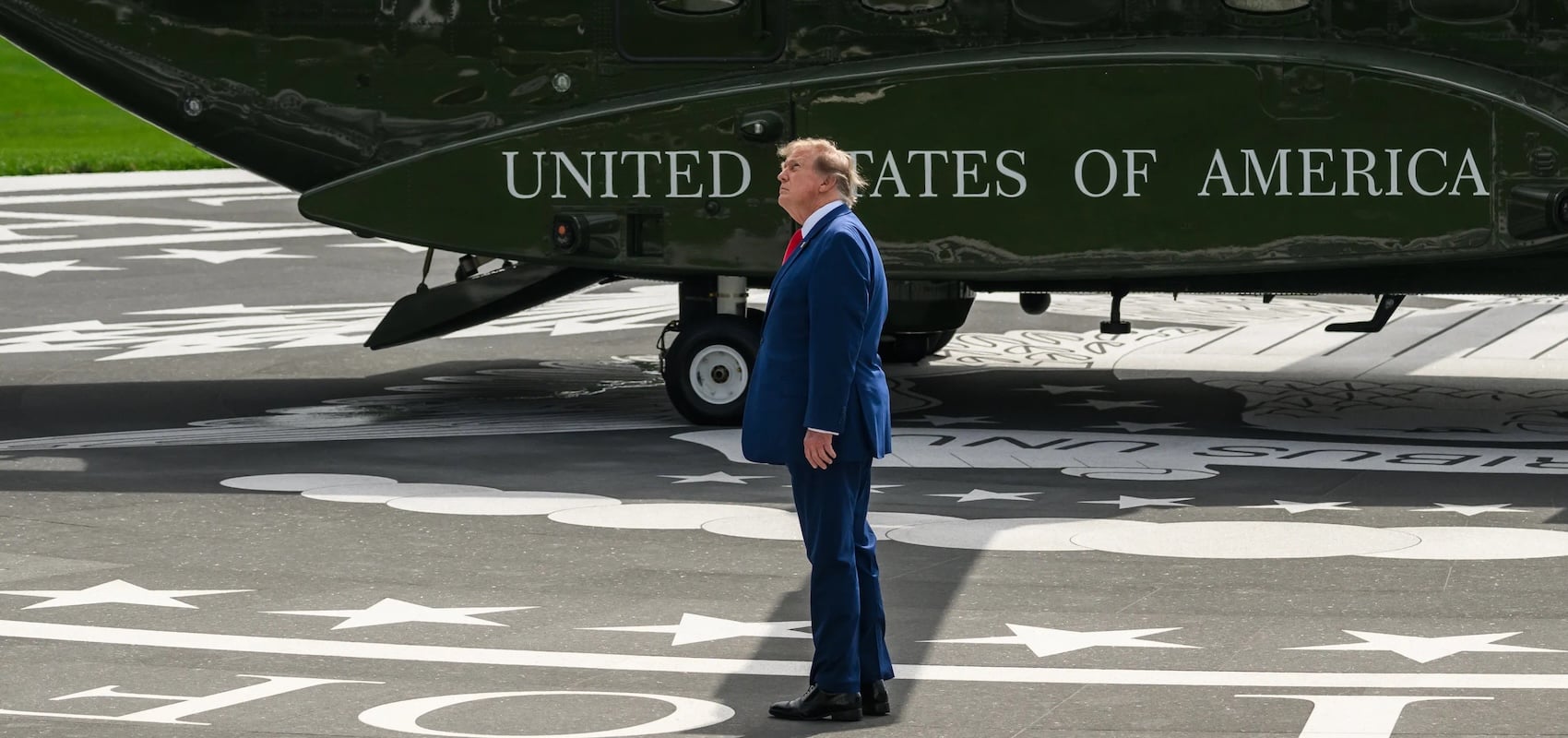
For a moment on CBS on Sunday, it sounded as though President Trump was about to give the same answer. Asked whether he could forgive James Comey, Nancy Pelosi, and his other enemies, Trump replied that he could not: “I found them to be . . . very bad for our country. I love our country far more than I can love people like that.” It was, he might have been implying, not in a president’s power to forgive. L’État, c’est moi.
But when pressed by the interviewer, that superb TV journalist Ross Douthat, Trump retreated from this nuance: “Look what they’ve put me through, the weaponization . . . I do hate some of my enemies and I always will.”
One striking feature of the second Trump administration is that the president keeps wrestling publicly with the promises and the demands of the gospel. “I want to try and get to heaven if possible,” he told Fox News in August 2025. “I’m hearing I’m not doing well, I am really at the bottom of the totem pole.” But as so often happens in life, those good intentions quickly evaporated. A month later, at Charlie Kirk’s memorial service, Trump declared that he could not imitate Kirk’s example of Christian charity: “I hate my opponent, and I don’t want the best for them.” By April he was insulting the pope and blasphemously presenting himself as Jesus Christ. On Sunday, he seemed torn between his heathen instincts and his Christian conscience, as though, in this late hour of our civilization, he were re-enacting in Trumpian form the drama of Augustine’s Confessions, which has resounded through the history of the West. You wouldn’t have got this from Nikki Haley.
There are a few arguments going around that Douthat’s line of questioning was unfair. One is that Christians are only meant to forgive when the offender is penitent. “If your brother sins, rebuke him, and if he repents, forgive him,” Christ tells us (Luke 17:3). But if—so this interpretation goes—Comey and Pelosi and all the rest never bother to repent, why should Trump spontaneously forgive them?
Yet in other places Christ speaks of forgiveness without that condition. And we are, surely, supposed to be ready to forgive—which is about as hard as forgiving, and comes to much the same thing. “There’s basically zero chance he’ll ever ask my forgiveness, so not much point in me thinking about forgiving him” must be less of a Christian sentiment than “If he ever asked my forgiveness, however unlikely that is, I would want to be able to give it there and then.”
That, at least, seems to have been how the saints saw it. St. Stephen, when being stoned to death, prayed: “Lord, lay not this sin to their charge.” St. Paul Miki, the sixteenth-century Japanese martyr, said as he was crucified: “My religion teaches me to pardon my enemies and all who have offended me. I do gladly pardon the emperor and all who have sought my death.” Blessed James Duckett, a victim of the Elizabethan persecution, not only forgave the man who had betrayed him to the authorities, but persuaded his wife to drink to the informer on their way to the execution. The eleven-year-old St. Maria Goretti, dying from stab wounds inflicted by her would-be rapist, was reminded by the hospital chaplain that Christ had forgiven his murderers. “Yes,” she replied, “for the love of Jesus I too pardon him, and I want him to be with me in heaven.” None of the perpetrators, in these cases, had asked for forgiveness before it was offered.
Another objection is that Douthat misframed the question by making it about emotions, asking Trump if he could “feel love and forgiveness.” Christianity, it might be said, makes demands on our choices, not on our feelings.
But the choice to forgive is, from one angle, a choice about what to do with the feelings we already have. The Holocaust survivor Corrie ten Boom, in a celebrated account, described meeting a former concentration camp guard whom she recognized from the camp where her sister had been murdered, and who now asked for her forgiveness: “Even as the angry, vengeful thoughts boiled through me, I saw the sin of them. Jesus Christ had died for this man; was I going to ask for more? . . . I breathed a silent prayer. Jesus, I cannot forgive him. Give me your forgiveness.”
Roger Scruton—not an orthodox believer, admittedly, but a profound moral psychologist—thought that forgiveness is an act of sacrifice. When I forgive, I give up something precious to me: namely, my resentment.
At the same time, it needs emphasizing that forgiveness is not the same as having warm, fuzzy feelings about someone, and is not even necessarily about wanting the best for him in this-worldly terms. It is a beautiful witness when, say, a bereaved person forgives a murderer and asks for him to be spared; but it is not necessarily always illogical to say, “I forgive him and I hope I see him in heaven, but death is the appropriate penalty for his crime.”
St. Thomas Aquinas, no less, teaches that while every Christian must be ready to forgive, “It is even lawful in praying to ask that temporal evils be inflicted on our enemies in order that they may mend their ways.” That seems like the kind of forgiveness that Donald Trump, with our prayers, might one day achieve.


YOU MIGHT ALSO LIKE
Oates vs. O’Connor
Joyce Carol Oates’s recent broadside on X against Flannery O’Connor’s Catholic faith is less interesting as a…
Wisdom in the Age of AI
A few weeks ago, I attended the Wisdom in the Age of AI conference at Calvin University,…
Is the Influencer the New Party Boss?
As Abdul El-Sayed celebrates his election as the first-ever Muslim U.S. senator, the GOP and president scramble…
