
Gabby” was fittingly named by her grandfather some seven decades ago; she would talk a blue streak out on the Minnesota prairies. I have known her these last few years from sitting in front of her in the church pew. Recently, I went to the nursing home to “take her into my care”: that euphemistic phrase that means “pick her up when dead.”
It is something of a privilege to handle the mortal remains of those I know and love. It is hard, certainly. But recognizing and knowing a face—even in its pallor, mouth agape—that smiled kindly upon me and my family humanizes the deceased at a time when her humanity is harder to see. With her physical body and soul now split, the hands that animated every conversation are lying still; the eyes that sparkled when listening to what I had to say are now matte and unmoving. Yet Gabby is still very visible.
I bring a cremation container with me to the nursing home in the silver minivan that I drive for death calls at night. Gabby rides alongside the cardboard box when we leave Woodside Village, her body enclosed in a pouch on a mortuary stretcher. The next stop is the crematory.
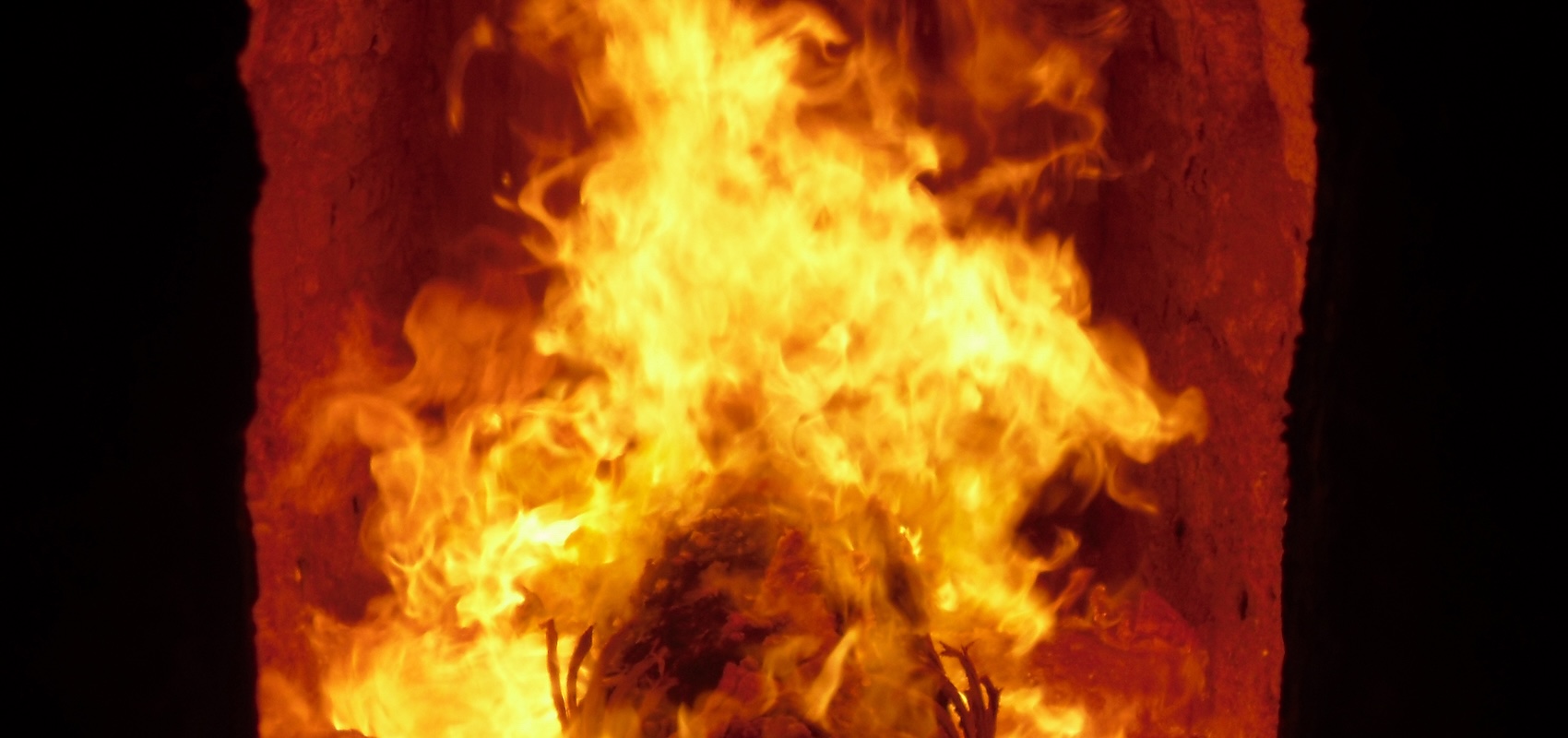
We arrive at 1:00 a.m. I’ve got the code for the large bay door that opens upon the crematory’s greatest resource, a large furnace that burns at thousands of degrees, rendering human bodies to nothing but bone and ash; the flesh and sinews are expelled into the atmosphere as pure energy and greenhouse gas.
For all the talk that cremation is an “easier” process than a burial, the fact that both methods require us to release the body into a void—that of an oven or an open grave—provides some commonality that I appreciate. If buried, we decay; our bones and flesh become one with the soil. If cremated, our bodies are offered up to the air. One cannot escape the realities of death by way of cremation.
And yet, having sat through thousands of funerals, I can tell you a funeral Mass is not the same when the body is missing. Our bodies—through which we live, love, dream, hold our children, and behold beauty—are important. The Catholic Church permits cremation, but wisely does not encourage it. Still, it is chosen, even by Catholics, which Gabby is.
As I lift Gabby into her cardboard cremation casket, which is not unlike a large shoebox, I think about how, through her, truths are still visible. After all, as children we put into shoeboxes our greatest treasures. One of my sons has a box like Gabby’s, but smaller. Inside are items that my boy imbues with meaning despite looking to me like trash: a bottle cap, a few pretty rocks, a bird skull. Gabby is all of these in her way: She has a fake hip of metal, calcified teeth that made a pretty smile, and a skull that indeed held a sharp wit and tongue. She is a treasure, despite most of us not seeing her corpse in such a light.
As I nestle her in the box to be cremated in the morning, I lift her hands to her abdomen, placing them left over right, then shroud her with the bedsheet on which she died. It is as much dignity I can give when she is clothed with nothing but a hospital gown. Her face I leave uncovered for the moment, as I complete the body check-in paperwork; I would like to see her face again before I close the lid. I write down her full name on the register and smile. “Gabby” is too unofficial for this document, despite that name being much closer to her truth than “Margaret.” I affix my signature and license number to the bottom and jot down a five-digit number, 13335, taken from the stainless steel disc that is next on the stack: the disc that will go inside the cardboard casket in order to identify her remains after they become unidentifiable.
As I approach Gabby with the numbered disc, an intrusive thought pops into my head. We Christians traditionally bury our dead intact out of respect for the body and in imitation of Christ’s three days in the tomb. Cremation, while seemingly new, is a repackaged form of the ancient immolation of the dead by our pagan forebears. And, oddly enough, many of these long-dead pagans went to their final dispositions accompanied by a coin: a single obol in their mouth or two denarii placed upon each eye. Whether a good luck charm, or a payment to the ferryman over the River Styx, the coin has some symbolism that is maybe untapped in our age of death avoidance and afterlife negligence.
Could the disc tap into that symbolism? The five digits are only numbers here. Maybe we need a medal to place in the hands of those who are seeking the furnaces of cremation. A patron saint (Lawrence, Joan of Arc, Maximilian Kolbe?), or maybe a Marian apparition could be selected. As it is, Gabby is wearing her scapular, and that seems enough. I cover her face with an unspoken “goodbye” and place the disc in the foot-end of the box. When cremation is complete, and before her bones are ground into dust, that coin will be inspected. And when the bone-dust remains come back to me in a bag, the coin will be affixed to it. I’ll confirm the number and know that 13335 is insufficient shorthand for the treasure that is Gabby.
Image by Henry Mühlpfordt, licensed via Creative Commons. Image cropped.
Dear Reader,
Can I be direct with you?
War abroad. Socialists on the rise. AI upending human life. Endless uproar online. The modern attention economy doesn’t want readers — it wants users enslaved to the tyranny of the present.
First Things is the antidote: literary excellence, timeless truths, and a fixed point of reference in a culture that has lost its bearings.
But we can’t do it without readers like you.
Our goal: Raise $150,000 by November 1 to sustain First Things in the year ahead.
Your gift anchors readers in the permanent things.
Make your Fall Campaign gift now using the button below.
If you have any questions or would like more information, please contact Giovanni Del Piero, Director of the Editor’s Circle, at gdelpiero@firstthings.com or 212-627-1985.

YOU MIGHT ALSO LIKE
The Last Statesmen?
In the latest installment of the ongoing interview series with contributing editor Mark Bauerlein, Steven B. Smith…
The Cold Beauty of Jan Morris
Jan Morris (1926–2020) was a writer of astounding gifts who not only recorded history but made it.…
Forget Odysseus. Aeneas Is the True American Hero.
Who is our Odysseus? Or more precisely, who is the most Odyssean hero of American film? Matt…
