
Is AI conscious, or could it ever be? While smart people are vocal on both sides of the debate, the question is too abstract and vague, providing little opportunity for fruitful conversation. It also implies a range of other questions, not only about AI, but about human nature, knowledge, and reality. AI advocates are forcing these questions to the forefront, often unwittingly.
When Pope Leo XIV recently said there is an “ontological difference” between the actions of human artists and generative AI, it drew significant attention—and emotion—with many advocates of AI consciousness objecting. But their objections also suggested they hadn’t fully processed that the pope was highlighting questions they weren’t prepared to consider. Most common defenses of AI consciousness depend on an assumption of functionalism, traced back to the Turing test: If AI can imitate the products of human consciousness, then we have no reason to distinguish it from human consciousness. But Pope Leo was challenging functionalism: Even if the behavior is the same, there is still an “ontological difference”—that is, however much machine behavior might be made indistinguishable from human behavior (entirely possible, as a matter of technical achievement), there would still remain a difference, real and knowable, between the nature and activity of human beings and the nature and activity of machines.
The question of AI consciousness needs to be framed in such a way that allows us to at least consider this possibility. And that means it must be framed not as one question but as a set, or several interconnected sets, of questions that can’t be addressed unless they are formulated and distinguished.
For instance, how can we consider whether AI is conscious without first asking what consciousness is? Doesn’t “consciousness” really come in different modes of cognitive awareness—sensation, memory, aesthetic appreciation, abstract reasoning? How are these differentiated, in their objects, and in their relation to the conscious subject?
Modern neuroscience highlights what Aristotle already noticed: that familiar modes of consciousness are clearly dependent on particular activation of parts of living bodies. The experience of vision, memory, pleasure, pain, joy, depression, love, contemplation—these don’t only show up in different parts of the body; even in the brain they show up not only in different places but as entirely different modes of activity. As physical organs, brains are capable of “hosting” such behavior because they are alive, grow, and adapt. Is consciousness dependent on life? Even if human modes of consciousness are entirely dependent on brains, could some kind of non-organic, mechanistic body be conscious?
Then emerge further questions that highlight why atheists and materialists are more likely to have a different position on AI consciousness than religious people and non-materialists. Are any modes of consciousness not dependent on bodies at all? If some modes of cognition are, at least in principle, separable from particular bodily activity, are they separable only in the sense that they could be transferred from one body to another, or also in the sense that they could exist apart, not depending on any body whatsoever?
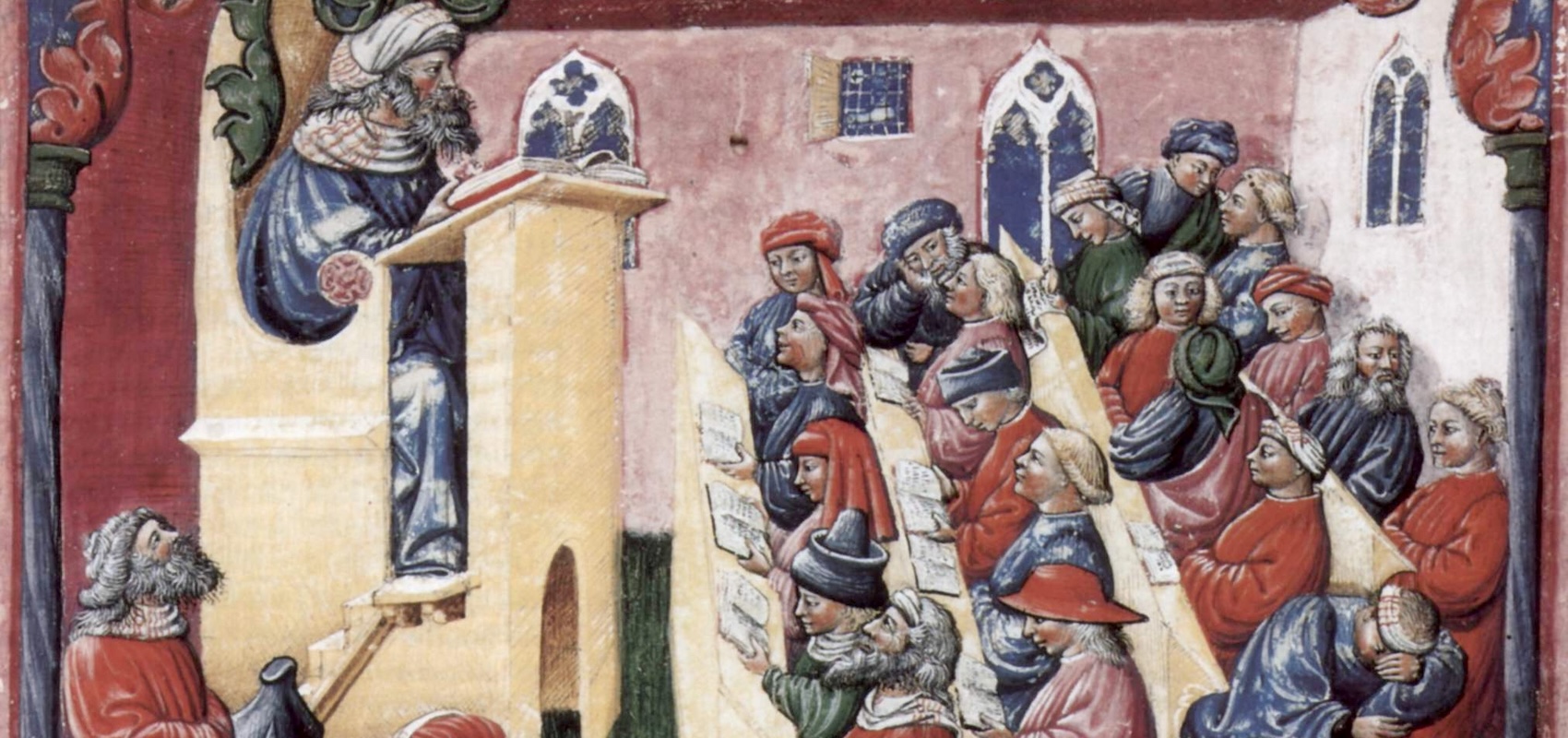
If articulating all these questions begins to sound like a plan for a medieval scholastic disputation, that is because medieval scholastics did indeed consider, and were well prepared to answer, such questions. Their preparedness came not from blind religious faith, spiritualist motivated reasoning, or a naive appeal to “magic,” but from a culture practiced in dialectic, skilled at making distinctions, and rooted in a tradition of inquiry about human nature that was both scientifically and psychologically insightful. Especially because of the influence of Aristotle’s philosophy, scholasticism valued metaphysical anthropology and sought to keep that discipline diligently empirical, perceptively phenomenological, and carefully speculative.
A sign of the vitality of scholastic speculative culture is that it fostered genuine debate and did not force agreement. Thomas Aquinas developed arguments about the immateriality of the intellect drawn from Aristotelian principles, compatible with but not derived from his Christian faith. But Siger of Brabant, drawing on a different tradition of Aristotelian commentary, argued that an individual’s intellectual activity was entirely dependent on matter, and could not survive the death of the body. (Dante, placing Siger in heaven with Aquinas, seems to be “punishing” him, irenically and ironically.)
A modern Siger might take the side of AI consciousness. Siger was not exactly a materialist, but he was a kind of spiritual emergentist: Intellectual power itself is separate from any individual human being, and only manifests through the biological hardware of the human body once it is sufficiently organized to receive it. In principle, why couldn’t some other hardware be set up to receive that power?
The current moment calls for a modern version of Siger vs. Aquinas on the nature of cognitive function and its relation to the human body. At the very least, we need something of the culture that fostered their reflection. They could rationally consider a range of answers to fundamental questions about human nature—including what we would recognize as mechanistic and atomistic hypotheses—because they had a habit of distinguishing and clarifying questions.
As Leo seems to anticipate, the rise of AI intensifies the need for such clarity and subtlety. The question of AI consciousness is really a whole ecosystem of questions about human nature. Modern science and engineering deserve credit for raising these questions, but those disciplines do not have the capacity to answer them. “Quid est homo?” This and the multiplying questions of psychology, metaphysics, and epistemology that follow from it are fundamentally human questions, raised by a certain kind of rational creature trying to understand its place in the universe. We can answer them intelligently, if we use reasoning that is well developed and properly disciplined. That starts with making sure we practice formulating the right questions.

YOU MIGHT ALSO LIKE
AI Doom Is Radically Uncertain
For roughly a week in September, Jacob Coxon, an obscure researcher at AI giant Anthropic, was the…
Romancing the Machine
A friend of mine asked a researcher at Anthropic whether Claude was conscious. He replied, “Are you…
The Boys on the Brink
In the latest installment of the ongoing interview series with contributing editor Mark Bauerlein, Leonard Sax joins…
