
The United Methodist Church (UMC) has removed Asbury Theological Seminary from its list of institutions approved to train its ministers. Hardly a bastion of right-wing Protestant fundamentalism, Asbury has nonetheless run afoul of the UMC. Why? The seminary has had the temerity to uphold the traditional Christian teaching on sex and marriage. Asbury’s conviction looks potentially costly, but what price should we place on such matters? Sexual morality isn’t just about behavior; it’s about the essence of human nature and society, involving the profoundest questions about personal relationships, social structures, and teleology—what human beings are for.
Years before “swinging” meant anything beyond big band music, thinkers such as Sigmund Freud and J. D. Unwin pointed out that sexual codes are at the heart of culture. Dismantle them, and you dismantle the essence of those human relationships that define a civilization. The sexual revolution did just that, turning a lifelong human bond connected to procreation into mere recreation. It thereby turned sexual partners into instruments of worth only insofar as they meet one’s sexual needs. Sex today is not about self-giving; it is about selfish taking. And the fruit of this “liberation” has been the unprecedented objectification of women, pornography being only the most obvious example.
In recent years, feminists such as Louise Perry, Christine Emba, and Mary Harrington have highlighted the sexual revolution’s obvious problems. But despite these green shoots of sanity, progressive Christianity, true to form, still cheers for the wrong team.
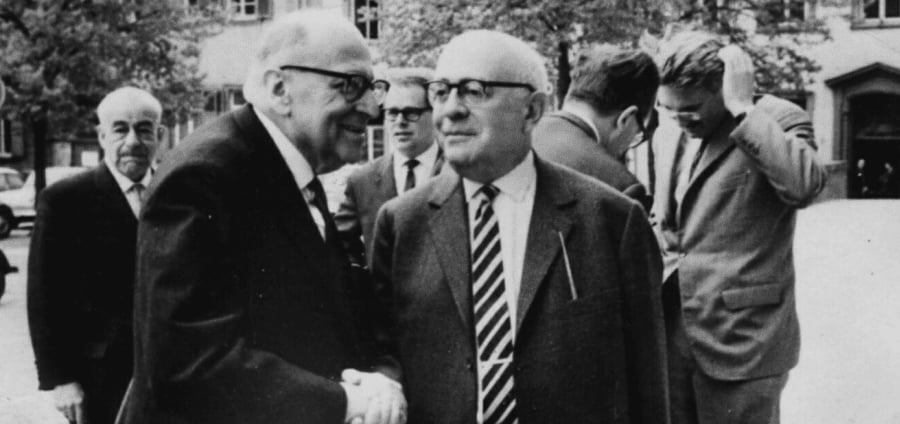
Critical theorist Max Horkheimer, who co-authored Dialectic of Enlightenment with Theodor Adorno, would go on to repudiate the sexual revolution. In an interview in the late 1960s, he expressed support for the encyclical Humanae Vitae, arguing that contraception, and the sexual revolution it helped enable, destroyed love and thereby led to the objectification and instrumentalization of other people. Hegelian Marxists like Horkheimer were concerned about how capitalism turned people into things—Lukács’s “commodity form.” Stripping erotic love, commitment, and fertility from the sex act was one way to accomplish this transformation. Horkheimer was clear that he opposed the sexual revolution not because he was converting to Christianity, but because he was, at least in his own mind, a consistent critical theorist.
In this, he broke with others such as Herbert Marcuse, the guiding light of the sexual iconoclasm of 1968. Marcuse argued that gay sex, because it was intrinsically sterile and non-productive, was a fine example of revolutionary behavior that refused to conform to capitalist values. But Horkheimer was the deeper thinker. He was aware that things turn into their opposite. In Dialectic of Enlightenment, he and Adorno trace how the scientific revolution liberated people from religion but then became a new master, as authoritarian and dogmatic as the Christianity it had supplanted. By 1968, Horkheimer saw the sexual revolution following the same pattern: liberation curdling into a new, dogmatic ideology that was destructive of humanity.
The dehumanizing effect of the sexual revolution is now rampant. Look at the fate of those who have the temerity to dissent. Last week, the U.K. barred Finnish politician Päivi Räsänen from transiting through Heathrow airport because she had been convicted of the crime of contrasting the teaching of the Bible with the orthodoxies of the sexual revolution. In the same week, professional agitator Peter Tatchell was one of many who celebrated the death of Ann Widdecombe on X, declaring the former Conservative member of Parliament a “BIGOT!” He later deleted the post after news emerged that she had been murdered. But his first intuition was to indulge in a ghoulish performance of his joy in public.
Widdecombe’s crime—the one that apparently exempted Tatchell from treating her with common human decency—was opposing the tenets of the sexual revolution. Tatchell describes himself as a campaigner for human rights, but his notion of who qualifies as “human” seems selective, conditional upon agreement with his taste in sexual politics. All humans are equal, but it appears that today’s sexual orthodoxies make some a tad more equal than others.
Asbury’s fidelity to Christian sexual ethics and the response of the UMC represent the real struggle that lies behind the emotive rhetoric of the sexual revolution—a revolution that destroys humanity in the name of affirming it. These are interesting times when a Hegelian Marxist who died in 1973 offers sounder guidance to being human than a prominent Christian denomination in 2026.
Dear Reader,
Can I be direct with you?
War abroad. Socialists on the rise. AI upending human life. Endless uproar online. The modern attention economy doesn’t want readers — it wants users enslaved to the tyranny of the present.
First Things is the antidote: literary excellence, timeless truths, and a fixed point of reference in a culture that has lost its bearings.
But we can’t do it without readers like you.
Our goal: Raise $150,000 by November 1 to sustain First Things in the year ahead.
Your gift anchors readers in the permanent things.
Make your Fall Campaign gift now using the button below.
If you have any questions or would like more information, please contact Giovanni Del Piero, Director of the Editor’s Circle, at gdelpiero@firstthings.com or 212-627-1985.


YOU MIGHT ALSO LIKE
Foucault’s Idol of Nothingness
Today marks the 100th anniversary of the birth of Michel Foucault. He was influential in his lifetime,…
Why the Death Penalty Is a Sore Point for Papal Authority
Pope Leo XIV marked World Day Against the Death Penalty, observed on October 10, with the following…
Forget Odysseus. Aeneas Is the True American Hero.
Who is our Odysseus? Or more precisely, who is the most Odyssean hero of American film? Matt…
