
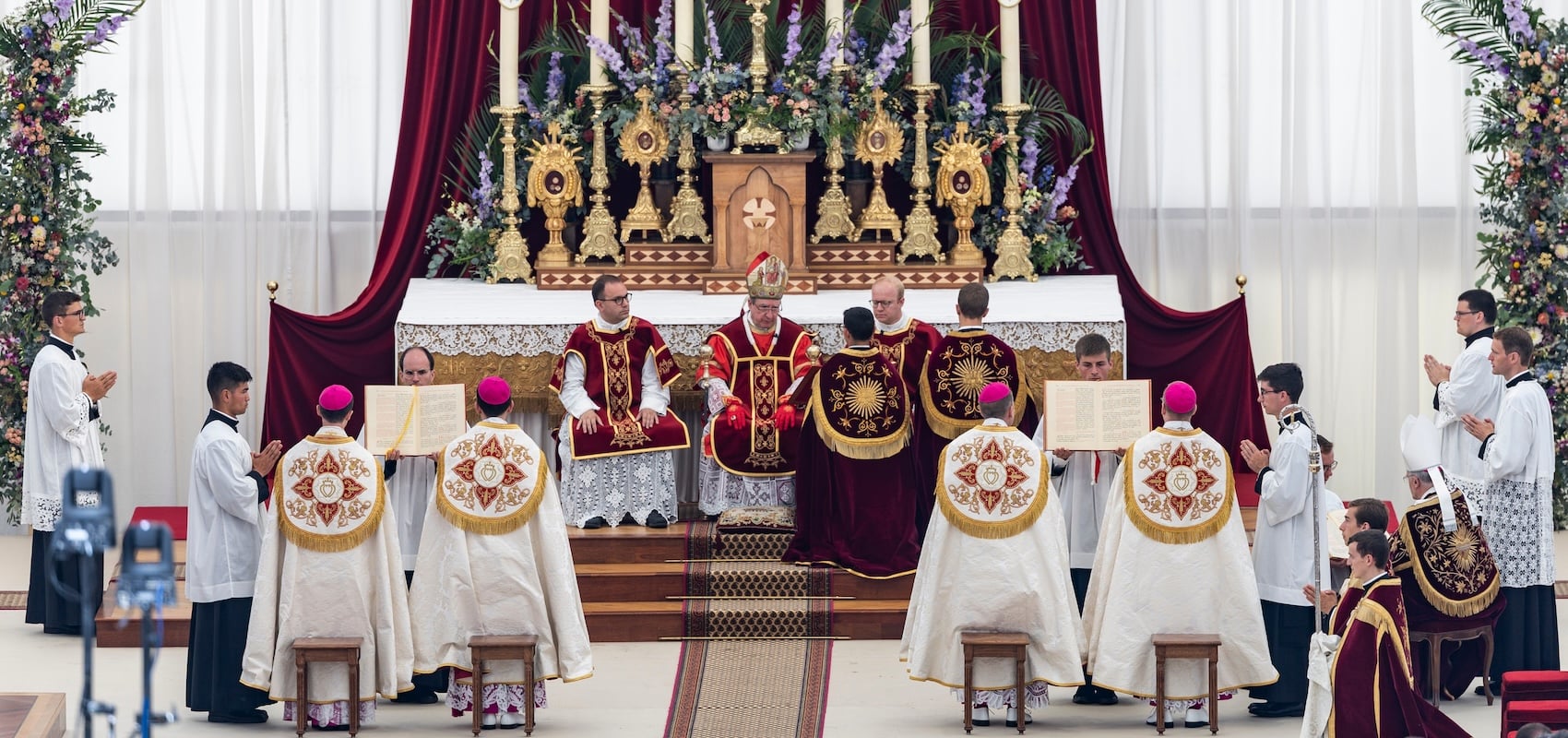
Immediately after the Society of St. Pius X (SSPX) consecrated four new bishops in an Alpine meadow next to its seminary at Écône, Switzerland, it received a personal message from the pope. But, from the Society’s point of view, it was the wrong message: All Lefebvrists would remain excommunicated until they renounced their heretical doctrines.
Also, it was the wrong pope—not Leo XIV but Peter III of the Palmarian Catholic Church in Palmar de Troya, Andalusia, which his followers believe is the new Holy See. Their “Vatican” is the gigantic Cathedral-Basilica of Our Crowned Mother of Palmar, whose domes and towers are surrounded by fortified walls topped with barbed wire.
In a statement reported by the Ad Vaticanum website, Pope Peter, the Swiss-born Joseph Odermatt, said he wished to “address all Catholic faithful who are wandering through the spiritual desert after witnessing the collapse and the general excommunication of the followers of Marcel Lefebvre.” As he explained, the SSPX had been excommunicated decades ago by Gregory XVII.
There has, of course, never been a Catholic pope with that name. Odermatt was referring to the founder of the Palmarians, Clemente Domínguez y Gómez (1946–2005), a Spanish office clerk and alleged Marian visionary who rejected Vatican II, had himself illicitly ordained bishop, and then assumed the title of pope. He is not to be confused with another “Pope Gregory XVII,” the French-Canadian Gaston Tremblay, who ruled a sect called the Apostles of Infinite Love in Quebec from 1968 until his death in 2011.
It goes without saying that no one in the SSPX cares what Peter III, or any other antipope, thinks about their canonical status. The history of the Palmarian Catholic Church is riddled with criminal behavior that stands in sharp contrast to the austere discipline of the Society. Why, then, does the subject of the Palmarians touch a raw nerve with the SSPX? Why do Lefebvrists on social media respond so furiously to any mention of the Andalusian “Holy See”?
The truth is that, having carried out consecrations that excommunicated all six of its bishops, the SSPX has moved closer to the ecosystem of episcopi vagantes or “wandering bishops.” For centuries, and especially since the fractures created by the First Vatican Council, there have been independent prelates with more or less valid Catholic orders. They consecrate and excommunicate each other, their lines of succession becoming ever more entangled as they form and dissolve minuscule denominations, some of which have more bishops than priests and more clergy than laity.
A new episcopus vagans was created as recently as July 25 this year, when Fr. Michael Mary, founder of the Transalpine Redemptorists (FSSR), which was associated with the SSPX before reconciling and then breaking with Rome, was ordained bishop on Papa Stronsay, an island in the Orkneys. The consecrator was Pierre Roy, a Québécois sedevacantist bishop. The FSSR Oratory is tiny; rarely can so much silk and lace have been crammed into such a small space.
It was a scene worthy of the heyday of wandering bishops in the early twentieth century. Their pretensions are hilariously described in Peter Anson’s classic study Bishops at Large, which devotes a chapter to Arnold Harris Mathew (1852–1919), self-styled Earl of Landaff and Count Povoleri, an English Catholic priest who left to become a Unitarian and then an Anglo-Catholic curate. Mathew was consecrated bishop by the Old Catholics of Utrecht before adopting the titles of Metropolitan of the Western Orthodox Church, Ancient Catholic Archbishop of London, and Patriarch of the Old Roman Catholic Church. He ordained an unknown number of bishops and priests; many formed their own denominations, including the theosophical Liberal Catholic Church, which believes in reincarnation.
The dozens of sects created via the “Mathew succession” illustrate the tendency of schismatic consecrations to spin out of control. The SSPX, however, is by any standards a special case. It maintains that the Vatican has breached canon law by declaring it schismatic. Its official line is that its bishops must not be confused with sedevacantist episcopi vagantes.
The reality is considerably more messy. Bishop Roy is a former Lefebvrist priest. So is America’s most prominent sedevacantist prelate, Bishop Donald Sanborn, who was rector of the SSPX seminary in Michigan before breaking away to form the Society of St. Pius V (SSPV). He is now superior general of the Roman Catholic Institute (RCI) in Reading, Pennsylvania, whose dictatorial style has earned it the nickname “Crazy Church” among ex-members.
Sanborn is what is known as a “Thuc-line” bishop. He and his SSPV colleague, the late Bishop Daniel Dolan, were ordained into the episcopal succession established in the 1970s by the sedevacantist Monsignor Ngo Dinh Thuc, former Catholic Archbishop of Hué, Vietnam, and the older brother of the assassinated South Vietnamese president Ngo Dinh Diem. Meanwhile, another ex-Lefebvrist priest, Michael Kelly, rejecting Thuc, was consecrated by a first-generation Catholic bishop from Puerto Rico.
Until this point, there was no “Lefebvre line” of episcopi vagantes. That is no longer true. One of the bishops consecrated by Archbishop Lefebvre at Écône in 1988 was the late Richard Williamson. After expulsion from the SSPX in 2012, he consecrated five bishops to serve the so-called “SSPX Resistance,” a loosely organized group of Lefebvrist hardliners who, while not formally repudiating Pope Leo XIV, might be described as “sedevacantist-adjacent.”
Williamson was an infamous Holocaust denier; one can readily understand why the SSPX prefers not to discuss him, and also plays down the Lefebvrist connections of so many sedevacantist episcopal entrepreneurs. But why should it recoil from mention of the Palmarian Catholic Church? The history of this sect is unbelievably grotesque; in terms of doctrinal orthodoxy it is at the other end of the schismatic spectrum from the SSPX. Yet from the Society’s point of view there is an awkward plot twist.
When the alleged apparitions of the Virgin began at Palmar in 1968, Clemente Domínguez became their main interpreter. He founded a quasi-Carmelite order and was given funds by a gullible baroness to build the Palmarian cathedral. After becoming a bishop in 1975, he was involved in a car accident that necessitated the removal of his eyeballs.
Declaring himself Supreme Pontiff in 1978, the blind “Pope Gregory the Very Great” imposed extreme asceticism on his followers while embracing personal debauchery. Enemies accused him of being incapably drunk while he was carried aloft by gorgeously vested clergy whom he would consecrate bishop at the drop of a hat. Palmarian ceremonies might last for hours or, alternatively, five minutes: A truncated version of the Tridentine Mass boiled it down to 117 Latin words.
Gregory XVII was succeeded by the self-styled Pope Peter II, Manuel Alonso Corral, who died in 2011, and by Ginés Jesús Hernández, who, as Pope Gregory XVIII from 2011 to 2016, modeled himself on General Franco (a canonized Palmarian saint alongside, implausibly, Paul VI, who is venerated as a martyr drugged by Freemasons). But the Palmarians regard Hernández as an antipope rather than as a pope emeritus, and with good reason. After suddenly abdicating, he claimed that the Palmarian church was “all a hoax from the beginning.” In June 2018 he and his new wife broke into the cathedral-basilica, allegedly attacked a Palmarian bishop with a hammer, and were later both convicted of armed robbery and assault.
None of which would have happened if Domínguez had not been made a bishop by none other than Archbishop Thuc. According to Professor Magnus Lundberg of Uppsala University, an authority on fringe Catholicism, this is where the story of the Palmarians intersects with that of the Lefebvrists.
Lundberg writes that in 1975 individual members of the SSPX “seem to have been attracted by the antimodernist messages from Palmar.” He cites Noël Barbara, a French sedevacantist priest who claimed that “Lefebvre did not want to go to Palmar de Troya, but suggested that they should approach Archbishop Thuc instead.” This may or may not be true; what we do know is that Thuc was taken to Palmar by Maurice Revaz, who taught canon law at Écône.
The Society of St. Pius X has maintained that its dispute with Rome is confined to aspects of the Second Vatican Council and the liturgy it inspired. Yet such protestations ring increasingly hollow in the light of what appears to be the growing influence of anti-Vatican hardliners inside the Society. Moreover, they take no account of the further rebellions facilitated by Lefebvre, without whom there would have been no SSPV, RCI, SSPX Resistance, and—if Barbara is to be believed—no Disneyland-baroque cathedral-basilica shimmering like a mirage in the fields of Andalusia.
Making sense of all this is not easy. There is a fine line between drawing attention to the surprising number of episcopi vagantes who were at some point associated with the SSPX and unfairly attributing guilt by association.
In the conclusion to Bishops at Large, Anson writes that once you stray off the beaten track into the ecclesiastical forest, “It is hard to distinguish the wood from the trees, even more to memorize the names of its galaxy of fauna and flora. One almost despairs of disentangling the infinite ramifications of splinter-churches . . .”
Six decades later most of those churches have vanished, but it is in the nature of freelance consecrations that disappearing sects are supplanted by rivals that anathematize each other. For observers, this is the stuff of comedy—Monty Python’s People’s Front of Judea vs. the Judean People’s Front and the Judean Popular People’s Front. Unfortunately, it is also in the nature of these consecrations that they attract psychologically damaged men under whose autocephalous rule devotees are bullied or sexually abused.
Pope Leo is aware of this—and, also, that some responsibility for such abuses lies with dissident bishops who, however lofty their intentions, pass on episcopal orders in defiance of the Church. Hence, perhaps, the unusual severity of his reminder to the SSPX that “to tear the seamless garment of Christ is a sin of extreme gravity.”
Image by Cyril Zingaro/Keystone via AP
Dear Reader,
Can I be direct with you?
War abroad. Socialists on the rise. AI upending human life. Endless uproar online. The modern attention economy doesn’t want readers — it wants users enslaved to the tyranny of the present.
First Things is the antidote: literary excellence, timeless truths, and a fixed point of reference in a culture that has lost its bearings.
But we can’t do it without readers like you.
Our goal: Raise $150,000 by November 1 to sustain First Things in the year ahead.
Your gift anchors readers in the permanent things.
Make your Fall Campaign gift now using the button below.
If you have any questions or would like more information, please contact Giovanni Del Piero, Director of the Editor’s Circle, at gdelpiero@firstthings.com or 212-627-1985.

YOU MIGHT ALSO LIKE
Foucault’s Idol of Nothingness
Today marks the 100th anniversary of the birth of Michel Foucault. He was influential in his lifetime,…
Forget Odysseus. Aeneas Is the True American Hero.
Who is our Odysseus? Or more precisely, who is the most Odyssean hero of American film? Matt…
Why the Death Penalty Is a Sore Point for Papal Authority
Pope Leo XIV marked World Day Against the Death Penalty, observed on October 10, with the following…
