
Every year the American Library Association marks “Banned Books Week,” a celebration devoted mostly to books that aren’t banned at all, such as The Handmaid’s Tale. It does not usually include actually banned books, such as the terrorism manuals that may attract the attention of law enforcement.
There is, however, a third category of banned book. This the kind that’s banned not in the sense of being impossible to acquire, but in the sense that if you quote the ideas, or imply that you think the author should be treated as a thinker of note, your views will be dismissed as unserious, worryingly ideological, and even morally suspect.
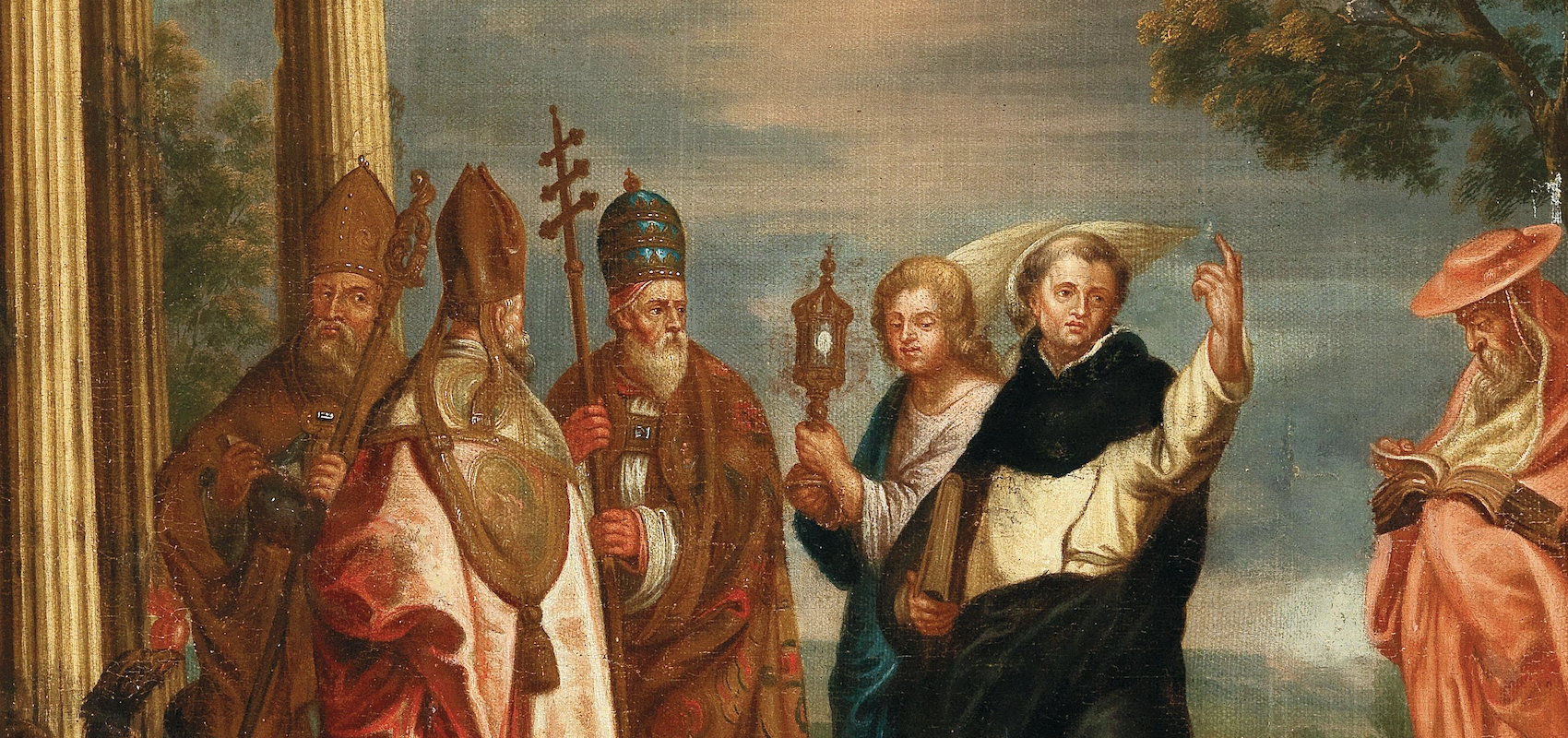
The most obvious title on this list is Mein Kampf. There are many more. One of the less obvious is the Summa Theologiae of St. Thomas Aquinas.
I am not suggesting a moral equivalence between these two texts. But I’m a journalist. In my experience, if you want people to read you, you have to calibrate what you want to say against what your audience takes for granted, and what needs to be said more carefully, in order not to upset people or derail the argument. And in my experience, outside a few specialist outlets in which I can make different assumptions about the audience, citing Thomas Aquinas requires as much care and context as citing Hitler.
Again: I am emphatically not drawing a moral equivalence. I also realize that First Things is one of those specialist contexts in which I can make different assumptions. I’m willing to bet that extremely literate Catholics are unusually well represented in this readership—a subgroup that forms perhaps the sole exception to an omertà I’ve come to think of, informally, as “the No Aquinas Rule,” or more forcefully: “Thomophobia.”
If that’s you, and you’re puzzled by this claim, let me assure you: You exist in a bubble. There exists a set of assumptions about the nature of reality that is, to you, obvious—assumptions from which a great many consequences flow, of foundational importance to all kinds of contemporary debates as apparently diverse as bioethics and high school athletics. These are assumptions that, were one able to cite Thomas Aquinas as casually as (say) John Locke, would be easy enough to ground. But we can’t—or at least in my ordinary journalistic work, I can’t. Because outside this bubble, the moment you cite Aquinas people stop listening. Game over.
The No Aquinas Rule is real, and it is an epistemological straitjacket. There is, I think, a way out. But first, I should explain how I stumbled on this line of thought: by trying to make sense of the mother-shaped blind spot.
I live somewhat up in my head. So you can perhaps imagine what a record-scratch moment it was to become a mother at the age of thirty-eight. My body was suddenly porous and unruly; so were my thoughts and feelings. My heart and time were no longer my own. Compared to my rather abstract previous world, it felt like being brusquely but wonderfully remade. Being a nerd, once the shock wore off I had lots more to think about. Two related questions puzzled me. The first: Why are mothers so invisible, and treated so routinely as second-class persons, when the human species literally cannot continue without us? And the second: Why is it so difficult to talk about what mothering is?
The answers I arrived at for the first question would in time form the argument of my book Feminism Against Progress: that the deprecation of mothering has developed in tandem with technological modernity, and as a by-product of its distinctive worldview. I argued further that when we turned the technological paradigm inward upon ourselves, there were further unanticipated consequences for women. We’ll return to that point, but for now let’s stick a pin in this intuition: that there exists a tension between the reality of embodied sex, and the ambitions of a civilization and worldview predicated on the pursuit of technological mastery.
The second question was thornier. What is it that mothering is? Mothering is comparatively easy to evoke imagistically. The canonical image of the Madonna and Child is one sacred expression of a phenomenon that is about as close as we get to a human universal: the devoted, highly attuned interdependence of a mother and her young child or children. But the words keep slipping away. Most stay-at-home moms have fielded the question “What do you actually do all day?” and felt sure that they’re doing something while also struggling to explain what that something is.
The best I was able to come up with is that mothering happens in the world of patterns, of relationality, of normativity. And that’s already the opposite of the stuff we think of as meaningful “signal,” which concerns the individual, the exceptional, the unexpected. The everyday, routine, generic, and predictable: That’s just “noise.” Most of mothering happens in the world of noise. When your whole purpose is enabling the normal healthy development of a baby, a good day is one in which nothing out of the ordinary happens.
But our whole culture is geared to noticing the exception, the signal. Mothering is the everyday, the normal, the noise. Why? I kept coming back to the same weirdly missing vocabulary, first on mothering, then on other cognate topics. I would find myself reaching for words to explain and defend the existence and value of human patterns that are normally the case: for instance, that mothers love their babies, and feel a visceral urge to protect and nurture them. Instead I’d find myself litigating whether or not anything at all about humans can ever be said to be normally true.
Or I would find myself struggling to articulate the obvious fact that the totality of what a baby is can’t be understood just by listing the attributes of that baby in that exact moment. You have to think of that baby through time as well, over the course of his or her whole maturational arc, and hold that whole four-dimensional picture in your mind. Which, in turn, requires being able to point to the existence of developmental patterns that are normally the case. Which is another phenomenon I didn’t have words to describe.
And without words for any of these things, I had no way of explaining why a man can’t be a mother, or indeed a woman—because men are normatively distinct from women at a level I also don’t have words for. For a lover of words such as I, being so regularly stumped was both unusual and aggravating. It’s doubly aggravating when your lack of vocabulary is being weaponized by the other side to argue, for example, that because there is no everyday language to describe normative realities, it’s fine for males who say they’re women to compete in women’s sports. Or that it’s okay to make kids undergo wrong-sex puberty, or even that we don’t really know what a woman is.
Over the time I’ve spent obsessing about this weird dead spot in my vocabulary, I’ve found that it affects issues well beyond mothers and gender politics. It shows up, for example, in our artistic values, and in our relationship to the natural world. By degrees it came to seem not just a political difficulty but something deeper: a metaphysical handicap.
I decided it was too big a topic to tackle in Feminism Against Progress, whose focus is the mother-shaped political blind spot. It’s there in one quick line about how the question of whether technology has limits turns on “whether or not men and women have a nature as such.” Here I just said, “In my view we do,” and left it at that.
I’ve spent the years since then hunting for that missing vocabulary. I didn’t find it until last summer, when an academic friend advised me to read Edward Feser’s Scholastic Metaphysics: A Contemporary Introduction. I don’t think Feser intended it as a page-turner, but I tore through it like it was an airport novel. Pretty much every page came with an “Oh, I see!” moment. It felt like having spent years trying to do fine electrical engineering with an old spoon and half a brick, only to be gifted a set of precisely machined tools.
At that point I realized that the vocabulary I had thought was missing was not missing at all. It exists, but is little-known, except in circles such as this one. Few readers will be surprised by the big reveal—that what I’d been looking for was Aristotelian metaphysics, as adapted by medieval theologians, among whom the greatest and most influential was Thomas Aquinas. In his Summa Theologiae, Thomas reconciled Aristotle’s metaphysics with Christian theology. It is a remarkable achievement, which set the terms for serious inquiry into the nature of things pretty much from Thomas’s day to the seventeenth century. I’m not qualified to summarize the Summa, but I am indebted to Feser, and behind him the scholastics and especially Thomas, for three tools that speak to the concepts I’d found so frustratingly missing from my writing work, and from political discourse more generally.
The first of these tools is the distinction between potency and act. Act describes what something is right now, whereas potency comprises all those things it could be, based on the kind of thing it is. Returning to my example of a baby, we might say she’s an infant in act, but an adult in potency. There’s a bit more to maturation than just potency—a point we’ll get into with the third missing tool. But in general we can understand “potency” as the things something could become, given the kind of thing it is. A calf could become a bull, or it could become dinner, but it could not become a retractable pencil.
The second tool is a distinction between substance and accident. I’ve referred a few times so far to “the kind of thing something is.” “Substantial form” is a more succinct way of saying this. The substantial form of a thing organizes what it is. The catness of a cat, the dogness of a dog. Or the humanness of a human. Another term sometimes used in this context is “essence.” Substantial form is the essence of a thing. Accident, by contrast, is an attribute that can vary without making the thing a different kind of thing. A cat can be black, or ginger, or bobtailed, and still be a cat. If it has flippers or scales, though, it’s a different kind of thing.
The last tool is the idea of fourfold causality. This concept is so alien to the way we’re taught to understand the world that it may need a little explanation. Today, “cause and effect” is generally treated as linear, and usually physical: A cue hits a billiard ball, it pings into a group of other balls, the balls roll around the billiard table. This account of cause and effect can of course be highly complex on its own. But at its core it rests on two kinds of “cause,” which make something what it is: the stuff it’s made of, and the forces acting on it.
But as I found, this premodern metaphysical tradition has a less linear and material understanding of causation. In this view, a thing is “caused” not only by stuff and forces, but also by the kind of thing it is (its substantial form), and by what it’s for: that is, the ends to which it’s directed, its final cause or telos. So even though the bull calf in my example above has the potency to become dinner or a handbag, its telos or final cause is neither of these things, but is rather intrinsic to the kind of thing it is. Its final cause is fully to realize its intrinsic bullness.
Finally and, as we’ll see, importantly, material cause (what we’d think of as the “substance” of a thing, its stuff) is inseparable from formal cause. The technical term is hylemorphism, from hyle, matter, and morphe, form. Things are what they are because they’re both. This is a whole rabbit hole of its own, but the basic idea is that physical stuff doesn’t exist on its own, but only inasmuch as it’s in-formed by essence. This goes for us as much as for the world around us, with the special extra consideration that for humans, the form of the body is the soul.
So I had gone looking for language to express aspects of mothering that felt real but were difficult to describe. I found those terms in a metaphysical worldview that is comprehensive and coherent, and which remained stable for several centuries. Now it seems that whole worldview has been memory-holed. So what happened? And why my persistent sense that this way of thinking is not just forgotten, but proscribed?
This story has been told by many more erudite thinkers than I. Shall we join Richard Weaver in blaming it all on William of Ockham? Shall we blame the printing press for fanning the flames of Protestant religiosity and undercutting the university centers of scholastic thought? Was the scientific revolution a cause, or an effect? Was it the scholastics themselves, growing decadent and abstruse? Should we be provocative and blame the Christian doctrine of incarnation itself, for forcing theology to reckon with the physical world, instead of just seeking to escape it like the Buddhists?
The story of how we became modern—by discarding form and telos—can be sliced a dozen different ways. In its aftermath, the winners have so completely written not just the history books, but also the accounts of metaphysics and theology, that older debates are no longer even intelligible. For example, it wasn’t until I discovered the medieval metaphysical meaning of “substance” that I could make head or tail of what was being litigated in Reformation-era disputes over transubstantiation.
Though this debate wasn’t strictly about Aquinas, its resolution was strictly enforced—especially in England, where Queen Elizabeth I effectively outlawed belief in transubstantiation under the Thirty-Nine Articles. From the late seventeenth century to the late nineteenth, it was so verboten that the Test Acts required anyone holding public office in England explicitly to repudiate this doctrine. It’s not hard to see how this proscription might expand to a general taboo on the idea of “substance” in the metaphysical sense.
This taboo was prosecuted intellectually, as well as politically, and not just in England. Descartes, Hobbes, Spinoza, Locke, Hume: As Pierre Manent has argued, since the seventeenth century more or less the entirety of modern philosophy has been a war on scholastic metaphysics. It is a war on the concept of substance, on the notion that there exists a hierarchy of substances or forms, and on the human soul as the “form” of the body. As Manent puts it in The City of Man: “That man is a substance and one substance, that is the Carthago delenda of the new philosophy.”
To be born at all, then, the modern world had to bury Aristotle and Aquinas. To be “modern” meant first bracketing, then in time discarding, act and potency, substance and accident, formal and final cause. From a stance of studied agnosticism toward the nature or “directedness” of anything, we would learn whatever there was to learn about the world through observation, analysis, measurement, and experiment.
The writer Yuval Noah Harari described thus the effects of this move: “Modernity is a surprisingly simple deal . . . [in which] humans agree to give up meaning in exchange for power.” If we understand “meaning” as the what and the why, form and ends, act and potency, this is precisely right. Discarding that older metaphysics shifted the purpose of human activity, especially of intellectual inquiry, away from the contemplation of God in his creation, toward the control and instrumentalization of that creation. As Charles Taylor has shown, the bracketing of God’s presence in the world led, in time, to God’s presumed disappearance. Increasingly, our activity in the world is understood to have no end beyond (as Bacon put it) “the relief of man’s estate,” or (in Descartes’s framing) to render us “masters and possessors of nature.”
In other words: We gave up seeing the meaning of the world in exchange for power over it. And what’s so intriguing about this trajectory is that until quite late in the picture, it remained a Christian one. Luther was trying not to expunge God from the world but to renew our relation to him. Hobbes may have reframed human society in terms of a single motivating force and external fear—power—but he wasn’t trying to abolish God. Nor was Descartes.
But the habitual opposition of the new science to the old metaphysics has become so ingrained that no one even realizes they’re walking over the graves of Aristotle and Aquinas to become masters and possessors of nature. This amnesia is all the more understandable in that the rewards have been abundant—indeed, are all around us today. Perhaps the closest we get to feeling uncomfortable about the trade-offs of exchanging meaning for power is when we are confronted with its side effects: pollution, strip-mined landscapes, depleted ecosystems, or the suffering of other species we have reordered as stuff, so as to exert our power over them regardless of their own nature, as in lab experiments or factory farming.
We were all more or less okay without formal or final cause, when it was just stuff out there in the world. We might feel, intuitively, that it’s not quite right that a pig is merely atoms arranged pig-wise, and would not substantially differ (at least in the modern sense of “substantially”) were those atoms arranged deli-meat-wise. It’s not us being rearranged, at the end of the day. But what happens when the same logic comes for people? Are we just atoms arranged human-wise?
Drawing on Charles Taylor, we can see how this conclusion is another corollary of God’s withdrawal from his creation. This departure prompted, Taylor argues, a corresponding shift in our account of the soul: from the medieval understanding of the soul as the form of the body to Locke’s “punctual self,” which exists only as a single point in one instant after another, then in due course to the rationalists’ “ghost in the machine,” and latterly to the still more ambiguous “self.”
Importantly—as the theologian Angela Franks shows in Body and Identity—our trajectory from “soul” to “self” was initially aided by the solvent power of Christian theology, working individuals free of the givens of their lives. But a further corollary of this retreat from givens, and from seeing ourselves in terms of form and ends, has been the temptation to apply the Baconian mindset to ourselves.
This realization would become a central thesis in Feminism Against Progress. There, I argued that the point at which we began in earnest to technologize ourselves was the introduction of the contraceptive pill. The pill is distinct from previous medical innovations, in that it sets out not to cure illness but to block normal human health. You don’t take the pill in the hope of being restored to a more perfect expression of your substantial form and telos, but to “cure” yourself of the former, with the aim of severing the sexual act from the latter.
The implications of thus setting out to reengineer ourselves are numerous for women. I explored this theme at length in Feminism Against Progress. In doing so, I realized how difficult it was even to discuss this topic, without this missing metaphysical vocabulary. Long before I learned the term “substantial form,” it was clear to me that there exists a healthy human “normal,” which comes in two sexes and whose stable reality is the foundational premise of all medical interventions up to the pill. It also seemed clear that there is a difference in kind between medicines that seek to bring someone closer to that “normal,” and biomedical interventions that set out to interrupt, co-opt, or otherwise reorder that “normal” for “the relief of man’s estate,” or simply to serve individual preference.
I was then struck by how many post-pill medical, cultural, and political innovations, from transgender “medicine” to gestational surrogacy, are predicated on the same refusal to recognize human form and human ends. These innovations serve the basic aspiration to become (as Descartes put it) masters and possessors of nature, including our own human nature. The central move is against the metaphysical ground of our own existence.
I argued myself by degrees from feminism to where you find me today, doing metaphysics with my learner plates on (to use a British expression). I coined the term “Meat Lego” as a means of foregrounding the instinctive revulsion most feel at the proposition that the material human body is not in-formed by substance at all. To the Meat Lego mindset we are merely atoms arranged human-wise, and arranging them otherwise would be morally neutral.
Of course, this mindset quickly gets you into trouble, as for example with the so-called “hard problem of consciousness,” and indeed the loss of anything that could ground our intuition that humans have intrinsic dignity, or that it is both morally wrong and categorically mistaken to try to reengineer our own substantial form. Since we became modern by burying Aquinas, this form officially doesn’t exist, which makes the intuition hard to explain. But people can still see it, much as they can see that there is a real (in fact a substantial) difference between a pig and a slab of deli meat. We are, in fact, human beings inasmuch as we are thus in-formed.
Aquinas would say that what in-forms us is our souls. But the enabling framework for the field of human reengineering rejects the notion of form and directedness. It can then collapse substantial into accidental form, and potency into act, for these things have ceased to be easily distinguishable. Perhaps the most egregious expression I have seen of this paradigm comes from a 2023 research paper, funded by a U.K. government–supported research body, which asserted that trans-identifying women should not be discouraged from taking synthetic testosterone while pregnant, regardless of the risks it might pose to a developing baby, because the discouragement would reflect “historical and ongoing social practices for creating ‘ideal’ and normative bodies.”
Formal cause, in this framing, has no ontological status outside that ascribed to it by “historical and ongoing social practices.” Any attempt to assert otherwise is not a defense of something real and important, but a disguised maneuver within the Hobbesian struggle for power. This presumption is perhaps the foundational premise of the poststructuralist philosophy that legitimizes transhumanism. In Of Grammatology, Derrida deftly links this purportedly untoward fixation with meaning to the gravest of modern sins: racism. It is, he says, “the most original and powerful ethnocentrism.” By extension, we can infer that hewing to formal and final cause is not merely, as for Bacon, an impediment to research. Now it is a moral transgression, too.
From Derrida on, anyone clinging to the meaning of meaning may be accused of “logocentrism,” an unseemly preoccupation with the idea that meaning might be meaningful. The implicit Thomophobia becomes even clearer when we recall the accusation flung at anyone who dares to assert that sex is real and not merely a social construct: essentialism. Recall that for Thomas, essence is a basic aspect of reality. To a Thomophobe, though, anyone who believes that sex is real is an ideologue, probably motivated by hatred and a burning Hobbesian desire to oppress the weak. It is through this genealogy that we reach the current situation, in which it really is the case that anyone citing Thomas will be received (at least by Thomophobes) with the same disgust as a person who cites Hitler.
We thus come by degrees to the anthropology described by Angela Franks as “liquid bodies and empty selves”: a formless, radically malleable view of physiology paired with an understanding of the self not as in-forming, as for Thomas, but rather to be formed itself, according to individual desire.
The basic predicament, then, is as follows. We have Bacon’d ourselves from the relief of man’s estate to losing the language for explaining what man is—never mind woman. The logic of this trajectory, and the critical impoverishment of modern metaphysical vocabularies, makes this aphasia difficult to criticize succinctly. But it is precisely confusion about our nature, as men and women, that is now forcing the issue. I found my way from the mother-shaped blind spot to the real Banned Books table. I am far from the only person who can see both that the dimension of pattern, form, act, and potency is right there and also that there are somehow no words for it.
Even the modern preoccupation with “natural” food, which has risen along with the industrialization of the food chain, derives from this basic intuition: that our food is made of something else, in addition to the atoms, however these are arranged. Likewise, most people intuit correctly that we are made of something in addition to our atoms.
But the Thomophobic epistemological straitjacket makes the case for realism difficult to argue with any precision. And this is a problem. It obliges us to argue for the directedness of sex difference without reference to final cause. To argue against the artificial disordering of normal child development without reference to act and potency. To dispute the legitimacy of reengineering normative physiology, without distinguishing substance from accident. My early intuition was right: There is a tension between technological modernity and the reality of sexed, embodied human life.
But so-called gender medicine was the canary in the coal mine. It’s easy enough to challenge transhumanist interventions when it’s progressives collapsing potency into act—for instance, in order to claim it’s just as legitimate for a child to undergo a synthetically imposed opposite-sex puberty, as for the child to develop normally. But what do we do when a right-leaning couple in our circle procures a baby by means of commercial surrogacy? Or when our “based” tech friends want to reengineer the human genome so that we can live forever, or gene-edit embryos to increase IQ?
The same difficulties apply, in spades, once we get to the contemporary question of “artificial intelligence.” A little way back I left a thread hanging, on the so-called hard problem of consciousness: That is, the paradox thrown up by reasoning ourselves into the soul’s impossibility, and then finding ourselves still experiencing the world from a vantage point whose simplest explanation we have already foreclosed. From inside this paradigm, built like the other edifices of scientific modernity over the graves of Aristotle and Aquinas, it is likewise difficult to advance any reason why we should consider a machine that passes the Turing Test meaningfully different from a thinking human being.
Furthermore, if humans are simply atoms arranged person-wise, it follows that there are no grounds to make a formal distinction between “training” an AI and raising a human child. Recently Sam Altman, cofounder of OpenAI, told the journalist Anant Goenka that “People talk about how much energy it takes to train an AI model. . . . But it also takes a lot of energy to train a human. It takes like 20 years of life and all of the food you eat during that time before you get smart.”
But of course this chilling comparison makes sense only from a Thomophobic perspective. From a realist perspective, the difference between a child and an AI is obvious. One of them (the child) is organized by a substantial form, while the other is, like all man-made objects, accidental. They are different in kind. Only one meets the definition of human being, namely “rational animal,” and that fact will not change just because a machine gets better at mimicking human speech patterns. From this perspective, imagining you can infuse a machine with a soul has it precisely backwards: Our bodies are as they are because they are in-formed by our souls. None of this is to say that AI is not capable of astonishing feats. It is. So, too, is biotech. The important thing is not to get confused about what is amenable to engineering and how, and what is just reasoning from incomplete premises.
To be clear: I do not think the end goal of transhumanism is possible. We may be able to engineer accidental changes, but the human form is not amenable to alteration through Baconian technology. Even the most noisily trans-inclusive person still knows exactly what a woman is when he or she wants to hire a surrogate. Nor, for the same reason, is it possible to give a computer a soul: From the Thomist perspective the proposition is self-evidently daft. But it’s clear we’re going to work this all out, painfully, the hard way.
That means we’ll try, and we’ll create victims. There are already too many regretful adults who outgrew a youthful “trans identity” but whose bodies will be scarred forever thanks to enablers in schools and clinics who were simply unable or unwilling to say, “No, your substantial form is what it is.” Or we’ll create monsters. How many trans shooters is it now? As for AI, we’re barely into the foothills of the nightmare scenarios that can result from our mistakenly interacting with LLMs as though they were rational animals.
Again, this isn’t to say biotech cannot achieve marvelous things, or AI prove helpful as a tool for extending human thought. It is possible to sustain both a scientific program and a metaphysical framework that reads the missing categories back into the overall picture. Indeed, I suspect we will not get much further with scientific knowledge until we do so—that is, until we restore the ultimate ground on which, if we’re honest, we never stopped interacting with the world.
This brings me to the second issue I ducked in Feminism Against Progress. There, I realized (even if I didn’t have the words) that my argument turned on the existence of humans as a substantial form, stable over time. In that book I left human nature a mystery, in the medieval sense of something that just is. But having argued myself to the conclusion that these metaphysical substances are real, plainly right there even if not quantifiable or otherwise empirical, I saw that under that acknowledgment was yet another can of worms.
If formal cause is real, in what sense is it so, where does it reside, and what is its origin? Of course, Thomas had plenty to say about this. In his view, at the ground of everything there must be an uncaused cause, or else the world would be as the postmodernists say it is: an infinite regress, without truth or meaning. The logical necessity of this uncaused cause served, for Aquinas, as one of the proofs of God. Is it cheating, then, to say that this is also a mystery, that “just is”? I think not. After all, “it just is” is really just another way of saying “uncaused cause.”
We’re now a long way from the mother-shaped blind spot. I started out trying to get a grip on feminism, expanded that effort to transhumanism, and have ended up reverse engineering bits of premodern metaphysics. In this, as it turns out, I’m hardly an innovator. Back in the 1960s, around the time the pill was launched, the theoretical physicist Werner Heisenberg suggested that making sense of quantum physics would require reinstating the Aristotelian ideas of act and potency.
If it’s good enough for him, it’s good enough for me. Even in my unskilled hands, Thomas’s analytic tools work a lot better than that old spoon and half-brick. But now, the internal logic of these tools has brought me to this conclusion: God just is. What am I to do with this? In for a penny, in for a pound, I guess. If I’m retrieving ideas from St. Thomas, I might as well go the whole hog and see what the Bible itself has to say about the uncaused cause. And what I’ve found there, I think, is the invitation into our contemporary, metaphysical, technological crisis, and also perhaps a signpost out of it.
The invitation lies in the account of creation, developed in the Old and New Testaments. In his response to temptation in the desert, Christ shows us the way out. I am indebted to the classical scholar Spencer Klavan for explaining to me that ancient Hebrew does not use tenses as does modern English. So where the English version says “In the beginning God created the heaven and the earth,” Klavan offers as an English approximation: “At the origin: God, creating heaven and creating earth.” In other words, a work of creation brings things into being, but it is also always active, and always complete. Just so! I look around me at the world springing back to life after winter, and it is easy to see at the origin God, creating heaven and creating earth. Creating form and creating matter.
Then, in the Gospel of John, we find a deliberate echo of this creation story, and an elaboration of it: “In the beginning was the Word.” Now, it is the speech of God creating heaven and creating earth. John continues with the central mystery of Christian faith: “And the Word was made flesh, and dwelt among us.” Put these pieces together, and you have a picture of God, the uncaused cause, ground of all creation, incarnate on earth as the Word made flesh. This extraordinary Incarnation in human form opened space first for the scholastic inquiry into God’s presence in the material world, then the great theological works on the soul, and, finally—in revolt against the schoolmen—a Baconian account of the world that bracketed that sense of its being thus in-formed.
Since Bacon, we have gained power in proportion to our refusal to see God at the origin, creating heaven and creating earth. By and large, we’ve accepted the trade-offs, as long as they are external to us: ruined ecosystems, tormented lab animals, and so on. But as we have moved along the same trajectory, from seeking mastery over the world to applying this paradigm to ourselves, it has followed that we must also discard human form and directedness. And we have been trying. But stubborn intuition, plus some fierce gender-critical mothers, continues to insist that no, we can’t do this. We cannot inflict formlessness on ourselves or others.
We can now begin to draw these threads together. If the Incarnation opened a door that led, by degrees, to our pretending the world is made only of atoms, and we likewise only of atoms, this too was anticipated: This time not in John’s Gospel but in Matthew’s. Matthew recounts that when Jesus grew hungry the Devil tempted him, saying, “If you are the son of God, command these stones to become loaves of bread.”
Jesus refused, saying: “Man shall not live by bread alone, but by every word that comes from the mouth of God.”
Perhaps we could understand this exchange, and the temptation on offer, as not just about food, but about honoring the form of the world. The Devil coaxes Jesus to gratify his hunger by doing something that precisely inverts the Eucharist, understood in the terms banned by Elizabeth I in the sixteenth century. Transubstantiation is understood as a change in the bread’s substance, but not its matter. In the desert, the Devil invites Jesus to do the opposite: rearrange the rock’s matter so it appears as bread, without any regard for its substance.
Satan says, in effect: “These atoms are arranged stone-wise, and you could sate your hunger by using your power to rearrange them bread-wise.” Jesus responds, no, man lives not just by bread, but by “every word that comes from the mouth of God.” He sees matter not just as matter, but as always in-formed by the creating Word of God. (Recall John: “In the beginning was the Word.”) Jesus makes clear that it’s not either/or but yes/and. Not bread alone, but also the Word.
This is more than an argument about dinner. The Devil is inviting Jesus to give up meaning, Logos, in exchange for power—the power to do as he pleases to matter, and never mind the violence it visits on form.
This is, too, the core of the temptation that produces both the mother-shaped blind spot and our contemporary ecological, political, ultimately metaphysical crisis: our refusal to see what’s right there; our uncompromising physicalism; the way our physicalism leaves us vulnerable to the depredations of technologies that whisper to us about transcending our own forms, or teaching sand to think. Finding this crisis adumbrated in the Gospel of Matthew is dizzying. It suggests that our predicament was all anticipated.
And Jesus’s temptation in the desert warns us of what awaits, should we follow the logic of power without regard for Logos, all the way down. We don’t live by bread alone. Logically, if we try to live by bread alone, and disregard the Word of God, we will not live.
Unless they are stupefied by education, people generally intuit the inadequacy and poverty of exerting mere technological power over matter. This is why people are suspicious of ultra-processed deli ham. In theory it’s just atoms, but most people sense that what nourishes us is not just molecules, but also our food’s substantial form, which is another way of saying God’s creating Word. The same goes when people recoil from gender mutilation, or from extreme genetic engineering.
The same goes, too, for the noise about conscious AI. The delusion that such a thing is possible is predicated on the same metaphysical blind spot. And that delusion is actively cultivated, as both anesthetic and temptation, even as it distracts from the much more important and politically urgent question of how we could use AI rightly, as a tool.
Similarly, people can still see what in-forms us—even as the penalties increase for noticing that mothers and babies are directed to one another, that human sexual desire is not really body-agnostic, and that humans can’t change sex. The same intuition powers revulsion at, for example, the prospect of human-animal chimeras. This is why the haters of “logocentrism” have to smear the Word as bigotry, and make “essentialism” a thought crime: It is right there all around us, all the time.
Today, people are rightly alarmed at the implications of pursuing still further the technological order that we have unleashed, and that would proceed on the basis of its animus against form, even into the ground of human existence. The closer that formless world looms, the more urgently people look for the metaphysical ideas we buried, in order to embark on this adventure in the first place.
We need to stop pretending we can’t see what’s right in front of us. The warning was always there. Jesus could have made stone into bread, but he chose not to violate reality just to fill his belly. Instead, he made bread into his own body, to fill our hearts.
If we want to survive this age of dissolution, we should take the hint. Share the bread, and attend to the Word. Along the way, it’s my hope that we might relearn the language for what mothering is.

YOU MIGHT ALSO LIKE
Who Killed the Clancy Children?
After a Massachusetts jury failed to convict Lindsay Clancy of strangling her three small children to death…
Vatican II Didn’t Kneel to Modernity
In his weekly catecheses on Vatican II, Pope Leo is now discussing Gaudium et Spes, one of…
No Right to Erase Baptism
Is baptism an irreversible spiritual and ontological change or a piece of recorded personal data to be…
