
American Catholicism is in steep decline. In 2000, 2.6 million American children attended Catholic schools. In 2025, only 1.6 million did. In 2001, more than a quarter-million Catholic weddings took place; in 2024, around 107,000 did. In 2001, more than a million infants were baptized in the Church. In 2024, fewer than half a million were. These numbers presage a future in which the Catholic Church will be much smaller and poorer than it currently is.
Given these facts, talk of a Catholic revival—spurred this spring by a surge in adult conversions, many in urban and university churches—is misplaced. At present, the trend in conversions shows no signs of offsetting broader decline. And yet something is stirring in the Catholic Church. It is evident not only in the number of adults seeking confirmation, but in the way Catholic concepts and figures have moved to the center of public debate. Rather than simple Catholic decline or Catholic revival, we appear to have entered a period of Catholic ferment, in which a process of breakdown is accompanied by the emergence of something new.
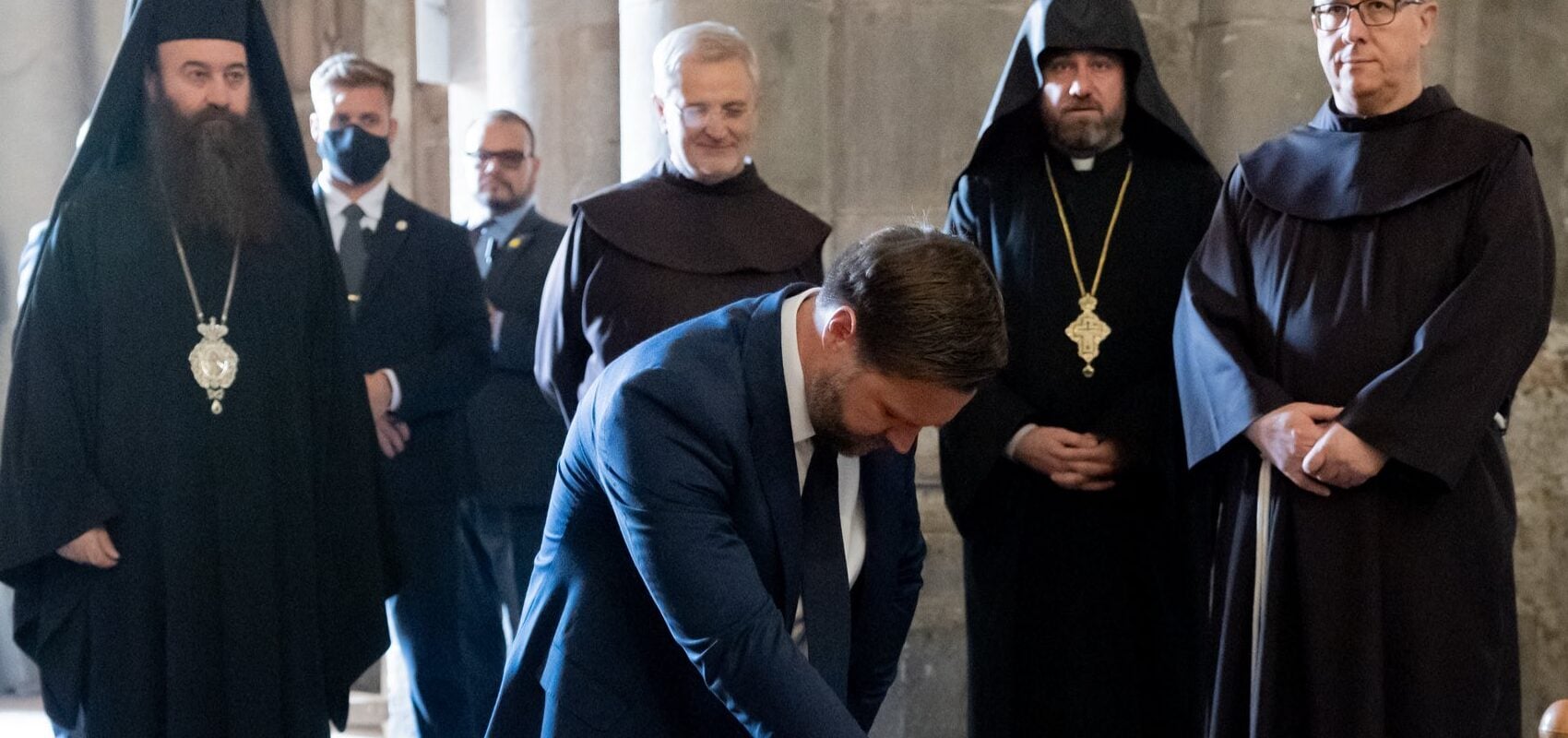
The ferment has been conspicuous during the second Trump term. Last year, shortly after Inauguration Day, Vice President JD Vance told an interlocutor on X to “google ‘ordo amoris,’” a Catholic theological term for the hierarchy of loves, the idea that we have greater obligations to our own children than to other people’s, and to our own town than to a town half a world away. He was responding to the former British official Rory Stewart, who had criticized Vance’s invocation of theology in the context of immigration policy.
Remarkably, Catholic theology set the terms of debate between representatives of two different countries and two different political outlooks. The conservative Vance is a Catholic; the more liberal Stewart is not. Those differences made little difference in how the debate unfolded. Stewart invoked the authority of Pope Francis after the pontiff criticized Vance’s use of the term. The United States and the United Kingdom are historically Protestant nations with long traditions of anxiety about papal involvement in politics. But in 2025, historical Protestantism was no impediment to referring a question to Rome.
A similar dynamic has played out during Operation Epic Fury. Francis’s successor, Pope Leo XIV, has spoken out repeatedly against the Trump administration’s campaign against Iran. In response, Vance invoked the Church’s “thousand-year tradition of just war theory” to suggest that some wars may be just, and a statesman might reasonably disagree with a pope about whether this one is. His remarks drew a rebuke from the U.S. Conference of Catholic Bishops, which said that the pope was “not merely offering opinions on theology” but was preaching the gospel and acting as the vicar of Christ.
Neither ordo amoris nor just war is a matter of revealed theology, like the virgin birth or the Trinity. Even so, it is notable that the debates over both concepts were conducted using Catholic terminology and with reference to the views of the head of the Catholic Church. Carl Schmitt famously claimed that modern political ideas are merely “secularized theological concepts.” But in Trump’s second term, the concepts haven’t lost their religious clothing. The Department of Defense’s Law of War manual specifies that “the Just War Tradition remains relevant for decisions to employ U.S. military forces and in warfighting.” That tradition is one in which the bishop of Rome has often intervened.
In 1987, the Lutheran minister Richard John Neuhaus argued that history had entered into a “Catholic moment,” in which the Catholic Church had a chance to take up its “rightful role” in constructing a “religiously informed public philosophy” for the United States. Given the Church’s declining numerical and institutional strength, it is striking to find that a strange kind of Catholic moment has indeed arrived—one in which the Church has a thinner presence on the ground but seemingly a greater one in public debates.
When the Catholic Church was at its institutional peak in mid-century, it had a far smaller role in shaping public debates than Protestantism did. At that point, the Protestant tradition had prominent mainline spokesmen, such as Reinhold Niebuhr, and powerful voices in the black church, such as Martin Luther King Jr. America still has more Protestants than Catholics—roughly twice as many, in fact—but Protestantism presently seems less central to America’s “religiously informed public philosophy” than Catholicism does.
One could see the prominence of Catholicism as adventitious, a mere artifact of Vance’s being a Catholic convert. But Vance’s conversion—like the recent general rise in adult converts—is a sign of Catholicism’s continuing intellectual and cultural strength. No mainline denomination or black church is seeing a surge in adult conversions. Many of these converts are part of a Catholic intellectual ecosystem that functions as a kind of counter-elite, supplying staffers for Republican administrations and, in time, elected officials and justices on the Supreme Court.
Of course, the Catholic Church stretches far beyond the small, if influential, world of Catholic conservatives. If these were the only Catholics, the Church might look something like the Presbyterian Church in America or the Anglican Church in North America, bodies that boast well-educated and conservative memberships but cannot shape the contours of public debate. Catholicism’s public importance depends in part on the fact that it incorporates liberals and conservatives, immigrants and old stock. In its sociological reach, it resembles the old mainline.
Unlike those mainline churches, Catholics always self-consciously stood apart from the mainstream. They had to build alternate institutions, because the oldest and most central ones were not theirs. This apartness has proved to be an advantage as American society has secularized. Protestant groups that once spoke for the American middle no longer do. Elite academic institutions that once were essential to the shaping of Protestant identity and projection of Protestant influence no longer take any interest in the religious traditions that founded them.
A further factor, explored by Julia Yost in the Washington Post, is the decline of the culture of literacy that Protestantism sustained and on which it depends. This decline has increased the salience of Catholicism, with its photogenic priestly black, cardinal red, and papal white. Among other things, our postliterate culture means that Americans no longer possess a common biblical language in which to carry out religious debates. In the absence of a truly common authoritative text such as the King James Bible, a personal religious authority such as the pope looks more necessary and relevant.
Perhaps the most tantalizing theory of Catholicism’s unexpected centrality was offered by Tocqueville, who in Democracy in America suggested that something in the Catholic faith was attractive to democratic societies. In a passage that I first encountered in Neuhaus’s kitchen—he had it affixed to the door of his refrigerator—Tocqueville observed that, in his own time, “Roman Catholics are seen to lapse into infidelity, and Protestants to be converted to Roman Catholicism.” This led to a strange combination of decline and growth, Tocqueville wrote: “If the Roman Catholic faith be considered within the pale of the church, it would seem to be losing ground; without that pale, to be gaining it.”
Standing behind this trend was a surprising sympathy between Catholicism and democracy. Democratic societies have an internal drive toward equality and unity. This drive can make them opposed to religion, but it also means that they are unlikely to accept any religion but the most universal and uniform—the most equitable, as it were. As Tocqueville put it, by “reducing all the human race to the same standard,” the Catholic faith “confounds all the distinctions of society.” Tocqueville thus predicted that Americans would “tend more and more to a single division into two parts—some relinquishing Christianity entirely, and others returning to the bosom of the Church of Rome.”
While all these factors may play a role, a Catholic must consider a final possibility—that of divine providence. If more Americans are entering the Church, if Catholic terms are increasingly central to public debates, then that may be a sign that God still has plans for the United States. Those tempted to a worldly triumphalism, however, should recall that while certain things are looking up, the trend lines continue to point down.

YOU MIGHT ALSO LIKE
Vatican II Didn’t Kneel to Modernity
In his weekly catecheses on Vatican II, Pope Leo is now discussing Gaudium et Spes, one of…
Two Spectacles, Two Frances
The Stade de France, the country’s largest soccer stadium, holds about 80,000 fans. On Friday, September 25,…
America’s Empty Confessionals
In the latest installment of the ongoing interview series with contributing editor Mark Bauerlein, James M. O’Toole…
