
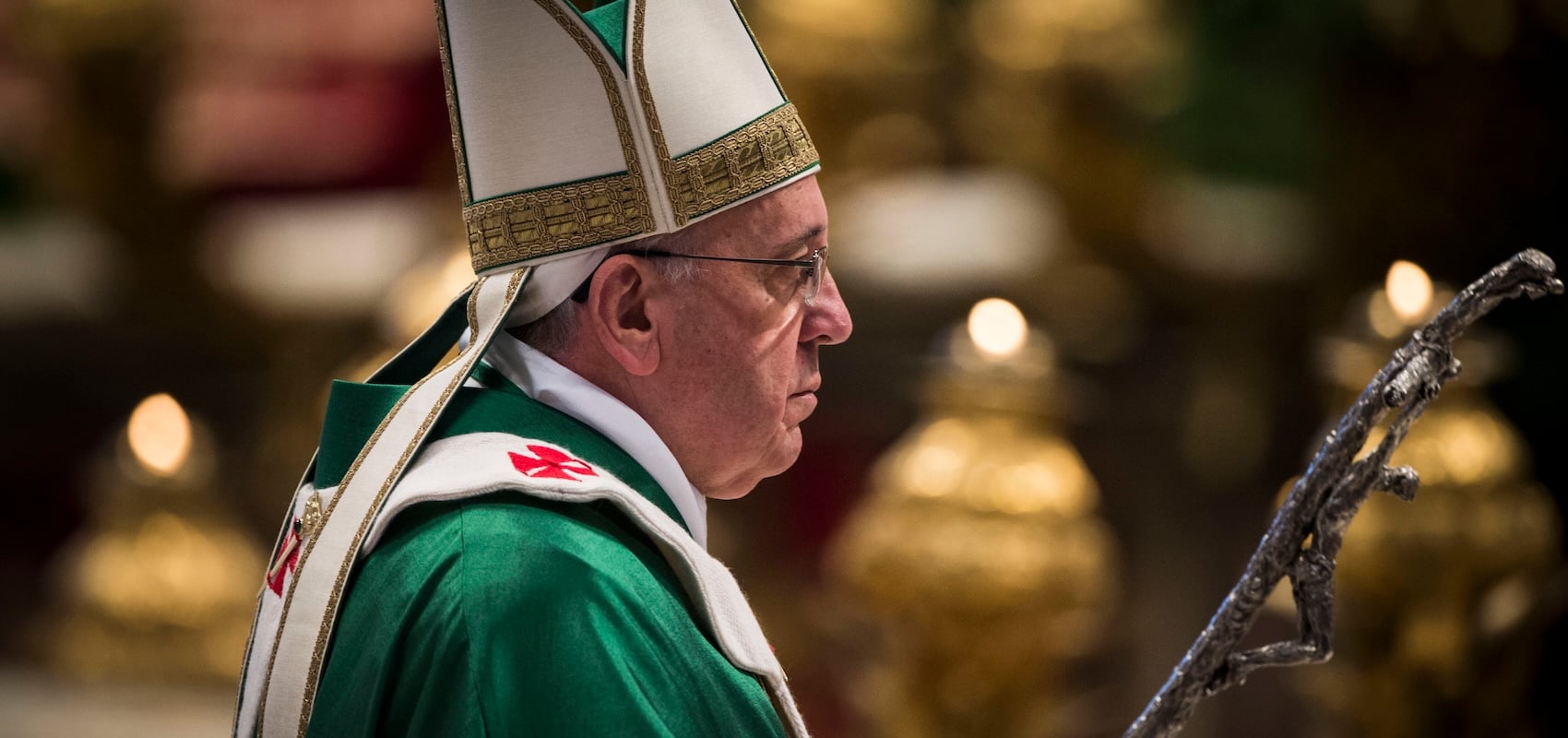
Earlier this week, Image Books published The Private Diary of Pope Francis by Cardinal Víctor Fernández. The publication of the late pope’s spiritual reflections invites those of us who struggled with his pontificate to reconsider the man who occupied the Chair of Peter from 2013 to 2025.
As a Dominican priest and theologian, I often found myself trying to understand and explain statements of Pope Francis that were not nearly as clear as either his critics or his most enthusiastic admirers insisted. I frequently defended Francis to fellow Catholics while privately wishing he had not made the defense of his words so difficult. I suspect many faithful Catholics had a similar experience—Catholics who prayed for the pope daily and genuinely wanted his pontificate to bear fruit. Nevertheless, there were times when we were frustrated, perplexed, and even discouraged. In all my years as a priest (I was ordained in 2009), I had never heard penitents confessing disdain for or hatred of the pope until Francis.
It is precisely to such Catholics that I recommend Cardinal Fernández’s new book.
The title is somewhat misleading. What Fernández has given us is not the diary itself, but a spiritual portrait of Jorge Mario Bergoglio drawn from selected entries in a diary he kept intermittently from 1992 until August 2024, along with his correspondence, personal conversations, devotional practices, and passages he underlined in books.
Fernández was a close collaborator and friend of Francis, and his affection for him is evident throughout. He wants us to see the man he knew. There is an apologetic quality to the book, and occasionally Fernández seems too eager to reconcile the interior dispositions of Francis with the external manifestations of his pontificate. Nevertheless, the diary entries themselves are remarkable, and Fernández deserves our gratitude for making them available, particularly since some of them are not altogether flattering.
What emerges from these pages is a man with a profound awareness of his own sinfulness and an equally profound conviction that everything good in his life was the fruit of God’s gratuitous mercy. Francis returned repeatedly in his prayer to the sixteenth chapter of Ezekiel, a rather astonishing account of the gratuitous love of God for Jerusalem, her subsequent infidelity, and God’s promise to reestablish his covenant with her. It is hardly a sentimental account of divine mercy. It is a passage that should make any sinner tremble, even as it gives him reason to hope: “I will reestablish my covenant with you, and you will know that I am the Lord, and thus remember and be ashamed and be reduced to silence when I forgive you for everything that you have done” (Ezek. 16:62–63).
Bergoglio saw his own life in that chapter. His episcopal motto, miserando atque eligendo, expressed not merely a pastoral program but his understanding of what God had done for him. “Mercy is my real story,” he wrote in 1994.
His diary is replete with expressions of gratitude for divine predilection, examinations of conscience, fear of self-sufficiency, and petitions for the grace of final perseverance. His devotion to the Blessed Virgin, St. Joseph, and St. Thérèse of Lisieux was remarkably childlike. He even regarded the diminishing number of slips of paper on which he wrote petitions to St. Joseph as a warning that he was becoming too confident in his own abilities.
Whatever one might think about the clarity with which Francis articulated the relationship between mercy and conversion during his pontificate, it is difficult to read these pages and conclude that his emphasis on mercy arose from a diminished sense of the gravity of sin. His private writings suggest quite the opposite.
Perhaps the most revealing passages concern what Francis considered the great spiritual temptation of his life: the temptation to omnipotence. It manifests itself in a desire to resolve everyone’s problems, an inability to say no, a distrust of others, and an inclination to manipulate people. Francis describes a particularly intense period of spiritual trial in 2021 and 2022, at the end of which he acknowledged that he had not responded faithfully to the light the Lord had given him.
Fernández suggests that by 2023, Francis had essentially become more spiritually mature and confident in grace and mercy. I tend to agree, and I noticed even at the time that his subsequent magisterial statements differed from those earlier in his pontificate. Fernández, however, is reluctant to see any significant external manifestations of this struggle in Francis’s governance during those years of trial. I am not sure that historians of the pontificate will be as reluctant.
I found these passages particularly moving for reasons that are somewhat personal. I was entrusted with considerable responsibility early in my priesthood, becoming dean of a pontifical faculty at thirty-four and later its president. I know something of the perils that accompany such responsibility: the temptation to self-sufficiency, the isolation that comes with authority as well as the isolation we impose upon ourselves, and the subtle ways in which we begin to manipulate others while convincing ourselves that we are simply serving a greater good. More recently, a period of considerable personal suffering and humiliation has occasioned a spiritual renewal in my own life and priesthood. I have had to confront some things about myself that I would rather not have, and to recognize anew my utter dependence upon the grace of Jesus Christ. I found myself recognizing something of my own struggles in the private writings of a pope whose public ministry I sometimes found difficult.
None of this requires a Catholic to revise every judgment made about the pontificate of Pope Francis. Personal humility does not necessarily guarantee the appropriate exercise of ecclesiastical authority. Profound spiritual insights do not always translate into sound prudential judgments. Nor does an intimate relationship with Jesus Christ guarantee that one will always preach and teach the mysteries of the Christian faith with theological precision. Indeed, Fernández himself acknowledges that Francis’s considerable reliance on pastoral intuition sometimes resulted in confusion among those attempting to understand the coherence of his thought.
As a Dominican, I remain convinced of the importance of articulating clearly the supernatural realities that underlie Christian moral and spiritual experience. I wish Francis had done so more consistently. Yet his diary has given me a greater appreciation of just how deeply those realities informed his own life.
A recurring theme of Francis’s pontificate was his insistence that we not reduce a person to his failures. Those of us who were sometimes frustrated with his pontificate might benefit from applying that same principle to Francis himself. We might find in him not only a pope whose words and decisions sometimes confounded us, but a fellow Christian and a sinner who, it seems, was painfully aware of how desperately he needed the mercy of Jesus Christ. I am grateful to Cardinal Fernández for introducing me to that man.
Image by Catholic Church England and Wales via Creative Commons. Image cropped.

YOU MIGHT ALSO LIKE
Scandalous Mary
The New Testament begins with a sex scandal—more specifically, with a scandalous woman. When Joseph learns his…
The Theology of Thanksgiving
An extended family crowds around a well-appointed table spread with a spotless and sharply creased white cloth.…
An Englishman Gives Thanks
Emigration is an odd experience. Having moved to the U.S. in my mid-thirties, I already had a…
