
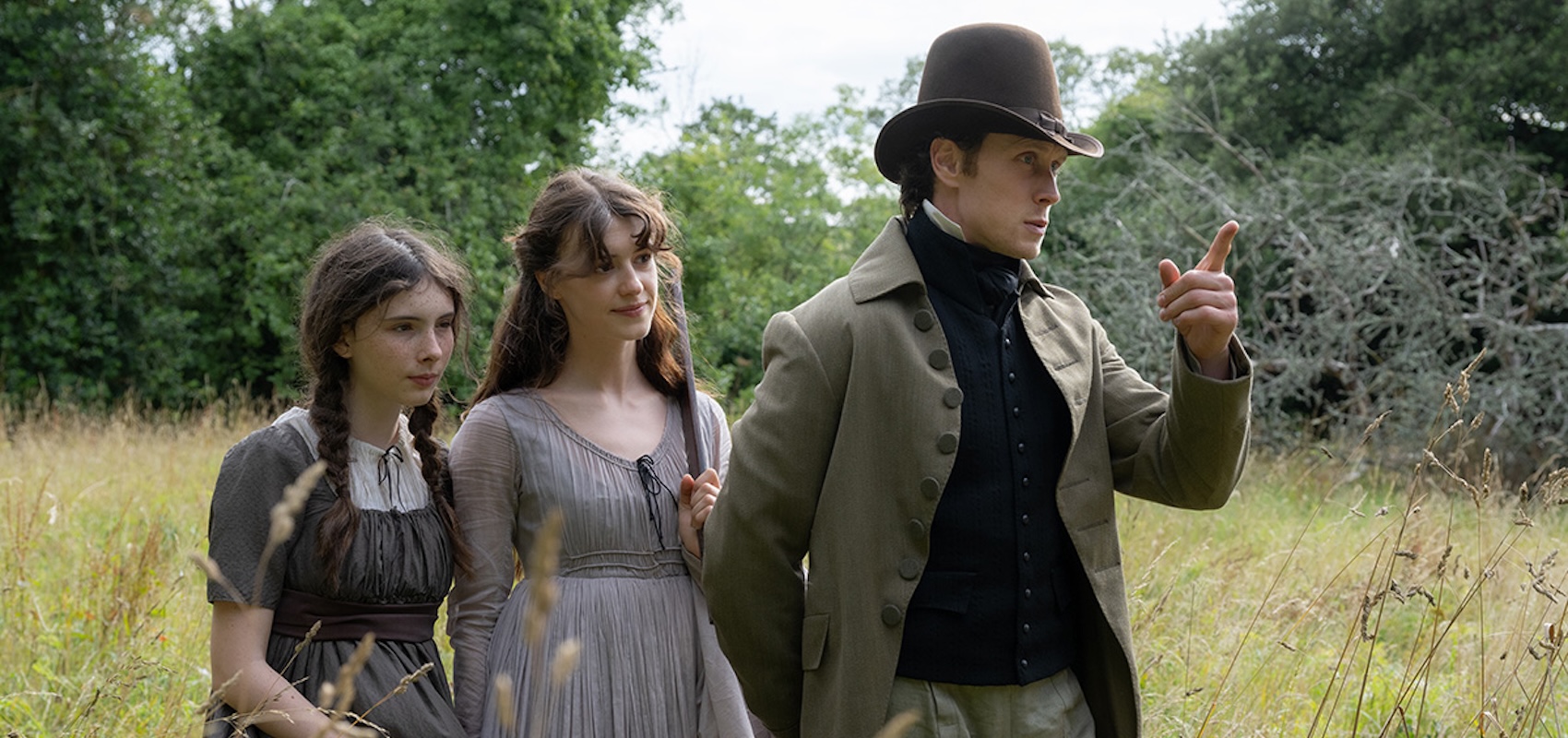
Georgia Oakley’s new Sense and Sensibility film adaptation is a tragedy. Not in the sense that it is bad. In fact, aside from Marianne’s scraggly hair and some weird interpretative dance interlude, it is thoroughly pleasant to watch. Shot entirely on film, the movie’s soft, warm lighting is especially delightful to see in this digital-camera age of drab grayness. But the film is a tragedy nonetheless, in the literary sense of the word: It refuses to capture Jane Austen’s comic vision of the world.
Austen’s novel is a story of hope in second chances. Mr. and Mrs. Dashwood’s happy marriage was the result of Mr. Dashwood having been left a widower. Edward Ferrars proposes to Elinor only after Lucy Steele ends their long-standing engagement. Colonel Brandon and Marianne’s love is, for both, a second attachment following ill-fated romances.
Even in its unhappiest moments, the story holds onto hope for future happiness. The 1995 film adaptation of the novel, with a brilliant script by Emma Thompson, who also plays Elinor, gets this. One of the first scenes of the film sees Fanny and John Dashwood—who have just inherited Norland Park—argue themselves out of financially supporting his half-sisters and stepmother, as he had promised to do at his father’s deathbed. Ang Lee, making the most of Thompson’s sharp writing, directed this scene to come across as farcical. In the tradition of literary satire, here we are supposed to laugh at Fanny and John’s avarice and scheming. We reject vice, in other words, by ridiculing it.
Oakley’s interpretation chooses an entirely different approach. In the equivalent scene, John and Fanny look almost menacing as the dialogue is drowned out by dramatic music. The excessively loud score is, indeed, one of the film’s distinctly contemporary flaws. Too many vibes, not enough audible words.
Another comical scene, in which Fanny Dashwood discovers Lucy Steele’s secret engagement to her brother Edward, and, as Austen puts it, falls “into violent hysterics,” is cut entirely. The tone remains constantly heightened, like an overly taut violin.
In the novel, we see the world through both Elinor’s and Marianne’s eyes. We experience Marianne’s strong feelings about poetry and love, but we also experience Elinor’s reserve. In this latest adaptation, there is no contrast. Elinor’s story is portrayed with as much intensity as Marianne’s. There’s a prolonged aerial shot of Elinor lying in the grass at the beginning of the film. When Edward tells Elinor his hopes for the future, the camera closes in and lingers on a crawling spider—another very contemporary cinematic gimmick, favored, for example, by Emerald Fennell in Wuthering Heights, which is brimming with gross close-ups. Elinor has no great Romantic appreciation of nature as Marianne does, so this makes no storytelling sense.
In the final proposal scene between Elinor and Edward, she runs up a craggy moor, breathless, like a Brontë heroine. Elinor’s despair at the thought that Marianne might die after falling ill doesn’t feel nearly as moving as Emma Thompson’s heart-wrenching performance—not because Daisy Edgar-Jones isn’t a good actor, but because the script and directorial choices don’t allow her to show the restraint that is so central to her character.
The film’s failure to understand Austen’s comic vision extends to how the script handles Willoughby’s betrayal of Marianne. Of course we should feel the pang of Marianne’s suffering, but we are also meant to see its redemptive quality, for her as well as for Willoughby. Oakley’s version of the story includes the scene in which Elinor confronts Willoughby for this betrayal (unlike the 1995 version, which famously cuts it), yet it refuses to show Elinor forgiving Willoughby, as she “forgave, pitied, [and] wished him well” in the novel.
Similarly, the scene of Marianne’s repentance in the novel is completely absent. In Austen’s still largely Christian society, Marianne’s descent into hopelessness after Willoughby’s abandonment could and probably would have been viewed as the sin of despair. Marianne knows this and eventually expresses her regret. A Job-like figure, she tells Elinor that she is glad to have lived long enough to make “atonement to my God.” No major adaptation of the novel, perhaps unsurprisingly, includes that line, though Kate Winslet’s Marianne in the 1995 film admits that her “conduct” should have been closer to her sister Elinor’s. In Oakley’s film, there is no suggestion that she has anything to be sorry for. The film is too in love with Marianne for her own good; it indulges her excesses of feeling and lacks any sense that wisdom has been gained from the pain that the sisters have endured. The suffering simply happens, and then the characters move on.
Because this dimension of repentance and forgiveness is largely lacking, the film leaves one with the impression of tragedy, despite the technically happy ending. That is why, ultimately, the film lacks so much of Austen’s ironic humor: It is much harder to laugh at other people’s follies (and at one’s own) without the anchoring belief in the possibility of redemption.
It would perhaps be too much to expect any adaptation of Sense and Sensibility to capture Austen’s moral vision convincingly. Oakley’s rendition can boast the distinction of understanding it the least. It’s a beautiful film, with excellent acting, but timeless it is not. Perfectly tolerable, but not subtle enough to tempt me.

YOU MIGHT ALSO LIKE
Serial Liar, Serial Comma
How would you write a public letter that you know will become front-page news? Would you write…
Shakespeare Under Stalin’s Shadow
”We wish that we could pass this play over, and say nothing about it. All that we…
Roger Scruton’s Eternal Youth
In this episode, First Things senior editor Dan Hitchens joins R. R. Reno on The Editor’s Desk…
