
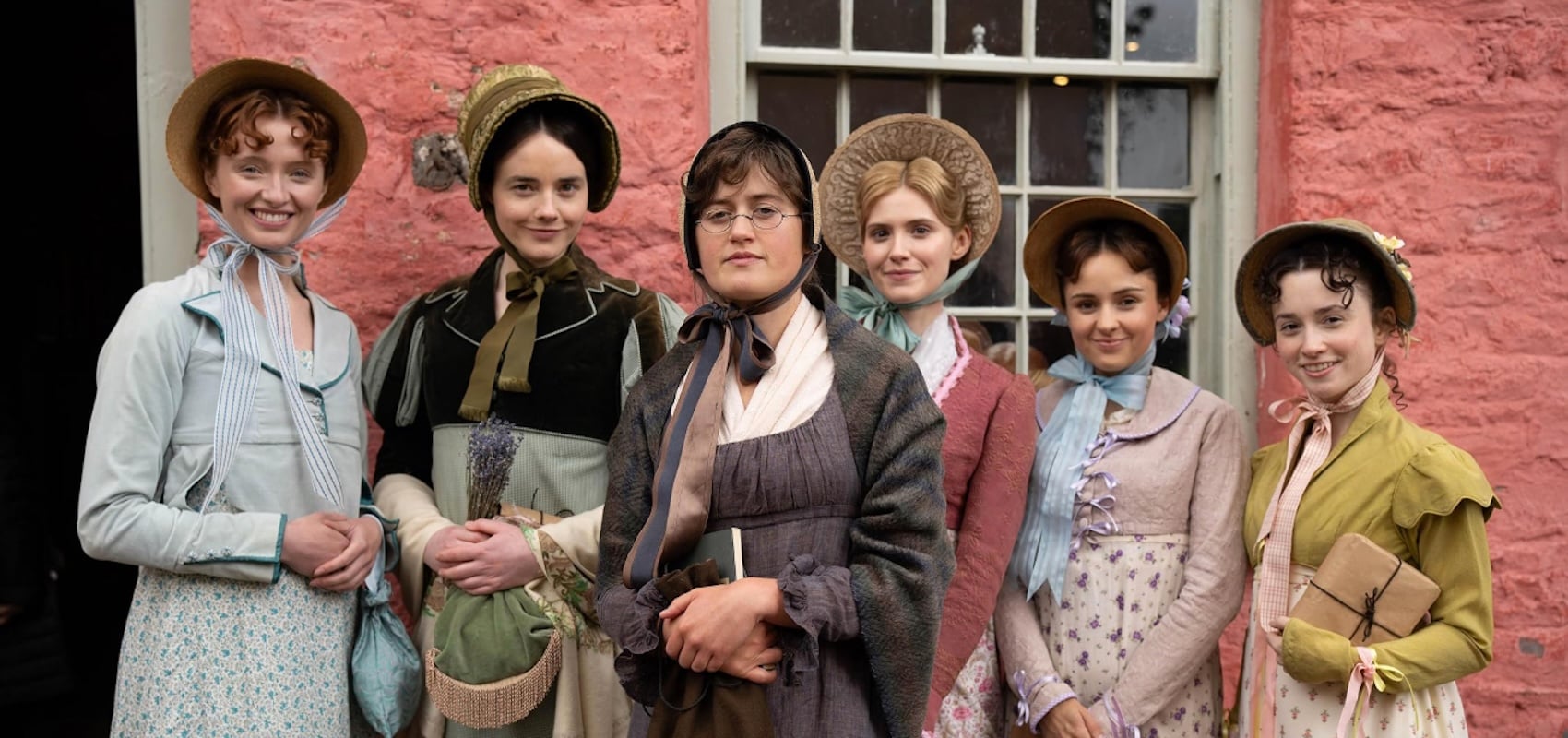
The Other Bennet Sister is the best costume drama I’ve seen in years. The story begins in the same way as Pride and Prejudice, with Mr. Bingley renting Netherfield Park and bringing Mr. Darcy along with him. From there, Janice Hadlow’s 2020 novel, on which this latest BBC adaptation is based, retells the plot from Mary Bennet’s point of view, expanding the character to show what might happen to her after Jane Austen’s story ends. By the time Mr. Bennet dies, Mary is the only unmarried Bennet sister left. She and Mrs. Bennet are unceremoniously kicked out of Longbourn by Mr. Collins, and Mary ends up living in London with her aunt and uncle, the Gardiners, working as a governess for their children. Misunderstandings and romantic intrigues suitably follow.
Unlike the recent moorland-milkmaid-dress adaptation of Emily Brontë’s Wuthering Heights, The Other Bennet Sister expects us to be intelligent viewers. The characters have entire conversations about the respective merits of literary figures popular in Regency-era England, from Cowper to Byron, Coleridge to Wordsworth. Mary alone is given several monologues on the excellencies of the eighteenth-century political theorist Catharine Macaulay. The script demands that you pay attention. You can’t just play the show in the background as ambient TV.
Nor does The Other Bennet Sister seek to alter the past for the sake of aesthetic, à la Bridgerton. Mary wears a gown even in the bathtub because that’s what was commonly done at the turn of the nineteenth century. She wears no makeup—you can clearly see actress Ella Bruccoleri’s rosacea showing through in almost every scene—because a young middle-class woman in Regency England wouldn’t have done so. The most salacious the show gets is when Mary looks intently at love interest Tom Hayward’s arm as he rolls up his sleeve. Sorry, no bodice-ripping happening here.
The show’s refusal to pander to modern sensibilities runs right through to Mary’s developing concept of happiness. This could have very easily been a story about self-acceptance, but it is instead about self-knowledge. Before anyone can accuse me of watching through the lens of my own Catholic Aristotelianism, it’s all right there in the script. Just as Mary is considering whether to accept William Ryder’s scandalous proposal to become his mistress, she develops an unexpected friendship with Mr. Collins, who introduces her to the Nicomachean Ethics. They discuss the idea that happiness can only be achieved through self-knowledge. Mary begins to understand that there are certain aspects of her person that she cannot change—her bookishness, her need to wear glasses—and ones that she can—her pedantry, her social awkwardness. She grows in virtue not because she accepts herself exactly as she is, but rather because she sees clearly how she can grow.
But perhaps most strikingly, Mary also learns to see the differences between men and women more clearly. I’m not saying that screenwriter Sarah Quintrell has read Louise Perry, but I can at least make the educated guess that she has not read Judith Butler. I’ve lost count, at this point, of how many supposedly “historical” dramas I’ve seen in recent years where the female protagonist carelessly engages in casual sex. More and more, we’re seeing a version of the past represented on screen that never happened, where pregnancy is not a consequence of sex and marriage is purely optional.
The Other Bennet Sister knows this is nonsense. In the middle of the story, Mary makes a decision that sets the course for the rest of her life. When Mr. Ryder offers to take Mary with him to Italy as his mistress, he declares he must respect his ideal of “living with freedom, unburdened by the shackles of marriage,” because “what woman wants to be owned in such a way?” Mary considers the offer. She doesn’t love him—I will not spoil whom it is that she does care for—but she is sick of living in the shadow of her sisters and mother. When she tells her sister, Lizzie knocks some sense into her, reminding her that Mr. Ryder is only thinking of his own convenience: “If he tires of this arrangement he can easily move on whilst your reputation is ruined forever.”
Mary decides that being a mistress isn’t conducive to her happiness. She hasn’t exactly had a model of a healthy marriage in her own parents, but she does in the Gardiners. She comes to accept that if marriage isn’t an option for her, she will have to find contentment within herself, not through a half-commitment. If that means continuing to work as a governess, so be it.
A powerful counter to our own dating culture, The Other Bennet Sister proposes two choices as respectful of our dignity as humans: either a good marriage, or a single life well-lived. You’ll have to see for yourself which of the two choices Mary ultimately makes.

YOU MIGHT ALSO LIKE
SlutCon’s Emotional Void
The tech-rationalist phenomenon “SlutCon” caused quite a stir online, perhaps predictably. SlutCon was a multi-day retreat and…
The Boys on the Brink
In the latest installment of the ongoing interview series with contributing editor Mark Bauerlein, Leonard Sax joins…
Serial Liar, Serial Comma
How would you write a public letter that you know will become front-page news? Would you write…
