
An Ocean Full of Angels
by peter kreeft
word on fire, 432 pages, $34.95
The Garden of Perfect Clarity
by roy peachey
os justi, 356 pages, $19.95
The nature and aims of Catholic fiction have been a matter of debate for generations now. What makes a novel “Catholic”? Is the “Catholic novelist” as Catholic essentially an apologist or an artist? If an apologist, to what extent does responsibility toward the soul of the reader bend the fiction in the direction of questions (and answers) concerning salvation at the expense of the art? If an artist, how much does attentiveness to the demands of creating the work obscure concern with its effect on the reader?
Two recent books by novelists who are Catholic help illustrate the scope of what qualifies as a Catholic novel. Earlier this year, Os Justi Press released The Garden of Perfect Clarity by British writer Roy Peachey, and Word on Fire’s new Luminor imprint republished Peter Kreeft’s 2011 novel An Ocean Full of Angels. In neither novel is the main character Catholic. Peachey’s Acheson, an English boy who grows up in China, has no religion, and Kreeft’s ‘Isa is (and remains) a devout Muslim. Catholicism per se can hardly be said to be the central topic of either novel; neither of the main characters ever sees the inside of a church. What, then, is Catholic about them?
The question is easier to answer with Kreeft’s novel, which overtly deals with recognizably (if not exclusively) Catholic themes such as abortion; Peachey’s works more subtly. These two novels fall into the opposite camps that Henry James delineates in his preface to The Tragic Muse. James praises novels with “composition” and “an absolutely premeditated art” as distinguished from those that contain mere “life”—for example, Thackeray’s The Newcomes, Dumas’s The Three Musketeers, and Tolstoy’s War and Peace. These big novels “incontestably” have life, he writes, “but what do such large, loose, baggy monsters, with their queer elements of the accidental and the arbitrary, artistically mean?” One hesitates to imagine what James might have said about Moby-Dick, to which he never alludes in any of his writings. For James, anything accidental to the formal purposes of the novel—however interesting it might be in itself—needs to be omitted; otherwise it does not “count” in the achievement of the artistic effect. “I delight,” writes James, “in a deep-breathing economy and an organic form.” Of these two recent novels, Kreeft’s situates itself amiably among the “large, loose, baggy monsters,” while Peachey’s exhibits, albeit most enigmatically, the economy of form.
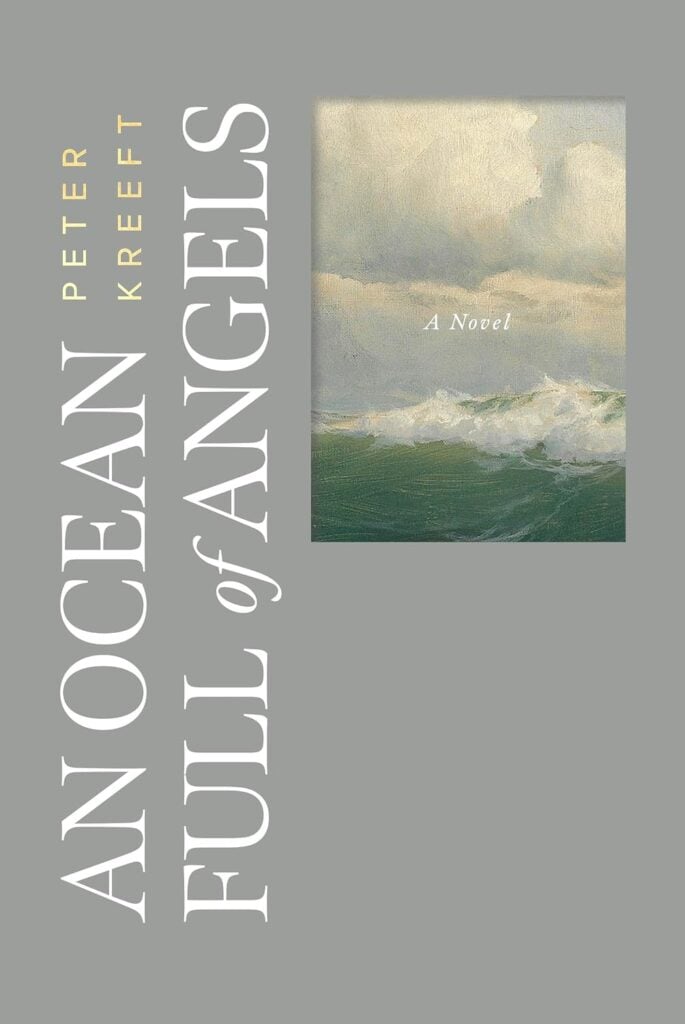
Even if a reader had never heard of Peter Kreeft before, it should not be a surprise to discover that the author of An Ocean Full of Angels is a distinguished philosophy professor at Boston College who has published innumerable popular books about serious issues. Centering on its Muslim narrator, ‘Isa Ben Adam, the novel imagines the apocalyptic reconciliation of Judaism, Christianity, and Islam. ‘Isa is the voice of the novel, and (as he tells us frequently) his name is the Muslim version of Jesus; he first introduces himself as a failed messiah who betrayed his calling. A student at Boston College, he has lost both of his parents, most recently his mother, and after a night of despair on Bailey’s Hill on the island of Nahant, he finds himself saved from suicide and taken in by the large, abbess-like Mother. Her ark of a house facing the sea contains an unlikely community of vivid misfits, each of whom has a more or less allegorical role. ‘Isa tries to discover where he fits in this mysteriously providential gathering of characters. At the emotional and figural center of the book, he falls in love with a Jewish woman named Mara, and the course of their romance gives the novel its symbolic action.
Kreeft makes no attempt at “a deep-breathing economy” or the “organic form” that James prefers. In fact, he disclaims authorship in his note “To My Readers,” ascribing the book to his student ‘Isa and asserting that “I have written more than one hundred books, but never one even remotely like this one. It is far too big for me. It is messy and diverse”—that is, it is a “large, loose, baggy monster.” He seems to have the Jamesian critique in mind when he adds, a bit grandiosely, “If you’re bothered by that, I guess you’re also bothered by the Bible—or the universe.” Still, as “composition” the novel resembles a seascape out of J. M. W. Turner’s storms and Winslow Homer’s rocky shorelines. After ‘Isa introduces himself, the novel veers into an extensive essay on the island of Nahant, including its history, its contemporary standing vis-à-vis Boston, and its most prominent physical features, described in great detail for later reference.
Kreeft needs the reader’s knowledge of the island and the Atlantic Ocean for his plot, as Melville needs the “Cetology” chapter for the later action of Moby-Dick, and he feels no obligation to tie the exposition and description into a natural sequence of discovery by ‘Isa, who simply narrates it as encyclopedically as Melville’s Ishmael might. Physical waves and wave theory (in conversation) dominate the book, and if Virginia Woolf had not pre-empted the title, this novel might have been called The Waves. There is a compelling chapter on the Great Nor’easter of 1978 and how ‘Isa survived it. There is a whole chapter on body-surfing and its connection to the core meaning of Islam, “surrender.” Images of waves and tides and storms wash through the whole novel, as do myths and archetypes.
Yet it is very much a philosopher’s novel. The conversations on various matters between the many denizens of the House function as Socratic dialogues, leading the interlocutors from a false opinion to a better grasp of the truth, often with Mother’s guidance. A chapter on abortion reveals horrific realities. Much of the novel works to correct contemporary half-truths, and one feels Kreeft’s teacherly role throughout. What does not work, alas, is the central romance on which the coherence of the plot depends. ‘Isa often waxes rapturous about Mara, but despite an entire chapter describing her, she never emerges for me as a believable character, which is to say that she never seems so much a real person as an idea, a dark trope of a fallen Mary in an attempted union of Judaism and Islam. As a reader, I want to know what Mara’s bare foot looks like when she props it up on a coffee table or whether she holds her wine glass with both hands when she’s excited. Not a chance.
Kreeft’s novel is long and rambling, often over-written and self-indulgent in descriptions. It feels like youthful work in this respect, but it is also large and memorable in its overall effect, especially when Nahant itself and the “ocean full of angels” are considered as major characters. Since the novel is set mostly in the late 1970s, I suspect that it is Kreeft’s beloved early project, revived and revised and ascribed to a younger “failed messiah,” less disciplined, more imaginative—and most importantly, not Catholic. ‘Isa’s observations of Catholic characters, especially Mother, find much to revere, much that shades into mystery, but part of the mystery is that ‘Isa himself remains resolutely outside the faith.
Roy Peachey’s non-Catholic narrator in The Garden of Perfect Clarity, in sharp contrast to ‘Isa, tells his story in a work of “absolutely premeditated art” in James’s sense. Symmetrically structured, with a key passage in the center, the novel reads like the unfolding of a saint’s autobiography, though the narrator, Acheson, has no named religion and no particular moral standing. An English child from Essex near an island in the River Blackwater, he appears strangely spared from harm and providentially chosen throughout his life, although the story begins with his sharp rejection. His father, a stonemason, casts him out of the house as useless: “He can neither break stone, nor shape it in his hands. He cannot farm, he cannot milk: he can neither make nor mend. All he does is eat and dream. He is good for nothing.” His distraught mother cannot convince her husband to change his mind, but as she is sending the boy away, she weeps, kneels, and “snaps her teeth hard around his little toe,” marking him for life—and with no more narrative explanation than one of Grimms’ fairy tales would offer.
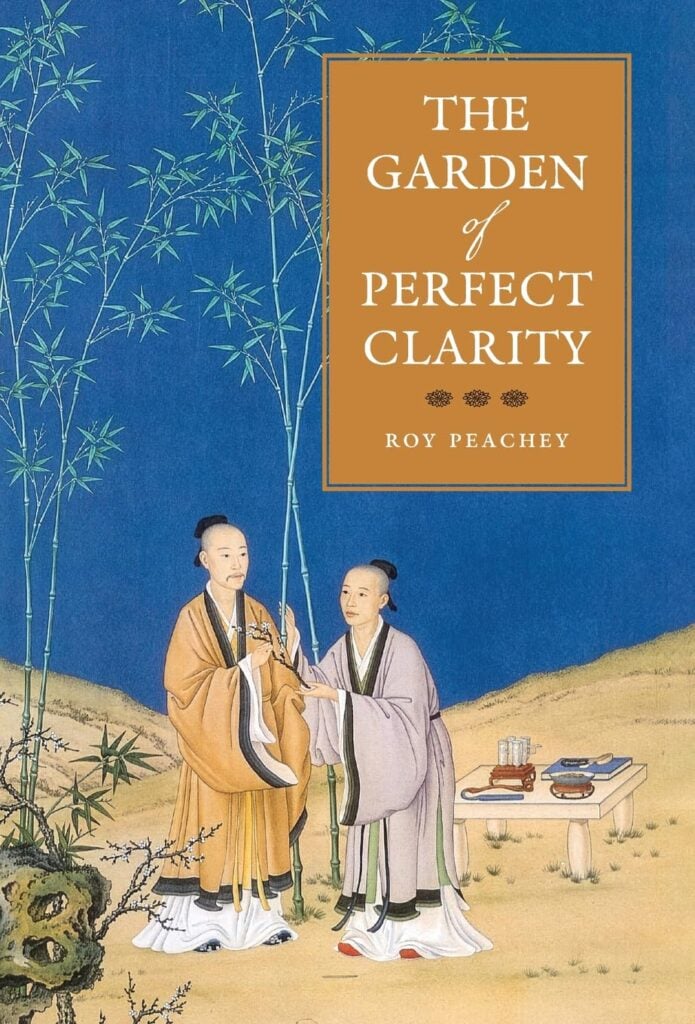
The boy makes his way to an unnamed English port, where he is conscripted to work on a ship, learning to handle himself high up in the rigging. On a long voyage, a priest named Jacobus befriends him, sees his capacities, and teaches him a new language that proves useful when the ship’s captain blames the boy unjustly for theft and casts him overboard at a port in China. At first taken by a friendly merchant into the also unnamed “City,” which is full of marvelous activity and color, Acheson becomes part of a Dickensian group of young beggar-thieves. They mock his English appearance at first, but gradually come to trust him. Captured by an aristocrat during an attempted theft, Acheson finds himself at first imprisoned and then adopted into service by this Master, who, like Jacobus, sees his potential as a scholar. In the Master’s house, he forms a strong relationship with his Master’s cook, Xiaomei, eventually learns to read and write, and speaks frequently with one of his Master’s young wives, Shenmi, who is similarly trapped. But just as he settles into happiness, his Master enrolls him in the City’s famous House of Learning under the tutelage of the great Tangren, who appears to be more of an abusive bully than a wise man.
Three major developments occur in the House of Learning: a new name for Acheson, Jiang Liu (literally “river flow”), which explains the loss of his little toe; his discovery of books and gardens; and his disillusioned submission to the regime of the mysterious Puppet Masters. Midway through the story, just before the catastrophic changes that give the novel its greatest pathos and symbolic power (comparable to the Reign of Terror or Mao’s Cultural Revolution), Jiang Liu reads about the Garden of Perfect Clarity, an image of the supreme meaning that is missing in the world he actually encounters. Jiang Liu, who becomes Acheson again after the fall of the House of Learning, never actually chooses his path so much as he discovers it. He becomes a teacher dedicated to the restoration of memory and the writer of the text we are reading—or somehow always re-reading.
Unlike Kreeft’s novel, The Garden of Perfect Clarity does not evoke the “lived world” in the way Milan Kundera thinks a novel should, nor does it open onto contemporaneity in the sense that Mikhail Bakhtin considers characteristic of the novel as a modern form. It reads like legend, like fantasy, like fairy tale, like Orwellian horror story. One of the most fascinating dimensions of the novel involves the periodic arrival by water of the Puppet Masters, whose extraordinarily engaging and lifelike puppets bewitch the people of the City. The Puppet Masters themselves remain hooded, hidden, while they manipulate these entertainments and then ascend to and enter the House of Learning. I am reminded of a brief exchange in An Ocean Full of Angels, when two of Kreeft’s characters discuss images. As one of them puts it, “images don’t have to stop and present their papers to the little guard at the gate of your mind, that little censor you call Reason. You can’t stop them. So whoever controls images, controls thought.” Ominously, the Puppet Masters overthrow the House of Learning and initiate the revolution to reorder the City. Both Peachey and Kreeft have in mind Plato’s critique of poetry and of mimesis generally in the Republic, especially in the famous Allegory of the Cave in Book 7. It is startling to find these delightful entertainments responsible for the advent of destructive revolution and ideological tyranny.
Peachey invokes real history in its deep cycles, its repetitions. It is the kind of book that presents a simple literal level but calls for interpretation from the first page. I felt that reading this book was somehow already rereading it. Peachey’s art increasingly emerges the more one probes details. For example, the Anglo-Scottish name “Acheson” means something like “son of Adam” (as does the “Ben Adam” of ‘Isa’s name in Ocean), which might help interpret both his casting-out and his chosenness. Northey Island in the River Blackwater, the region of Acheson’s birth, was the scene of the Battle of Maldon in a.d. 991 between the invading Vikings and the Anglo-Saxons. The battle (an English loss and a Christian one) was the basis of an Old English poem, which exists as a fragment and received a commentary on ofermod—overweening pride and spiritual overreach—in an essay by J. R. R. Tolkien, whose world subtly adjoined Peachey’s.
Jiang Liu is the childhood nickname of a character in the Chinese epic known to readers of Arthur Waley’s translation as Monkey: The boy’s mother tries to save him by sending him down the Yangtze River on a plank, having first bitten off his toe so that she will recognize him if she finds him later in his life. The Jiang Liu of Monkey grows up to become a monk who, like Acheson, seeks to recover ancient manuscripts and restore the wisdom of the past, much as those of us who honor the Great Books also do.
But how might the novel be called Catholic? Would references to Catholic things be enough? Once, near the beginning, a private Mass (never named as such) is in progress: Acheson sees Jacobus “muttering to himself and waving his arms around” in “a performance he played out every day” with “his face turned towards a silver plate and cup on his elegant, cloth-covered table.” A similar scene occurs toward the end, when Acheson happens to see through the knothole of a shed a man
standing alone—or maybe he was not alone—before a low block of stone. A single piece of cloth was draped across the stone, and on the cloth there stood a silver plate and a silver goblet. . . . With his eyes still fixed on what lay on that stone, he continued to mutter to himself in the way Jacobus once did, in the language Jacobus once used.
In the “Author’s Note” that follows the end of the novel, Peachey identifies Jacobus as a real historical figure from China, Li Xibiao, “a Catholic priest recently trained and ordained in Naples.” In exchange for passage back to China, he agreed in 1792 to serve as an interpreter for the voyage of “HMS Lion, a 64-gun warship,” which was trying to open new trade routes to the Far East for King George III. Peachey provides more than a few further hints in his “Note.” For example, the four major symbols used throughout the novel—two soldiers locked in deadly combat, a countrywoman, a farmer with a sickle, and a woman holding an infant—are drawn from The Memory Palace of Matteo Ricci by Jonathan Spence. Ricci was a sixteenth-century Jesuit priest whose mission was to bring Christianity to China.
Reading Spence’s book would no doubt open avenues into Peachey’s novel. On the other hand, the novel does not read as though crucial information were missing—at least, no more than for Acheson himself—and major symbols work organically within the story. For example, Acheson protects an endangered mother and child (woman with infant) in the City, a central event in the discovery of his own calling, and then leads the family in a difficult exodus into the country. The cook Xiaomei, whom Acheson had known as a boy in the Master’s house, is the “countrywoman” who offers Acheson and his companions refuge. The action of the novel can be understood as rediscovering and vivifying static symbols, just as, in the Christian tradition, our daily lives entail a rediscovery of what our iconic symbols mean. As in Peachey’s novel, their significance has to be lived—perhaps endured—before it can be recognized as symbolically prefigured. The Garden of Perfect Clarity enacts this discovery of meaning in Acheson’s narrative of his life, which circles back from the vocation of his old age to his first rejection by his stonemason father. The useless son that the mason rejected has become the cornerstone.
When Caroline Gordon was wrestling with what it meant to be a Catholic novelist back in the early 1950s, she observed: “There is in every artist a still, small and at times intensely disagreeable voice.” She meant the divine imperative of art, which, for a novelist, must be “the contrivance of the illusion of life”—her way of saying that fiction must be painstakingly true to reality. She does not mean that the artist must include religious themes, but that the work must be believable. It is in precisely this regard that she faults such Catholic luminaries as François Mauriac and Georges Bernanos, who lack a “patient, passionate portrayal of natural objects . . . a recognition of the natural order which I can only call Christian.” In this regard, much as she admires Bernanos, she writes, “I think that Faulkner is, on the whole, a more Christian writer.”
Her essay (available in an anthology I edited, The Southern Critics) might be a starting point for renewed discussion of the Catholic novel. Her major emphasis is not confessional Catholicism but a deeper current that moves within the novelist. In other words, “a novelist’s conscious mind may be influenced by what is going on around him, he may announce himself a pragmatist, a skeptic, an atheist while his creative faculties seem to move in and subscribe to a totally different order.” Jamesian as she certainly was, Gordon here insists on the givenness that supplements artistic premeditation, the artist’s deep openness as artist to the uncontrolled forces within creative intuition.
On the surface the action seems to run in one direction while the current in its depths runs in quite another. I believe that it could be shown that in the nineteenth century and in our own century as well the fiction writer’s imagination often operates within the pattern of Christian symbolism rather than in the patterns of contemporary thought.
This current in the depths, she argues, this “primal plot,” is the Christian story of redemption.
I wonder, then, about the Jamesian preference for “an absolutely premeditated art.” Should the novelist carefully prepare for the effect of crucial scenes? Certainly—but there is something confining about an art so much under the writer’s strict control that it has curated the reader’s emotional response in advance, like a tour guide who will not let the experience speak for itself. As Robert Frost recognized, “no surprise for the writer, no surprise for the reader.” I have always liked Keats’s letter to J. H. Reynolds about the attempt to design the reader’s response:
Each of the moderns like an Elector of Hanover governs his petty state, and knows how many straws are swept daily from the Causeways in all his dominions and has a continual itching that all the Housewives should have their coppers well scoured: The ancients were Emperors of vast Provinces, they had only heard of the remote ones and scarcely cared to visit them.
This isn’t simply a preference for “loose, baggy monsters,” but a recognition that the work of art must have an opening to powers outside those in the artist’s conscious control. In Creative Intuition in Art and Poetry, Maritain calls it a “sacred weakness.” Through the convincing movement of the action and its surprises for both writer and reader, I would argue, comes the imaginatively lived completeness experienced as beauty in its inevitable but also somehow unexpected closure, like the silence after Benjy’s bellowing at the end of Faulkner’s The Sound and the Fury. In art, beauty is truth. The truth of a great novel is both an unveiling (something freshly apprehended) and a foundation (something trustworthy because experienced).
In this regard, neither of the two novels under discussion is great. Peachey’s novel certainly seems more “premeditated” than Kreeft’s with its essays, dialogues, and digressions, including a late foray into the Viking discovery of America. But in its archetypal rendering of the power of nature, Kreeft’s novel seems larger than Peachey’s in the sense that it opens the soul to an experience of grandeur. On the other hand, Kreeft’s failure to render the central romance believable makes The Garden of Perfect Clarity appear superior as art. Both novelists bestow on their narrators a certain wonder, a crucial passivity that characterizes life open to grace. They are “Christian in hope,” in a generous phrase of Maritain’s. ‘Isa and Acheson wait (like the attentive reader) for things to happen that will lead to illumination, if never perfect clarity.
These two novels are good news. Katy Carl of Luminor (herself a novelist) has recently suggested that
we are at the beginning of a wave of renewal in global literary writing to which Catholics are going to contribute unmistakably, vitally, indispensably. That wave is going to crest sometime in the next five to ten years. We’re in the swell of it now.
Independent, intentional Catholic writers now find publishers like Wiseblood, Angelico, or Word on Fire; mainstream North American novelists like Phil Klay, Christopher Beha, and Randy Boyagoda are openly Catholic; and globally, as Carl comments, “we now have a recent Catholic Nobel laureate in literature, Jon Fosse.” Carl also points to a number of African, Australian, and South American writers who “are deeply influenced by Catholic and Christian ideas, culture, and experience, often in more positive ways than we’re typically encouraged to acknowledge.”
It’s dangerous to be too optimistic—or, on the other hand, too limited in where we look. Caroline Gordon would certainly caution us not to confine our attention to writers with the proper Catholic credentials, nor to dismiss those who profess, on the surface, all kinds of disagreeably fashionable opinions. Suppose that a deeper symbolism still moved in its hidden stream—might Sally Rooney or even Miranda July be writing about redemption?

YOU MIGHT ALSO LIKE
After Disenchantment
What does the phrase “disenchantment of the world” mean? Disenchantment is easy to identify and even easier…
Seeking God, Finding the Devil
On the wedding night of his second marriage, August Strindberg (1849–1912), the Swedish writer, painter, polymath, and…
Tell the Stories of Your People
Fifteen centuries ago, in a land whose frontiers had collapsed, whose fields were overrun, and whose monarch…
