
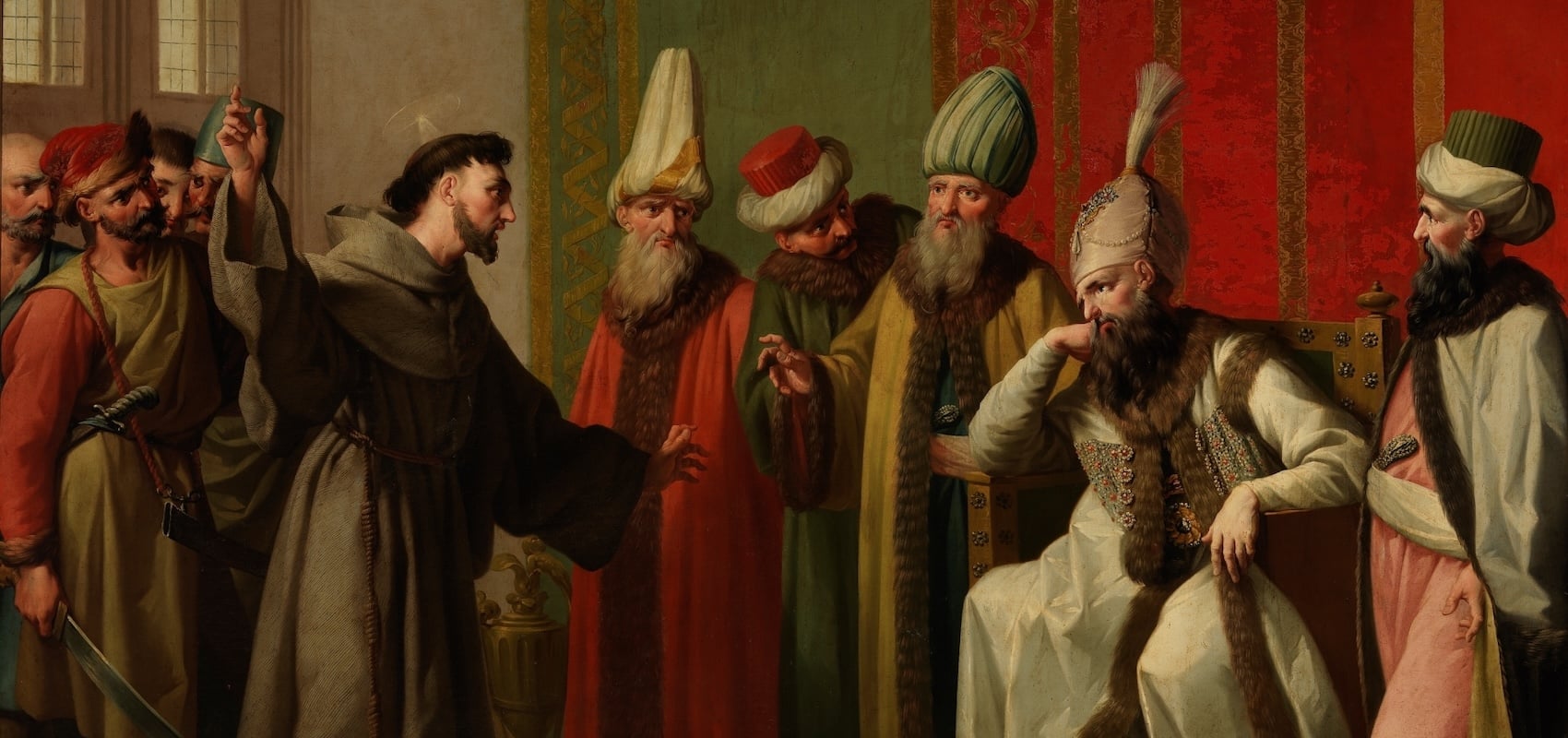
At the beginning of his 2020 encyclical, Fratelli Tutti, Pope Francis speaks of “an episode in the life of St. Francis that shows his openness of heart, which knew no bounds and transcended differences of origin, nationality, color, or religion.” He means, of course, St. Francis’s celebrated journey to Egypt in the early thirteenth century. According to the popular version of this story, St. Francis arrived amid war-mongering Crusaders, crossed through enemy lines, and embraced the Muslim sultan Malik al-Kamil (nephew of Saladin) in friendship.
In Fratelli Tutti, Pope Francis not only tells this story, but relates his own story of meeting with a powerful Egyptian:
I have felt particularly encouraged by the Grand Imam Ahmad Al-Tayyeb, with whom I met in Abu Dhabi, where we declared that “God has created all human beings equal in rights, duties, and dignity, and has called them to live together as brothers and sisters.” This was no mere diplomatic gesture, but a reflection born of dialogue and common commitment. The present Encyclical takes up and develops some of the great themes raised in the Document that we both signed.
The declaration from which Pope Francis quotes here is The Document on Human Fraternity for World Peace and Living Together, which he signed on February 4, 2019, together with Ahmad Al-Tayyeb, the Egyptian grand imam of Al-Azhar: the most important Sunni Muslim religious institution in Egypt and, arguably, the world. As Pope Francis explains here, this meeting, and the document the two of them signed, was the very basis and inspiration for Fratelli Tutti.
The meeting of Pope Francis and Al-Tayyeb was carefully planned and directly connected to the story of St. Francis. The year 2019 marked the eight-hundredth anniversary of the meeting of St. Francis and Malik al-Kamil. On stage in Abu Dhabi, the pope and the grand imam embraced. Many articles on the meeting include the image of an icon (written years earlier by Franciscan friar Robert Lentz) that shows St. Francis and “Saint” Malik al-Kamil embracing. The icon has both men depicted with halos, and each is named with the Arabic word qiddis—“saint.” Even the Vatican itself compared the meeting of St. Francis and Malik al-Kamil in Egypt with the meeting of Pope Francis and Ahmad Al-Tayyeb centuries later. The implication was that God had raised two visionary men of peace in the thirteenth century and had done so again in the twenty-first century.
But how well do these images correspond with reality? Let’s consider them one at a time, beginning with Pope Francis and Ahmad Al-Tayyeb.
Pope Francis shaped his pontificate around the figure of St. Francis as a man of peace who defied the violence and materialism around him. He was the first pope to choose the name Francis, and he titled two of his encyclicals, Laudato Si’ and Fratelli Tutti, after Italian sayings of St. Francis. Pope Francis signed Fratelli Tutti on October 3, the vigil of the Feast of St. Francis, in St. Francis’s city of Assisi. His meeting with Ahmad Al-Tayyeb, which would become the basis of Fratelli Tutti, symbolized his commitment to follow the path of St. Francis in the twenty-first century.
Toward the beginning of Fratelli Tutti, Pope Francis says the following of St. Francis’s journey to Egypt:
That journey, undertaken at the time of the Crusades, further demonstrated the breadth and grandeur of his love, which sought to embrace everyone. Francis’s fidelity to his Lord was commensurate with his love for his brothers and sisters.
The message of peace and inclusion in Fratelli Tutti was widely praised. Anarticle in The Guardian quotes Christine Allen (director of the Catholic aid agency CAFOD) explaining: “This is a message not just to Catholics, or people of other faiths, it is to everyone. It is a powerful voice amid the pandemic, growing inequality, conflict and racial unrest.” Writing about the encyclical in Commonweal, Massimo Faggioli used the moment to compare Francis to Joseph Ratzinger:
October 3, the day that Francis signed Fratelli tutti in Assisi, also happened to mark the twentieth anniversary of a somewhat less illustrious moment in the Church’s interreligious outreach. In 2000, a planned day of dialogue between Jews and Christians in Rome had to be canceled because of the negative reaction to Dominus Iesus, a recently published declaration from the Congregation of the Doctrine of Faith, led at the time by Cardinal Joseph Ratzinger. Around the same time, the Jesuit theologian Jacques Dupuis was under trial on charges brought by the Holy Office for his work on the theology of interreligious dialogue. How far we’ve come in twenty years, thanks to Jorge Mario Bergoglio.
Ratzinger did indeed differ from Pope Francis (formerly Jorge Bergoglio) in his approach to non-Christian religions and even to Ahmad Al-Tayyeb himself. Ratzinger, as Pope Benedict, called attention to the persecution of Christians in Egypt after the bombing of a church in Alexandria at a New Year’s Eve service in 2010 (which killed over twenty people). Ahmad Al-Tayyeb responded by suspending Al-Azhar’s dialogue with the Vatican, angry at the pope’s “interference.” He insisted that there were worse cases of Muslims being persecuted by Christians.
Under Pope Francis, the Vatican dialogue with Al-Azhar resumed. Francis cultivated a close personal relationship with Al-Tayyeb. Between 2016 and 2022, Francis and Al-Tayyeb met on nine different occasions, including at the Vatican and in Cairo, at Al-Azhar.
Was Benedict wrong to anger Al-Tayyeb? Did Francis save the day by re-establishing the Church’s relationship with Al-Azhar and forming a strong diplomatic connection with Al-Tayyeb? These are complicated questions, and the Holy See must weigh various considerations in forming diplomatic relationships and deciding what approach is ultimately best for Christians in Egypt (and elsewhere in the Muslim world). Nevertheless, the least one can say is that Al-Tayyeb is not an ideal interlocutor, let alone coauthor, of a document on “Human Fraternity.”
Al-Tayyeb has collaborated closely with the Egyptian Sisi government, which according to Amnesty International has ruled over a “decade of shame” in Egypt, marked by arbitrary detentions, unfair trials, attacks on freedom of expression, and various forms of discrimination. Al-Tayyeb has not simply been a passive observer of state crimes. Even before Sisi, he never opposed rulings in favor of the traditional Islamic teaching that converts from Islam to Christianity must return to Islam or be executed. He has supported the arrest and imprisonment of Muslims accused of blasphemy, and he has explicitly argued against the freedom of Baha’is to practice their religion in Egypt. This is the same man who, with Pope Francis, signed the document declaring: “God has created all human beings equal in rights, duties, and dignity, and has called them to live together as brothers and sisters.”
With the support of Al-Azhar, the Egyptian state has repeatedly refused to change the ID cards of converts from Islam to “Christian.” The most recent case was that of Saeid Mansour Abdulraziq. His request to change his ID card to reflect his Christian faith was rejected, and in July 2025 he was arrested under charges of terrorism and “contempt for Islam.” Al-Tayyeb, as with previous cases, had no objection.
Even some Muslim observers worried that Francis might have chosen the wrong dialogue partner. Rashied Omar, a Muslim imam and teaching professor in the Keough School of Global Affairs at Notre Dame, noted in response to Fratelli Tutti that Al-Tayyeb is an example of a Middle Eastern religious leader who collaborates closely with repressive political leaders:
In many countries across the world the idea of religious leaders and institutions challenging the excesses of state power is anathema and frowned upon. This is the case in Western democracies such as France and the United States of America. In the Middle East, this is an even bigger problem. Here religious leaders and institutions have been rendered state apparatchiks whose primary role is to buttress and provide religious legitimacy to state power. In almost all Middle East countries the highest Islamic religious authorities are state appointed, including the Grand Shaykh of Al-Azhar Islamic University, and most Friday mosque sermons are state sanctioned. Moreover, religious leaders who criticize state policies are routinely incarcerated.
So what about the other image in the comparison mentioned above, that of St. Francis and Malik al-Kamil? Fratelli Tutti describes their meeting like this:
Unconcerned for the hardships and dangers involved, Francis went to meet the Sultan with the same attitude that he instilled in his disciples: if they found themselves “among the Saracens and other nonbelievers,” without renouncing their own identity they were not to “engage in arguments or disputes, but to be subject to every human creature for God’s sake.”
Pope Francis quotes here from St. Francis’s Earlier Rule of the Friars Minor. The quotation does not, however, give a clear or robust sense of his teaching in the rule. In this section, St. Francis actually mentions two ways for the friars to live among Muslims “and other nonbelievers [Latin: infideles]”:
Chapter 16: Those going among the Saracens and other nonbelievers
The Lord says: Behold, I am sending you as lambs in the midst of wolves. Therefore, be prudent as serpents and simple as doves (Matt. 10:16). Therefore, any brother who, by divine inspiration, desires to go among the Saracens and other nonbelievers should go with the permission of his minister and servant. . . . As for the brothers who go, they can live spiritually among [the Saracens and nonbelievers] in two ways. One way is not to engage in arguments or disputes (1 Tim. 3:2, 2 Tim. 2:14), but to be subject to every human creature for God’s sake (1 Pet. 2:13) and to acknowledge that they are Christians. Another way is to proclaim the word of God when they see that it pleases the Lord, so that they believe in the all-powerful God—Father, and Son, and Holy Spirit—the Creator of all, in the Son who is the Redeemer and Savior, and that they be baptized and become Christians; because whoever has not been born again of water and the Holy Spirit cannot enter into the kingdom of God (John 3:5).
Clearly St. Francis was not opposed to the public and vocal preaching of the gospel to Muslims. He believed that they could be saved only through baptism. Their eternal welfare was at stake.
This leads to another question. What do we actually know about the meeting between Francis and the sultan?
As John Tolan explains in his excellent book Saint Francis and the Sultan, our earliest and best source for the story of St. Francis in Egypt is written by Bishop Jacques de Vitry to celebrate the conquest of the city of Damietta (which fell to the Crusaders in November 1219). In two versions of this letter (sent to two of his friends), he mentions Francis at the very end. (A third version, sent to the pope, does not mention the episode at all.)
Jacques’s letter suggests that Francis really did meet the sultan. But this source—the most important one we have—suggests that the meeting was completely different in nature from what Fratelli Tutti implies:
The head of these brothers, who also founded the Order, came into our camp. He was so inflamed with zeal for the faith that he did not fear to cross the lines to the army of our enemy. For several days he preached the Word of God to the Saracens and made little progress. The Sultan, king of Egypt, privately asked him to pray to the Lord for him, so that he might be inspired by God to adhere to that religion which most pleased God.
In other words, it seems that St. Francis went to see the sultan for one purpose only: to convince the sultan to convert and be baptized.
Around 1224, a few years after the surrender of Damietta to Malik al-Kamil, Jacques himself embellished his account of Francis with new details in his chronicle Historia Occidentalis:
[Francis] was so moved by spiritual fervor and exhilaration that, after he reached the army of Christians before Damietta in Egypt, he boldly set out for the camp of the Sultan of Egypt, fortified only with the shield of faith. When the Saracens captured him on the road, he said: ‘I am a Christian. Take me to your master.’ They dragged him before the Sultan. When that cruel beast saw Francis, he recognized him as a man of God and changed his attitude into one of gentleness, and for some days he listened very attentively to Francis as he preached the faith of Christ to him and his followers. But ultimately, fearing that some of his soldiers would be converted to the Lord by the efficacy of his words and pass over to the Christian army, he ordered that Francis be returned to our camp with all reverence and security.
Here Jacques speaks of how Francis was captured and brought as a captive to the sultan. Yet the principal addition to this version is Jacques’s explanation for why the sultan ultimately released Francis from captivity: His preaching was so brilliant that the sultan was afraid that some of his soldiers would be converted. (This suggestion is not impossible, but it is open to question. Conversion, apostasy, would mean certain death for a medieval Muslim soldier.)
There still is nothing here about Francis seeking peace. We read only of his zeal to preach to and convert the sultan. Jacques celebrates Francis precisely for his efforts to convince the sultan to convert through lengthy arguments. Apparently St. Francis had not heard of the quotation so often attributed to him: “Preach the gospel always. When necessary, use words.”
The boldness and courage of Francis was not, then, in standing up for peace among bloodthirsty Crusaders. It was in preaching the gospel to Muslims when that sort of thing could get you killed. One might question whether Francis had prudence, but he clearly had an abundance of fortitude.
Some of Francis’s friars were in Morocco at precisely the same time, and they, too, were preaching the gospel to Muslims. Like him, they were ready to die for their faith. Unlike him, some of them did. Five of the friars whom Francis sent to Morocco—Berard of Carbio, Peter, Otho, Accursius, and Adjutus—were beheaded for their offense against Islam in 1220 (only one year after Francis met the sultan).
The contrast between the Francis of history and the Francis we read about in Fratelli Tutti is stark. Jacques de Vitry, writing in 1220, relates: “For several days he preached the Word of God to the Saracens and made little progress.” Pope Francis, writing in 2020, relates: “Francis did not wage a war of words aimed at imposing doctrines; he simply spread the love of God.”
In his encyclical, Pope Francis lays out a compelling vision of a peaceful, fraternal, diverse, global society. However, this was not the vision of St. Francis. St. Francis went to Egypt to preach the gospel, not to preach peace. He was ready to die for the sake of spreading the gospel far and wide. The St. Francis of Fratelli Tutti, on a mission to bring peace to Egypt and oppose the violent Crusaders, never existed. Not a single line of St. Francis condemns the Crusades.
Fratelli Tutti’s presentation of a mythical St. Francis is especially problematic for Catholic men. The encyclical presents them with only two sorts of men to choose from as models: the bigoted, bloodthirsty Crusaders and the meek, peace-loving St. Francis.
The real Francis, however, offers a third option for Catholic men. In preaching the gospel to Muslims, St. Francis put his own life at risk. Catholic men today may not, and perhaps should not, follow Francis’s footsteps in Egypt. They can, however, learn from him the virtue of fortitude, which he had in abundance. There is no need to invent a new Francis. The real Francis was a saint.

YOU MIGHT ALSO LIKE
Letters—November 2026
I appreciate J. H. H. Weiler’s desire for God’s mercy to be extended to Gentiles and his…
Job and Her
It is said that Job lost everything, but she has lost more. All her possessions—the money, the…
Briefly Noted
Sir Andrew Motion is former poet laureate of the United Kingdom and cofounder of the Poetry Archive,…
