
There is a long-running strain of New Testament criticism, associated most famously with Albert Schweitzer, that places great weight on the theme of deferred apocalyptic expectation. On this paradigm, the New Testament is read as an account of how the earliest Christian communities dealt with the fact that the Parousia—once believed to be imminent, within the very lifetimes of Christ’s disciples—was somehow postponed. Where was Jesus? Surely he was coming soon—but when?
In the year following the assassination of Charlie Kirk, a similarly deferred apocalyptic expectation has produced many of the rifts that now cleave the right. Today, over a decade into the age of Trump, the makeup of the conservative coalition is decidedly not fixed. Trump’s GOP is not Bush’s or Romney’s GOP. But the days and weeks following Kirk’s murder were a time of remarkable unity between the factions. And that unity gave rise to a certain expectation. Maybe, at long last, something big could be done, or a reckoning forced: a final showdown between real America and its globalist adversaries.
It is difficult to overstate the extent to which the motif of a coming “zero day”—an impending inflection point or moment of final crisis—dominates certain sectors of the online right-wing media landscape. This anticipation goes well beyond normal concern over the American future or a natural desire to win the next election. It is brutally existential in character, predicated on a rejection of the idea that the American story—messy as it is—can continue in the decades to come. What if the center cannot hold?
For years now, this expectation has been concentrated around the singularly dominant person of the president, ranging from calls for Schmittian decisionism to QAnon-inflected prophecies of a cleansing “storm” to come. The presidency, of course, possesses great power and authority. But that power is not unlimited: Supreme Court decisions and legislative inaction still matter.
But apocalyptic mythology has little use for such roadblocks. Against a backdrop of intense expectation, Kirk’s murder—like the 1914 shooting of Archduke Ferdinand—was widely received as a catalyst for the great reckoning to begin. Merely consider some of the immediate responses by prominent influencers, many with hundreds of thousands of followers. In the words of MAGA provocateur Laura Loomer: “It’s time for the Trump administration to shut down, defund, & prosecute every single Leftist organization. . . . We must shut these lunatic leftists down. Once and for all. The Left is a national security threat.” Podcaster Joey Mannarino urged that the Democratic Party be “classified as a domestic terror organization and their members & leaders treated accordingly.” And not to be outdone, journalist Nick Sortor pronounced that “the left has declared LITERAL WAR on us.”
But little changed. There was no moment of avenging catharsis followed by national redemption. For one thing, the fantasy always depended on the notion that somewhere out there, waiting in the wings, were elite cadres of loyalists prepared to orchestrate something like de-Baathification. There weren’t, and—more to the point—American politics has never worked like this. Party ideologies, from the era of the Federalists and Anti-Federalists on, have always adapted to meet the needs of the political moment. Factions rise and fall and blur into one another as the decades pass.
For another, the fantasy was incoherent on its own terms. What even is “the left,” anyway? Is it a political party? All who oppose the current administration? Or is it the Enlightenment civilizational project as a whole? And what could it even mean to wage an organized offensive against such an amorphous notion? “Left,” like “right,” is always a relative term—originally, in the days of the French Revolution, denoting an inclination toward equality and leveling over hierarchy and tradition. So even total political victory, and the emergence of a one-party regime, would simply replicate that same polarity within one’s own ranks: There will always be a “left” and “right” in any coalition.
And so, unsurprisingly, the great storm did not come. Politicians and commentators and voters muddled on as usual. The apocalyptic expectation was defeated, or at least deferred. But—as Schweitzer would have predicted—the energy stirred up by that expectation did not dissipate. It has merely taken a new form.
Infighting on the right, often taking the form of competing claims to Kirk’s legacy, is now rampant. (What did Kirk think about Israel? Was he changing his views toward the end of his life?) Frustrated expectation manifests as a desire to lay blame: someone, somewhere, delivered a stab in the back. Theorist Anton Jäger has memorably described this kind of turbulence as “hyperpolitics”: a state in which ideological conflict is more salient than ever, but those most exercised by it lack any material outlet or operational capacity to realize their vision. Put more simply: No one organizes or marches; they simply post on X and scroll through TikTok, growing ever angrier and more frustrated. The memory of Charlie Kirk is not cherished or seriously engaged but appropriated for self-serving ends—or, alternatively, reduced by more cynical sorts into bathetic memes.
It is, of course, impossible to truly say “what Kirk would have wanted.” But it is hard to imagine him—as a longtime champion of public debate and the American tradition—approving of many of the causes that now claim his name.
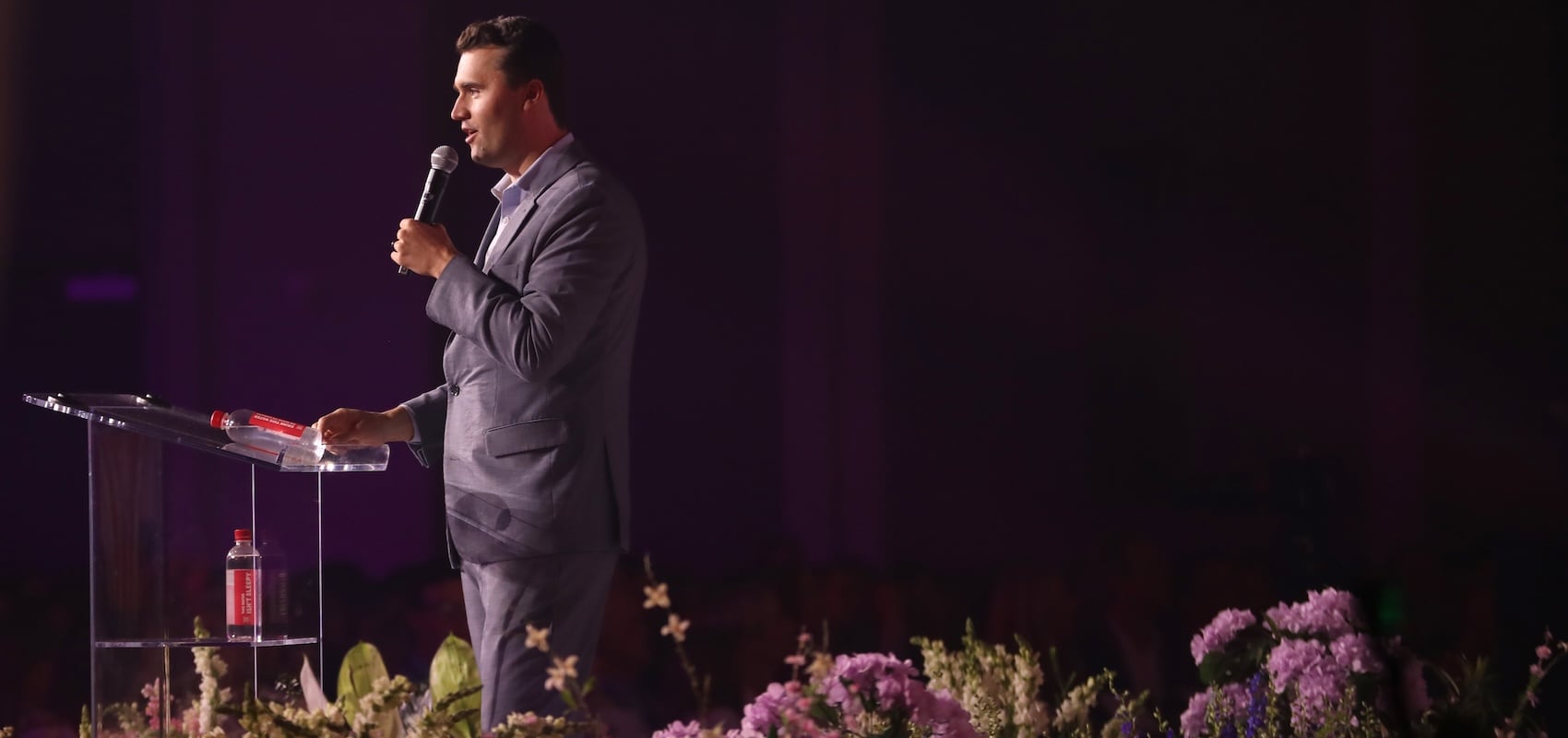
Image by Gage Skidmore via Creative Commons. Image cropped.
Dear Reader,
Can I be direct with you?
War abroad. Socialists on the rise. AI upending human life. Endless uproar online. The modern attention economy doesn’t want readers — it wants users enslaved to the tyranny of the present.
First Things is the antidote: literary excellence, timeless truths, and a fixed point of reference in a culture that has lost its bearings.
But we can’t do it without readers like you.
Our goal: Raise $150,000 by November 1 to sustain First Things in the year ahead.
Your gift anchors readers in the permanent things.
Make your Fall Campaign gift now using the button below.
If you have any questions or would like more information, please contact Giovanni Del Piero, Director of the Editor’s Circle, at gdelpiero@firstthings.com or 212-627-1985.

YOU MIGHT ALSO LIKE
Forget Odysseus. Aeneas Is the True American Hero.
Who is our Odysseus? Or more precisely, who is the most Odyssean hero of American film? Matt…
Meet the Post-Religious Right
There have been many books written about the online right and the Trump movement, most by people…
Candace Owens and the Sin of Anti-Semitism
According to the online Encyclopedia Britannica, Sir Moses Montefiore (1784–1885) was “an Italian-born businessman who was noted…
