
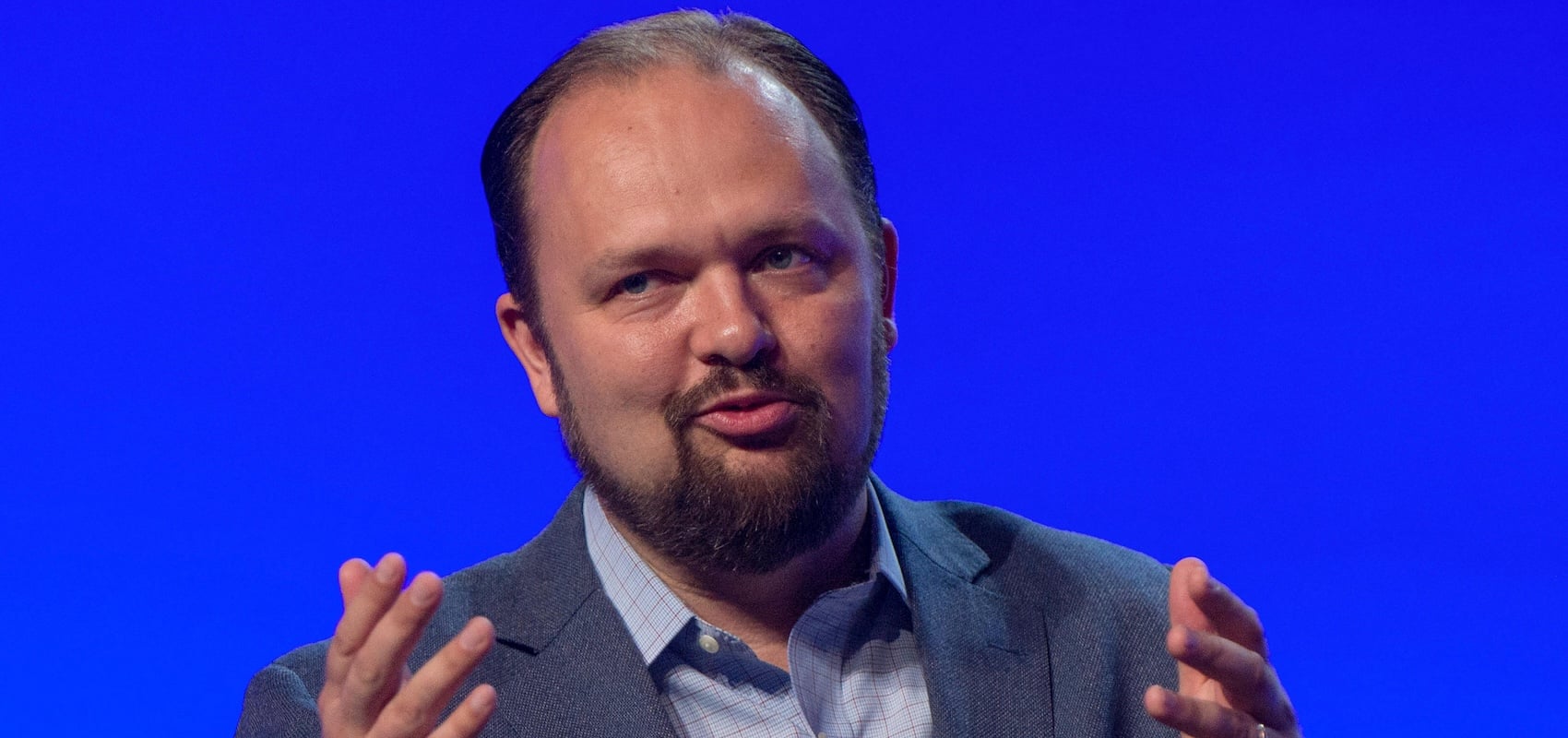
For conservative Christian nerds it is a hammer blow. Imagine the grief and shock if Taylor Swift were to announce that she was giving up songwriting to focus on her acting career, and you will have some faint notion of the impact of Ross Douthat’s departure from the New York Times in order to become a TV correspondent at the new Bari Weiss–run 60 Minutes. From around 2015, when politics and culture felt the first tremors of a series of history-restarting earthquakes, the Douthat column has been a touchstone of rare wisdom. Now it is gone.
If you work in the media the move is even more distressing, because it fulfills the iron law that every person of talent you know will eventually be hired by Bari Weiss. From the most obscure editor to the most celebrated public intellectual, they all, one by one, end up being poached. From that day forth they belong entirely to the Bari Weiss Empire. You try to commission an article from them, and they reply saying they are taking a risk even responding to your email and please can you never contact them again.
Ah well. Instead of moping, let us celebrate Douthat’s remarkable decade of writing. I think, for instance, of his “Ten Theses on Immigration” (2016), in which he meticulously laid out for the progressive reader the reasons to think very, very carefully about the wisdom of mass immigration. Even if you weren’t persuaded by the sociocultural case, he wrote, you had to be realistic about the politics of it. “Native backlash against perceived cultural transformation is very powerful, and any politics that refuses to take account of it will fail.” Some quite prominent figures, no longer in office, could have benefited from rereading that sentence a few times.
Yes, other people were saying the same thing; but very few were saying it with the nuance, the generosity toward opposing arguments, the almost Dominican habit of arguing by making distinctions, which has been the Douthat hallmark. (“Punctuated immigration encourages assimilation; constant immigration limits it.”) At times, especially when the Great Awokening was at its ecstatic height, this approach could seem all too cautious. But Douthat kept at it, and speculated that the quasi-religious hegemony of wokeness was in any case unstable:
It’s still an open question whether that intolerance will lead inexorably to greater power over the entire culture, or whether in a society as diverse and complex as ours the zeal of a hegemon has a self-limiting effect—generating stronger backlash when it uses power too overtly, creating new centers of resistance when it imposes theological conformity too explicitly, and imposing a Brezhnevian (or late-nineteenth-century Bostonian) freeze that looks solid but can’t survive the heat of crisis.
When I heard that sentence delivered in a 2022 lecture for the Morningside Institute—later published by First Things—I thought, “Hmm, we’ll see.” But subsequent events have proved it correct.
Douthat’s crystal ball has been unusually reliable, and it says something about this very confusing moment that he now tells us he doesn’t quite know what is going on or what to think about it; hence the decision to exchange the columnist’s soapbox for the TV man’s roving camera. Nevertheless, in recent years he has made two especially important arguments for our times: one about tech and one about religion.
On tech, he saw the effect of the smartphone and now of AI as a kind of mass-extinction “bottleneck,” an epoch when the virtual is becoming more attractive and in some ways more potent than the real. Everything solid, Douthat warned, risks melting into air:
Languages will disappear, churches will perish, political ideas will evanesce, art forms will vanish, the capacity to read and write and figure mathematically will wither, and the reproduction of the species will fail—except among people who are deliberate and self-conscious and a little bit fanatical about ensuring that the things they love are carried forward.
If there is a criticism to be made of Douthat, it is that he has sometimes seemed too relaxed about economic injustice, and about the massive monopoly power exercised by the big corporations. Here, for instance, the destruction of familiar institutions and practices is portrayed as inevitable, not as something accelerated by very particular companies in very particular ways. And yet, it was Douthat who produced maybe the essential description of the tech era, and of the individual virtues needed to get through it.
On religion, he has urged his fellow believers to take a more assertive approach in defending their commitments. Don’t say, “If you look at the data, churchgoers live for nineteen months longer and are 2.7 percent less likely to say they feel a bit lonely sometimes.” Don’t say, “Religious belief can be very comforting, and we all feel there must be, you know, something more.” Don’t take refuge in politics, either. Make the case that atheism is frankly a reach and that belief in God is extremely plausible.
Finally, this tribute can’t omit the controversies of the early Pope Francis era, when major truths of Catholic doctrine were being kicked around like footballs, when people were losing their minds and sometimes their faith, and when even the pope emeritus was making mysterious comments about the barque of Peter being “almost filled to the point of shipwreck.” If you ask what did most in those years to blunt the attacks on Church teaching, to demonstrate their intellectual weaknesses, and to strip away the soothing rhetoric about doctrinal development, one possible answer is the series of annoyingly reasonable, doggedly persistent columns that appeared in the pages of the world’s premier newspaper.
Of course he was in many ways unsuited for the Athanasius role: unsuited by his habitual irony and even-handedness, by his uncertain relationship with the conservative Catholic settlement, by having to make his points to a secular liberal audience who could scarcely be expected to take seriously arguments from Scripture and tradition. But while 99.99 percent of journalism is by its nature utterly forgettable, I can still remember my then-housemate saying to me one evening in 2016, “Ross Douthat has written a ‘Letter to the Catholic Academy,’ shall we make a cup of tea and read it?” So, with a sense that this was a real event, we sat down to read that magnificent riposte, which rises by stages from gentle self-deprecation to a noble anger on behalf of the true, the good, and the beautiful. That, for me, was the finest episode of the Douthat Decade.
Image by ZUMA Press via Alamy. Image cropped.
Dear Reader,
Can I be direct with you?
War abroad. Socialists on the rise. AI upending human life. Endless uproar online. The modern attention economy doesn’t want readers — it wants users enslaved to the tyranny of the present.
First Things is the antidote: literary excellence, timeless truths, and a fixed point of reference in a culture that has lost its bearings.
But we can’t do it without readers like you.
Our goal: Raise $150,000 by November 1 to sustain First Things in the year ahead.
Your gift anchors readers in the permanent things.
Make your Fall Campaign gift now using the button below.
If you have any questions or would like more information, please contact Giovanni Del Piero, Director of the Editor’s Circle, at gdelpiero@firstthings.com or 212-627-1985.


YOU MIGHT ALSO LIKE
Forget Odysseus. Aeneas Is the True American Hero.
Who is our Odysseus? Or more precisely, who is the most Odyssean hero of American film? Matt…
Foucault’s Idol of Nothingness
Today marks the 100th anniversary of the birth of Michel Foucault. He was influential in his lifetime,…
Meet the Post-Religious Right
There have been many books written about the online right and the Trump movement, most by people…
