
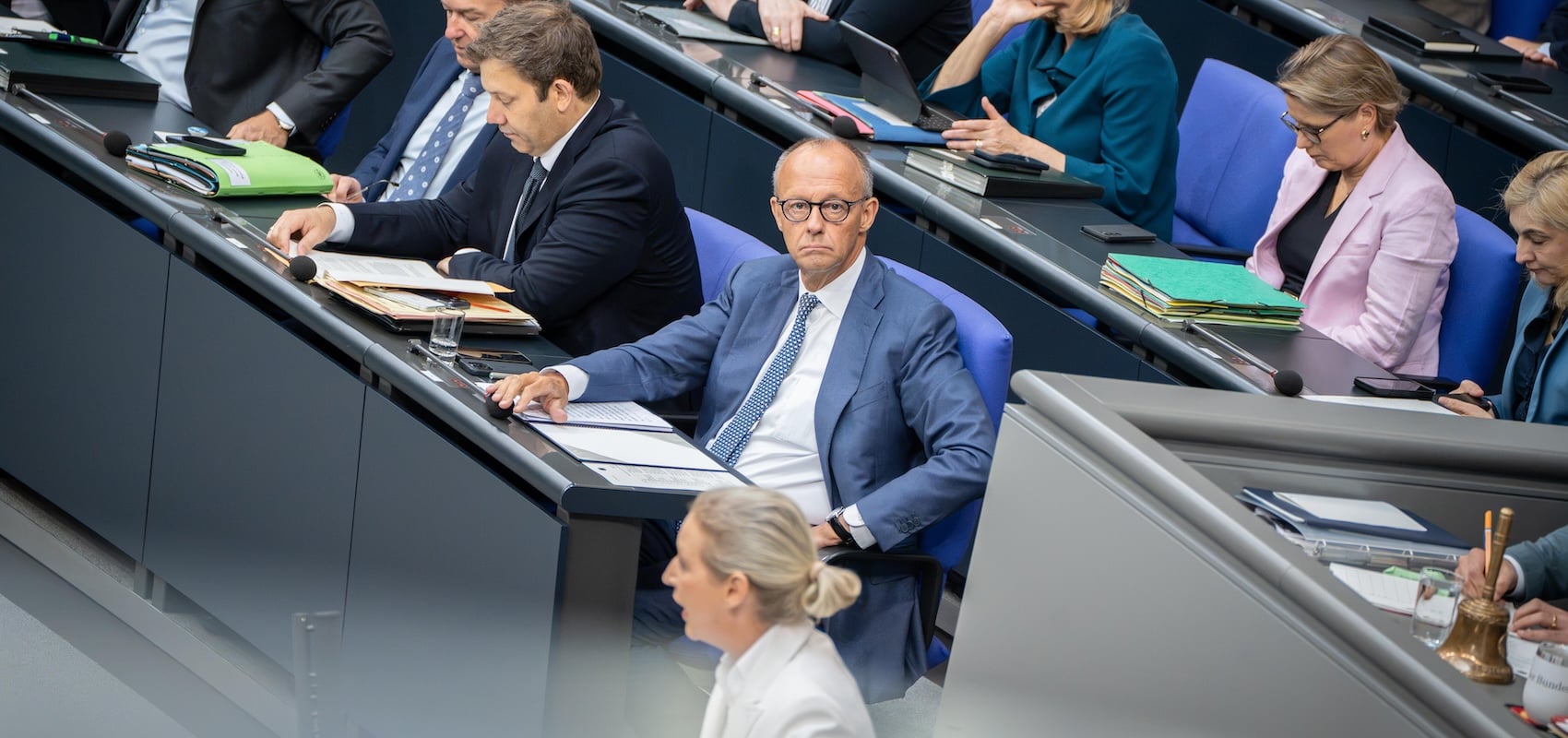
Germany finds itself in a strange situation. The Alternative for Germany (AfD) is steadily growing in popularity, as shown by its September 6 victory in Sachsen-Anhalt, where it came close to winning a governing majority. As such, it has dethroned the Social Democrats (SPD) and Christian Democrats (CDU) to become the new Volkspartei, the people’s party. Yet even though it is now the country’s most popular party, the AfD remains locked out of power by an uncooperative political establishment. As a result, Germany is becoming ungovernable.
The CDU’s ideological profile is similar enough to the AfD’s that the two parties could theoretically form a coalition. Many disappointed former CDU voters who switched to the AfD would then return to their old loyalty. But the CDU party leadership categorically rules out any cooperation with the AfD, insisting upon the “firewall” (Brandmauer) ostracization tactic that it and the other parties wield as a weapon in their “anti-fascist” struggle. Chancellor Friedrich Merz (CDU) is displaying a particular zeal for equating the AfD with Hitler’s party—thereby grotesquely trivializing National Socialism.
Various measures have been discussed and taken to severely limit the power of the AfD and potential governments it might form. This partisan use of political “purgatory” is itself unconstitutional: The Grundgesetz (basic law) recognizes no such twilight status—a party is either formally banned or not. If the AfD were truly dangerous, it would have been banned long ago.
The day after the AfD’s victory in Sachsen-Anhalt, Merz threatened to employ Article 37 of the Grundgesetz, which allows the federal government to exercise emergency powers to compel member states such as Sachsen-Anhalt to conform to federal law—by force if necessary. Article 37 has never been employed in the history of the federal republic. Merz specifically alluded to migration policy—an area in which he himself had, not too long ago, made demands in line with the position of the AfD. Before he became chancellor, he even voted the same way as the AfD in the Bundestag. His countless shifts in position—call it voter deception—have left the majority of the German people embittered.
In December 2024, a Saudi asylum recipient killed six people and injured hundreds in an attack on the Christmas market in Sachsen-Anhalt’s capital, Magdeburg. At the “Democracy Festival” in the same city on the Saturday before the election, organizers forbade displays of the German flag. Banning the German flag in favor of European and Pride flags, a common practice, dramatically symbolizes what is going on—and exposes the reason why voters are shifting toward the AfD.
When the German national colors—black, red, and gold—are suppressed, it seems that both democracy and national unity are being targeted. Democracy itself is being restructured, shifting Germany from an electoral democracy to an authoritarian form of “values-based” democracy. This shift has been taking place since around 1990, marketed to the public as the resurgence of “liberal” democracy. It involves a purported “strengthening” of democracy through court rulings, NGOs, and “civil society”—a process implemented top-down. Over the last three decades, this project has weakened parliamentary democracy, even to the point of its abolition.
Because these new instruments of governance operate without regard to election results, they multiply political conflicts, which can only be resolved through even more intervention—deepening the very crisis they are meant to resolve. Rather than finding ways to work with the AfD—which a shrewd politician would recognize as an opportunity to co-opt it—Merz is threatening to declare what amounts to a state of emergency.
In addition to fears of inflation and further economic decline, the biggest sources of frustration for the conservative majority are gender ideology, climate extremism, and unsustainable migration policies. Tellingly, all of these unpopular priorities and policies were developed on a supranational level at countless conferences, in treaties, and in declarations of intent, going back even to the 1970s. All establishment parties are beholden to these extra-democratic developments, which means they increasingly resemble one another—effectively becoming a uniparty. The fact that they would rather plunge Germany into ungovernability than allow the AfD to share power reveals the true object of their loyalty: not the German people, but supranational “values.”
The German chancellor is losing the support of his own party, which threatens to split. As if the political realities of 2026 were a personal slight, Merz reacts narcissistically. This is unfortunate, because he has a historic opportunity to “tear down the wall” against the AfD and restore the ordinary workings of parliamentary democracy. His likely failure to seize it will be a failure for the ages.
In addition to threatening to invoke Article 37 and impose federal coercion in Sachsen-Anhalt, Merz has hinted at even more extreme measures. He attributed the AfD’s success to Russian influence: “We know who we’re dealing with here.” The accusation of treason amounts to an attack on the voters who gave the AfD its decisive win. So much for “liberal” democracy.
Image by Chris Emil Janssen via AP
Dear Reader,
Can I be direct with you?
War abroad. Socialists on the rise. AI upending human life. Endless uproar online. The modern attention economy doesn’t want readers — it wants users enslaved to the tyranny of the present.
First Things is the antidote: literary excellence, timeless truths, and a fixed point of reference in a culture that has lost its bearings.
But we can’t do it without readers like you.
Our goal: Raise $150,000 by November 1 to sustain First Things in the year ahead.
Your gift anchors readers in the permanent things.
Make your Fall Campaign gift now using the button below.
If you have any questions or would like more information, please contact Giovanni Del Piero, Director of the Editor’s Circle, at gdelpiero@firstthings.com or 212-627-1985.

YOU MIGHT ALSO LIKE
How Sweden’s Immigrant Vote Toppled the Right
For decades, Sweden had perhaps the most open immigration policy and the strongest commitment to tolerance and…
The Last Statesmen?
In the latest installment of the ongoing interview series with contributing editor Mark Bauerlein, Steven B. Smith…
De Gaulle Triumphant
The Second World War left Europe invaded and ruined, divided between Soviet and American occupations. Hitler’s defeat…
