
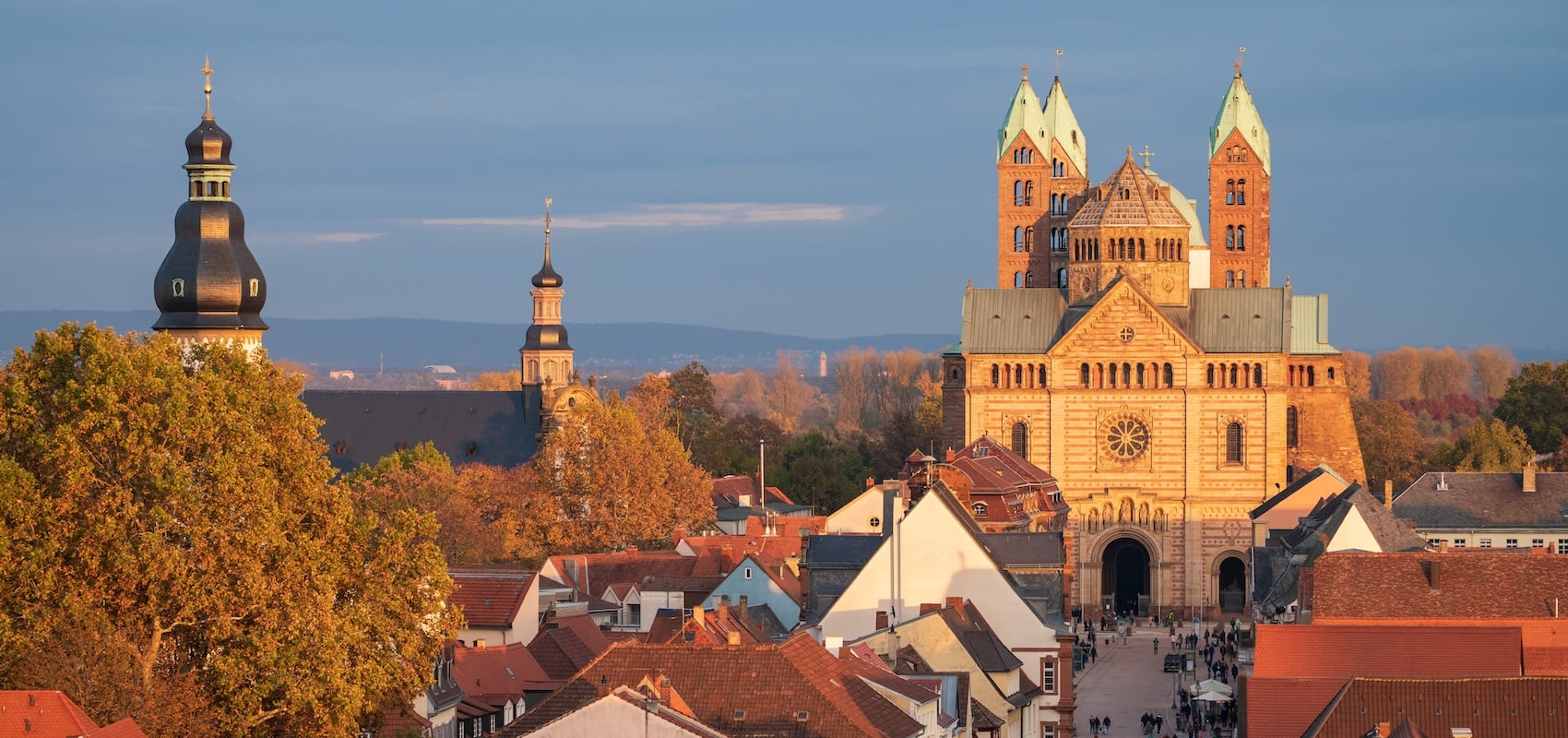
Speyer is a charming city on the west bank of the Rhine River. Its splendid medieval core is dominated by a magnificent eleventh-century cathedral, the resting place of German emperors for three hundred years and one of Europe’s greatest expressions of Romanesque architecture. (For fans of British royalty, the future King Edward VII was introduced to his future wife, Alexandra, in the Dom zu Speyer in 1861, the matchmaker for “Bertie” being his sister Crown Princess Victoria of Prussia [“Vicky”].) Speyer was erected as a diocese at some point in the fourth century, a local Catholic bishop being mentioned for the first time in written records in 346.
Bear with me now for a few moments of tedious, but revealing, statistics.
According to the current edition of the Vatican yearbook, the Annuario Pontificio, there are 504,210 Catholics in the Diocese of Speyer, which I presume means that 504,210 people within the diocesan boundaries identify as Catholic when ticking the box for the Kirchensteuer, the “church tax,” on their German tax returns. There are 239 diocesan priests and twenty-six priests belonging to religious orders resident in the diocese, which is also home to sixty-five permanent deacons, 304 members of men’s religious orders, and 312 members of women’s religious communities. There were no priestly ordinations in the diocese in 2024, and at that point Speyer had four seminarians. Average Sunday Mass attendance is 5.1 percent of registered Catholics.
In June, the diocese announced a major restructuring, with its seventy parishes being reduced by 87 percent to nine. These new “parishes,” which will replace the current diocesan deaneries, will be run by a “synodal council” and a “full-time executive board,” the parish finances being managed by an “administrative council.” The nine new parishes will include “community teams” as “places of pastoral closeness and lived faith.” All of this was presaged last fall when a synodal process in the diocese published a proposal for structural reform entitled “You Shall Be a Blessing”—a curious title, given that the diocesan vicar general conceded that “a great deal of uncertainty and sometimes even resignation were palpable” during that consultative process.
Indeed. Yet what caused that uncertainty? Consider this:
Shortly before the announcement of this radical transformation—some might say, deconstruction—of a historic diocese formed a century before the pontificate of Pope St. Leo the Great, Bishop Georg Bätzing of Limburg defiantly supported the blessing of same-sex couples as couples, publicly stating that this would happen “within a responsible framework. It serves the people and, in my view, does not endanger the unity of the Church.” The former chairman of the German Bishops’ Conference did this right after Pope Leo, speaking during his return flight from Equatorial Guinea, criticized such practices and said that the Church “[does] not approve of the formal blessings of same-sex couples.” Concurrently, the president of the Central Committee of German Catholics, Irme Stetter-Karp, said that she hoped that “blessing ceremonies will continue to be used in as many places as possible for blessings of same-sex couples and couples in so-called irregular situations.”
There are many intensely aggravating aspects of German Catholicism’s Gadarene rush down the cliff of ecclesiastical oblivion; among the most disturbing, because of its dishonesty, is the claim that clerical sexual abuse requires the Church to rethink its ethic of human love and its ancient commitment to clerical celibacy. There is zero empirical evidence that clerical sexual predators were somehow turned into monsters by the sixth commandment and the Catholic Church’s understanding of how following that commandment makes for human happiness and flourishing. As for the notion that marriage is some sort of crime-prevention program, such that a married clergy would be less given to sexual predation, that is both a gross insult to the sacrament of matrimony and a claim belied by the grave problems of sexual abuse in Christian denominations with married ministry.
As I have noted in this space before, the root of the German crisis is apostasy: an unabashed denial of what the Catholic Church believes and teaches to be true. The Diocese of Speyer is not dying because of “financial and staffing reasons,” despite claims from diocesan officials. German Catholicism is awash in money because of the church tax, and 265 priests should be more than enough to serve seventy parishes. The death rattle is being caused by a failure to preach, teach, and live, with joy and compassion, the gospel in full: “the faith which was once for all delivered to the saints” (Jude 1:3).
That is what accounts for 5.1 percent Sunday Mass attendance. And that is what has caused the tragedy of the Speyer death spiral.
George Weigel’s column “The Catholic Difference” is syndicated by the Denver Catholic, the official publication of the Archdiocese of Denver.
Image by Roman Eisele, licensed via Creative Commons. Image cropped.


YOU MIGHT ALSO LIKE
Vatican II Didn’t Kneel to Modernity
In his weekly catecheses on Vatican II, Pope Leo is now discussing Gaudium et Spes, one of…
Two Spectacles, Two Frances
The Stade de France, the country’s largest soccer stadium, holds about 80,000 fans. On Friday, September 25,…
America’s Empty Confessionals
In the latest installment of the ongoing interview series with contributing editor Mark Bauerlein, James M. O’Toole…
