
Against Post-Liberalism:
Why ʻFamily, Faith and Flagʼ Is a Dead End for the Left
by paul kelly
polity, 208 pages, $22.95
Post-Liberalism
by matt sleat
polity, 240 pages, $22.95
Something of a shift in the landscape is signaled when a press like Polity releases, almost simultaneously, two book-length critical engagements with postliberalism—a body of thought that just a decade ago would have struggled to earn a footnote in most political theory journals. And whatever the two new studies make of this school—rather little, in the end—they have at least grasped this much: The unquestioned hegemony of liberal political theory is over. The liberal case is now one that has to be made.
Both Kelly and Sleat deserve credit for taking their interlocutors seriously. Too many critics of postliberalism have been content to gesture at the specter of authoritarianism, tether the entire discourse to Trumpist populism, and move on. These books do better. They trace intellectual genealogies, distinguish among competing strands, and engage with actual arguments.
Kelly’s is the more prosecutorial critique. He wants to demonstrate that the postliberal program is a dead end, primarily for the left, but really for anyone who cares about egalitarian politics. Sleat is more constructive. He wants to hold a mirror up to liberals so that they can recognize what their opponents have actually identified. Of the two, Sleat’s is the one with the most promise for genuine dialogue.
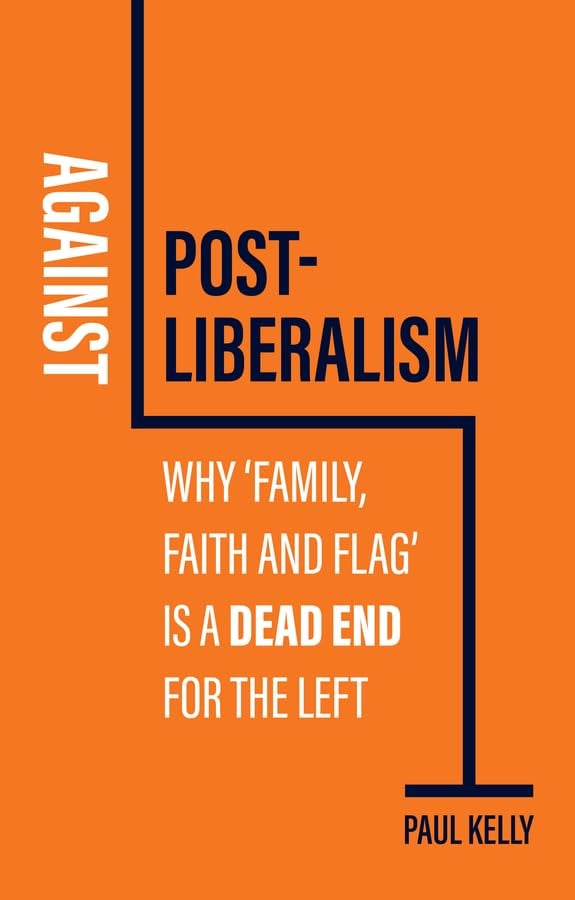
Kelly organizes postliberalism into three strands: national populism, common-good communitarianism, and common-good absolutism. The taxonomy is useful, though the title of his book—with its emphasis on faith, family, and flag—reflects something narrower than the tradition he is analyzing. The “flag” in particular signals an overweighting of the nationalist-populist strand, which is, as Kelly rightly observes, the most relativistic and philosophically thin current within postliberalism. Beginning with Trump, who is by now the most tedious entry point into these discussions, he tends to frame postliberalism as a politics of nostalgia animated more by resentment than by vision.
The most valuable parts of Kelly’s book are his concessions. In articulating what liberalism is, he makes claims that postliberals will find vindicating. “Liberalism,” he writes, “covers a broad family of theories, values and commitments” best understood through “the idea of separation”—the separation of church from state, the right from the good, economy from society, positive law from morality, public sphere from private sphere. So far, so accurate. But having identified separation as liberalism’s constitutive logic, he then characterizes the postliberal objection as directed primarily at the individualism those separations produce. He argues that what unites postliberals is a rejection of the priority liberals attach to individual autonomy and self-rule. This argument is not wrong, but it does not reach the heart of the matter. It captures the dominant register of American postliberalism, but not the whole tradition—and what it misses is decisive. For those formed by Radical Orthodoxy (à la John Milbank) and the Communio school (à la David L. and D. C. Schindler), the primary objection is not individual autonomy as such—it is the separations themselves. The severing of the political from the theological, of law from morality, of the economy from social life—these are the deeper disorders, of which autonomy-maximization is more symptom than root cause. Kelly does not disavow these separations; he upholds them. What is striking is that he does not register them as the object of critique.
On the subject of political economy, by contrast, Kelly’s criticisms are entirely fair. Many forms of postliberalism have been insufficiently attentive to matters of redistribution, and if postliberals want to support family formation and thick local communities—and they do—this imperative cannot be avoided. It is a real lacuna. Kelly is similarly sure-footed in his treatment of Adrian Vermeule and the Schmittian commitments that animate Vermeule’s work. Vermeule draws explicitly and approvingly on Schmitt in his writings on jurisprudence, and the same framework appears in his political thought: In his writings on politics, he argues that “the eternal friend–enemy dynamic” is fundamental to any serious account of political life. This is Schmitt’s friend–enemy distinction embraced without apology—a framework that reduces politics to existential confrontation and forecloses the reasoned deliberation that any genuine common-good politics requires. Importing it into the postliberal project is corrosive of the very politics it purports to serve—and Kelly is right to insist that this strand not be mistaken for the whole.
What is frustrating about his account is its retreat to Rawlsianism. Kelly advocates a robust political liberalism—John Rawls’s separation of political life from comprehensive doctrines, defended on egalitarian grounds. The frustration is not that this position is indefensible, but that Kelly gestures toward its central vulnerability without following the implication. He concedes, for instance, that liberalism is “merely another contentious and overarching conception of the good”—an acknowledgment that the postliberal critique of liberal neutrality has real force. But that concession places political liberalism under pressure it cannot easily withstand—for if liberalism is itself a substantive account of the good, then its claim to bracket such accounts at the political level becomes unstable.
This was the burden of the communitarian critique advanced by figures such as Alasdair MacIntyre, Michael Sandel, and Charles Taylor in the late twentieth century—and it is largely out of that debate that postliberalism emerged. That genealogy is easy to miss now, but it matters. Postliberalism is not simply a reaction from outside the liberal tradition; it arises, in part, from sustained engagement with it, extending lines of criticism that liberal theory never fully answered. Nor is it obvious that political liberalism can be cleanly separated from the comprehensive liberalism Kelly wishes to disavow: The “procedural” liberal framework already presupposes a substantive moral anthropology, as Sleat concedes. Kelly’s response to postliberalism is thus to return to the very framework against which these criticisms were first directed—without showing why they failed, and without fully reckoning with the concessions he has already made.
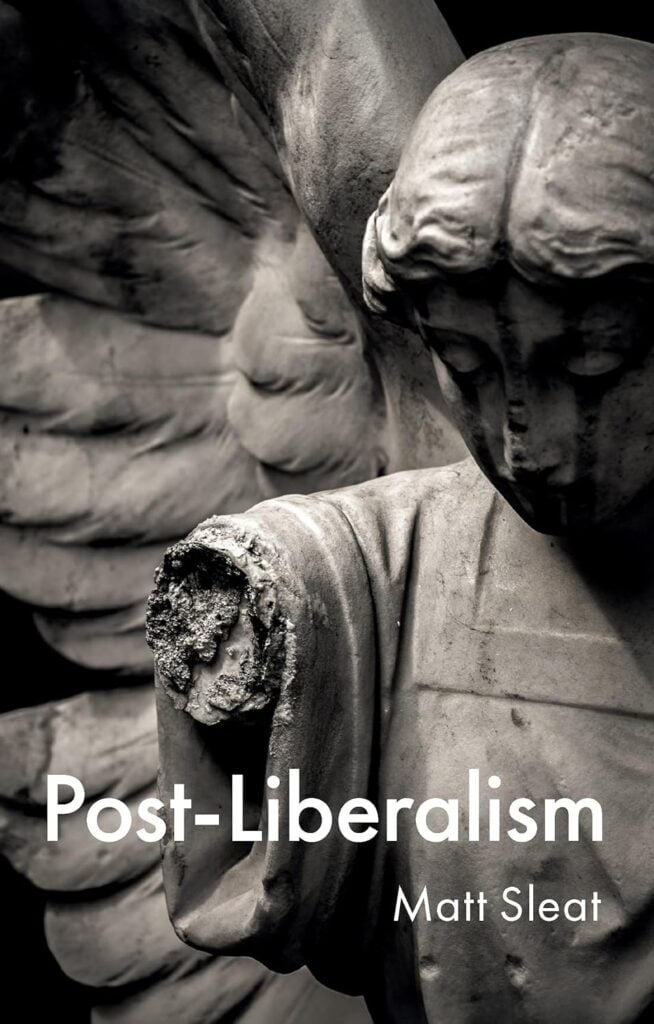
Sleat does not make the same retreat, and it is where he is most constructive that he is most worth reading. His most valuable contribution is a challenge issued to liberals themselves: Stop hiding behind claims of neutrality that cannot bear scrutiny, and be willing to defend the actual vision of the good that liberalism advances. As he puts it:
When post-liberals reject liberalism, they do so not because they think it stands for nothing, but because they object to what it stands for. Liberals should be willing to defend that vision of the good, rather than hiding behind a pretence of moral neutrality that cannot bear on the substantive moral disagreements at stake. In doing so, they might just make a genuine conversation between liberals and their critics possible—one where both sides, finally, stop talking past each other.
Crucially, Sleat does not presume to specify what that vision must contain. For him, liberalism is not a fixed philosophical system but a political tradition—one that has developed across centuries in response to particular social upheavals, from the French Revolution to the rise of industrial capitalism to the Cold War, and that has taken genuinely different forms along the way. Drawing on historians of liberalism such as Helena Rosenblatt, he resists the postliberal tendency to flatten this diversity into a single monolithic ideology and then hold it responsible for every pathology of modernity. Classical liberals, neoliberals, progressives, social liberals, liberal perfectionists—each group carries a different substantive inheritance, and each should be pressed to own and defend it. The challenge Sleat issues is therefore not to liberalism as such but to liberals of every stripe: Stop retreating behind the pretense of neutral procedure and make your actual case. Postliberals have pressed the neutrality question for some time, and Sleat’s willingness to concede it is a real contribution. Once liberals admit that they too advance a substantive vision of the good, the honest debate can begin—both sides at last arguing about what really divides them.
Sleat is particularly strong on the distinction between Patrick Deneen and Vermeule—a distinction critics routinely collapse, allowing Vermeule’s provocations to stand in for the movement as a whole. Deneen’s bark is considerably worse than his bite. He is not actually calling for regime change (which would entail violence) but for an ethos change—the replacement of one set of governing values with another, pursued through democratic politics and the conversion of elites. Whether or not one agrees with that vision, mischaracterizing it as authoritarianism does not advance understanding. Sleat’s observation that liberal alarm may betray “lack of exposure to genuinely non-liberal challengers for so long that they see authoritarianism skulking in every alternative” is a welcome admission.
When it comes to Vermeule, however, the alarm is more warranted, and Sleat’s critique lands. Vermeule’s vision is fundamentally modern in its understanding of the state and its reduction of politics to a contest of power and will: It merely deploys modern political categories for anti-modern ends. His Schmittian framework accepts the very ontology of violence that, on a Radical Orthodox reading, lies at the root of modernity’s pathologies. It is a curious position for someone who wants to overcome liberalism from within a Catholic theological tradition, and Sleat is right to press against it.
Despite these strengths, Sleat’s account ultimately misdescribes the terrain in ways that limit its explanatory power. The problem is not simply that he gets certain details wrong, but that he does not fully grasp what the most theologically grounded forms of postliberalism are trying to set before us as an alternative.
First, the charge of statism is too blunt an instrument. Sleat frequently characterizes postliberalism as committed to a strong, morally directive state. This description fits Vermeule, and perhaps other strands of integralism, but it cannot bear the weight Sleat places on it. He himself notes that Radical Orthodoxy decisively decenters the state, yet he does not follow through on the implications. An important strand of postliberal thought—associated with figures such as the Schindlers, Michael Hanby, and Andrew Willard Jones—is defined largely by its resistance to both liberal statism and its integralist mirror. For these thinkers, the central problem is not that the state is too weak to promote the good, but that the political order has been severed from the metaphysical and theological conditions that make any common good intelligible in the first place. To treat Vermeule’s strand as though it were the whole is to confuse a prominent branch with the tree itself.
Second, Sleat argues that though modernity—the intellectual and social transformation of the past several centuries—is an inescapable horizon we all inhabit, liberalism is merely one political response to it, and therefore optional in a way that modernity itself is not. The distinction seems plausible, but it ultimately misreads the disagreement. For the more theologically serious forms of postliberalism, the claim is not that modernity can be escaped, but that it admits of alternative political expressions—that a nonliberal modernity is not a contradiction in terms. On this point, they are closer to Sleat than he allows. They do not reject the now-standard genealogies of modernity offered by figures such as Charles Taylor or Michael Allen Gillespie; they largely accept them. They grant that secularity has Christian origins, that late medieval nominalism marked a decisive shift, and that modernity emerged from within Christianity rather than in straightforward opposition to it. Where they differ is in what follows from this history. For Milbank, the Schindlers, and others working within a participatory metaphysics, the Christian genealogy of modernity is not a vindication of the liberal settlement but a diagnosis of its distortions—and therefore an invitation to correction. To say that modernity is inescapable does not settle the question of whether its dominant political form is necessary.
These limitations point toward a deeper omission that neither Sleat nor Kelly adequately confronts: the status of the Church as a political reality. This is not a minor oversight but a structural one, and it goes to the heart of what liberalism achieved historically. The privatization of religion was not an accidental by-product of liberalism but one of its central accomplishments.
As Pierre Manent has argued, Christianity presents a distinctive political problem because the Church is a “real universal community,” which claims all persons and thereby relativizes every political order. Early modern political theory can be read, in part, as a sustained effort to neutralize this rival. Thomas Hobbes “resolves” the tension through subordination, placing the Church under the authority of the sovereign. John Locke’s strategy is more subtle and more enduring: By redefining the Church as a voluntary association concerned with inward belief and otherworldly ends, he preserves its formal freedom while stripping it of public significance. As Peter Leithart has shown, this move is not incidental but constitutive, for redefining politics as concerned with outward behavior and civil order is inseparable from confining the Church to inward belief and private devotion.The Church, on these terms, is free—but free only insofar as politically irrelevant.
What emerges from this liberal settlement is a drastically simplified political ontology. Only two actors remain fully visible: the autonomous individual and the sovereign state. Intermediate or rival forms of authority are either absorbed (most recently marriage) or marginalized (the long-term project with regard to religious authority). Allegiances once directed to the Church are gradually redirected to the state, which comes to function as the most comprehensive, and the only indispensable, form of common life. The proliferation of denominations and the language of “religious choice” are not merely sociological developments; they are the outworking of a deeper conceptual transformation in which the Church has been reconstituted as one voluntary association among many. A critique of liberalism that focuses narrowly on autonomy while leaving this ecclesiological settlement intact has not yet reached the root of the disorder it seeks to diagnose.
This blind spot in Kelly’s and Sleat’s analyses, in turn, clarifies a final point that remains underdeveloped in both books. Postliberalism at its most theologically coherent does not attempt to dismantle liberalism’s achievements, so much as to preserve them on firmer ground. Oliver O’Donovan’s description of late-modern liberalism as a prodigal child of Christendom captures the paradox well: Liberalism did not generate its most compelling moral insights ex nihilo. It received them from a Christian inheritance it no longer fully acknowledges. The relativization of political authority before God; the dignity of the person; the nonultimate character of the state—these are not liberal discoveries but Christian ones. What liberalism does is detach these goods from the theological and metaphysical framework that first made them intelligible, recasting them as if they could stand on procedural or neutral foundations alone.
And this detachment comes at a cost. David L. Schindler devoted his career to exposing what he called liberalism’s “con game”: the pretense that its political theory is neutral or formally empty, when in fact it carries a substantive anthropology and theology, which quietly reshape the very goods it claims to protect. Schindler’s argument was not that liberal structures should be discarded. He explicitly affirmed the intention to protect human dignity, freedom of conscience, and the limited state. The burden of his critique was more precise: that the ends rightly intended by political liberalism can be realized only on nonliberal terms, because the hidden metaphysical logic of the liberal-juridical state ultimately undermines the goods it was meant to secure. The dynamic is visible in two directions. On one side, the liberal state, following the Hobbesian logic it never fully shed, has progressively expanded its authority as the supreme guarantor of rights and dignity—absorbing into itself the role once played by church, guild, and family. On the other side, the very freedoms liberalism promises—of conscience, of association, of religious practice—have been narrowed whenever they conflict with the state’s vision of equal autonomy, as the mounting litigation over religious institutions, adoption agencies, and medical conscience clauses makes plain. What liberalism framed as the protection of goods it has, by its own logic, come to administer and constrain. This is the dynamic Schindler had in mind. His aim, therefore, was not rejection but retrieval—to free liberalism’s genuine moral achievements from the framework that subtly deforms them.
Both Kelly and Sleat grasp something important: that the postliberal challenge cannot be dismissed, and that liberals must now make their case rather than assume it. What neither fully reckons with is what that challenge, at its most serious, actually involves. There are those on the postliberal right who would simply bury liberalism—accelerationists who long for collapse and imagine they will be the ones to shape what rises from the wreckage. They are likely too confident about that. Disruption on a grand scale has a way of exceeding the plans of those who invite it. But the postliberalism worth taking seriously wants something different.
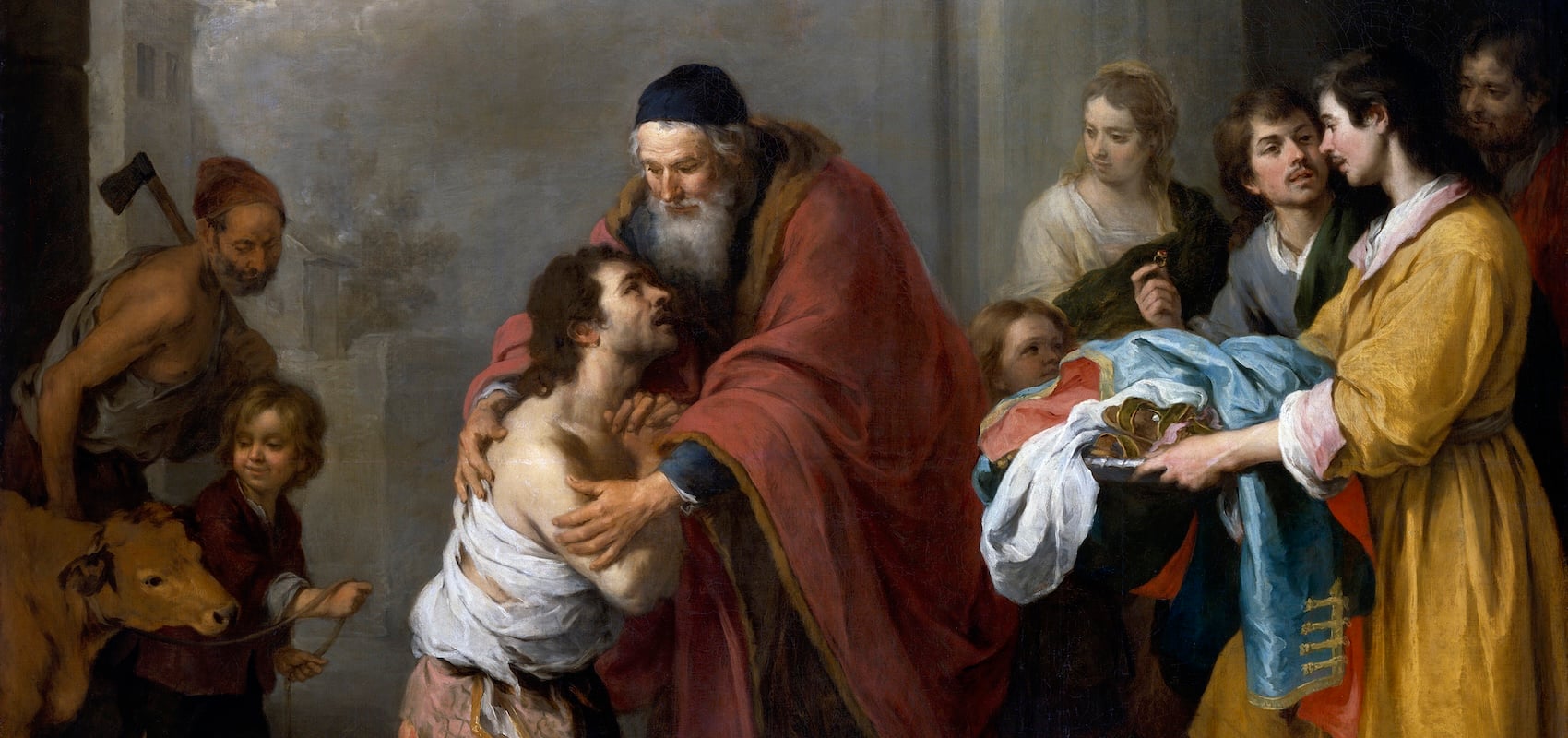
Its most compelling form seeks not destruction but renewal. It wants the prodigal to come home. And it insists that the inheritance being squandered—the dignity, the freedom, the limits on power—was never self-generated. These goods were received from a Father’s house and remain intelligible only there. The task is not to abandon the far country for some imagined preliberal past, but to bring these goods home—to recover the theological and metaphysical grammar within which they remain intelligible. This is not a temporal project of restoration but a conceptual one: not a return to medieval Christendom, but a recognition that the goods liberalism prizes can be grounded and sustained only in the tradition that first articulated them. The defenders of liberalism as it has evolved, Kelly and Sleat among them, risk persuading the prodigal that his condition is sustainable—that the squalor can be managed, that adjustment is sufficient, and that return is unnecessary. The question these books circle but do not confront is whether liberalism can find its way back, or whether it will continue to insist, even from the far country, that it is already home.

YOU MIGHT ALSO LIKE
Who Killed the Clancy Children?
After a Massachusetts jury failed to convict Lindsay Clancy of strangling her three small children to death…
Roger Scruton’s Eternal Youth
In this episode, First Things senior editor Dan Hitchens joins R. R. Reno on The Editor’s Desk…
A Terrible Coarsening
The now-ubiquitous terms “reproductive health” and “reproductive freedom” have contributed mightily to a slaughter of the innocents…
