
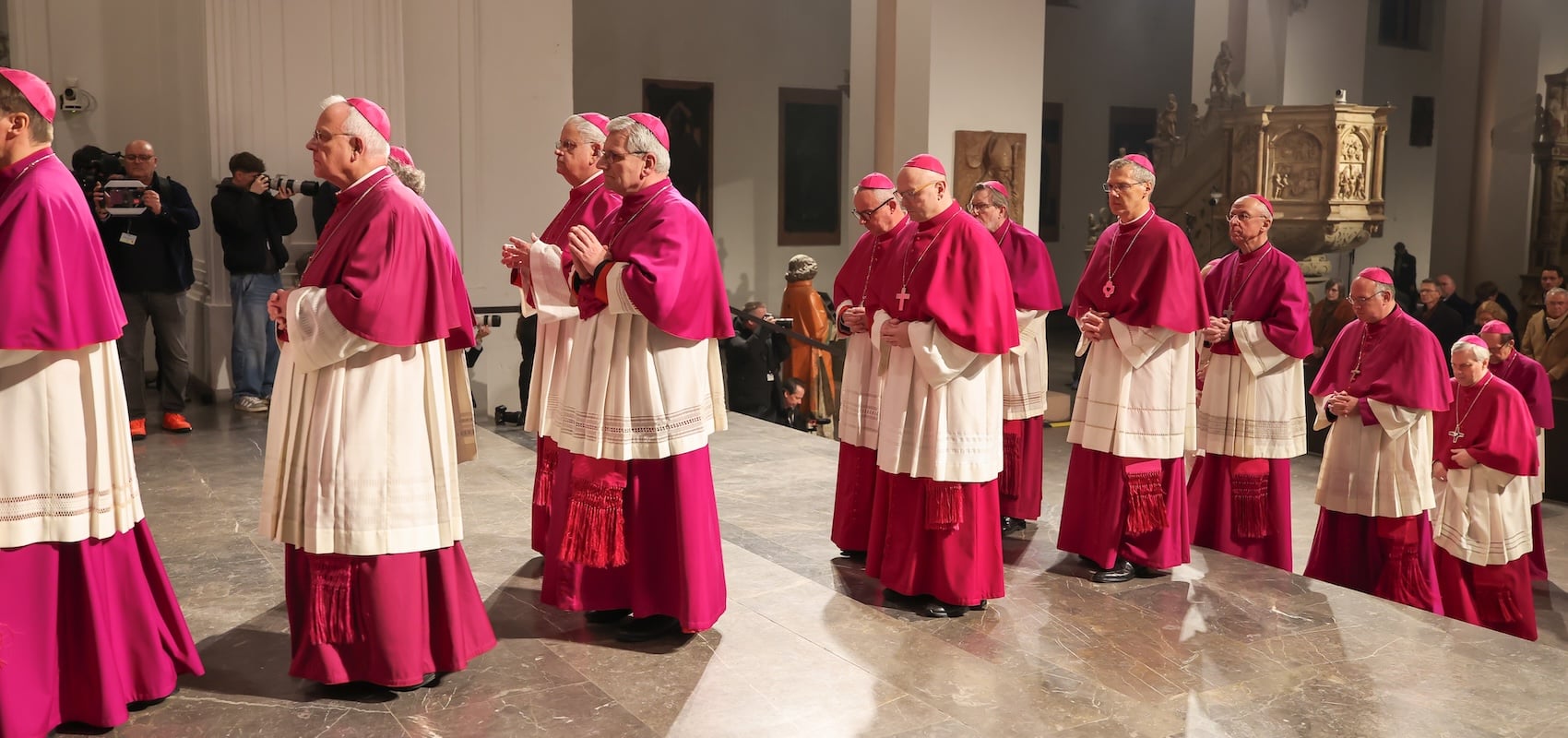
Reinhard Cardinal Marx stated recently that the German bishops intend to issue a formal liturgical blessing for homosexual unions, one that explicitly blesses those unions as such. Unfortunately for the Germans, this violates Fiducia Supplicans in four ways. And regardless of what one thinks of that declaration, at the very least the German attempt to go beyond its stipulations indicates that they are willing to test this new papacy to gauge how much traction they can get for implementing the various conclusions of their “Synodal Way.”
First, Fiducia Supplicans is clear that the blessings must be spontaneous and requested by the lay persons involved. Second, and related to the first, there can be no formal liturgical rite, commissioned and approved of by the diocese, for blessing those in “irregular unions.” Third, the blessings must in no way be viewed as a blessing of those unions as such, even if it is a couple that is presenting themselves for the blessing. Fourth, the blessings must not be publicized by the parish, most likely to avoid the impression that some kind of Church-approved and liturgically official “ceremony” is about to take place to which family and friends will be invited.
This latter point is important. If the German proposal were to be approved by Rome, or at least be met with benign neglect, the floodgates would open, and the German example would metastasize to many other corners of the Church, creating a tsunami of liturgical blessings functioning as quasi-marriage rites that the Vatican would be powerless to stop.
To think that this is hyperbole is naive. One can easily imagine, for example, a gay couple in Munich following a civil marriage at court with a “blessing ceremony” at the local parish, complete with a reception and cake in the church hall. One can further imagine—again without hyperbole—the entire blessing rite being performed by a “gay-friendly” priest with a rainbow stole and ukulele, crooning Leonard Cohen’s “Hallelujah” over the happy couple—or perhaps soon, the “throuple.” Because, after all, “love is love,” and “who are we to judge”?
The Vatican must surely know this, which is why I think it highly likely that the Germans will meet explicit rejection from Rome. Indeed, in his off-the-cuff remarks during the airplane interview on his return from Africa, Pope Leo indicated his disapproval of any such move. And if it does meet Vatican rejection, the only real remaining question will be how the Germans will respond. Will they ignore the Vatican view as just a “regrettable and retrograde opinion” and move forward anyway, or will they obey, thus risking deep disapproval at home?
One has to think that the German bishops did not make this move lightly and certainly must have considered the potential consequences. Too many observers have treated the entire German Synodal Way as just a tired spectacle of aging liberal clerics desperately seeking social relevance. Too many therefore assume that once Rome says “no” to their synodal conclusions, that will be the end of it; the last vestiges of the Bergoglian era will finally be put to bed without its supper.
But there is another possibility, and one far more serious. And that is the very real chance that the Germans are not going to go quietly into the night because they are committed to a protestantizing and revolutionary ecclesiology of rupture, complete with all of the usual theological banalities about Vatican II and how it was “really” about empowering “the people of God” as the unvarnished and unfiltered voice of the Holy Spirit, who is now doing “a new thing.” Therefore, they will cast their “disobedience” as a true “obedience” to the council and will push forward the tired, but still effective, narrative of “obscurantist and reactionary” Rome standing against the inevitable arc of history toward sexual freedom.
It will become a narrative of Rome versus the Francis Fukuyama party bus—those who hold that modern liberal bourgeois values no longer need to be submitted to the judgment of the gospel, but rather the opposite. All must now bow to the final denouement of history as the vindication of Locke, with a nod toward Kant and even Nietzsche.
Therefore, it could very well be that the controversy over “gay blessings” is simply a test case, like an ecclesial weather balloon sent aloft to gauge the wind. It has the feel as well of a kind of “end game” gambit wherein the German Synodal Way must either fish or cut bait. And with a relatively young pope who might be on the chair of Peter for many years more, there is no need to wait. Act now, and challenge Rome to show its cards in a high stakes poker game, or wait and run the risk of the Synodal Way becoming a large set of glossy brochures nobody reads, stored away in chancery closets alongside church tax receipts.
Unfortunately, very few German Catholics attend Mass anymore, and with the demographic implosion of German Protestantism serving as both a cautionary tale and a control case in this ecclesial experiment, the German Catholic Church will become even less relevant should it choose to pursue the protestantizing path.
One can hope that it never comes to that. But one thing is certain: Leo’s current strategy of avoiding such controversies is going to be tested. And combined with the headache of the Society of St. Pius X, red lines will need to be drawn.
Daniel Löb/picture-alliance/dpa/AP Images
Dear Reader,
Can I be direct with you?
War abroad. Socialists on the rise. AI upending human life. Endless uproar online. The modern attention economy doesn’t want readers — it wants users enslaved to the tyranny of the present.
First Things is the antidote: literary excellence, timeless truths, and a fixed point of reference in a culture that has lost its bearings.
But we can’t do it without readers like you.
Our goal: Raise $150,000 by November 1 to sustain First Things in the year ahead.
Your gift anchors readers in the permanent things.
Make your Fall Campaign gift now using the button below.
If you have any questions or would like more information, please contact Giovanni Del Piero, Director of the Editor’s Circle, at gdelpiero@firstthings.com or 212-627-1985.

YOU MIGHT ALSO LIKE
The Myth of St. Francis
At the beginning of his 2020 encyclical, Fratelli Tutti, Pope Francis speaks of “an episode in the…
Job and Her
It is said that Job lost everything, but she has lost more. All her possessions—the money, the…
Letters—November 2026
I appreciate J. H. H. Weiler’s desire for God’s mercy to be extended to Gentiles and his…
