

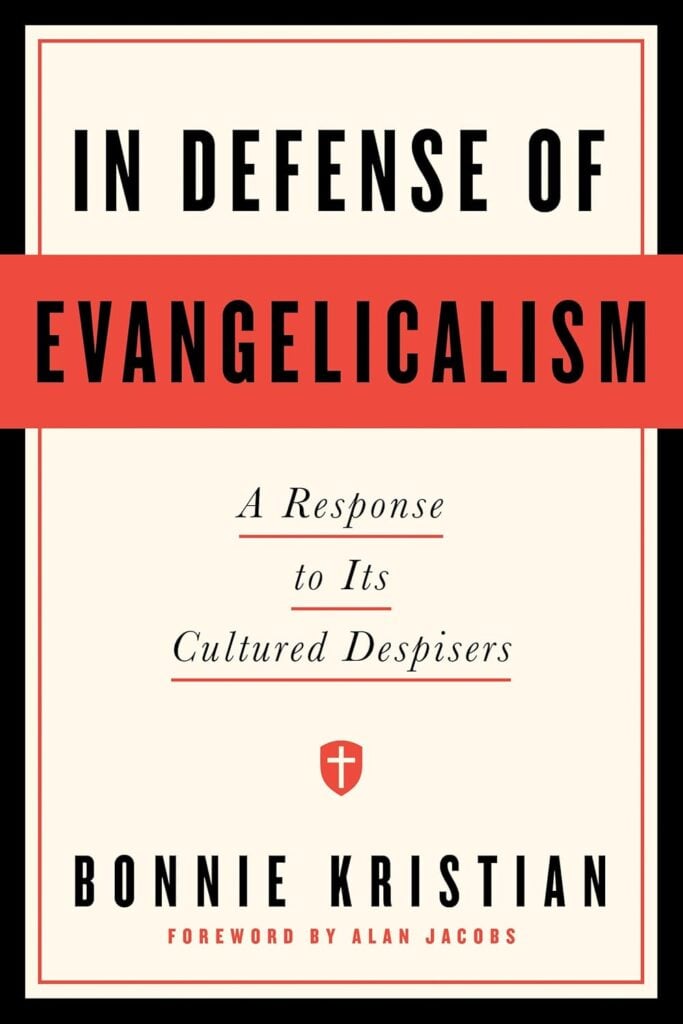
In Defense of Evangelicalism:
A Response to Its Cultured Despisers
by bonnie kristian
forum, 224 pages, $27
Recent years have seen an explosion in a particular subgenre of sociopolitical commentary. Bonnie Kristian calls it the “In Defense of Nice Evangelicals Who Think and Vote Exactly As I Do” subgenre. But she is at pains to stress that her new book, In Defense of Evangelicalism, is not that kind of book. The difference is signaled in the subtitle, “A Response to Its Cultured Despisers.” From this, the reader may correctly infer that Kristian has undertaken a much more expansive and nuanced task, which includes defending a great many evangelicals who don’t think exactly as she does.
Kristian, a pacifist, egalitarian Anglican who was an editor for Christianity Today, is on paper a surprising candidate to pen this sort of book. But she explains that her “normie evangelical” roots run deep. Her single mother was such a zealous adult convert that she changed her surname to Kristian. Bonnie attended Christian schools with money her mother couldn’t really afford to spend. Though she went through her phases, at one point in college self-importantly choosing as her Facebook religious descriptor “Jesus follower” instead of “evangelical,” she never de-converted. And despite the fact that she has arrived at theological conclusions that diverge from her upbringing, she doesn’t regard it as a foreign country. Evangelicalism remains her homeland.
But what exactly are we talking about when we talk about “evangelicalism”? Kristian doesn’t set out to untie this definitional knot, but she doesn’t believe she needs to in order to say meaningful things about the object of her defense. Her aim is “to describe more than define, to point toward a center instead of drawing a hard border.” That center is defined by a highly individualized, personal relationship with Jesus Christ, a serious commitment to the Bible and the local church, and a drive to evangelize and care for the world. This definition is more academically fleshed out in the “Bebbington quadrilateral” of conversionism, activism, biblicism, and crucicentrism. Thus defined, evangelicalism may have no pope or magisterium, but it has a certain “I know it when I see it” quality. Or, as Kristian puts it, “a vibe.” I’m inclined to more precision myself. For instance, biblical inerrancy seems to me a sine qua non of evangelicalism (which would technically place me outside its boundaries). Nevertheless, I, too, have spent my life catching the vibes.
The book is neatly structured around five common lines of attack from evangelicalism’s cultured despisers. It begins with “Insincerity”: You evangelicals don’t really believe anything. Next comes “Evil”: All right, maybe you believe in things, but your beliefs are horrific. Then “Hypocrisy”: Fine, maybe you believe nice things, but you don’t live up to them. Then “Imposition”: Whatever you sincerely believe, you’re being too public about it. Finally, “Control”: You want to force the rest of us to go along with it. Kristian takes writers like Kristin Kobes Du Mez, Samuel L. Perry, and Tim Alberta as her foils in these chapters. She goes out of her way to seek points of agreement but generally finds their readings of evangelicalism too tendentious to engage with.
Looming over this project is the figure of Donald Trump, on whose broad evangelical support many of these polemics are fixated. Kristian’s fair-minded response threads the needle. She has declined to vote for either major-party candidate (my decision, too), but she understands the math equation that ends in a “normie evangelical” Trump vote: Democrats’ radical social agenda, plus an ingrained sense of duty to vote, plus a binary system that shuts out all third-party alternatives. We might wish more evangelicals had arrived at a different answer, but alas, it is what it is.
Which leaves the rest of us with a choice. We can either toss these voters into a “basket of deplorables” or continue to respect them as our brothers, sisters, and neighbors in Christ, many of whom have logged many more years of faithful service to the kingdom than those of us who write think pieces about them. Kristian meets some Trump-voting Christians face-to-face and finds none of the hypocritical, egomaniacal, grasping stereotypes the despisers harp on.
She also goes in search of “Christian nationalists,” as defined in Perry and Whitehead’s influential Taking America Back for God by their responses to agree-or-disagree statements like “The federal government should advocate Christian values” or “The success of the United States is part of God’s plan.” Testing one interviewee, Kristian finds his score high enough to make him—by these criteria—a “Christian nationalist Ambassador.” Inconveniently, he happens to be a Mexican immigrant. The book is peppered with such narrative-busting reveals.
At moments, though, it’s unclear whether Kristian wants to defend evangelicals because they have nothing to apologize for, or because they are so eager to meet the despisers halfway. For instance, Kristian liberally criticizes Kristin Kobes Du Mez, whose book Jesus and John Wayne built up and tore down a strawman of misogynistic evangelical masculinity. Yet Kristian also lingers on the point that a lot of men in evangelical ministry welcomed Du Mez’s critique, inviting her on their podcasts and assigning Jesus and John Wayne in church small groups. It’s rhetorically irresistible for Kristian to point out that this undercuts Du Mez’s thesis. However, unlike Kristian, I wouldn’t frame the anxious rush of these men to appease Du Mez as a positive thing, or a thing that particularly looks “a lot like Jesus.” A pastor needn’t be a patriarchal Doug Wilsonite to give Du Mez’s manipulative, shoddy work the summary dismissal it deserves. Summary dismissal is not definitionally uncharitable, nor is it definitionally un-Christlike.
Kristian personally identifies as an egalitarian, meaning she believes evangelical women should be able to minister and lead on equal footing with men. (On the complementarian view, only men can be pastors.) When she puts these cards on the table, she’s careful to do so with humility and an admission that she is not the metric of historic orthodoxy. But she also drops the perhaps surprising statistic that most evangelicals are now egalitarian. This makes more sense when you consider how many large nondenominational churches are pastored by a “Mr. and Mrs. So-and-So,” some of whom Kristian introduces us to. It speaks to the definitional puzzle of evangelicalism that some of these churches are in other respects very right-leaning, even willing to stump for Trump. While researching a story about the aftermath of Charlie Kirk’s assassination, I spoke with TPUSA Faith’s senior director, Lucas Miles, whose wife is the executive pastor of their Indiana church.
It’s not Kristian’s goal to invent a new classification schema that will clear all this up, but one is tempted to make a four-quadrant graph: complementarian hard right-wingers in one quadrant, complementarian conservative Never Trumpers in another (I am here), egalitarian centrists or center-leftists in another (Kristian is here), and egalitarian “normie” right-wingers in another. The first quadrant is where your big-bearded Reformed “theobros” are clustered, along with some Baptists; the second holds a potpourri of Reformed, Baptists, and Anglicans; the third is home to evangelical-Anglican transplants comfortable with female priests; and the fourth is where your charismatic megachurches are booming. Personally, I am just as staunch in my complementarianism as I am in my Never Trumpism. I reject Kristian’s thesis, following Timothy Larsen, that egalitarianism is the “historical distinctive” of evangelicalism. Where exactly this places me in relation to someone like Paula, the female co-pastor of a deep Texas “cowboy church,” God knows. But, as Kristian reminds us, we all love Jesus.
Kristian’s explorations also reveal much racial diversity, sometimes under one church roof. So it is all the more puzzling that she lingers on the charge of racial hypocrisy and finds it the most damning. Even today, after decades of reform—which, as she rightly argues, have been under-recognized—Kristian still writes that evangelicals are “often two steps forward, one step back” and currently “we’re back a step, maybe even two.” There’s no elaboration beyond a footnote citing an article by Justin Giboney. Giboney in turn cites little by way of convincing evidence for his claim that white evangelicals have displayed irrational hostility toward indisputably sound racial bridge-building endeavors. In the much-debated case of David Platt and McLean Bible Church, the truth was far messier than Giboney acknowledges, including Platt’s overt attempts to foist white guilt onto his already diverse congregation. (“I know as a white pastor . . . I am part of the problem.” “I want Christ to be exalted through increasing diversity in our leadership and in our membership.”)
The uncomfortable truth concerning racial issues is that there is nothing of substance or good faith to be saved out of the despisers’ screeds, which label as hatefully racist what is merely not politically correct. Bad faith is evident in the work of Kristin Kobes Du Mez. It was evident, as well, in how various black church figures hastened past obligatory denunciations of Charlie Kirk’s murder to strenuously relitigate his “racist,” “hate-filled” rhetoric, or attack people who compared the murder with Martin Luther King Jr.’s assassination. Kirk’s refusal to join the cultus of King Jr. in life has in itself been cited as problematic.
Kristian describes her “relief” that her kids’ Christian school is straightforwardly teaching them that “MLK was good. . . . We are celebrating him. We should be like him.” Yet it is now well-established that King was a prolific adulterer—not to mention the FBI evidence (disputed, but convincing to at least one friendly biographer) that he was complicit in a rape. The serial immorality of Donald Trump is rightly up for discussion, but why should King Jr.’s FBI tape be passed over in total silence, along with his infidelities? Both sides should apply equal weights and measures. Such questions cannot be beyond the pale for evangelicals, or indeed for any American. Yet black evangelical influencers like Giboney continue to compare King to the apostles and shower him with honorifics like “the model of the unabashedly, unmistakably Christian activism we need.”
Similarly vague throat-clearing weakens Kristian’s otherwise very strong chapter on sexual dogma—which, as she demonstrates, is more imposed by the secular state on evangelicals than the other way around. Kristian praises evangelicals like the Lees, a Korean-American family under pressure to admit men into their women’s spa. The book nevertheless wags a finger at the Church for its “poor treatment of LGBTQ people.”
Kristian’s main source here is Rachel Gilson, who has written about her own experience of same-sex attraction and asserts sweepingly that “Christians have basically been jerks about this topic for a long time.” By way of evidence, Kristian simply piles on more of Gilson’s assertions about evangelicals’ theological incompetence around the issue. It would have been better to provide readers with something more than an argument from Gilson’s authority to make such high-handed claims.
However, Kristian is clear-eyed and even righteously snarky where it matters, highlighting the various ways in which Christian families have been oppressed and hedged in. She nods to legal cases where “non-affirming” parents are told they can’t foster children, like Greg and Marianelly Schrock in Massachusetts or Jessica Bates in Oregon. She highlights a youth leader’s dispiriting report of Christian children too worn down by peer pressure to be salt and light to their deeply confused, depressed schoolmates. The social cost of speaking truth in love on issues where young people are already primed to see Christians as bigots is simply not worth it for them.
Kristian could also have included the various ways in which businesses create a hostile work environment for Christians, imposing corporate litmus tests and otherwise making the zero-sum game between Christian and LGBTQ dogma clear. Kristian encourages evangelicals to say what they believe with their whole chests and damn the consequences, because this is the essence of evangelicalism.
It is touching, and presumably not a coincidence, that Kristian begins and ends the book with images of motherhood: first of her own mother and finally of evangelicalism as a mother we rightly defend against playground bullies. Kristian’s instinct to confront the despisers is—as her interviewee Matthew Milliner says of his loyalty to evangelicalism—born of a kind of filial devotion. She recognizes the class snobbery hovering behind these denunciations, the reflexive sneering at evangelical culture, tastes, and habits. Kristian herself may not share all those tastes, but since when is tackiness a sin? And since when is “Bible thumper” the worst of all insults?
At one conference, Kristian recalls someone proudly dubbing the assembly “the 19%,” meaning those 19 percent of evangelicals who didn’t vote for Trump in 2016. It struck Kristian as an example of just the sort of us-versus-them rhetoric that is so self-righteously censured when the right uses it. For her part, Kristian doesn’t want to attend “a church of just the 19 percent.” She doesn’t want to be that shopper who prides herself on only ever going to Whole Foods while the plebs shop at Walmart. This is evangelicalism in an analogical nutshell, and Kristian is happy to claim it.
The anti-evangelical publishing machine will churn on. Meanwhile, Kristian writes, “We still bring casseroles. We still lay on hands. We have the same Scripture as ever, the same Spirit as ever, and ‘Jesus Christ is the same yesterday and today and forever.’ Evangelicalism has never been wrong about that.”
In Washington, D.C., recently, one of my Uber drivers was an Ethiopian woman. Many Ethiopians in the area are Eastern Orthodox, but this woman identified in her own words as “evangelical.” I said I attended a Presbyterian church. “Well,” she said, “the important thing is we believe in Jesus. Jesus is Lord.”
To channel my own inner evangelical: And all God’s people said Amen.

YOU MIGHT ALSO LIKE
Realism and Reunion
Ecumenism has, to put it mildly, stalled. Since the beginning of this century, efforts aimed at bringing…
Briefly Noted
Contrary to its titular claim, Joshua W. Brown’s Proving a Miracle does not prove that miracles can…
The Vatican and the Good of Judaism
Since the Second Vatican Council, Catholics have known that they can’t accuse Jews of “killing God.” But…
